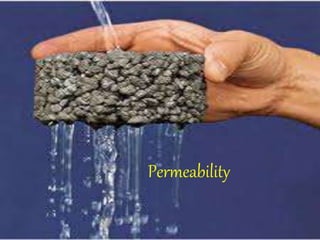
Permeability
PERMEABILITY
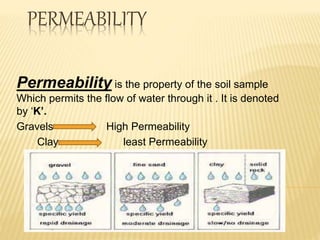
Permeability is the property of the soil sample
Which permits the flow of water through it . It is denoted
by ‘K’.
Gravels High Permeability
Clay least Permeability
FACTORS AFFECTING PERMEABILITY
1. Grain size.
2. Properties of pore water pressure.
3. Temperature.
4. Void ratio.
5. Stratification of soil.
6. Entrapped air and organic impurities.
7. Adsorbed water.
8. Degree of saturation.
9. Shape of particles.
10. Structure of soil mass.
1. GRAIN SIZE
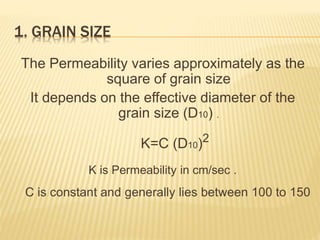
The Permeability varies approximately as the
square of grain size
It depends on the effective diameter of the
grain size (D10) .
K=C (D10)2
K is Permeability in cm/sec .
C is constant and generally lies between 100 to 150
2. PROPERTIES OF PORE FLUID
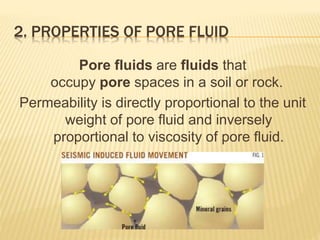
Pore fluids are fluids that
occupy pore spaces in a soil or rock.
Permeability is directly proportional to the unit
weight of pore fluid and inversely
proportional to viscosity of pore fluid.
3. TEMPERATURE
As the viscosity of the pore fluid decrease with
the temperature , permeability increases with
temperature , as unit weight of pore fluid
does not change much with change in
temperature.
4. VOID RATIO
Increase in the void ratio increases the area
available for flow hence permeability
increases for critical conditions.
5. STRATIFICATION OF SOIL
Stratified soils are those soils which are formed
by layer upon layer of the earth or dust
deposited on each other.
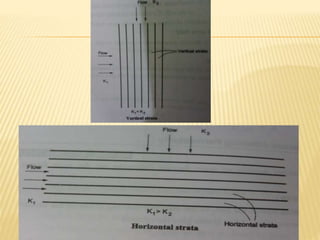
If the flow is parallel to the layers of
stratification , the permeability is max. while
the flow in Perpendicular direction occur with
min. permeability.
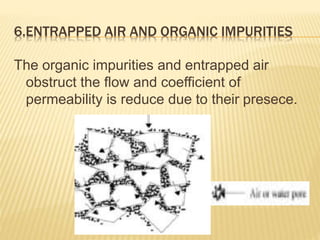
6.ENTRAPPED AIR AND ORGANIC IMPURITIES
The organic impurities and entrapped air
obstruct the flow and coefficient of
permeability is reduce due to their presece.
7. ADSORBED WATER
Adsorbed Water means a thin microscopic film
of water surrounding individual soil grains
This water is not free to move and hence
reduces the effective pore space an thus
decreases coefficient of permeability .
8. DEGREE OF SATURATION
The permeability of partially saturated soil is
less than that of fully saturated soil.
9. SHAPE OF PARTICLES
Permeability is inversely proportional to specific
surface e.g. as angular soil have more specific
surface area compared to the round soil
therefore, the soil with angular particles is less
permeable than soil of rounded particles.
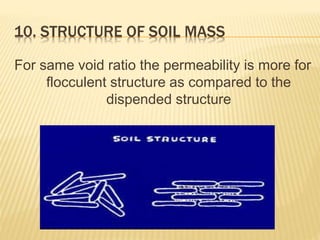
10. STRUCTURE OF SOIL MASS
For same void ratio the permeability is more for
flocculent structure as compared to the
dispended structure

Permeability and factors affecting permeability

  • 1.
  • 2.
    PERMEABILITY Permeability is theproperty of the soil sample Which permits the flow of water through it . It is denoted by ‘K’. Gravels High Permeability Clay least Permeability
  • 3.
    FACTORS AFFECTING PERMEABILITY 1.Grain size. 2. Properties of pore water pressure. 3. Temperature. 4. Void ratio. 5. Stratification of soil. 6. Entrapped air and organic impurities. 7. Adsorbed water. 8. Degree of saturation. 9. Shape of particles. 10. Structure of soil mass.
  • 4.
    1. GRAIN SIZE ThePermeability varies approximately as the square of grain size It depends on the effective diameter of the grain size (D10) . K=C (D10)2 K is Permeability in cm/sec . C is constant and generally lies between 100 to 150
  • 5.
    2. PROPERTIES OFPORE FLUID Pore fluids are fluids that occupy pore spaces in a soil or rock. Permeability is directly proportional to the unit weight of pore fluid and inversely proportional to viscosity of pore fluid.
  • 6.
    3. TEMPERATURE As theviscosity of the pore fluid decrease with the temperature , permeability increases with temperature , as unit weight of pore fluid does not change much with change in temperature.
  • 7.
    4. VOID RATIO Increasein the void ratio increases the area available for flow hence permeability increases for critical conditions.
  • 8.
    5. STRATIFICATION OFSOIL Stratified soils are those soils which are formed by layer upon layer of the earth or dust deposited on each other. If the flow is parallel to the layers of stratification , the permeability is max. while the flow in Perpendicular direction occur with min. permeability.
  • 10.
    6.ENTRAPPED AIR ANDORGANIC IMPURITIES The organic impurities and entrapped air obstruct the flow and coefficient of permeability is reduce due to their presece.
  • 11.
    7. ADSORBED WATER AdsorbedWater means a thin microscopic film of water surrounding individual soil grains This water is not free to move and hence reduces the effective pore space an thus decreases coefficient of permeability .
  • 12.
    8. DEGREE OFSATURATION The permeability of partially saturated soil is less than that of fully saturated soil.
  • 13.
    9. SHAPE OFPARTICLES Permeability is inversely proportional to specific surface e.g. as angular soil have more specific surface area compared to the round soil therefore, the soil with angular particles is less permeable than soil of rounded particles.
  • 14.
    10. STRUCTURE OFSOIL MASS For same void ratio the permeability is more for flocculent structure as compared to the dispended structure