Permeability
Permeability
 Permeability is defined as the property of a porous
material which permits the passage of water (or other
fluids) through its interconnecting voids.
 A material having continuous voids is called permeable.
Gravels are highly permeable while stiff clay is the least
permeable, and hence such a clay may be termed
impermeable for all practical purposes.
 The flow of water through soils may either be a laminar flow
or a turbulent flow.
 In laminar flow, each fluid particle travels along a definite
path which never crosses the path of any other particle.
 In turbulent flow, the paths are irregular and twisting,
crossing and recrossing at random.
 In most of the practical flow problems in soil mechanics, the
flow is laminar.
 The average coefficient of permeability of natural
deposits Parallel to stratification is always greater than
that perpendicular to stratification
 The study of seepage of water through soil is important
for the following engineering problems
1. Determination of rate of settlement of a saturated
compressible soil layer.
2. Calculation of seepage through the body of earth
dams, and stability of slopes.
3. Calculation of uplift pressure under hydraulic
structures and their safety against piping.
4. Ground water flow towards wells and drainage of soil.
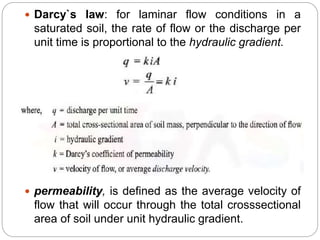
 Darcy`s law: for laminar flow conditions in a
saturated soil, the rate of flow or the discharge per
unit time is proportional to the hydraulic gradient.
 permeability, is defined as the average velocity of
flow that will occur through the total crosssectional
area of soil under unit hydraulic gradient.
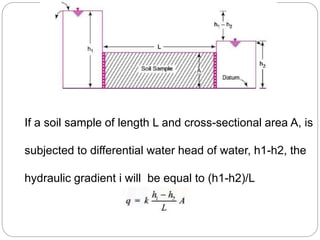
If a soil sample of length L and cross-sectional area A, is
subjected to differential water head of water, h1-h2, the
hydraulic gradient i will be equal to (h1-h2)/L
Poiseuille’s law of flow through capillary tube
 The relationship governing the laminer flow of
water through capillary tube is known as
Poiseuille s law.
 The factors affecting permeability are
 Grain size
 Voids ratio of the soil
 Entrapped air and foreign-matter
 Properties of the pore fluid
 Structural arrangement of the soil particles
 Adsorbed water in clayey soils
Effect of size and shape of
particle
 Permeability varies approximately as the square
of the grain size. Since soils consist of many
different-sized grains, some specific grain size
has to be used for comparison.
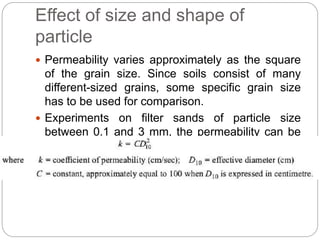
 Experiments on filter sands of particle size
between 0.1 and 3 mm, the permeability can be
expressed as
Grouting
 Grout is usually a mixture of cement, sand, and
water or chemicals that are used to fill gaps. They
are used in repairing concrete cracks, filling
seams and gaps in tiles, gaps for sealing and
waterproofing, and for soil stabilization
 The process of injecting fluids (i.e. grouts) into the
pores space of the soil, is called grouting
 The permeability of the coarse-grained soils may
be reduced by grouting
 The grouting increases the soil strength
Effect of properties of pore fluid
 Permeability is directly proportional to the unit
weight of water and inversely proportional to its
viscosity.
 Though the unit weight of water does not change
much with the change in temperature, there is
great variation in viscosity with temperature.
 Coefficient of permeability of soil increases with
the increase in temperature
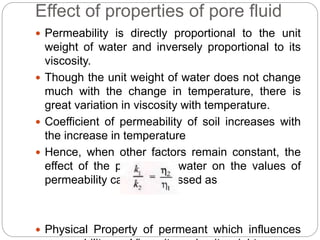
 Hence, when other factors remain constant, the
effect of the property of water on the values of
permeability can be expressed as
 Physical Property of permeant which influences
Effect of void ratio
 When stress decreases void ratio, coefficients of
permeability and volume change decrease
Determination of coefficient of
permeability
 Laboratory methods
(1) Constant head permeability test.
(2) Falling head permeability test.
 Field methods
(1) Pumping-out tests.
(2) Pumping-in tests.
 Indirect methods
(1) Computation from grain size or specific surface.
(2) Horizontal capillarity test.
(3) Consolidation test data.
 Direct measurement of permeability of the
specieman at any stage of loading can be made
only in fixed ring type consolido meter
 Falling head method is more suitable for the
determination of permeability of clayey soil

Permeability.ppt

  • 1.
  • 2.
    Permeability  Permeability isdefined as the property of a porous material which permits the passage of water (or other fluids) through its interconnecting voids.  A material having continuous voids is called permeable. Gravels are highly permeable while stiff clay is the least permeable, and hence such a clay may be termed impermeable for all practical purposes.  The flow of water through soils may either be a laminar flow or a turbulent flow.  In laminar flow, each fluid particle travels along a definite path which never crosses the path of any other particle.  In turbulent flow, the paths are irregular and twisting, crossing and recrossing at random.  In most of the practical flow problems in soil mechanics, the flow is laminar.
  • 3.
     The averagecoefficient of permeability of natural deposits Parallel to stratification is always greater than that perpendicular to stratification  The study of seepage of water through soil is important for the following engineering problems 1. Determination of rate of settlement of a saturated compressible soil layer. 2. Calculation of seepage through the body of earth dams, and stability of slopes. 3. Calculation of uplift pressure under hydraulic structures and their safety against piping. 4. Ground water flow towards wells and drainage of soil.
  • 4.
     Darcy`s law:for laminar flow conditions in a saturated soil, the rate of flow or the discharge per unit time is proportional to the hydraulic gradient.  permeability, is defined as the average velocity of flow that will occur through the total crosssectional area of soil under unit hydraulic gradient.
  • 5.
    If a soilsample of length L and cross-sectional area A, is subjected to differential water head of water, h1-h2, the hydraulic gradient i will be equal to (h1-h2)/L
  • 6.
    Poiseuille’s law offlow through capillary tube  The relationship governing the laminer flow of water through capillary tube is known as Poiseuille s law.  The factors affecting permeability are  Grain size  Voids ratio of the soil  Entrapped air and foreign-matter  Properties of the pore fluid  Structural arrangement of the soil particles  Adsorbed water in clayey soils
  • 7.
    Effect of sizeand shape of particle  Permeability varies approximately as the square of the grain size. Since soils consist of many different-sized grains, some specific grain size has to be used for comparison.  Experiments on filter sands of particle size between 0.1 and 3 mm, the permeability can be expressed as
  • 8.
    Grouting  Grout isusually a mixture of cement, sand, and water or chemicals that are used to fill gaps. They are used in repairing concrete cracks, filling seams and gaps in tiles, gaps for sealing and waterproofing, and for soil stabilization  The process of injecting fluids (i.e. grouts) into the pores space of the soil, is called grouting  The permeability of the coarse-grained soils may be reduced by grouting  The grouting increases the soil strength
  • 9.
    Effect of propertiesof pore fluid  Permeability is directly proportional to the unit weight of water and inversely proportional to its viscosity.  Though the unit weight of water does not change much with the change in temperature, there is great variation in viscosity with temperature.  Coefficient of permeability of soil increases with the increase in temperature  Hence, when other factors remain constant, the effect of the property of water on the values of permeability can be expressed as  Physical Property of permeant which influences
  • 10.
    Effect of voidratio  When stress decreases void ratio, coefficients of permeability and volume change decrease
  • 11.
    Determination of coefficientof permeability  Laboratory methods (1) Constant head permeability test. (2) Falling head permeability test.  Field methods (1) Pumping-out tests. (2) Pumping-in tests.  Indirect methods (1) Computation from grain size or specific surface. (2) Horizontal capillarity test. (3) Consolidation test data.
  • 12.
     Direct measurementof permeability of the specieman at any stage of loading can be made only in fixed ring type consolido meter  Falling head method is more suitable for the determination of permeability of clayey soil