BCE 27
1
PROF S M ALI JAWAID
Permeability
Permeability
2
Permeability is defined as a property of porous material which
permits the passage of water through its interconnecting voids.
3
Water flow through soil
Laminar flow
Each fluid particles travel
along a definite path which
never crosses the path of any
other particle
(In Soils, mostly flow is
laminar)
Turbulent flow
Path of travel irregular.
Twisting, crossing and re-
crossing at random
4
Why its study is required
5
• To calculate the rate of settlement of a saturated
compressible soil layer.
• To calculate seepage through the body of earth
dams and stability of slopes.
• To calculate the uplift pressure under the
hydraulic structures and their safety against
piping.
• Ground water flow towards wells and drainage
of soil.
DARCY’s LAW Based on Expt study
For laminar flow condition in a saturated soil, the rate
of flow/discharge per unit time across a cross-sectional
area A is proportional to hydraulic gradient (under an
standard temp of 270C)
where i =
(h)/L
When hydraulic gradient i=1, the V= k 6
So, coefficient of permeability (k) may be defined
as the average velocity of flow that will occur
through the total cross-sectional area of soil under
unit hydraulic gradient.
k is normally expressed in cm/sec; m/day or
feet/day
7
VALIDITY OF DARCY’s LAW
8
Darcy’s type of flow is stable in character as long as
the four basic conditions are always satisfied:
The steady state is laminar flow
Hundred percent saturation
Flow fulfilling continuity conditions
No volume changes occur during or as a result of
flow.
Note: For ground water flow occurring in nature and
normally encountered in Soil Mech. Problems, the
Darcy’s law is generally within validity limits.
9
Discharge/Superficial Velocity and Seepage Velocity
Since flow takes place through the voids,
hence, actual velocity of flow is more than
discharge velocity.
By the principle of continuity, the velocity of
approach, v, may be related to the seepage velocity, vs,
as follow :
is called the
where kp, the constant of proportionality,
‘Coefficient of Percolation’, and is given by :
kp = k/n
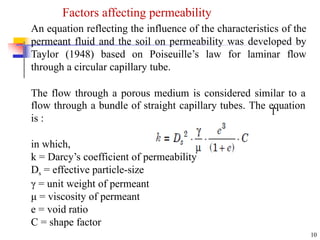
An equation reflecting the influence of the characteristics of the
permeant fluid and the soil on permeability was developed by
Taylor (1948) based on Poiseuille’s law for laminar flow
through a circular capillary tube.
The flow through a porous medium is considered similar to a
flow through a bundle of straight capillary tubes. The equation
is :
in which,
k = Darcy’s coefficient of permeability
Ds = effective particle-size
γ = unit weight of permeant
μ = viscosity of permeant
e = void ratio
C = shape factor
10
1
Factors affecting permeability
Grain-size
• Equ. 1 suggests that the permeability varies with the square
of particle diameter.
• It is logical that the smaller the grain-size the smaller the
voids and thus the lower the permeability and vice versa.
•Allen Hazen proposed;
2
k = 100 D10 where D10 is in cm and k is in cm/s.
Density and Viscosity
Equation 1 indicates that the permeability is influenced
by both the viscosity and the unit weight of the permeant fluid.
k 
11
 &  depends on temp, hence k depends on temperature.
Since effect of temp is more on , neglecting variation of
 with temp
Since
where kT and μT are the permeability of soil and the viscosity of
water at the test temperature of t°C and, k27 and μ27 are the
permeability and viscosity at the standard temperature, i.e.,
27°C.
Void Ratio
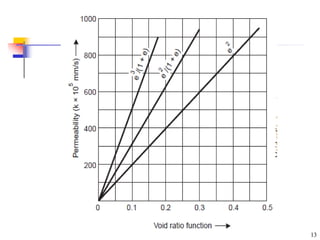
Equation 1 indicates that a plot of k versus e3/(1 + e) should
be a straight line.
This is more true of coarse grained soils since the shape
factor C does not change appreciably with the void ratio for
these soils.
12
13
Fabric or Structural Arrangement of Particles
14
•The fabric
important
or structural arrangement of
particles is an soil
characteristic influencing
permeability,
especially of fine-grained soils.
•At the same void ratio, it is logical to expect a soil in the
most flocculated state will have the highest permeability, and
the one in the most dispersed state will have the lowest
permeability.
Degree of saturation
Higher the degree of saturation, higher will be the
permeability. In the case of certain sands the permeability
may increase three-fold when the degree of saturation
increases from 80% to 100%.
Presence of entrapped air & other foreign matter
The entrapped air and foreign matter will block the voids in
soil results in decreasing in permeability
15
16
17
18
Two standard laboratory tests are us
to determine the coefficient
of
permeability of soil
Laboratory Testing to find coefficient of
permeability
1.Constant Head Test
If Q is total quantity of flow in time
interval t, then from Darcy’s law
When steady state of flow is reached, the total quantity
of
For Sandy Soil Only
h
L
Porus
Stone
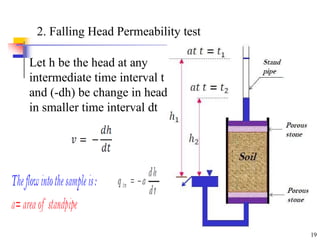
2. Falling Head Permeability test
Let h be the head at any
intermediate time interval t
and (-dh) be change in head
in smaller time interval dt
19
Integrating between two time limits, we get
20
- Sign change by changing limit from
h2 to h1 to h1 to h2
21
Flow Perpendicular to the Bedding Planes
22
In this case, the velocity of flow
v, and hence the discharge q, is
the same through all the layers,
for the continuity of flow.
Let the total head lost be Δh and
the head lost in each of the layers
be Δh1, Δh2, Δh3, ......
Δhn.
Δh = Δh1 + Δh2 + Δh3 + ... Δhn.
The hydraulic gradients are :
i1 = Δh1/h1 ; i2 = Δh2/h2 and in = Δhn/hn
Since q is the same in all the layers, and area of cross-
section of flow is the same, the velocity is the same in all
layers.
Let kz be the average permeability perpendicular to the
bedding planes.
Since Δh = Δh1 + Δh2 + Δh3 + ...
Δhn.
23
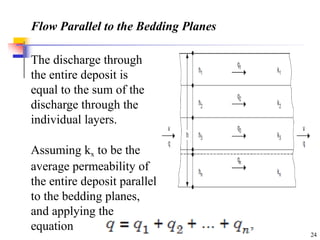
Flow Parallel to the Bedding Planes
The discharge through
the entire deposit is
equal to the sum of the
discharge through the
individual layers.
Assuming kx to be the
average permeability of
the entire deposit parallel
to the bedding planes,
and applying the
equation
24
25
SEEPAGE
• Defined as the flow of water/fluid through a soil
under a hydraulic gradient.
• The interaction between soils and percolating
water has an important influence on:
1 . The design of foundations and earth
slopes,
2. The quantity of water that will be lost by
percolation through a water.
• The pressure that is exerted on the soil due to the
seepage of water is called the seepage force. 26
• If h is the hydraulic head or head loss causes the
water to flow through a soil mass of thickness, z,
the seepage pressure
– ps = h w = (h/z) z w = i z
w
Hydraulic gradient
Length over which h is loss
27
The total seepage force transmitted to soil by
seepage
= ps . A = i z w A
And seepage force per unit volume = i z w
A / z A
= i w
BASIC EQUATION FOR SEEPAGE/
Laplace’s Equation of continuity
28
The following assumptions are made:
1. Darcy’s law is valid for flow through soil.
2.The hydraulic boundary conditions are
known at entry and exit of the fluid (water)
into the porous medium (soil).
3. Water is incompressible.
4. The porous medium is incompressible.
These assumptions have been known to be
very nearly or precisely valid.
• Let us consider an element of soil through which laminar
flow of water is occurring
Vx and Vz are components of discharge
velocity in the horizontal and vertical
direction.
The rate of flow of water into the
elementary block in the horizontal
direction is Vx dz dy and in the vertical
direction is Vz dx dy .
Again the rate of outflow from
the block in horizontal and
vertical directions are
Vx + (Vx/x) dz dy
& Vz + (Vz/z) dx
dy
Assuming water is incompressible
and no change in soil mass occurs,
then total rate of inflow should be 29
[Vx + (Vx/x) dz dy] + [Vz + (Vz/z)
dx dy]
- [Vx dz dy + Vz dx dy ] = 0
30
Or Vx/x + Vz/z = 0
From Darcy’s Law Vx = Kx ix = Kx (h/x) & Vz = Kz iz =
= Kz (h/z)
For isotropic soil Kx = kz
2h/2
x + 2h/2
z = 0
known as Continuity Equation.
The flow net which consists of two sets of curves –
a series of flow lines and of equil-potential lines–is
obtained merely as a solution to the Laplace’s
equation.
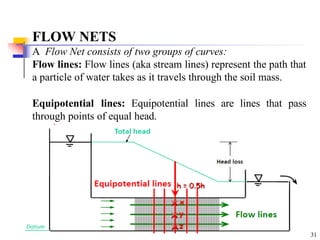
FLOW NETS
A Flow Net consists of two groups of curves:
Flow lines: Flow lines (aka stream lines) represent the path that
a particle of water takes as it travels through the soil mass.
Equipotential lines: Equipotential lines are lines that pass
through points of equal head.
31
DRAWING OF FLOW NETS
32
1. Flow lines and equipotential lines are at right angles to
one
another.
2. Flow lines are ║ to no flow boundaries.
3. Equipotential lines are ║ to permeable boundaries.
4. Discharge through each flow path is equal.
5. Head loss through each equipotential space is equal.
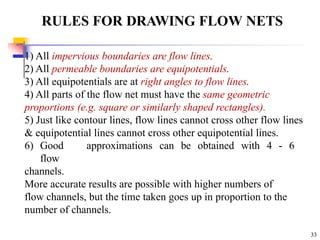
RULES FOR DRAWING FLOW NETS
33
1) All impervious boundaries are flow lines.
2) All permeable boundaries are equipotentials.
3) All equipotentials are at right angles to flow lines.
4) All parts of the flow net must have the same geometric
proportions (e.g. square or similarly shaped rectangles).
5) Just like contour lines, flow lines cannot cross other flow lines
& equipotential lines cannot cross other equipotential lines.
6) Good approximations can be obtained with 4 - 6
flow
channels.
More accurate results are possible with higher numbers of
flow channels, but the time taken goes up in proportion to the
number of channels.
Sample flownet
34
Flow net under a dam with toe filter
35
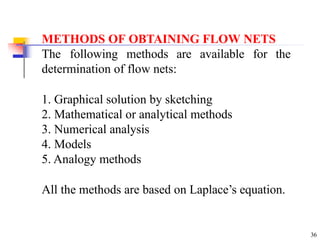
METHODS OF OBTAINING FLOW NETS
The following methods are available for the
determination of flow nets:
1. Graphical solution by sketching
2. Mathematical or analytical methods
3. Numerical analysis
4. Models
5. Analogy methods
All the methods are based on Laplace’s equation.
36
1. Graphical Solution by Sketching
37
A flow net for a given cross-section is obtained by first
transforming the cross-section, and then sketching by
trial and error, taking note of the boundary conditions.
The properties of flow nets such as the orthogonality of
the flow lines and equipotential lines, and the spaces
being elementary squares, and the various rules
concerning boundary conditions and smooth transitions
must be observed.
Sketching by trial and error was first suggested by Forchheimer
(1930) and further developed by A. Casagrande (1937).
The following suggestions are made by Casagrande for the
benefit of the sketcher.
(a) Every opportunity to study well-constructed flow nets should
be utilised to get the feel of the problem.
(b) Four to five flow channels are usually sufficient for the first
attempt.
(c) The entire flow net should be sketched roughly before details
are adjusted.
(d) The fact that all transitions are smooth and are of elliptical
or parabolic shape should be borne in mind.
(e) The boundary flow lines and boundary equipotentials should
first be recognised and sketched.
38
39
2. Mathematical or Analytical
Methods
In a few relatively simple case the boundary conditions may be
expressed by equations and solutions of Laplace’s equation may
be obtained by mathematical procedure.
This approach is not popular because of the complexity of
mathematics even for relatively simply problems.
Perhaps the best known theoretical solution was given by
Kozeny (1933) and later extended further by A. Casagrande, for
flow through an earth dam with a filter drain at the base
towards the downstream side.
Another problem for which a theoretical solution is available is a
sheet pile wall
(Harr, 1962).
40
3. Numerical Analysis
Laplace’s equation for two-dimensional flow can be
solved by numerical techniques in case the
mathematical solution is difficult.
Relaxation methods involving successive
approximation of the total heads at various points in a
mesh or net work are used.
The Laplace’s differential equation is put in its finite
difference form and a digital computer is used for
rapid solution.
41
4. Models
A flow problem may be studied by constructing a scaled model
and analysing the flow in the model.
Earth dam models have been used quite frequently for
the determination of flow lines.
Such models are commonly constructed between two parallel
glass or lucite sheets. By the injection of spots of dye at
various points, the flow lines may be traced.
This approach facilitates the direct determination of the top
flow line.
Piezometer tubes may be used for the determination
of the heads at various points.
5. Analogy Methods
Lapalce’s equation for fluid flow also holds for electrical and
heat flows.
The use of electrical models for solving complex fluid flow
problems in more common.
In an electrical model, voltage corresponds to total head, current
to velocity and conductivity to permeability.
Ohm’s Law is analogous to Darcy’s Law. Measuring voltage,
one can locate the equi-potentials.
The flow pattern can be sketched later.
42
SEEPAGE CALCULATION
Since there is no flow across flowline
Piezometric level
q1=  q2 …….=
 q From Darcy’s
law, The rate of flow
KiA
Rate of flow per unit
width
3

l1

q = K


= K
l1
 h 1  h 2




 3

4
l
 h
= K  h 3
l
l
2
43


 2
l
 h 2  h 3

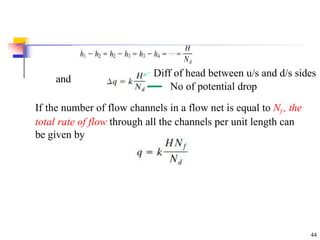
Above Equation shows that if the flow elements are drawn as
approximate squares, then the drop in the piezometric level
between any two adjacent equipotential lines is the same.
This is called the potential drop. Thus
and
Diff of head between u/s and d/s sides
No of potential drop
If the number of flow channels in a flow net is equal to Nf , the
total rate of flow through all the channels per unit length can
be given by
44
45
FLOW CALCULATIONS
Flow thmugh each flow channel. Sq ——
z
k — peiuieabilityfliydraulic conductivity of
soil
H = Head lDSs
N = Nimiber of potential drops
Nt = 1 G for square chaiuiel
N,= b/1 G for iectaiigular chaiinel
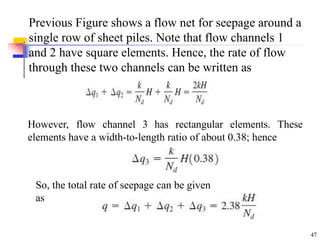
Previous Figure shows a flow net for seepage around a
single row of sheet piles. Note that flow channels 1
and 2 have square elements. Hence, the rate of flow
through these two channels can be written as
However, flow channel 3 has rectangular elements. These
elements have a width-to-length ratio of about 0.38; hence
So, the total rate of seepage can be given
as
47
48
49
Piping
50
Defined as movement of soil particles by percolating
water leading to development of channel
Heave Piping
When the seepage pressure of upward percolating water
equal or exceeds the pressure due to submerged weight of
soil at a certain level, quick condition develops, leading
the blowing of soil by leaving water creating a hole/pipe
in soil mass.
Backward erosion Piping
Starts with removal of soil at the point of exit of flowlines.
Watch https://youtu.be/qEAU8abZ-uY
51
Failure of Teton dam, Idaho, USA
52
53
Piping can be avoided by lengthening the flowpaths of
water within the dam and its foundations.
54
This decreases the hydraulic gradient of the water flow and
hence its velocity.
The flowpaths can be increased by: Cutoff walls.
Seepage path may be increased by providing sheet pile,
pile walls and other thin cutoffs, cutoff trenches,
upstream impervious blanket .
Piping Prevention
By reducing Seepage
Embankment zoning (providing impervious zone or a
core wall) reduces seepage within an earthdam.
By controlling the exit of seepage and reducing uplift
pressure
Downstream drainage blanket, toe drain and drainage
trenches are used to control the exit of seepage and
allow its safe escape with out inducing piping.
Providing additional stabilizing load
Seepage may be prevented by covering the area with
blanket of heavy coarse graded material called protective
filters.
55
Piping Prevention (contd.)
56
 When seepage water flows from a soil with
relatively fine grains into a coarser material, there
is danger that the fine soil particles may wash away
into the coarse material. Over a period of time, this
process may clog the void spaces in the coarser
material.
 Hence, the grain-size distribution of the coarse
material should be properly manipulated to avoid
this situation. A properly designed coarser material
is called a filter.
57
Drainage Filter Design
58
.
For proper selection of the filter material, two conditions
should
be kept in mind:
Condition 1: The size of the voids in the filter material should be
small enough to hold the larger particles of the protected
material in place.
Condition 2: The filter material should have a high hydraulic
conductivity to prevent buildup of large seepage forces and
hydrostatic pressures in the filters.
Steady-state seepage condition in an earth dam
which has a toe filter
FILTER DESIGN (Contd.)
Terzaghi and Peck (1948), for example, proposed
the following set of criteria for an effective soil
filter.
59
Most filters are multi layers of sand and gravel. These
filters are difficult to construct, and their efficiency is
easily compromised by even a small amount of fines.
Geotextiles—a permeable, polymeric material—have
replaced soil filters in many construction applications.
Construction is simple and cost-effective compared
with soil filters.
Generally, the filter is about 10 to 20 times more
permeable than the soil.
60
FILTER DESIGN (Contd.)
61
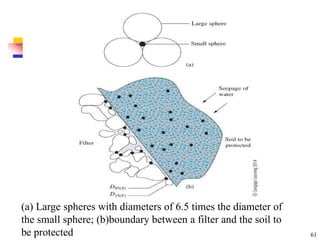
(a) Large spheres with diameters of 6.5 times the diameter of
the small sphere; (b)boundary between a filter and the soil to
be protected
62
A large excavation was made in a stratum of stiff clay with
a saturated unit weight of 18.64 kN/m3. When the depth of
excavation reached 8 m, the excavation failed as a mixture
of sand and water rushed in. Subsequent borings indicated
that the clay was underlain by a bed of sand with its top
surface at a depth of 12.5 m. To what height would the
water have risen above the stratum of sand into a drill hole
before the excavation was started ?
Exercise Problem
63
the effective stress at the top of sand stratum goes on getting
reduced as the excavation proceeds due to relief of stress,
the neutral pressure in sand remaining constant.
The excavation would fail when the effective stress
reached zero value at the top of sand.
Effective stress at the top of sand stratum,
Therefore, the water would have risen to a height of 8.55 m
above the stratum of sand into the drill hole before
excavation under the influence of neutral pressure.
Compaction (Mechanical Modification)
• Soil densification by external forces.
• Densification of an unsaturated soil by reduction in
volume of voids filled with air, while the volume of
solids remains essentially the same.
• Major purpose of compaction of soil are:
1. To increase shear strength
2. To reduce permeability
3. To reduce compressibility
4. To reduce liquefaction potential
5. To control swelling and shrinkage
* Improvement of Engineering properties by densification
is possible for natural soils as well as for soil stabilized
with chemicals such as lime and cement.
• Proctors Theory of Compaction
* Developed by R R Proctor in 1933
*When he was supervising the construction of
dam for bureau of waterworks and supply in Los
Angeles, USA
* Based on laboratory Study using MOULD
Vol 1000 cc; I.D. = 100 mm, Ht= 127.3 mm
Rammer 2.6 kg 310 mm drop
d = ( 
/(1+w))
1 ω
γ
d
γ 
• Factors Affecting Compaction
1. Moisture Content
2. Effect of Compactive Effort
• Effect of Soil Type
Compaction of Sand
Small moisture films around the grains tend to keep them apart and can
decrease the density up to a certain water content. The point Q on the
curve indicates the minimum density.
Later on, the apparent cohesion gets reduced as the water content
increases and is destroyed ultimately at 100% saturation of the sand.
Thus, the point R on the curve indicates maximum density. Thereafter,
once again, the density decreases with increase in water content
R
Q
• Compaction Energy
No of blows/layer *No of Layers*W * H
F =
Vol of mould
1. Core Cutter Method
Insitu
Determination
of Density
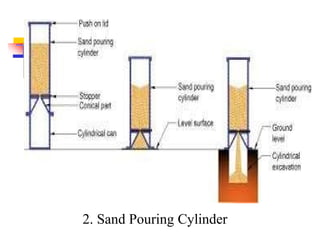
2. Sand Pouring Cylinder
Field Compacton
Mostly carried out by Rollers
Tarn ng foot roller
Factors affecting Roller Passes
1. No of roller passes
Control of Compaction in the Field
Control of compaction in the field consists of checking the water
content in relation to the laboratory optimum moisture content and
the dry unit weight achieved in-situ in relation to the laboratory
maximum dry unit weight from a standard compaction test.
Typically, each layer is tested at several random locations after it
has been compacted.
Relative compaction = field / lab
Relative compaction of 90 to 100 is specified and sought to
be achieved.
Eelati've densi'ty should not be
confused
zni'th relative compacti'on.
Correlation befzreen relatlm compaction (E) an
I
the relative Iensi'ty Dr
R
— D,(1 — R )
Dr. Abdul man nan 0 rabi
d(min)
R -
IUST
Proctor Needle
The Proctor needle approach given here, is an efficient and
fast one for the simultaneous determination of in-situ unit
weight and in-situ moisture content, it is also called
‘penetration needle’
THANK YOU!
Prof. S. M. Ali Jawaid
Phone
9235500523
Email
smajce@mmmut.ac.in

Permeability notes for geotechnical engineering.pptx

  • 1.
    BCE 27 1 PROF SM ALI JAWAID Permeability
  • 2.
    Permeability 2 Permeability is definedas a property of porous material which permits the passage of water through its interconnecting voids.
  • 3.
  • 4.
    Water flow throughsoil Laminar flow Each fluid particles travel along a definite path which never crosses the path of any other particle (In Soils, mostly flow is laminar) Turbulent flow Path of travel irregular. Twisting, crossing and re- crossing at random 4
  • 5.
    Why its studyis required 5 • To calculate the rate of settlement of a saturated compressible soil layer. • To calculate seepage through the body of earth dams and stability of slopes. • To calculate the uplift pressure under the hydraulic structures and their safety against piping. • Ground water flow towards wells and drainage of soil.
  • 6.
    DARCY’s LAW Basedon Expt study For laminar flow condition in a saturated soil, the rate of flow/discharge per unit time across a cross-sectional area A is proportional to hydraulic gradient (under an standard temp of 270C) where i = (h)/L When hydraulic gradient i=1, the V= k 6
  • 7.
    So, coefficient ofpermeability (k) may be defined as the average velocity of flow that will occur through the total cross-sectional area of soil under unit hydraulic gradient. k is normally expressed in cm/sec; m/day or feet/day 7
  • 8.
    VALIDITY OF DARCY’sLAW 8 Darcy’s type of flow is stable in character as long as the four basic conditions are always satisfied: The steady state is laminar flow Hundred percent saturation Flow fulfilling continuity conditions No volume changes occur during or as a result of flow. Note: For ground water flow occurring in nature and normally encountered in Soil Mech. Problems, the Darcy’s law is generally within validity limits.
  • 9.
    9 Discharge/Superficial Velocity andSeepage Velocity Since flow takes place through the voids, hence, actual velocity of flow is more than discharge velocity. By the principle of continuity, the velocity of approach, v, may be related to the seepage velocity, vs, as follow : is called the where kp, the constant of proportionality, ‘Coefficient of Percolation’, and is given by : kp = k/n
  • 10.
    An equation reflectingthe influence of the characteristics of the permeant fluid and the soil on permeability was developed by Taylor (1948) based on Poiseuille’s law for laminar flow through a circular capillary tube. The flow through a porous medium is considered similar to a flow through a bundle of straight capillary tubes. The equation is : in which, k = Darcy’s coefficient of permeability Ds = effective particle-size γ = unit weight of permeant μ = viscosity of permeant e = void ratio C = shape factor 10 1 Factors affecting permeability
  • 11.
    Factors affecting permeability Grain-size •Equ. 1 suggests that the permeability varies with the square of particle diameter. • It is logical that the smaller the grain-size the smaller the voids and thus the lower the permeability and vice versa. •Allen Hazen proposed; 2 k = 100 D10 where D10 is in cm and k is in cm/s. Density and Viscosity Equation 1 indicates that the permeability is influenced by both the viscosity and the unit weight of the permeant fluid. k  11
  • 12.
     & depends on temp, hence k depends on temperature. Since effect of temp is more on , neglecting variation of  with temp Since where kT and μT are the permeability of soil and the viscosity of water at the test temperature of t°C and, k27 and μ27 are the permeability and viscosity at the standard temperature, i.e., 27°C. Void Ratio Equation 1 indicates that a plot of k versus e3/(1 + e) should be a straight line. This is more true of coarse grained soils since the shape factor C does not change appreciably with the void ratio for these soils. 12
  • 13.
  • 14.
    Fabric or StructuralArrangement of Particles 14 •The fabric important or structural arrangement of particles is an soil characteristic influencing permeability, especially of fine-grained soils. •At the same void ratio, it is logical to expect a soil in the most flocculated state will have the highest permeability, and the one in the most dispersed state will have the lowest permeability. Degree of saturation Higher the degree of saturation, higher will be the permeability. In the case of certain sands the permeability may increase three-fold when the degree of saturation increases from 80% to 100%.
  • 15.
    Presence of entrappedair & other foreign matter The entrapped air and foreign matter will block the voids in soil results in decreasing in permeability 15
  • 16.
  • 17.
  • 18.
    18 Two standard laboratorytests are us to determine the coefficient of permeability of soil Laboratory Testing to find coefficient of permeability 1.Constant Head Test If Q is total quantity of flow in time interval t, then from Darcy’s law When steady state of flow is reached, the total quantity of For Sandy Soil Only h L Porus Stone
  • 19.
    2. Falling HeadPermeability test Let h be the head at any intermediate time interval t and (-dh) be change in head in smaller time interval dt 19
  • 20.
    Integrating between twotime limits, we get 20
  • 21.
    - Sign changeby changing limit from h2 to h1 to h1 to h2 21
  • 22.
    Flow Perpendicular tothe Bedding Planes 22 In this case, the velocity of flow v, and hence the discharge q, is the same through all the layers, for the continuity of flow. Let the total head lost be Δh and the head lost in each of the layers be Δh1, Δh2, Δh3, ...... Δhn. Δh = Δh1 + Δh2 + Δh3 + ... Δhn.
  • 23.
    The hydraulic gradientsare : i1 = Δh1/h1 ; i2 = Δh2/h2 and in = Δhn/hn Since q is the same in all the layers, and area of cross- section of flow is the same, the velocity is the same in all layers. Let kz be the average permeability perpendicular to the bedding planes. Since Δh = Δh1 + Δh2 + Δh3 + ... Δhn. 23
  • 24.
    Flow Parallel tothe Bedding Planes The discharge through the entire deposit is equal to the sum of the discharge through the individual layers. Assuming kx to be the average permeability of the entire deposit parallel to the bedding planes, and applying the equation 24
  • 25.
  • 26.
    SEEPAGE • Defined asthe flow of water/fluid through a soil under a hydraulic gradient. • The interaction between soils and percolating water has an important influence on: 1 . The design of foundations and earth slopes, 2. The quantity of water that will be lost by percolation through a water. • The pressure that is exerted on the soil due to the seepage of water is called the seepage force. 26
  • 27.
    • If his the hydraulic head or head loss causes the water to flow through a soil mass of thickness, z, the seepage pressure – ps = h w = (h/z) z w = i z w Hydraulic gradient Length over which h is loss 27 The total seepage force transmitted to soil by seepage = ps . A = i z w A And seepage force per unit volume = i z w A / z A = i w
  • 28.
    BASIC EQUATION FORSEEPAGE/ Laplace’s Equation of continuity 28 The following assumptions are made: 1. Darcy’s law is valid for flow through soil. 2.The hydraulic boundary conditions are known at entry and exit of the fluid (water) into the porous medium (soil). 3. Water is incompressible. 4. The porous medium is incompressible. These assumptions have been known to be very nearly or precisely valid.
  • 29.
    • Let usconsider an element of soil through which laminar flow of water is occurring Vx and Vz are components of discharge velocity in the horizontal and vertical direction. The rate of flow of water into the elementary block in the horizontal direction is Vx dz dy and in the vertical direction is Vz dx dy . Again the rate of outflow from the block in horizontal and vertical directions are Vx + (Vx/x) dz dy & Vz + (Vz/z) dx dy Assuming water is incompressible and no change in soil mass occurs, then total rate of inflow should be 29
  • 30.
    [Vx + (Vx/x)dz dy] + [Vz + (Vz/z) dx dy] - [Vx dz dy + Vz dx dy ] = 0 30 Or Vx/x + Vz/z = 0 From Darcy’s Law Vx = Kx ix = Kx (h/x) & Vz = Kz iz = = Kz (h/z) For isotropic soil Kx = kz 2h/2 x + 2h/2 z = 0 known as Continuity Equation. The flow net which consists of two sets of curves – a series of flow lines and of equil-potential lines–is obtained merely as a solution to the Laplace’s equation.
  • 31.
    FLOW NETS A FlowNet consists of two groups of curves: Flow lines: Flow lines (aka stream lines) represent the path that a particle of water takes as it travels through the soil mass. Equipotential lines: Equipotential lines are lines that pass through points of equal head. 31
  • 32.
    DRAWING OF FLOWNETS 32 1. Flow lines and equipotential lines are at right angles to one another. 2. Flow lines are ║ to no flow boundaries. 3. Equipotential lines are ║ to permeable boundaries. 4. Discharge through each flow path is equal. 5. Head loss through each equipotential space is equal.
  • 33.
    RULES FOR DRAWINGFLOW NETS 33 1) All impervious boundaries are flow lines. 2) All permeable boundaries are equipotentials. 3) All equipotentials are at right angles to flow lines. 4) All parts of the flow net must have the same geometric proportions (e.g. square or similarly shaped rectangles). 5) Just like contour lines, flow lines cannot cross other flow lines & equipotential lines cannot cross other equipotential lines. 6) Good approximations can be obtained with 4 - 6 flow channels. More accurate results are possible with higher numbers of flow channels, but the time taken goes up in proportion to the number of channels.
  • 34.
  • 35.
    Flow net undera dam with toe filter 35
  • 36.
    METHODS OF OBTAININGFLOW NETS The following methods are available for the determination of flow nets: 1. Graphical solution by sketching 2. Mathematical or analytical methods 3. Numerical analysis 4. Models 5. Analogy methods All the methods are based on Laplace’s equation. 36
  • 37.
    1. Graphical Solutionby Sketching 37 A flow net for a given cross-section is obtained by first transforming the cross-section, and then sketching by trial and error, taking note of the boundary conditions. The properties of flow nets such as the orthogonality of the flow lines and equipotential lines, and the spaces being elementary squares, and the various rules concerning boundary conditions and smooth transitions must be observed.
  • 38.
    Sketching by trialand error was first suggested by Forchheimer (1930) and further developed by A. Casagrande (1937). The following suggestions are made by Casagrande for the benefit of the sketcher. (a) Every opportunity to study well-constructed flow nets should be utilised to get the feel of the problem. (b) Four to five flow channels are usually sufficient for the first attempt. (c) The entire flow net should be sketched roughly before details are adjusted. (d) The fact that all transitions are smooth and are of elliptical or parabolic shape should be borne in mind. (e) The boundary flow lines and boundary equipotentials should first be recognised and sketched. 38
  • 39.
    39 2. Mathematical orAnalytical Methods In a few relatively simple case the boundary conditions may be expressed by equations and solutions of Laplace’s equation may be obtained by mathematical procedure. This approach is not popular because of the complexity of mathematics even for relatively simply problems. Perhaps the best known theoretical solution was given by Kozeny (1933) and later extended further by A. Casagrande, for flow through an earth dam with a filter drain at the base towards the downstream side. Another problem for which a theoretical solution is available is a sheet pile wall (Harr, 1962).
  • 40.
    40 3. Numerical Analysis Laplace’sequation for two-dimensional flow can be solved by numerical techniques in case the mathematical solution is difficult. Relaxation methods involving successive approximation of the total heads at various points in a mesh or net work are used. The Laplace’s differential equation is put in its finite difference form and a digital computer is used for rapid solution.
  • 41.
    41 4. Models A flowproblem may be studied by constructing a scaled model and analysing the flow in the model. Earth dam models have been used quite frequently for the determination of flow lines. Such models are commonly constructed between two parallel glass or lucite sheets. By the injection of spots of dye at various points, the flow lines may be traced. This approach facilitates the direct determination of the top flow line. Piezometer tubes may be used for the determination of the heads at various points.
  • 42.
    5. Analogy Methods Lapalce’sequation for fluid flow also holds for electrical and heat flows. The use of electrical models for solving complex fluid flow problems in more common. In an electrical model, voltage corresponds to total head, current to velocity and conductivity to permeability. Ohm’s Law is analogous to Darcy’s Law. Measuring voltage, one can locate the equi-potentials. The flow pattern can be sketched later. 42
  • 43.
    SEEPAGE CALCULATION Since thereis no flow across flowline Piezometric level q1=  q2 …….=  q From Darcy’s law, The rate of flow KiA Rate of flow per unit width 3  l1  q = K   = K l1  h 1  h 2      3  4 l  h = K  h 3 l l 2 43    2 l  h 2  h 3  Above Equation shows that if the flow elements are drawn as approximate squares, then the drop in the piezometric level between any two adjacent equipotential lines is the same. This is called the potential drop. Thus
  • 44.
    and Diff of headbetween u/s and d/s sides No of potential drop If the number of flow channels in a flow net is equal to Nf , the total rate of flow through all the channels per unit length can be given by 44
  • 45.
  • 46.
    FLOW CALCULATIONS Flow thmugheach flow channel. Sq —— z k — peiuieabilityfliydraulic conductivity of soil H = Head lDSs N = Nimiber of potential drops Nt = 1 G for square chaiuiel N,= b/1 G for iectaiigular chaiinel
  • 47.
    Previous Figure showsa flow net for seepage around a single row of sheet piles. Note that flow channels 1 and 2 have square elements. Hence, the rate of flow through these two channels can be written as However, flow channel 3 has rectangular elements. These elements have a width-to-length ratio of about 0.38; hence So, the total rate of seepage can be given as 47
  • 48.
  • 49.
  • 50.
    Piping 50 Defined as movementof soil particles by percolating water leading to development of channel Heave Piping When the seepage pressure of upward percolating water equal or exceeds the pressure due to submerged weight of soil at a certain level, quick condition develops, leading the blowing of soil by leaving water creating a hole/pipe in soil mass. Backward erosion Piping Starts with removal of soil at the point of exit of flowlines. Watch https://youtu.be/qEAU8abZ-uY
  • 51.
  • 52.
    Failure of Tetondam, Idaho, USA 52
  • 53.
  • 54.
    Piping can beavoided by lengthening the flowpaths of water within the dam and its foundations. 54 This decreases the hydraulic gradient of the water flow and hence its velocity. The flowpaths can be increased by: Cutoff walls. Seepage path may be increased by providing sheet pile, pile walls and other thin cutoffs, cutoff trenches, upstream impervious blanket . Piping Prevention
  • 55.
    By reducing Seepage Embankmentzoning (providing impervious zone or a core wall) reduces seepage within an earthdam. By controlling the exit of seepage and reducing uplift pressure Downstream drainage blanket, toe drain and drainage trenches are used to control the exit of seepage and allow its safe escape with out inducing piping. Providing additional stabilizing load Seepage may be prevented by covering the area with blanket of heavy coarse graded material called protective filters. 55 Piping Prevention (contd.)
  • 56.
  • 57.
     When seepagewater flows from a soil with relatively fine grains into a coarser material, there is danger that the fine soil particles may wash away into the coarse material. Over a period of time, this process may clog the void spaces in the coarser material.  Hence, the grain-size distribution of the coarse material should be properly manipulated to avoid this situation. A properly designed coarser material is called a filter. 57 Drainage Filter Design
  • 58.
    58 . For proper selectionof the filter material, two conditions should be kept in mind: Condition 1: The size of the voids in the filter material should be small enough to hold the larger particles of the protected material in place. Condition 2: The filter material should have a high hydraulic conductivity to prevent buildup of large seepage forces and hydrostatic pressures in the filters. Steady-state seepage condition in an earth dam which has a toe filter
  • 59.
    FILTER DESIGN (Contd.) Terzaghiand Peck (1948), for example, proposed the following set of criteria for an effective soil filter. 59
  • 60.
    Most filters aremulti layers of sand and gravel. These filters are difficult to construct, and their efficiency is easily compromised by even a small amount of fines. Geotextiles—a permeable, polymeric material—have replaced soil filters in many construction applications. Construction is simple and cost-effective compared with soil filters. Generally, the filter is about 10 to 20 times more permeable than the soil. 60 FILTER DESIGN (Contd.)
  • 61.
    61 (a) Large sphereswith diameters of 6.5 times the diameter of the small sphere; (b)boundary between a filter and the soil to be protected
  • 62.
    62 A large excavationwas made in a stratum of stiff clay with a saturated unit weight of 18.64 kN/m3. When the depth of excavation reached 8 m, the excavation failed as a mixture of sand and water rushed in. Subsequent borings indicated that the clay was underlain by a bed of sand with its top surface at a depth of 12.5 m. To what height would the water have risen above the stratum of sand into a drill hole before the excavation was started ? Exercise Problem
  • 63.
    63 the effective stressat the top of sand stratum goes on getting reduced as the excavation proceeds due to relief of stress, the neutral pressure in sand remaining constant. The excavation would fail when the effective stress reached zero value at the top of sand. Effective stress at the top of sand stratum, Therefore, the water would have risen to a height of 8.55 m above the stratum of sand into the drill hole before excavation under the influence of neutral pressure.
  • 64.
    Compaction (Mechanical Modification) •Soil densification by external forces. • Densification of an unsaturated soil by reduction in volume of voids filled with air, while the volume of solids remains essentially the same. • Major purpose of compaction of soil are: 1. To increase shear strength 2. To reduce permeability 3. To reduce compressibility 4. To reduce liquefaction potential 5. To control swelling and shrinkage
  • 65.
    * Improvement ofEngineering properties by densification is possible for natural soils as well as for soil stabilized with chemicals such as lime and cement. • Proctors Theory of Compaction * Developed by R R Proctor in 1933 *When he was supervising the construction of dam for bureau of waterworks and supply in Los Angeles, USA * Based on laboratory Study using MOULD Vol 1000 cc; I.D. = 100 mm, Ht= 127.3 mm Rammer 2.6 kg 310 mm drop d = (  /(1+w)) 1 ω γ d γ 
  • 66.
    • Factors AffectingCompaction 1. Moisture Content
  • 67.
    2. Effect ofCompactive Effort
  • 68.
    • Effect ofSoil Type
  • 69.
    Compaction of Sand Smallmoisture films around the grains tend to keep them apart and can decrease the density up to a certain water content. The point Q on the curve indicates the minimum density. Later on, the apparent cohesion gets reduced as the water content increases and is destroyed ultimately at 100% saturation of the sand. Thus, the point R on the curve indicates maximum density. Thereafter, once again, the density decreases with increase in water content R Q
  • 70.
    • Compaction Energy Noof blows/layer *No of Layers*W * H F = Vol of mould
  • 72.
    1. Core CutterMethod Insitu Determination of Density
  • 73.
  • 76.
  • 87.
  • 88.
    Factors affecting RollerPasses 1. No of roller passes
  • 89.
    Control of Compactionin the Field Control of compaction in the field consists of checking the water content in relation to the laboratory optimum moisture content and the dry unit weight achieved in-situ in relation to the laboratory maximum dry unit weight from a standard compaction test. Typically, each layer is tested at several random locations after it has been compacted. Relative compaction = field / lab Relative compaction of 90 to 100 is specified and sought to be achieved.
  • 90.
    Eelati've densi'ty shouldnot be confused zni'th relative compacti'on. Correlation befzreen relatlm compaction (E) an I the relative Iensi'ty Dr R — D,(1 — R ) Dr. Abdul man nan 0 rabi d(min) R - IUST
  • 91.
    Proctor Needle The Proctorneedle approach given here, is an efficient and fast one for the simultaneous determination of in-situ unit weight and in-situ moisture content, it is also called ‘penetration needle’
  • 93.
    THANK YOU! Prof. S.M. Ali Jawaid Phone 9235500523 Email smajce@mmmut.ac.in