Rajesh K. Devmurari et al. Int. Journal of Engineering Research and Applications www.ijera.com
ISSN: 2248-9622, Vol. 5, Issue 11, (Part - 4) November 2015, pp.20-22
www.ijera.com 20 | P a g e
Permeability
Rajesh K. Devmurari1
, Purvansh B. Shah2
, Mahesh B Shrivastav3
, Tejas D
Khediya4
1,3,4
Lecturer (Water Resources Management)(Construction Engineering & Management)2
Department of Civil Engineering Sir Bhavsinhji Polytechnic Institute, Bhavnagar-364002
Abstract
In Soil, Generally there exists pores which are field with water. These pores are interconnected & hence it
becomes highly complex & intricate network of irregular tubes. Where there is pressure difference, water flows
from high potential to low potential zone. The pores may be large or small, may be irregular in shape. The
quantum of flow depends on the above. The ease with which water can flow through soil is the permeability of
the soil. Geotechnical engineers may come across the problem of soil which may be highly permeable or may
have restricted permeability. Engineers are needed to quantitatively assess the amount of flow likely to occur.
Key words: Permeability, Darcy’s Law.
I. PERMEABILITY –A FUNCTION
OF SOIL TYPE
The engineering behavior of soil depends on
permeability of soil. Difference in permeability of
different soil may be very large. For example, the
permeability of a clean, medium sand is about a
million times as much as that of a clay of medium
plasticity. This is true for same void ratio, because
clay has narrower channels and tortuous than in sand,
and offer much more resistance to flow of water.
Permeability represents the ease with which water
travels through soil. It has unit of velocity, the greater
the ease, the greater the velocity. As stated above the
permeability differs largely i.e of the power raised to
10. i.e. 10-7
, 10-3
. The important figure for us is -7
and -3 and not the multiplying integer.
Table 1.1
Typical values of permeability, k, for different soils.
Soil k in m/sec
Gravel 10-2
Sand, Coarse 10-2
To 10-3
Sand, Medium 10-3
To 10-4
Sand, Fine 10-4
To 10-5
Sand, Silty 10-5
To 10-6
Delhi Silt 6 X 10⁻⁷
London Clay 1.5 X 10⁻¹¹
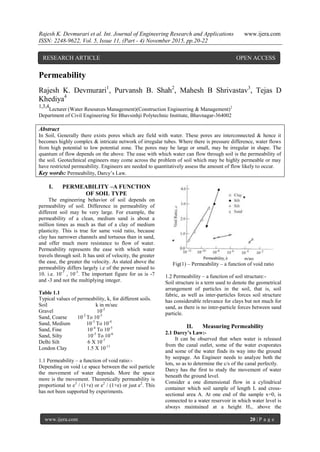
1.1 Permeability – a function of void ratio:-
Depending on void i.e space between the soil particle
the movement of water depends. More the space
more is the movement. Theoretically permeability is
proportional to e3
/ (1+e) or e2
/ (1+e) or just e2
. This
has not been supported by experiments.
Fig(1) – Permeability – a function of void ratio
1.2 Permeability – a function of soil structure:-
Soil structure is a term used to denote the geometrical
arrangement of particles in the soil, that is, soil
fabric, as well as inter-particles forces soil structure
has considerable relevance for clays but not much for
sand, as there is no inter-particle forces between sand
particle.
II. Measuring Permeability
2.1 Darcy’s Law:-
It can be observed that when water is released
from the canal outlet, some of the water evaporates
and some of the water finds its way into the ground
by seepage. An Engineer needs to analyze both the
lots, so as to determine the c/s of the canal perfectly.
Darcy has the first to study the movement of water
beneath the ground level.
Consider a one dimensional flow in a cylindrical
container which soil sample of length L and cross-
sectional area A. At one end of the sample x=0, is
connected to a water reservoir in which water level is
always maintained at a height H1, above the
RESEARCH ARTICLE OPEN ACCESS
Rajesh K. Devmurari et al. Int. Journal of Engineering Research and Applications www.ijera.com
ISSN: 2248-9622, Vol. 5, Issue 11, (Part - 4) November 2015, pp.20-22
www.ijera.com 21 | P a g e
container’s longitudinal axis. At the other end of the
section water level is maintained at H2. Out flow
from the tube is collected in the graduated jar. [as
shown in the figure].
(Schematic diagram of one dimensional flow)
apparatus
Thus, flow shall take between the L-section due
to potential head difference. The potential difference
that causes flow is the difference between total
potential ( or total head) which is the sum of the
pressure head, the elevation head and the velocity
head. For flow through sand, silt and clays the
velocity head is very small and can be neglected.
Thus total head is equal to the sum of the pressure
and the elevation head and is called Piezometer head.
This can be determined by just inserting two
piezometer at the ends and measure the head
difference. The measured difference is say ∆H. As
shown in the figure, flow occurs through c/s ‘A’ and
through the length L. The flow occurring per unit
time can be measured in graduated jar. We may
change any of the three variable ∆H,L and A and
conduct the experiment.
From this experiment we can see that,
 If area of c/s and head is doubled, the flow
occurring is double.
 If the length is doubled the flow occurring is
halved.
 The head causing flow is lost linearly along the
length of sample.
Now, say water collected in jar is Q, then it is
directly proportional to the head causing flow and of
c/s of the soil sample but is inversely proportional to
the length of the soil sample, or,
Q ∝
∆H
L
A …………………………………….. 2.1
The constant changed when soil sample was
changed. Thus it is property of soil & is known as
permeability ‘k’.
Q = k
∆H
L
A………………………………….…2.2
Dimensionally,
L3
T
=
L
T
L
L
L2
=
L3
T
Where L is length and T is time.
Equation 2.2 can be written as,
Q = kiA……………………………………….…2.3
Where i=
∆H
L
. The hydraulic gradient, is the head lost
per unit distance and it is a dimensionless parameter.
Dividing both sides by Ae.g we get,
𝑄
𝐴
= k i=v
Where v is the superficial velocity of flow. It is not
actual velocity of the flow, through the pores in the
cross-section A and not A itself.
The permeability of a soil, than, can be viewed
as the superficial velocity under a hydraulic gradient
of 1.0. Thus we can also make an estimate of the
average actual velocity of water, known as seepage
velocity,Vs. Volume of soil multiplied by its porosity
is the volume of pores. The cross-sectional area A
multiplied by the porosity is thus the cross-sectional
area of the pores.
Vs=
𝑄
𝐴 𝑛
=
𝑣
𝑛
Darcy’s law has been working up til the flow is
laminar and almost flow of water underground is
generally laminar.
How to measure permeability?
2.2 Constant Head Permeameter
As shown in the figure the same set-up can be
used to measure permeability of soils. ∆H,L, A and Q
need to be measured. By Darcy’s law the
permeability can be calculated from
K=
Q
A
L
∆H
The apparatus shown in the figure is known as
‘”Constant Head Permeameter”, because the head
∆H , is kept constant throughout the experiment. The
flow Q is measured by calculating volume in Jar and
a stop-water. To measure the flow, by this method it
is necessary to have the flow considerable, hence this
method is useful only for sand and siltysand. As the
flow is only in one direction.i.e. X-direction i.e. it is
one-dimensional steady state flow through
homogeneous material.
2.3 Falling Head Permeameter:-
We saw in above section, that we had constant
head and is possible for the soils of high
permeability. But to determine the permeability of
Rajesh K. Devmurari et al. Int. Journal of Engineering Research and Applications www.ijera.com
ISSN: 2248-9622, Vol. 5, Issue 11, (Part - 4) November 2015, pp.20-22
www.ijera.com 22 | P a g e
soil with low permeability such as silts, silty clays
and clays falling head permeability method is used.
The apparatus are shown in fig..
Fig.(2) - Falling Head Permeameter
The flow is measured very precisely by
measuring in a vertical pipe, for a long duration of
time. As seen in the figure when the flow takes place,
there is fall in the head in the vertical pipe. (fig 2)
According to Darcy, for head change causing the
flow, at any time t.
Q=k
h
L
A
For time dt, water level drops to dh,
Q=−a
dh
dt
= k
h
L
A
Or
−
dh
h
=
kA
La
dt
Integrating over the limits of initial and final
condition of head causing flow and time,
hf
dh
h
=
hf
hi
kA
La
dt
tf
ti
ln
hi
hf
=
kA
La
tf − ti
k=
La
A
ln
hi
hf
tf−ti
By the above apparatus and arrangement we can
measure permeability of soil in laboratory.
References
[1.] Irrigation Water Resources and water power
engineering P N Modi
[2.] Irrigation and water power engineering B C
Punamia
[3.] Geotechnical Engineering by Shashi K
Gulhati, Manoj Datta Google scholar
NPTEL Lectures Google.

Permeability

  • 1.
    Rajesh K. Devmurariet al. Int. Journal of Engineering Research and Applications www.ijera.com ISSN: 2248-9622, Vol. 5, Issue 11, (Part - 4) November 2015, pp.20-22 www.ijera.com 20 | P a g e Permeability Rajesh K. Devmurari1 , Purvansh B. Shah2 , Mahesh B Shrivastav3 , Tejas D Khediya4 1,3,4 Lecturer (Water Resources Management)(Construction Engineering & Management)2 Department of Civil Engineering Sir Bhavsinhji Polytechnic Institute, Bhavnagar-364002 Abstract In Soil, Generally there exists pores which are field with water. These pores are interconnected & hence it becomes highly complex & intricate network of irregular tubes. Where there is pressure difference, water flows from high potential to low potential zone. The pores may be large or small, may be irregular in shape. The quantum of flow depends on the above. The ease with which water can flow through soil is the permeability of the soil. Geotechnical engineers may come across the problem of soil which may be highly permeable or may have restricted permeability. Engineers are needed to quantitatively assess the amount of flow likely to occur. Key words: Permeability, Darcy’s Law. I. PERMEABILITY –A FUNCTION OF SOIL TYPE The engineering behavior of soil depends on permeability of soil. Difference in permeability of different soil may be very large. For example, the permeability of a clean, medium sand is about a million times as much as that of a clay of medium plasticity. This is true for same void ratio, because clay has narrower channels and tortuous than in sand, and offer much more resistance to flow of water. Permeability represents the ease with which water travels through soil. It has unit of velocity, the greater the ease, the greater the velocity. As stated above the permeability differs largely i.e of the power raised to 10. i.e. 10-7 , 10-3 . The important figure for us is -7 and -3 and not the multiplying integer. Table 1.1 Typical values of permeability, k, for different soils. Soil k in m/sec Gravel 10-2 Sand, Coarse 10-2 To 10-3 Sand, Medium 10-3 To 10-4 Sand, Fine 10-4 To 10-5 Sand, Silty 10-5 To 10-6 Delhi Silt 6 X 10⁻⁷ London Clay 1.5 X 10⁻¹¹ 1.1 Permeability – a function of void ratio:- Depending on void i.e space between the soil particle the movement of water depends. More the space more is the movement. Theoretically permeability is proportional to e3 / (1+e) or e2 / (1+e) or just e2 . This has not been supported by experiments. Fig(1) – Permeability – a function of void ratio 1.2 Permeability – a function of soil structure:- Soil structure is a term used to denote the geometrical arrangement of particles in the soil, that is, soil fabric, as well as inter-particles forces soil structure has considerable relevance for clays but not much for sand, as there is no inter-particle forces between sand particle. II. Measuring Permeability 2.1 Darcy’s Law:- It can be observed that when water is released from the canal outlet, some of the water evaporates and some of the water finds its way into the ground by seepage. An Engineer needs to analyze both the lots, so as to determine the c/s of the canal perfectly. Darcy has the first to study the movement of water beneath the ground level. Consider a one dimensional flow in a cylindrical container which soil sample of length L and cross- sectional area A. At one end of the sample x=0, is connected to a water reservoir in which water level is always maintained at a height H1, above the RESEARCH ARTICLE OPEN ACCESS
  • 2.
    Rajesh K. Devmurariet al. Int. Journal of Engineering Research and Applications www.ijera.com ISSN: 2248-9622, Vol. 5, Issue 11, (Part - 4) November 2015, pp.20-22 www.ijera.com 21 | P a g e container’s longitudinal axis. At the other end of the section water level is maintained at H2. Out flow from the tube is collected in the graduated jar. [as shown in the figure]. (Schematic diagram of one dimensional flow) apparatus Thus, flow shall take between the L-section due to potential head difference. The potential difference that causes flow is the difference between total potential ( or total head) which is the sum of the pressure head, the elevation head and the velocity head. For flow through sand, silt and clays the velocity head is very small and can be neglected. Thus total head is equal to the sum of the pressure and the elevation head and is called Piezometer head. This can be determined by just inserting two piezometer at the ends and measure the head difference. The measured difference is say ∆H. As shown in the figure, flow occurs through c/s ‘A’ and through the length L. The flow occurring per unit time can be measured in graduated jar. We may change any of the three variable ∆H,L and A and conduct the experiment. From this experiment we can see that,  If area of c/s and head is doubled, the flow occurring is double.  If the length is doubled the flow occurring is halved.  The head causing flow is lost linearly along the length of sample. Now, say water collected in jar is Q, then it is directly proportional to the head causing flow and of c/s of the soil sample but is inversely proportional to the length of the soil sample, or, Q ∝ ∆H L A …………………………………….. 2.1 The constant changed when soil sample was changed. Thus it is property of soil & is known as permeability ‘k’. Q = k ∆H L A………………………………….…2.2 Dimensionally, L3 T = L T L L L2 = L3 T Where L is length and T is time. Equation 2.2 can be written as, Q = kiA……………………………………….…2.3 Where i= ∆H L . The hydraulic gradient, is the head lost per unit distance and it is a dimensionless parameter. Dividing both sides by Ae.g we get, 𝑄 𝐴 = k i=v Where v is the superficial velocity of flow. It is not actual velocity of the flow, through the pores in the cross-section A and not A itself. The permeability of a soil, than, can be viewed as the superficial velocity under a hydraulic gradient of 1.0. Thus we can also make an estimate of the average actual velocity of water, known as seepage velocity,Vs. Volume of soil multiplied by its porosity is the volume of pores. The cross-sectional area A multiplied by the porosity is thus the cross-sectional area of the pores. Vs= 𝑄 𝐴 𝑛 = 𝑣 𝑛 Darcy’s law has been working up til the flow is laminar and almost flow of water underground is generally laminar. How to measure permeability? 2.2 Constant Head Permeameter As shown in the figure the same set-up can be used to measure permeability of soils. ∆H,L, A and Q need to be measured. By Darcy’s law the permeability can be calculated from K= Q A L ∆H The apparatus shown in the figure is known as ‘”Constant Head Permeameter”, because the head ∆H , is kept constant throughout the experiment. The flow Q is measured by calculating volume in Jar and a stop-water. To measure the flow, by this method it is necessary to have the flow considerable, hence this method is useful only for sand and siltysand. As the flow is only in one direction.i.e. X-direction i.e. it is one-dimensional steady state flow through homogeneous material. 2.3 Falling Head Permeameter:- We saw in above section, that we had constant head and is possible for the soils of high permeability. But to determine the permeability of
  • 3.
    Rajesh K. Devmurariet al. Int. Journal of Engineering Research and Applications www.ijera.com ISSN: 2248-9622, Vol. 5, Issue 11, (Part - 4) November 2015, pp.20-22 www.ijera.com 22 | P a g e soil with low permeability such as silts, silty clays and clays falling head permeability method is used. The apparatus are shown in fig.. Fig.(2) - Falling Head Permeameter The flow is measured very precisely by measuring in a vertical pipe, for a long duration of time. As seen in the figure when the flow takes place, there is fall in the head in the vertical pipe. (fig 2) According to Darcy, for head change causing the flow, at any time t. Q=k h L A For time dt, water level drops to dh, Q=−a dh dt = k h L A Or − dh h = kA La dt Integrating over the limits of initial and final condition of head causing flow and time, hf dh h = hf hi kA La dt tf ti ln hi hf = kA La tf − ti k= La A ln hi hf tf−ti By the above apparatus and arrangement we can measure permeability of soil in laboratory. References [1.] Irrigation Water Resources and water power engineering P N Modi [2.] Irrigation and water power engineering B C Punamia [3.] Geotechnical Engineering by Shashi K Gulhati, Manoj Datta Google scholar NPTEL Lectures Google.