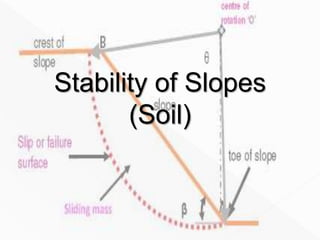

Stability of Slopes
(Soil)
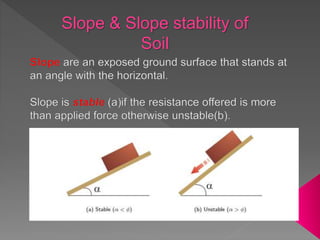
Slope & Slope stability of
Soil
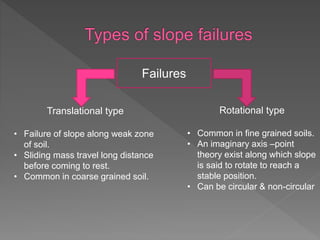
Failures
Translational type
• Failure of slope along weak zone
of soil.
• Sliding mass travel long distance
before coming to rest.
• Common in coarse grained soil.
Rotational type
• Common in fine grained soils.
• An imaginary axis –point
theory exist along which slope
is said to rotate to reach a
stable position.
• Can be circular & non-circular
Erosion
Water Seepage force
Sudden Drawdown
Earthquakes
Gravity
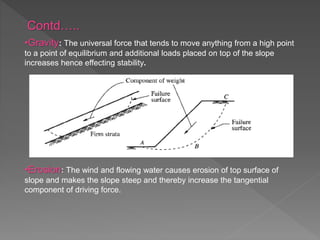
•Gravity: The universal force that tends to move anything from a high point
to a point of equilibrium and additional loads placed on top of the slope
increases hence effecting stability.
•Erosion: The wind and flowing water causes erosion of top surface of
slope and makes the slope steep and thereby increase the tangential
component of driving force.
Contd…..
•Water Seepage force: Seepage
forces in the sloping direction add to
gravity forces and make the slope
susceptible to instability. The pore water
pressure decrease the shear strength.
This condition is critical for the
downstream slope
•Sudden Drawdown:
In this case there is reversal in the
direction flow and results in instability of
side slope. Due to sudden drawdown the
shear stresses are more due to saturated
unit weight while the shearing resistance
decreases due to pore water pressure
that does not dissipate quickly.
•Earthquakes: They induce dynamic
shear forces. In addition there is
sudden buildup of pore water pressure
that reduces available shear strength.
Slopes
Natural
•Hilly & Valley slopes.
•River terraces and coastal
cliffs.
Man-made
•Embankment for highways and earth
dams.
•Excavation dumps and waste heaps for
landfill.
•Landscape development
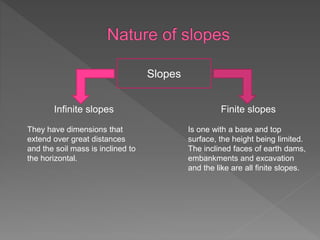
Slopes
Infinite slopes
They have dimensions that
extend over great distances
and the soil mass is inclined to
the horizontal.
Finite slopes
Is one with a base and top
surface, the height being limited.
The inclined faces of earth dams,
embankments and excavation
and the like are all finite slopes.
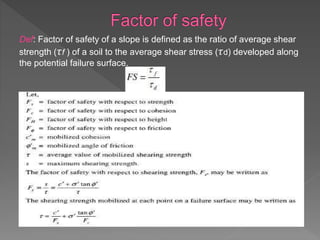
Def: Factor of safety of a slope is defined as the ratio of average shear
strength ( 𝜏f ) of a soil to the average shear stress ( 𝜏d) developed along
the potential failure surface.
The shearing strength mobilized at each point on a failure surface (10.2)
FoS for cohesion and internal friction if different the eq. of mobilsed
shearing resistance (10.3)
Infinite slope (SAND)
Assumptions,
β=angle of infinite slope w.r.t horizontal, a cohesion-less soil slope.
If the slope is stable,
slope angle limits to angle
of cohesion
FoS of an infinite slope of
sand
Infinite slope (CLAY)
CONDITION 1:No seepage, no pore pressure.
Vertical stress:
Components of
stress:
Value substitution: Allowable height
 Stability number=
•A dimensionless quantity, is directly proportional to
required cohesion an is inversely proportional to
allowable height.
Factor of safety,
Critical height
CONDITION 2: (A) Seepage parallel to ground
surface
Normal stress:
Shear stress:
Hence, if FoS=1,
Then stability number=
CONDITION 2: (B) Slope completely submerged
under water and no seepage
Stability number=
Where,
Finite slope
Steps for investigation:
•Assumptions of possible failure surface
•Equilibrium forces acting on the slope.
Methods of Analysis:
 Culmann method (Planar failure).
 Method considering whole free body:
- Slope failure under undrained condition.
- Friction-circle method.
- Tailor stability number
 Method of slice (Swedish c-φ method)
Culmann’s Method: for planar
failure surface
Assumptions,
• failure of a slope occurs along a plane
when the average shearing stress
tending to cause the slip is more than
the shear strength of the soil.
• Also, the most critical plane is the one
that has a minimum ratio of the
average shearing stress that tends to
cause failure to the shear strength of
soil.
Methods of Analysis
Culmann’s Method……
Solving the equations, and substituting
&
Types of Rotational (Circular)
failure
Face (Slope) failure
Toe failure
Base failure
Face (Slope) failure
• This type of failure occurs
when the slope angle (β) is
large and when the soil at
the toe portion is strong.
Toe failure
• In this case the failure surface
passes through the toe. This
occurs when the slope is steep
and homogeneous.
toe
Base failure
• In this case the failure
surface passes below the toe.
This generally occurs when
the soil below the toe is
relatively weak and soft.
Base failed
Failure under undrained conditions (φu=0):
Assumptions,
• Soil is homogeneous.
• Potential failure surface is a circular arc.
• This is seen in fully saturated, undrained soil.
 Two failure types
Slope failure
Base failure
Factor of safety
Contd….
Friction-circle method
Contd….
Factor of safety using frictional-circle method
Tailor’s stability number:
• Taylor (1937) conceived the idea of analyzing the stability of a
large number of slopes through a wide range of slope angles and
angles of internal friction, and then representing the results by an
abstract number which he called the "stability number".
Stability number
&
Factor of safety
Tailor’s chart:
Fos plot Fφ’ vs Fc’ to find Fs
• In this procedure, the soil above the surface of sliding is divided
into a number of vertical parallel slices. The stability of each slice
is calculated separately. This is a versatile technique in which the
non homogeneity of the soils and pore water pressure can be
taken into consideration. It also accounts for the variation of the
normal stress along the potential failure surface.
Method of slices:
Method of slices: for steady seepage
Graphical method:
Contd….
Method of slices: Bishop’s method
•A simplified and more refined solution.
• Useful if slope contains different kind of soil
with different C-φ.
Here,
W = weight of the slice
N = total normal force on the failure surface
cd
U = pore water pressure = ul on the failure
surface cd
FR = shear resistance acting on the base of
the slice
Er E2 - normal forces on the vertical faces be
and ad
Tr T2 = shear forces on the vertical faces be
and ad
θ = the inclination of the failure surface cd to
the horizontal
=FoS by conventional method
Where, frictional
resistance
And,
Solving and substituting,
Factor of safety
Contd….
Bishop’s and Morgenstern method:
Spencer method:
•Bishop’s method satisfies the
equation of equilibrium w.r.t
moment but not with force.
Factor of safety:
The charts developed by Spencer for
different values of Ns, φ'm and ru:
a
b
c
Worked out example:
Soil slope stability

Soil slope stability

  • 1.
  • 2.
    Slope & Slopestability of Soil
  • 3.
    Failures Translational type • Failureof slope along weak zone of soil. • Sliding mass travel long distance before coming to rest. • Common in coarse grained soil. Rotational type • Common in fine grained soils. • An imaginary axis –point theory exist along which slope is said to rotate to reach a stable position. • Can be circular & non-circular
  • 4.
    Erosion Water Seepage force SuddenDrawdown Earthquakes Gravity
  • 5.
    •Gravity: The universalforce that tends to move anything from a high point to a point of equilibrium and additional loads placed on top of the slope increases hence effecting stability. •Erosion: The wind and flowing water causes erosion of top surface of slope and makes the slope steep and thereby increase the tangential component of driving force. Contd…..
  • 6.
    •Water Seepage force:Seepage forces in the sloping direction add to gravity forces and make the slope susceptible to instability. The pore water pressure decrease the shear strength. This condition is critical for the downstream slope •Sudden Drawdown: In this case there is reversal in the direction flow and results in instability of side slope. Due to sudden drawdown the shear stresses are more due to saturated unit weight while the shearing resistance decreases due to pore water pressure that does not dissipate quickly.
  • 7.
    •Earthquakes: They inducedynamic shear forces. In addition there is sudden buildup of pore water pressure that reduces available shear strength.
  • 8.
    Slopes Natural •Hilly & Valleyslopes. •River terraces and coastal cliffs. Man-made •Embankment for highways and earth dams. •Excavation dumps and waste heaps for landfill. •Landscape development
  • 10.
    Slopes Infinite slopes They havedimensions that extend over great distances and the soil mass is inclined to the horizontal. Finite slopes Is one with a base and top surface, the height being limited. The inclined faces of earth dams, embankments and excavation and the like are all finite slopes.
  • 11.
    Def: Factor ofsafety of a slope is defined as the ratio of average shear strength ( 𝜏f ) of a soil to the average shear stress ( 𝜏d) developed along the potential failure surface.
  • 12.
    The shearing strengthmobilized at each point on a failure surface (10.2) FoS for cohesion and internal friction if different the eq. of mobilsed shearing resistance (10.3)
  • 15.
    Infinite slope (SAND) Assumptions, β=angleof infinite slope w.r.t horizontal, a cohesion-less soil slope.
  • 16.
    If the slopeis stable, slope angle limits to angle of cohesion FoS of an infinite slope of sand
  • 17.
    Infinite slope (CLAY) CONDITION1:No seepage, no pore pressure. Vertical stress: Components of stress: Value substitution: Allowable height
  • 18.
     Stability number= •Adimensionless quantity, is directly proportional to required cohesion an is inversely proportional to allowable height. Factor of safety, Critical height
  • 19.
    CONDITION 2: (A)Seepage parallel to ground surface Normal stress: Shear stress: Hence, if FoS=1, Then stability number=
  • 20.
    CONDITION 2: (B)Slope completely submerged under water and no seepage Stability number= Where,
  • 22.
    Finite slope Steps forinvestigation: •Assumptions of possible failure surface •Equilibrium forces acting on the slope. Methods of Analysis:  Culmann method (Planar failure).  Method considering whole free body: - Slope failure under undrained condition. - Friction-circle method. - Tailor stability number  Method of slice (Swedish c-φ method)
  • 23.
    Culmann’s Method: forplanar failure surface Assumptions, • failure of a slope occurs along a plane when the average shearing stress tending to cause the slip is more than the shear strength of the soil. • Also, the most critical plane is the one that has a minimum ratio of the average shearing stress that tends to cause failure to the shear strength of soil. Methods of Analysis
  • 24.
    Culmann’s Method…… Solving theequations, and substituting &
  • 25.
    Types of Rotational(Circular) failure Face (Slope) failure Toe failure Base failure
  • 26.
    Face (Slope) failure •This type of failure occurs when the slope angle (β) is large and when the soil at the toe portion is strong.
  • 27.
    Toe failure • Inthis case the failure surface passes through the toe. This occurs when the slope is steep and homogeneous. toe
  • 28.
    Base failure • Inthis case the failure surface passes below the toe. This generally occurs when the soil below the toe is relatively weak and soft. Base failed
  • 29.
    Failure under undrainedconditions (φu=0): Assumptions, • Soil is homogeneous. • Potential failure surface is a circular arc. • This is seen in fully saturated, undrained soil.  Two failure types Slope failure Base failure
  • 30.
  • 31.
  • 32.
    Contd…. Factor of safetyusing frictional-circle method
  • 33.
    Tailor’s stability number: •Taylor (1937) conceived the idea of analyzing the stability of a large number of slopes through a wide range of slope angles and angles of internal friction, and then representing the results by an abstract number which he called the "stability number". Stability number & Factor of safety
  • 34.
    Tailor’s chart: Fos plotFφ’ vs Fc’ to find Fs
  • 35.
    • In thisprocedure, the soil above the surface of sliding is divided into a number of vertical parallel slices. The stability of each slice is calculated separately. This is a versatile technique in which the non homogeneity of the soils and pore water pressure can be taken into consideration. It also accounts for the variation of the normal stress along the potential failure surface. Method of slices:
  • 36.
    Method of slices:for steady seepage Graphical method:
  • 37.
  • 38.
    Method of slices:Bishop’s method •A simplified and more refined solution. • Useful if slope contains different kind of soil with different C-φ. Here, W = weight of the slice N = total normal force on the failure surface cd U = pore water pressure = ul on the failure surface cd FR = shear resistance acting on the base of the slice Er E2 - normal forces on the vertical faces be and ad Tr T2 = shear forces on the vertical faces be and ad θ = the inclination of the failure surface cd to the horizontal
  • 39.
    =FoS by conventionalmethod Where, frictional resistance And, Solving and substituting, Factor of safety Contd….
  • 40.
  • 41.
    Spencer method: •Bishop’s methodsatisfies the equation of equilibrium w.r.t moment but not with force. Factor of safety:
  • 42.
    The charts developedby Spencer for different values of Ns, φ'm and ru: a b c Worked out example: