PERMEABILITY
OF
SOIL
Prepared By:
Arbaz Kazi
B.E, M.E[Civil Engg.]
Free water (bulk water): It has the usual properties of liquid water. It
moves always under the influence of gravity, or because of a
difference in hydrostatic pressure head. It is classified into two types.
 Free surface water. Free surface water may be from precipitation,
run-off, floodwater, melting snow, water from certain hydraulic
operations.
 Ground water. Ground water is that water which fills up the voids
in the soil up to the ground water table and translocates through
them. It fills coherently and completely all voids. In such a case,
the soil is said to be saturated.
TYPES OF WATER
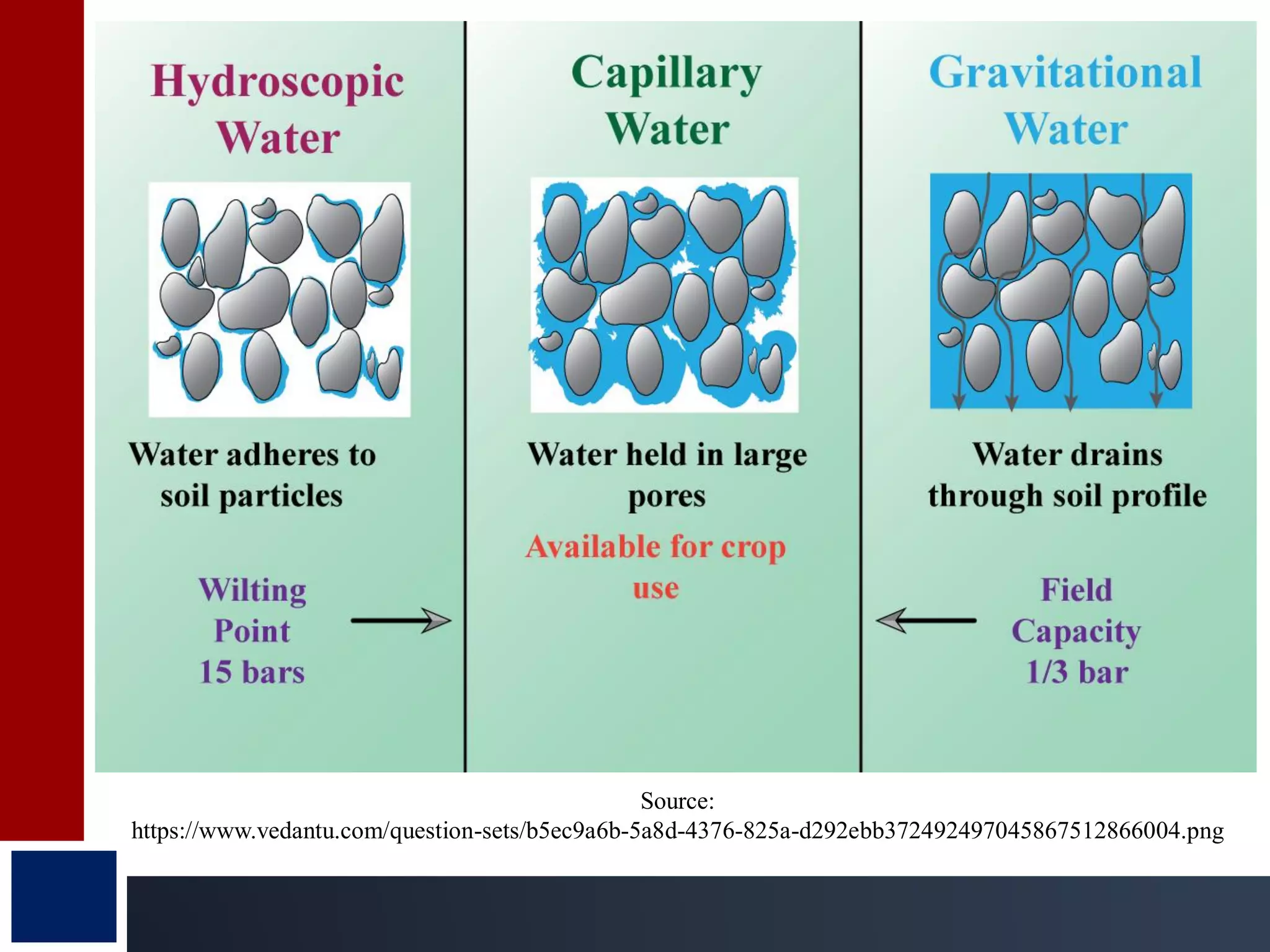
Capillary water. Water which is in a suspended condition, held by
the forces of surface tension within the interstices and pores of
capillary size in the soil, is called ‘capillary water’.
Held Water:
‘Held water’ is that water which is held in soil pores or void spaces
because of certain forces of attraction. It can be further classified as
(a) Structural water and (b) Absorbed water
a) Structural water. Water that is chemically combined as a part of
the crystal structure of the mineral of the soil grains is called
‘Structural water’.
TYPES OF WATER
a) Adsorbed water. This comprises, (i) hygroscopic moisture and
(ii) film moisture.
Hygroscopic moisture. Soils which appear quite dry contain,
nevertheless, very thin films of moisture around the mineral grains,
called ‘hygroscopic moisture’, which is also termed‘ contact
moisture’ or ‘surface bound moisture’.
Film moisture. Film moisture forms on the soil grains because of
the condensation of aqueous vapour; this is attached to the surface of
the soil particle as a film upon the layer of the hygroscopic moisture
film.
TYPES OF WATER
Source:
https://www.vedantu.com/question-sets/b5ec9a6b-5a8d-4376-825a-d292ebb372492497045867512866004.png
WHAT IS PERMEABILITY?
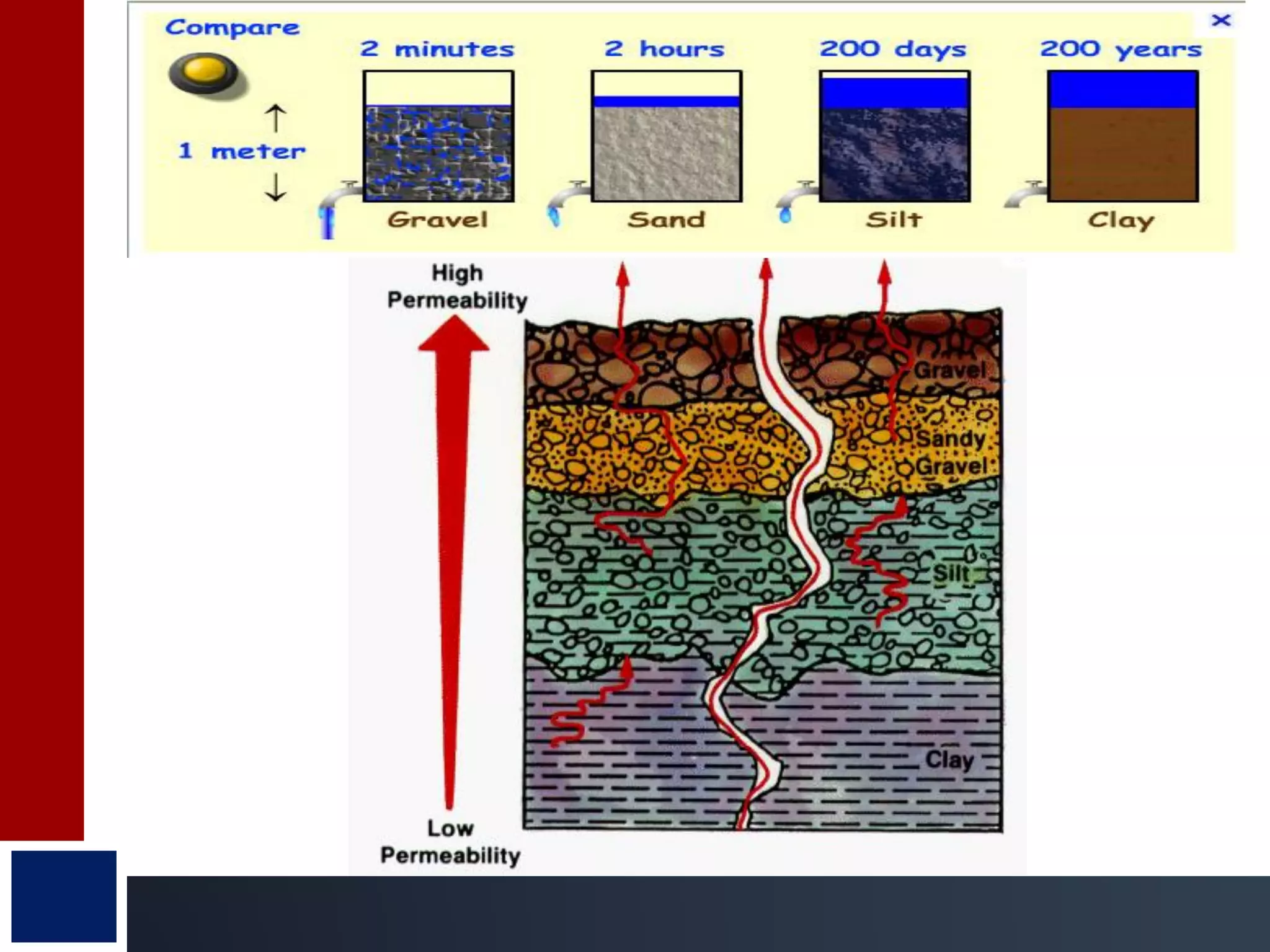
• Permeability is defined as the property of a porous material which
permits the passage or seepage of water through its interconnecting
voids.
• A measure of how easily a fluid (e.g., water) can pass through a
porous medium (e.g., soils)
• It is a very important Engineering property
gravels highly permeable
stiff clay least permeable
Permeability through soil is important for the following
engineering problems:
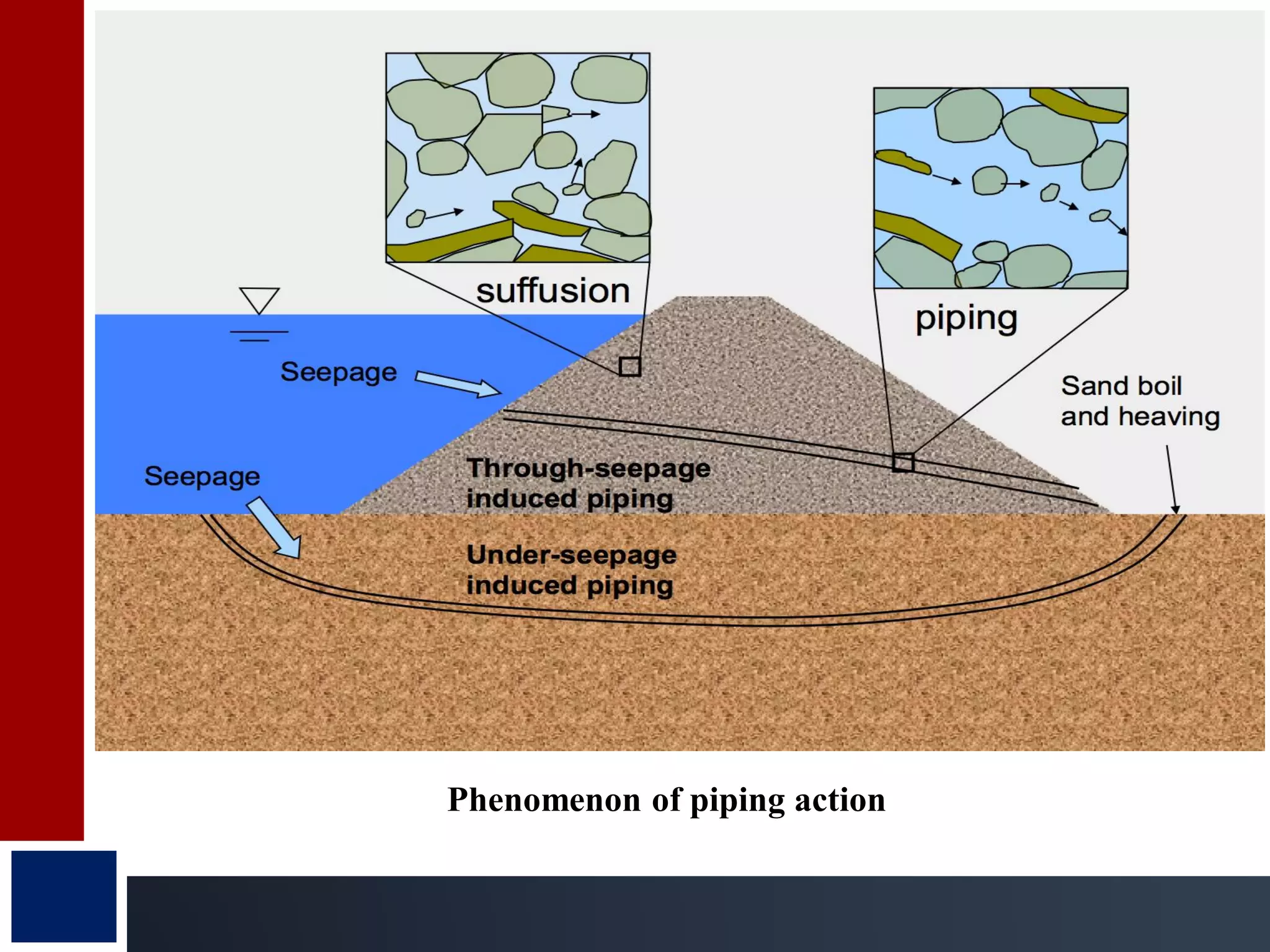
• Calculation of uplift pressure under hydraulic structure and
their safety against piping
• Ground water flow towards wells and drainage of soil
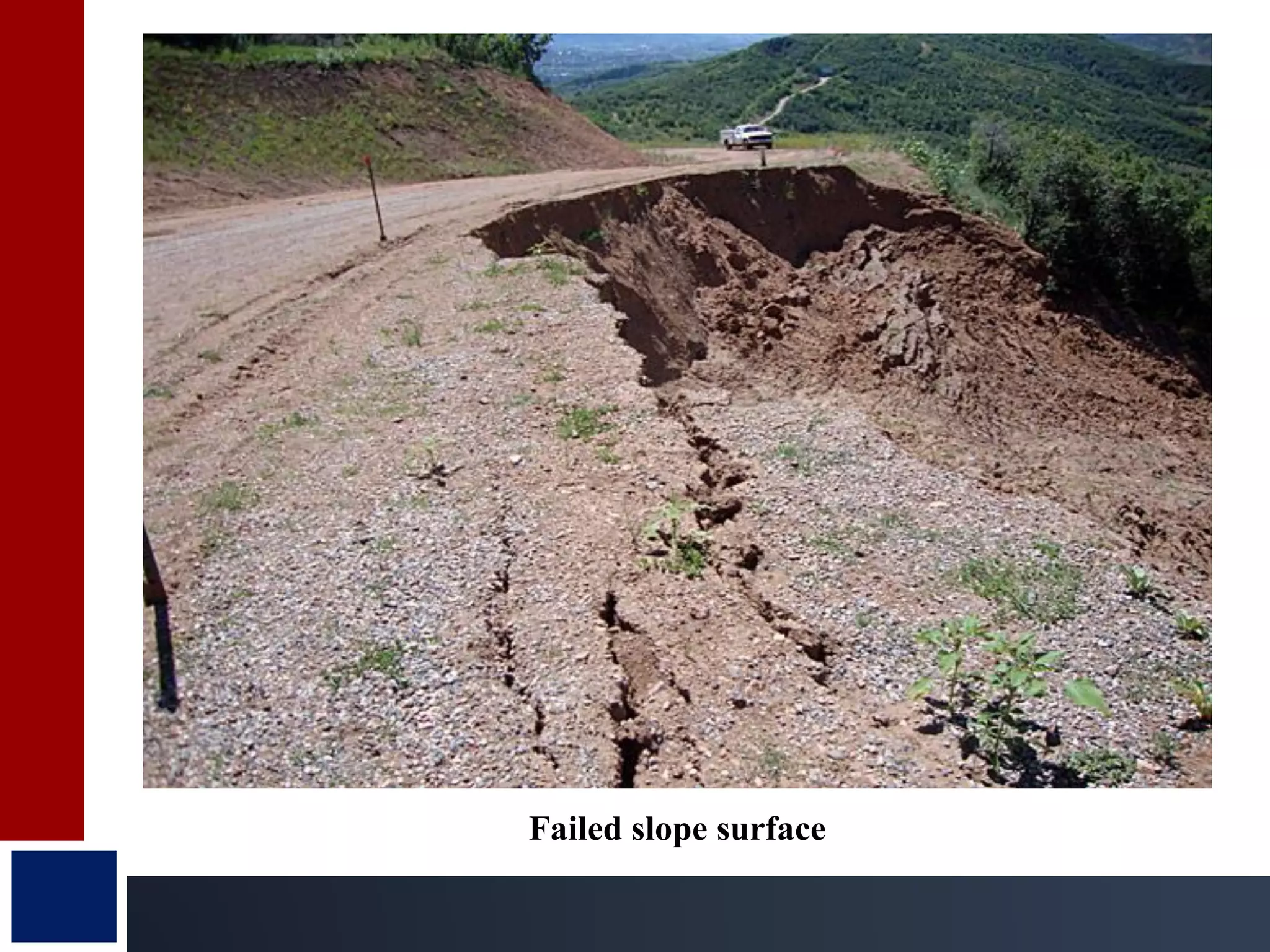
• Calculation of seepage through the body of earth dams and
stability of slopes
• Determination of rate of settlement of a saturated compressible
soil layer
Phenomenon of piping action
Failed slope surface
How permeability is measured?
• Permeability is measured in terms of rate
of flow of water through the soil in a
given period of time.
• It is expressed in cm/day or cm/hour or
m/sec.
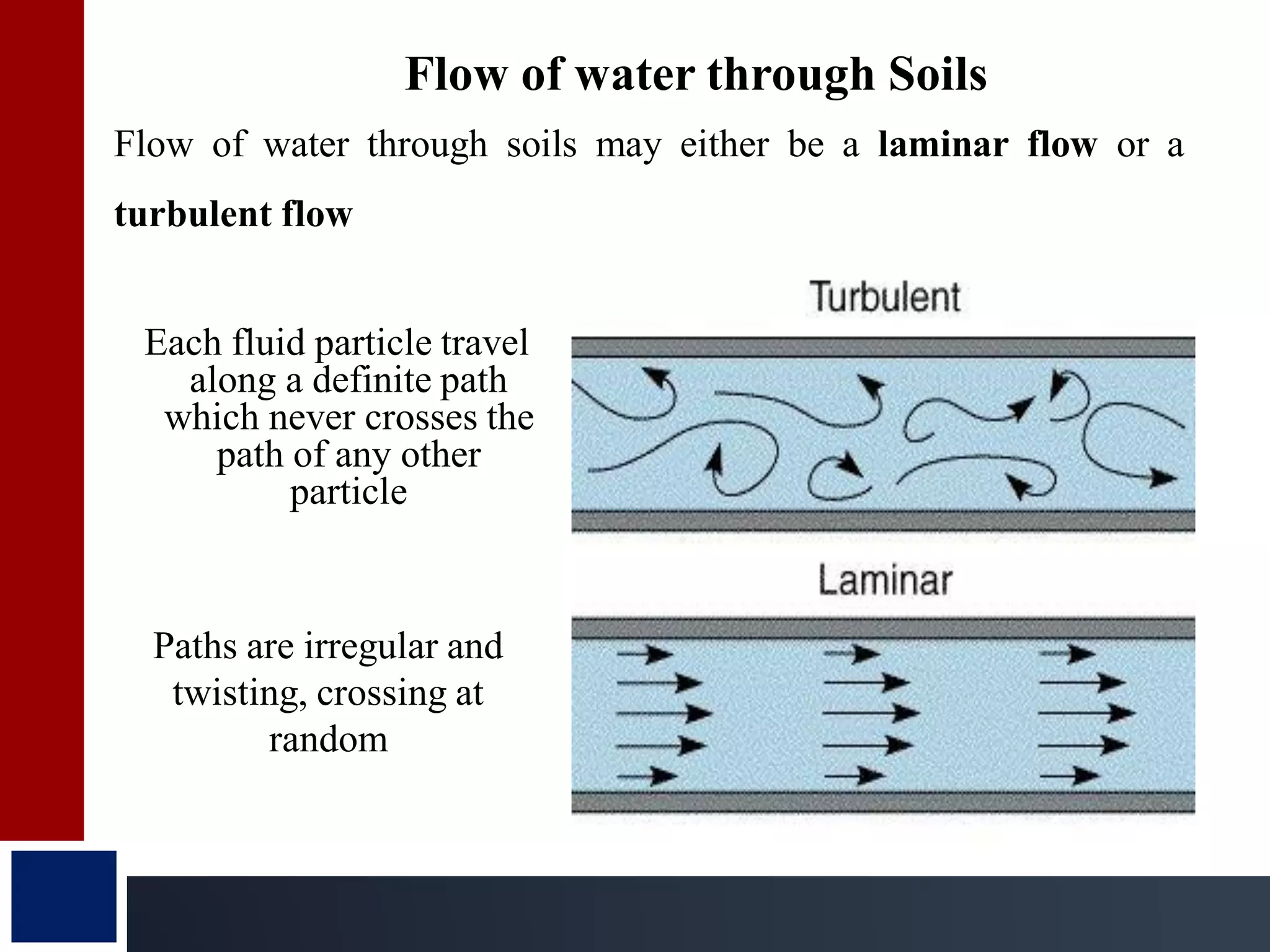
Flow of water through soils may either be a laminar flow or a
turbulent flow
Each fluid particle travel
along a definite path
which never crosses the
path of any other
particle
Paths are irregular and
twisting, crossing at
random
Flow of water through Soils
Henry Darcy (1803-1858), Hydraulic Engineer.
His law is a foundation stone for several fields of
study
Assumptions of Darcy’s law :-
• The following assumptions are made in Darcy’s law.
The soil is saturated.
The flow through soil is laminar.
The flow is continuous and steady.
The total cross sectional area of soil mass is considered.
The temperature at the time of testing is 270C.
Darcy’s Law: Darcy demonstrated experimentally that for
laminar flow conditions in a saturated soil, the rate of flow or the
discharge per unit time is proportional to the hydraulic gradient
vA
q 
ki
v 
kiA
q 
Validity of Darcy’s law - When flow is laminar
Henry Darcy (1803-1858), Hydraulic Engineer.
His law is a foundation stone for several fields of
study
Darcy’s Law
Darcy’s Experiment.
VALIDITY OF DARCY’S LAW
1) Darcy’s law is valid if the flow through soils is laminar:
 The flow of water through soils depends upon the dimension of
particles. In fine grained soils the dimensions of the interstices
(voids) are very small and flow is necessarily laminar.
 In course- grained soil, the flow is also laminar. However, in very
coarse-grained soils, such as gravels, the flow may be turbulent.
 For flow through soils, the flow is laminar if the Reynolds
number is less than unity.
2) As per Allen Hazen, the maximum diameter of the particle for the
flow to be laminar is about 0.50 mm.
3) It is valid for flow in clays, slits and fine sands. In coarse sands,
gravels and boulders, the flow may be turbulent, and Darcy’s law
may not be applicable.
4) For Darcy’s law to be valid, the relationship between velocity (v)
and hydraulic gradient (i) should be linear.
5) In extremely fine-grained soils, such as colloidal clay, the
interstices are very small. The velocity is therefore very small. In
such soils, the Darcy’s law is not valid.
VALIDITY OF DARCY’S LAW
Relation between Discharge Velocity and Seepage
Velocity:
From Continuity equation we have, q = v.A = k.i.A
But, A = total area including voids and solids
But in actual practice flow of water through soil takes place through
voids only, the actual velocity will be more than discharge velocity.
This actual velocity is called as seepage velocity (vs), and is defined
as rate of discharge of percolating water per unit cross-sectional area
of voids perpendicular to the direction of flow.
L
Relation between Discharge Velocity and Seepage
Velocity:
Therefore,
q = v.A = vs.Av
vs = v x A/Av
But, A/Av = V/Vv = 1/n
vs = v x 1/n
from definition we have, n = e /1+e
vs = v x (1 + e/e)
Hence from above equation it is clear that seepage velocity >
discharge velocity.
Factors affecting Permeability of soil
In above equation, the factor k depends on:
There is an equation known as Poiseuille's equation, which when
compared with the Darcy's law gives the value of coefficient of
permeability,
k =
𝛄𝐰
n
∗ Ds
2∗
e3
(1+e)
𝐱 𝐂
1. Grain Size: Allen Hazen found that the co-efficient of
permeability can be expressed as
k (in cm) = C x D10
2
where, D10= effective diameter(cm), C = constant, approximately equal to 100.
From the above relation is clear that greater the grain size of soil
greater will be the permeability and vice-versa
Factors affecting Permeability of soil
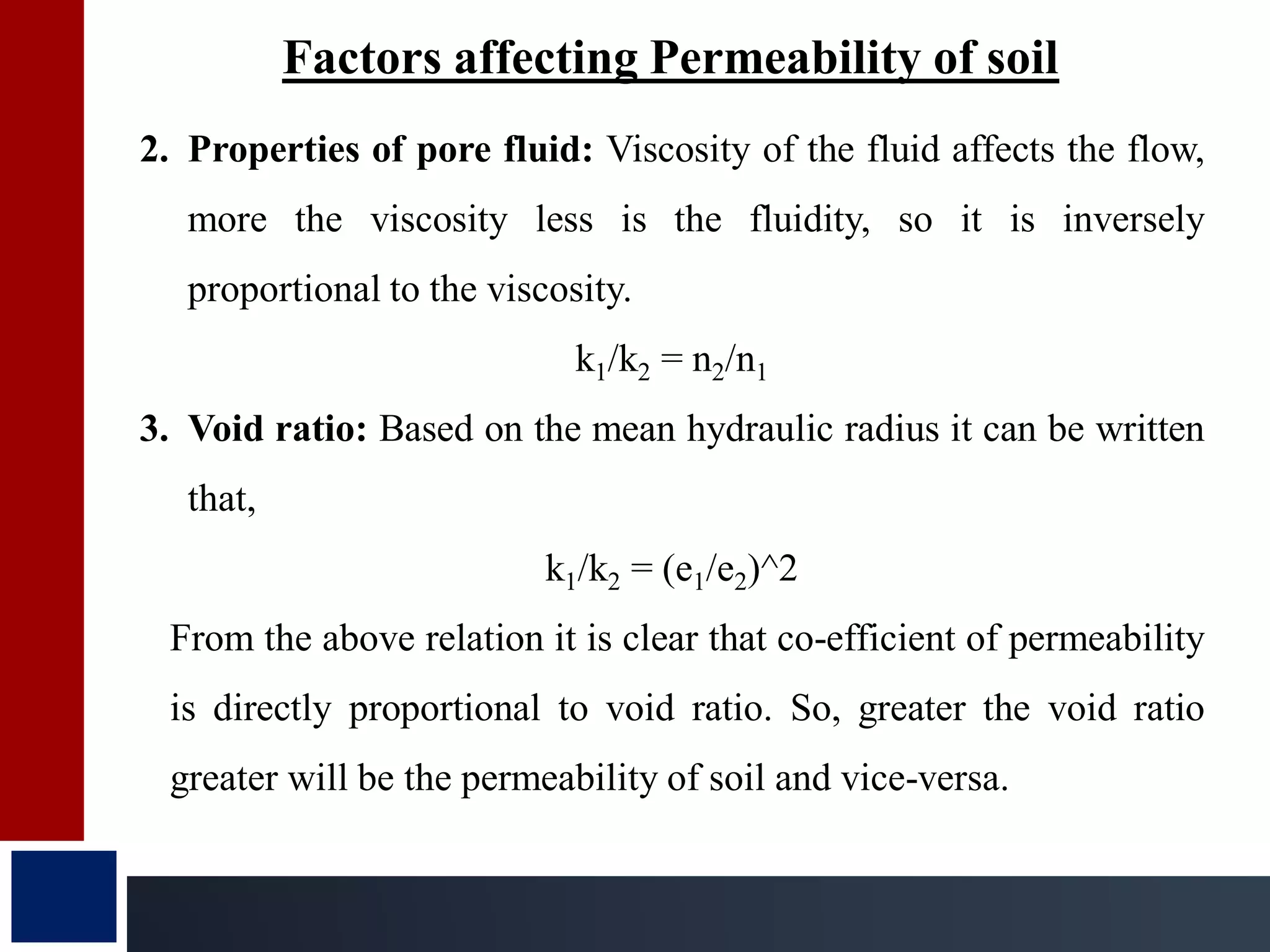
2. Properties of pore fluid: Viscosity of the fluid affects the flow,
more the viscosity less is the fluidity, so it is inversely
proportional to the viscosity.
k1/k2 = n2/n1
3. Void ratio: Based on the mean hydraulic radius it can be written
that,
k1/k2 = (e1/e2)^2
From the above relation it is clear that co-efficient of permeability
is directly proportional to void ratio. So, greater the void ratio
greater will be the permeability of soil and vice-versa.
Factors affecting Permeability of soil
4. Structural arrangements: Depending upon the method of
compaction and condition existing during deposition, the structural
arrangement of soil mass may vary at the same void ratio and
consequently permeability also varies. it is defined by the factor C is
the above equation. For stratified deposits the flow is different for
flow parallel and perpendicular or stratification.
5. Degree of saturation and other foreign matter:
The permeability is affected by the partial saturation of the soil, when
it has entrapped the air inside. Other foreign matter has the general
tendency to flow towards the critical flow channel and thus choking
it.
6. Adsorbed water: The adsorbed water held on the surface of
colloidal particles are highly cohesive and is immobile to normal
hydrodynamic forces. Because of this the area of effective void
space is reduced and thus permeability is reduced.
Factors affecting Permeability of soil
Absolute permeability
Independent of the properties of water
It depends only on the characteristics of soil
The absolute permeability only depends on the geometry of the
pore-channel system.
Relative permeability
It is the ratio of effective permeability of a particular fluid to its
absolute permeability.
Methods of Determination of co-efficient of
Permeability:
Constant Head Permeability Test
• Quantity of water that flows under a
given hydraulic gradient through a soil
sample of known length & cross
sectional area in a given time
• Water is allowed to flow through the
cylindrical sample of soil under a
constant head
• For testing of pervious, coarse grained
soils
K = Coefficient of permeability
Q = total quantity of water
t = time, L = Length of the coarse soil
Aht
QL
k 
Setup for Constant Head Test
Test Procedure:-
1. Measure internal dimensions of the mould. Apply a little grease on
the inside to the mould.
2. Take about 2.5kg of the soil, from a thoroughly mixed wet soil, in
the mould. Compact the soil at the required dry density using a
suitable compacting device.
3. Remove the collar and base plate. Trim the excess soil level with
the top of the mould.
4. Clean the outside of the mould. Find the mass of the soil in the
mould. Take a small specimen of the soil in container for the water.
Constant Head Permeability Test
6. Place the porous stone (disc) on the drainage base and keep a filter
paper on the porous stone. Place a filter paper and a porous stone
on the top of specimen.
7. Connect the constant head tank to the drainage cap inlet.
8. Open the stop cock, and allow the water downward so that all the
air is removed, then close the stop cock.
9. Now, again open the stop cock and at the same time start the
stopwatch. Collect the water flowing out of the base in a
measuring flask for some convenient time interval.
10. Measure the difference of head (h) in levels between the constant
head tank and the outlet in the base.
Constant Head Permeability Test
• Relatively for less permeable soils
• Water flows through the sample from a
standpipe attached to the top of the
cylinder.
• The head of water (h) changes with
time as flow occurs through the soil.
At different times the head of water is
recorded.
t = time
L = Length of the fine soil
A = cross section area of soil
a = cross section area of tube
K = Coefficient of permeability
2
1
10
log
30
.
2
h
h
At
aL
k 
Falling Head Permeability Test
Setup for Falling Head Test
Test Procedure:-
Falling Head Permeability Test
1. Prepare the remoulded soil specimen in the permeameter and
saturate it.
2. Keep the permeameter mould in the bottom tank and fill the
bottom tank with water up to its outlet.
3. Connect the water inlet nozzle of the mould to the stand pipe
filled with water.
4. Permit water to flow for some time till steady state of flow is
reached.
5. Now open the valve of stand pipe and record the time (t) to fall
the head from h1 to h2. Repeat this step at least twice.
By Indirect Method
Constants, a = 1.365
b = 5.15
c = value b/w 100 & 150
T= Tortuosity
S = surface area
2
10
cD
k 
Allen hazen’s formula
bn
a
kS 

)
(
log 2
10
Loudon’s formula
e
e
T
S
C
g
k
s
w


1
)
(
3
2
2


Kozeny carman equation
v
w
v m
C
k 

Consolidation test data
REFERENCES
• K.R. Arora “Soil Mechanics & Foundation Engineering”
• Gopal Ranjan & A.S.R. Rao “Basic & Applied Soil
Mechanics”
• B.C. Punmia “Soil Mechanics & Foundation”
• T. William Lambe(1969) “soil mechanics”
• Ernst and Sohn (2002) “Geotechnical Engineering Hand
Book”
Permeability in Stratified Soils
Flow parallel to the plane of stratification
Let ℎ1, ℎ2, ℎ3 ...ℎ𝑛 be the thicknesses of each of
the n layers which constitute the deposit, of total
thickness h. Let𝑘1, 𝑘2, 𝑘3 ... 𝑘𝑛 be the Darcy
coefficients of permeability of these layers
respectively.
Let 𝑘𝑥 = average permeability of soil deposit
parallel to bedding plane.
Total discharge through the soil deposit = sum of discharge through individual layers
𝑞 = 𝑞1 + 𝑞2 + ⋯ 𝑞𝑛
𝑘𝑥. 𝑖. ℎ = 𝑘1. 𝑖. ℎ1 + 𝑘2. 𝑖. ℎ2 + ⋯ 𝑘𝑛. 𝑖. ℎ𝑛
𝑘𝑥 =
𝑘1. ℎ1 + 𝑘2. ℎ2 + ⋯ 𝑘𝑛. ℎ𝑛
ℎ
Permeability in Stratified Soils
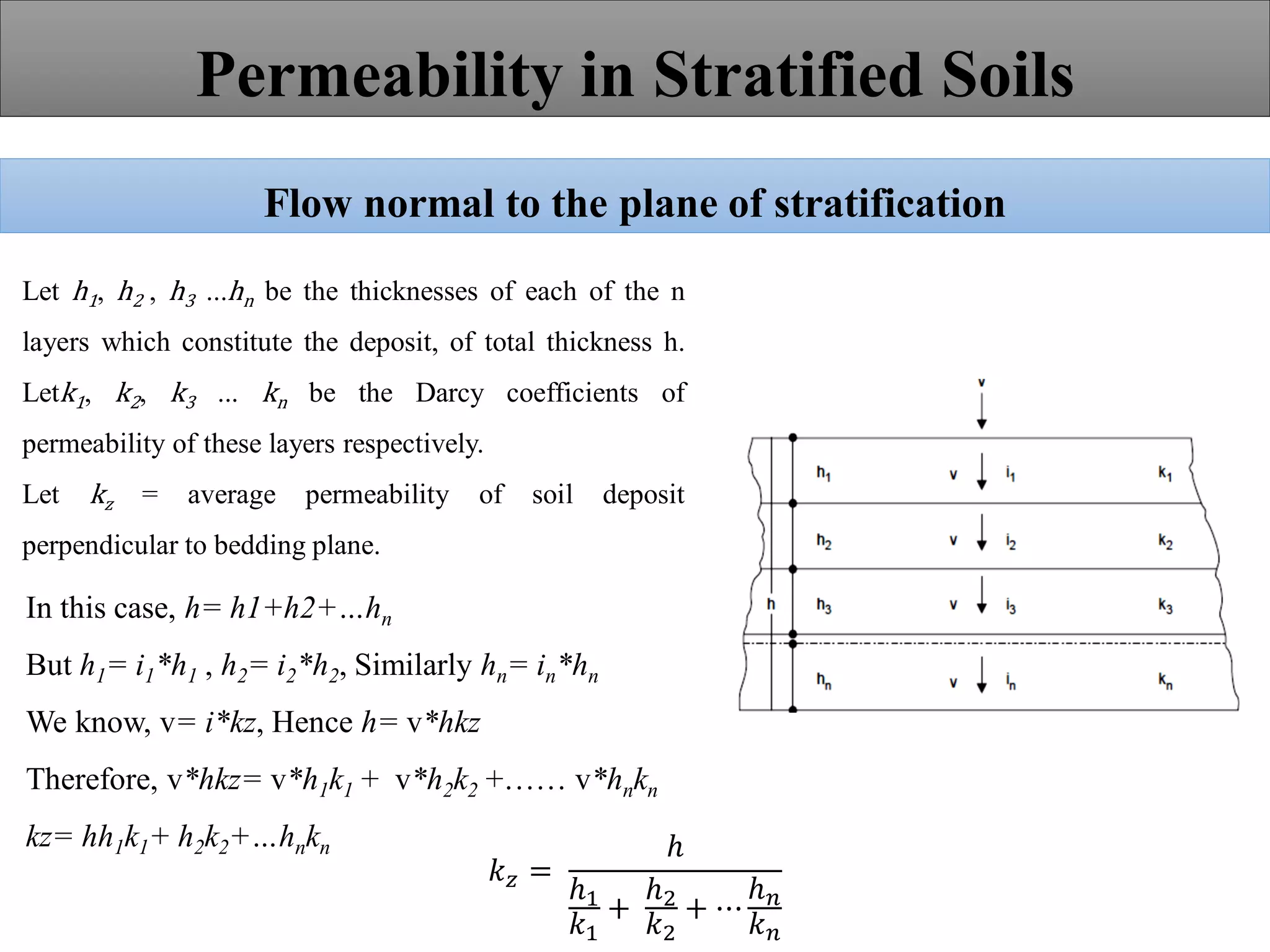
Flow normal to the plane of stratification
Let h1, h2 , h3 ...hn be the thicknesses of each of the n
layers which constitute the deposit, of total thickness h.
Letk1, k2, k3 ... kn be the Darcy coefficients of
permeability of these layers respectively.
Let kz = average permeability of soil deposit
perpendicular to bedding plane.
In this case, h= h1+h2+…hn
But h1= i1*h1 , h2= i2*h2, Similarly hn= in*hn
We know, v= i*kz, Hence h= v*hkz
Therefore, v*hkz= v*h1k1 + v*h2k2 +…… v*hnkn
kz= hh1k1+ h2k2+…hnkn
𝑘𝑧 =
ℎ
ℎ1
𝑘1
+
ℎ2
𝑘2
+ ⋯
ℎ𝑛
𝑘𝑛
Permeability of Soil

Permeability of Soil

  • 1.
  • 2.
    Free water (bulkwater): It has the usual properties of liquid water. It moves always under the influence of gravity, or because of a difference in hydrostatic pressure head. It is classified into two types.  Free surface water. Free surface water may be from precipitation, run-off, floodwater, melting snow, water from certain hydraulic operations.  Ground water. Ground water is that water which fills up the voids in the soil up to the ground water table and translocates through them. It fills coherently and completely all voids. In such a case, the soil is said to be saturated. TYPES OF WATER
  • 3.
    Capillary water. Waterwhich is in a suspended condition, held by the forces of surface tension within the interstices and pores of capillary size in the soil, is called ‘capillary water’. Held Water: ‘Held water’ is that water which is held in soil pores or void spaces because of certain forces of attraction. It can be further classified as (a) Structural water and (b) Absorbed water a) Structural water. Water that is chemically combined as a part of the crystal structure of the mineral of the soil grains is called ‘Structural water’. TYPES OF WATER
  • 4.
    a) Adsorbed water.This comprises, (i) hygroscopic moisture and (ii) film moisture. Hygroscopic moisture. Soils which appear quite dry contain, nevertheless, very thin films of moisture around the mineral grains, called ‘hygroscopic moisture’, which is also termed‘ contact moisture’ or ‘surface bound moisture’. Film moisture. Film moisture forms on the soil grains because of the condensation of aqueous vapour; this is attached to the surface of the soil particle as a film upon the layer of the hygroscopic moisture film. TYPES OF WATER
  • 5.
  • 6.
    WHAT IS PERMEABILITY? •Permeability is defined as the property of a porous material which permits the passage or seepage of water through its interconnecting voids. • A measure of how easily a fluid (e.g., water) can pass through a porous medium (e.g., soils) • It is a very important Engineering property gravels highly permeable stiff clay least permeable
  • 8.
    Permeability through soilis important for the following engineering problems: • Calculation of uplift pressure under hydraulic structure and their safety against piping • Ground water flow towards wells and drainage of soil • Calculation of seepage through the body of earth dams and stability of slopes • Determination of rate of settlement of a saturated compressible soil layer
  • 9.
  • 10.
  • 11.
    How permeability ismeasured? • Permeability is measured in terms of rate of flow of water through the soil in a given period of time. • It is expressed in cm/day or cm/hour or m/sec.
  • 12.
    Flow of waterthrough soils may either be a laminar flow or a turbulent flow Each fluid particle travel along a definite path which never crosses the path of any other particle Paths are irregular and twisting, crossing at random Flow of water through Soils
  • 13.
    Henry Darcy (1803-1858),Hydraulic Engineer. His law is a foundation stone for several fields of study Assumptions of Darcy’s law :- • The following assumptions are made in Darcy’s law. The soil is saturated. The flow through soil is laminar. The flow is continuous and steady. The total cross sectional area of soil mass is considered. The temperature at the time of testing is 270C.
  • 14.
    Darcy’s Law: Darcydemonstrated experimentally that for laminar flow conditions in a saturated soil, the rate of flow or the discharge per unit time is proportional to the hydraulic gradient vA q  ki v  kiA q  Validity of Darcy’s law - When flow is laminar Henry Darcy (1803-1858), Hydraulic Engineer. His law is a foundation stone for several fields of study
  • 15.
  • 16.
    VALIDITY OF DARCY’SLAW 1) Darcy’s law is valid if the flow through soils is laminar:  The flow of water through soils depends upon the dimension of particles. In fine grained soils the dimensions of the interstices (voids) are very small and flow is necessarily laminar.  In course- grained soil, the flow is also laminar. However, in very coarse-grained soils, such as gravels, the flow may be turbulent.  For flow through soils, the flow is laminar if the Reynolds number is less than unity.
  • 17.
    2) As perAllen Hazen, the maximum diameter of the particle for the flow to be laminar is about 0.50 mm. 3) It is valid for flow in clays, slits and fine sands. In coarse sands, gravels and boulders, the flow may be turbulent, and Darcy’s law may not be applicable. 4) For Darcy’s law to be valid, the relationship between velocity (v) and hydraulic gradient (i) should be linear. 5) In extremely fine-grained soils, such as colloidal clay, the interstices are very small. The velocity is therefore very small. In such soils, the Darcy’s law is not valid. VALIDITY OF DARCY’S LAW
  • 18.
    Relation between DischargeVelocity and Seepage Velocity: From Continuity equation we have, q = v.A = k.i.A But, A = total area including voids and solids But in actual practice flow of water through soil takes place through voids only, the actual velocity will be more than discharge velocity. This actual velocity is called as seepage velocity (vs), and is defined as rate of discharge of percolating water per unit cross-sectional area of voids perpendicular to the direction of flow. L
  • 19.
    Relation between DischargeVelocity and Seepage Velocity: Therefore, q = v.A = vs.Av vs = v x A/Av But, A/Av = V/Vv = 1/n vs = v x 1/n from definition we have, n = e /1+e vs = v x (1 + e/e) Hence from above equation it is clear that seepage velocity > discharge velocity.
  • 20.
    Factors affecting Permeabilityof soil In above equation, the factor k depends on: There is an equation known as Poiseuille's equation, which when compared with the Darcy's law gives the value of coefficient of permeability, k = 𝛄𝐰 n ∗ Ds 2∗ e3 (1+e) 𝐱 𝐂 1. Grain Size: Allen Hazen found that the co-efficient of permeability can be expressed as k (in cm) = C x D10 2 where, D10= effective diameter(cm), C = constant, approximately equal to 100. From the above relation is clear that greater the grain size of soil greater will be the permeability and vice-versa
  • 21.
    Factors affecting Permeabilityof soil 2. Properties of pore fluid: Viscosity of the fluid affects the flow, more the viscosity less is the fluidity, so it is inversely proportional to the viscosity. k1/k2 = n2/n1 3. Void ratio: Based on the mean hydraulic radius it can be written that, k1/k2 = (e1/e2)^2 From the above relation it is clear that co-efficient of permeability is directly proportional to void ratio. So, greater the void ratio greater will be the permeability of soil and vice-versa.
  • 22.
    Factors affecting Permeabilityof soil 4. Structural arrangements: Depending upon the method of compaction and condition existing during deposition, the structural arrangement of soil mass may vary at the same void ratio and consequently permeability also varies. it is defined by the factor C is the above equation. For stratified deposits the flow is different for flow parallel and perpendicular or stratification. 5. Degree of saturation and other foreign matter: The permeability is affected by the partial saturation of the soil, when it has entrapped the air inside. Other foreign matter has the general tendency to flow towards the critical flow channel and thus choking it.
  • 23.
    6. Adsorbed water:The adsorbed water held on the surface of colloidal particles are highly cohesive and is immobile to normal hydrodynamic forces. Because of this the area of effective void space is reduced and thus permeability is reduced. Factors affecting Permeability of soil
  • 24.
    Absolute permeability Independent ofthe properties of water It depends only on the characteristics of soil The absolute permeability only depends on the geometry of the pore-channel system. Relative permeability It is the ratio of effective permeability of a particular fluid to its absolute permeability.
  • 25.
    Methods of Determinationof co-efficient of Permeability:
  • 26.
    Constant Head PermeabilityTest • Quantity of water that flows under a given hydraulic gradient through a soil sample of known length & cross sectional area in a given time • Water is allowed to flow through the cylindrical sample of soil under a constant head • For testing of pervious, coarse grained soils K = Coefficient of permeability Q = total quantity of water t = time, L = Length of the coarse soil Aht QL k  Setup for Constant Head Test
  • 27.
    Test Procedure:- 1. Measureinternal dimensions of the mould. Apply a little grease on the inside to the mould. 2. Take about 2.5kg of the soil, from a thoroughly mixed wet soil, in the mould. Compact the soil at the required dry density using a suitable compacting device. 3. Remove the collar and base plate. Trim the excess soil level with the top of the mould. 4. Clean the outside of the mould. Find the mass of the soil in the mould. Take a small specimen of the soil in container for the water. Constant Head Permeability Test
  • 28.
    6. Place theporous stone (disc) on the drainage base and keep a filter paper on the porous stone. Place a filter paper and a porous stone on the top of specimen. 7. Connect the constant head tank to the drainage cap inlet. 8. Open the stop cock, and allow the water downward so that all the air is removed, then close the stop cock. 9. Now, again open the stop cock and at the same time start the stopwatch. Collect the water flowing out of the base in a measuring flask for some convenient time interval. 10. Measure the difference of head (h) in levels between the constant head tank and the outlet in the base. Constant Head Permeability Test
  • 29.
    • Relatively forless permeable soils • Water flows through the sample from a standpipe attached to the top of the cylinder. • The head of water (h) changes with time as flow occurs through the soil. At different times the head of water is recorded. t = time L = Length of the fine soil A = cross section area of soil a = cross section area of tube K = Coefficient of permeability 2 1 10 log 30 . 2 h h At aL k  Falling Head Permeability Test Setup for Falling Head Test
  • 30.
    Test Procedure:- Falling HeadPermeability Test 1. Prepare the remoulded soil specimen in the permeameter and saturate it. 2. Keep the permeameter mould in the bottom tank and fill the bottom tank with water up to its outlet. 3. Connect the water inlet nozzle of the mould to the stand pipe filled with water. 4. Permit water to flow for some time till steady state of flow is reached. 5. Now open the valve of stand pipe and record the time (t) to fall the head from h1 to h2. Repeat this step at least twice.
  • 31.
    By Indirect Method Constants,a = 1.365 b = 5.15 c = value b/w 100 & 150 T= Tortuosity S = surface area 2 10 cD k  Allen hazen’s formula bn a kS   ) ( log 2 10 Loudon’s formula e e T S C g k s w   1 ) ( 3 2 2   Kozeny carman equation v w v m C k   Consolidation test data
  • 32.
    REFERENCES • K.R. Arora“Soil Mechanics & Foundation Engineering” • Gopal Ranjan & A.S.R. Rao “Basic & Applied Soil Mechanics” • B.C. Punmia “Soil Mechanics & Foundation” • T. William Lambe(1969) “soil mechanics” • Ernst and Sohn (2002) “Geotechnical Engineering Hand Book”
  • 33.
    Permeability in StratifiedSoils Flow parallel to the plane of stratification Let ℎ1, ℎ2, ℎ3 ...ℎ𝑛 be the thicknesses of each of the n layers which constitute the deposit, of total thickness h. Let𝑘1, 𝑘2, 𝑘3 ... 𝑘𝑛 be the Darcy coefficients of permeability of these layers respectively. Let 𝑘𝑥 = average permeability of soil deposit parallel to bedding plane. Total discharge through the soil deposit = sum of discharge through individual layers 𝑞 = 𝑞1 + 𝑞2 + ⋯ 𝑞𝑛 𝑘𝑥. 𝑖. ℎ = 𝑘1. 𝑖. ℎ1 + 𝑘2. 𝑖. ℎ2 + ⋯ 𝑘𝑛. 𝑖. ℎ𝑛 𝑘𝑥 = 𝑘1. ℎ1 + 𝑘2. ℎ2 + ⋯ 𝑘𝑛. ℎ𝑛 ℎ
  • 34.
    Permeability in StratifiedSoils Flow normal to the plane of stratification Let h1, h2 , h3 ...hn be the thicknesses of each of the n layers which constitute the deposit, of total thickness h. Letk1, k2, k3 ... kn be the Darcy coefficients of permeability of these layers respectively. Let kz = average permeability of soil deposit perpendicular to bedding plane. In this case, h= h1+h2+…hn But h1= i1*h1 , h2= i2*h2, Similarly hn= in*hn We know, v= i*kz, Hence h= v*hkz Therefore, v*hkz= v*h1k1 + v*h2k2 +…… v*hnkn kz= hh1k1+ h2k2+…hnkn 𝑘𝑧 = ℎ ℎ1 𝑘1 + ℎ2 𝑘2 + ⋯ ℎ𝑛 𝑘𝑛