GEOTECHNICAL
ENGINEERING
CHAPTER-III
PERMEABILITY AND SHEAR
STRENGTH OF SOIL
PART-I
PERMEABILITY OF SOIL
PREPARED BY
GOURHARI BISWAS
PERMEABILITY OF SOIL
• A material is porous if it contains
interstices(voids).
• The porous material is permeable if the
voids are interconnected or continuous.
• A liquid can flow through a permeable
material.
• Electron photomicrographs of even very
stiff clay soil indicate that the voids are
interconnected.
Permeability-Definition
• Permeability- Permeability is defined as
the property of a porous material which
permits the passage or seepage of water(
or any liquid) through its interconnecting
voids.
• Permeability in fluid mechanics and the
earth sciences (commonly symbolized as
κ, or k) is a measure of the ability of a
porous material (often, a rock or an
unconsolidated material) to allow fluids to
pass through it.
Facts about Permeability
• It is a very important Engineering property
of soil.
• Gravels are highly permeable and stiff clay
is least permeable.
• A material having contentious voids is
known as permeable. A soil is called highly
permeable when water can flow through it
very easily.
• The permeability of a medium is related to
the porosity, but also to the shapes of the
pores in the medium and their level of
connected ness.
LAMINAR AND TURBULANT FLOW
• Flow of water through soils may either be
a laminar flow or a turbulent flow.
• In laminar flow condition each fluid particle
travel along a definite path which never
crosses the path of any other particle.
• While in turbulent flow travel paths of
particles are irregular and twisting,
crossing at random.
Fields of Civil Engineering where Knowledge
of Permeability is Required
• Calculation of uplift pressure under hydraulic
structure and their safety against piping
• Ground water flow towards wells and drainage
of soil
• Calculation of seepage through the body of
earth dams and stability of slopes
• Determination of rate of settlement of a
saturated compressible soil layerors .
• Construction of foundation of structures below
ground water table.
DARCY’S LAW
• Darcy's law is an equation that describes the
flow of a fluid through a porous medium. The law
was formulated by Henry Darcy based on the
results of experiments on the flow of water
through beds of sand, forming the basis of
hydrogeology, a branch of earth sciences.
• Darcy's law states that there is a linear
relationship between flow velocity (v) and
hydraulic gradient (i) for any given saturated,
isotropic and homogeneous soil under steady
laminar flow conditions, i.e, flow velocity through
a porous media is proportional to hydraulic
gradient.
Mathametical Expression of Darcy’s Law
If the rate of flow is q
(volume/time) through cross-
sectional area (A) of the soil
mass, Darcy's Law can be
expressed as
v ∞ i
Or, v = q/A = k.i
where k = permeability of the
soil
i = ∆h/L = Hydraulic Gradient
∆h = difference in total heads
L = length of the soil mass
Coefficient of permeability(k)
Darcy’s Law v = q/A = k.i
When hydraulic gradient is unity, i.e. i = 1, q
= kA Or v = k, since v=q/A
From this relation we can define Coefficient
of permeability(k) as the average velocity of
flow that will occur through the total cross
sectional area of soil under unit hydraulic
gradient.
Unit of k is cm/sec. M/day etc.
Coefficient of Permeability
Permeability (k) is an
engineering property of
soils and is a function of
the soil type. Its value
depends on the average
size of the pores and is
related to the distribution of
particle sizes, particle
shape and soil structure.
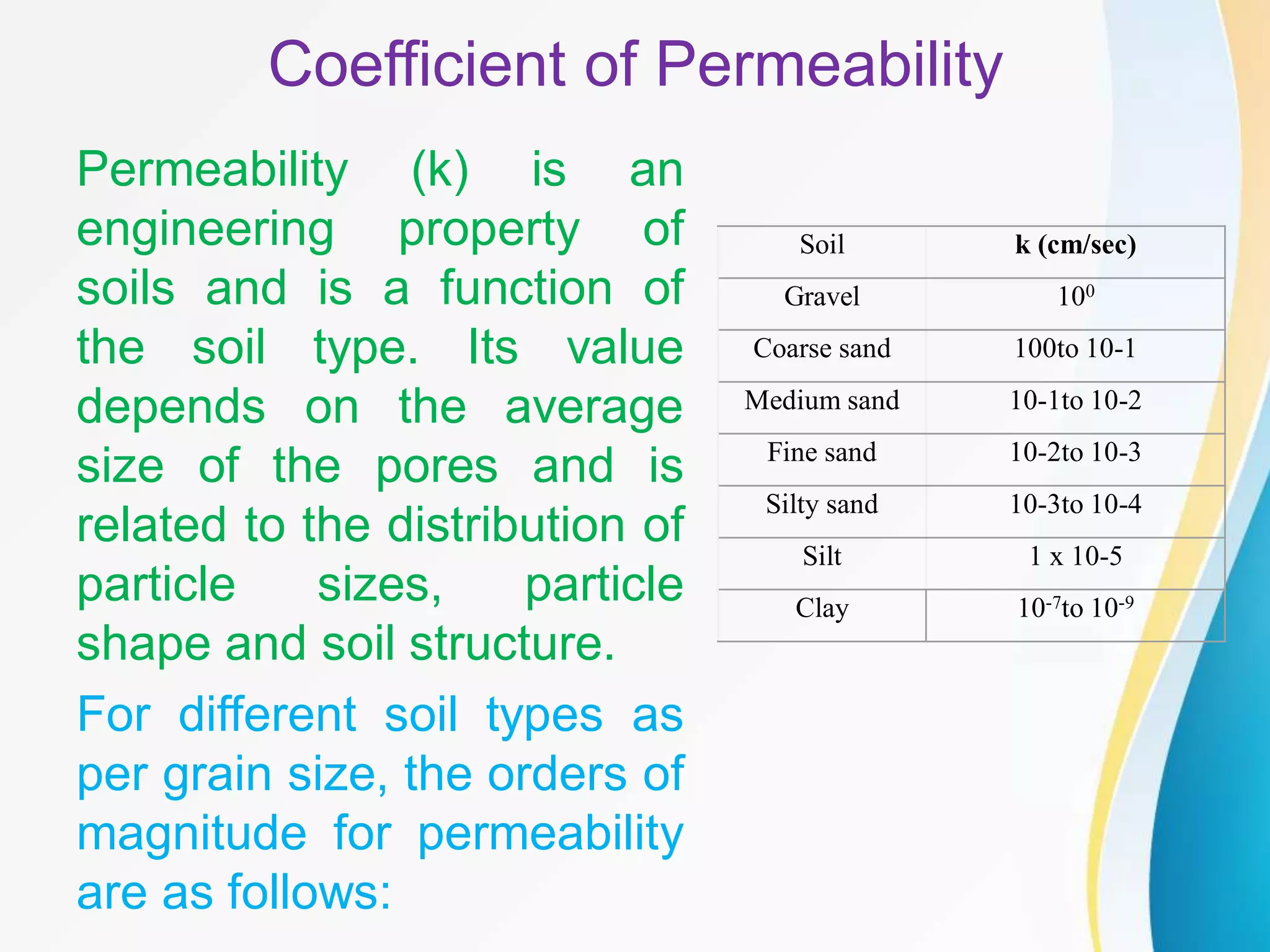
For different soil types as
per grain size, the orders of
magnitude for permeability
are as follows:
Soil k (cm/sec)
Gravel 100
Coarse sand 100to 10-1
Medium sand 10-1to 10-2
Fine sand 10-2to 10-3
Silty sand 10-3to 10-4
Silt 1 x 10⁻⁵
Clay 10-7to 10-9
Factors affecting permeability of soils
• Particle Size : It was studied by Allen Hazen that the
coefficient of permeability (k) of a soil is directly
proportional to the square of the particle size (D). Thus
|permeability of coarse grained soil is very large as
compared to that of fine grained soil. The permeability of
coarse sand may be more than one million times as
much that of clay.
• Impurities in water : Any foreign matter in water has a
tendency to plug the flow passage and reduce the
effective voids and hence the permeability of soil.
• Void ratio (e) : For a given soil, the greater the void ratio,
the higher the value of the coefficient of permeability.
Here 'e' is the void ratio.
contd...
• Degree of Saturation : If the soil is not fully saturated, it
contains air pockets. The permeability is reduced due to the
presence of air which causes a blockage to the passage of
water. Consequently, the permeability of a partially saturated
soil is considerably smaller than that of fully saturated soil.
In fact, Darcy's Law is not strictly applicable to such soils.
• Adsorbed water : Fine grained soils have a layer of
adsorbed water strongly attached to their surface. This
adsorbed layer is not free to move under gravity. It causes
an obstruction to the flow of water in the pores and hence
reduces the permeability of soils.
• Entrapped air and organic matter : Air entrapped in the soil
and organic matter block the passage of water through soil,
hence permeability considerably decreases. In permeability
tests, the sample of soil used should be fully saturated to
avoid errors.
CONSTANT HEAD PERMEABILITY TEST
In the constant head
permeameter, the head
causing flow through the
specimen remains constant
throughout the test. The
coefficient of permeability (k)
is obtained from the relation
Where q= discharge,
Q=total volume of water,
t=time period, h=head
causing flow, L= length of
specimen, A= cross-
sectional area.
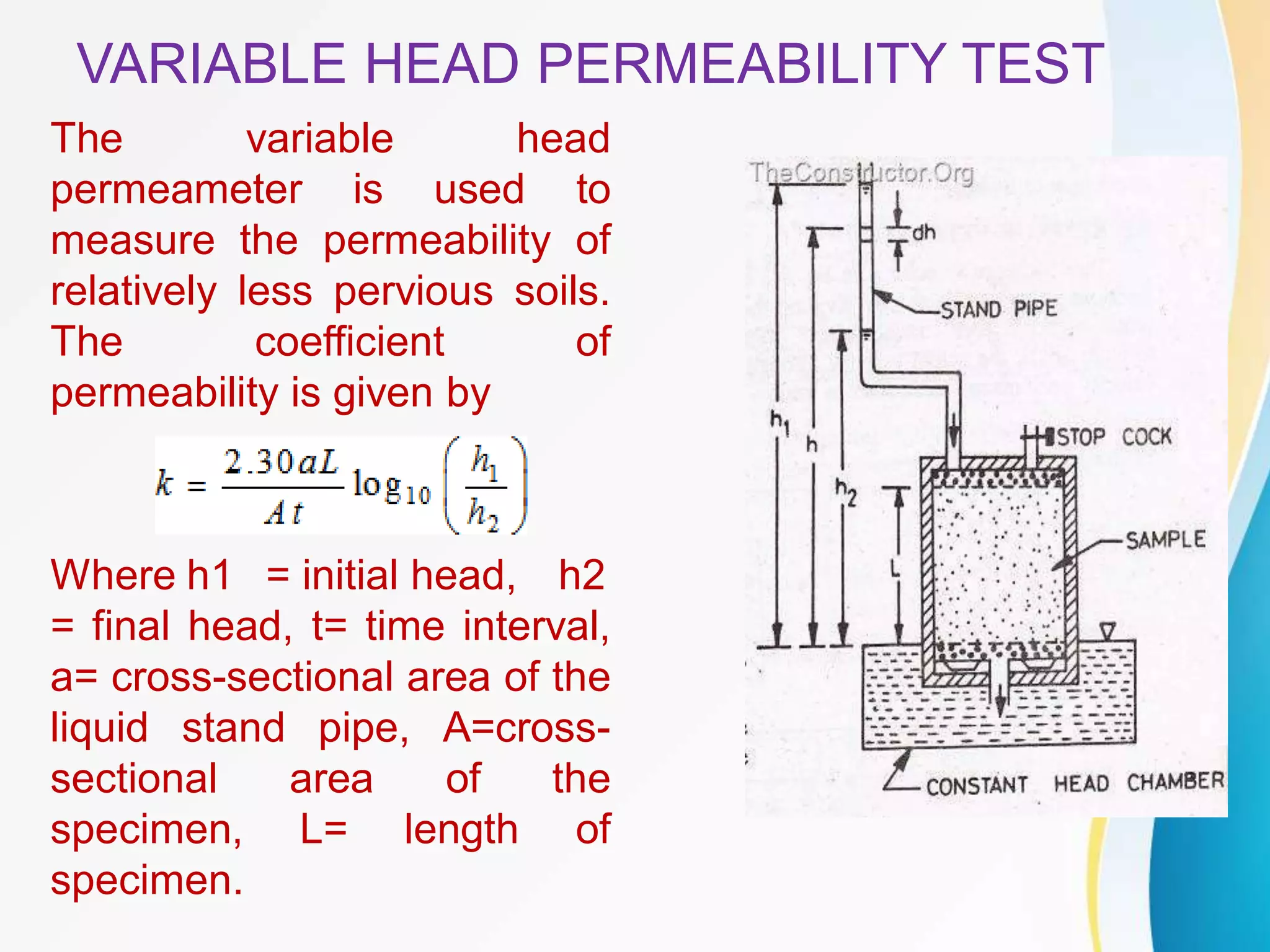
VARIABLE HEAD PERMEABILITY TEST
The variable head
permeameter is used to
measure the permeability of
relatively less pervious soils.
The coefficient of
permeability is given by
Where h1 = initial head, h2
= final head, t= time interval,
a= cross-sectional area of the
liquid stand pipe, A=cross-
sectional area of the
specimen, L= length of
specimen.
NEED AND SCOPE OF PERMEABILITY
TESTS OF SOIL
The test results of the permeability experiments
are used:
1.To estimate ground water flow.
2.To calculate seepage through dams.
3.To find out the rate of consolidation and settlement of
structures.
4.To plan the method of lowering the ground water table.
5.To calculate the uplift pressure and piping.
6.To design the grouting.
7.And also for soil freezing tests.
8.To design pits for recharging.

SOIL PERMEABILITY.pdf

  • 1.
    GEOTECHNICAL ENGINEERING CHAPTER-III PERMEABILITY AND SHEAR STRENGTHOF SOIL PART-I PERMEABILITY OF SOIL PREPARED BY GOURHARI BISWAS
  • 2.
    PERMEABILITY OF SOIL •A material is porous if it contains interstices(voids). • The porous material is permeable if the voids are interconnected or continuous. • A liquid can flow through a permeable material. • Electron photomicrographs of even very stiff clay soil indicate that the voids are interconnected.
  • 3.
    Permeability-Definition • Permeability- Permeabilityis defined as the property of a porous material which permits the passage or seepage of water( or any liquid) through its interconnecting voids. • Permeability in fluid mechanics and the earth sciences (commonly symbolized as κ, or k) is a measure of the ability of a porous material (often, a rock or an unconsolidated material) to allow fluids to pass through it.
  • 4.
    Facts about Permeability •It is a very important Engineering property of soil. • Gravels are highly permeable and stiff clay is least permeable. • A material having contentious voids is known as permeable. A soil is called highly permeable when water can flow through it very easily. • The permeability of a medium is related to the porosity, but also to the shapes of the pores in the medium and their level of connected ness.
  • 5.
    LAMINAR AND TURBULANTFLOW • Flow of water through soils may either be a laminar flow or a turbulent flow. • In laminar flow condition each fluid particle travel along a definite path which never crosses the path of any other particle. • While in turbulent flow travel paths of particles are irregular and twisting, crossing at random.
  • 6.
    Fields of CivilEngineering where Knowledge of Permeability is Required • Calculation of uplift pressure under hydraulic structure and their safety against piping • Ground water flow towards wells and drainage of soil • Calculation of seepage through the body of earth dams and stability of slopes • Determination of rate of settlement of a saturated compressible soil layerors . • Construction of foundation of structures below ground water table.
  • 7.
    DARCY’S LAW • Darcy'slaw is an equation that describes the flow of a fluid through a porous medium. The law was formulated by Henry Darcy based on the results of experiments on the flow of water through beds of sand, forming the basis of hydrogeology, a branch of earth sciences. • Darcy's law states that there is a linear relationship between flow velocity (v) and hydraulic gradient (i) for any given saturated, isotropic and homogeneous soil under steady laminar flow conditions, i.e, flow velocity through a porous media is proportional to hydraulic gradient.
  • 8.
    Mathametical Expression ofDarcy’s Law If the rate of flow is q (volume/time) through cross- sectional area (A) of the soil mass, Darcy's Law can be expressed as v ∞ i Or, v = q/A = k.i where k = permeability of the soil i = ∆h/L = Hydraulic Gradient ∆h = difference in total heads L = length of the soil mass
  • 9.
    Coefficient of permeability(k) Darcy’sLaw v = q/A = k.i When hydraulic gradient is unity, i.e. i = 1, q = kA Or v = k, since v=q/A From this relation we can define Coefficient of permeability(k) as the average velocity of flow that will occur through the total cross sectional area of soil under unit hydraulic gradient. Unit of k is cm/sec. M/day etc.
  • 10.
    Coefficient of Permeability Permeability(k) is an engineering property of soils and is a function of the soil type. Its value depends on the average size of the pores and is related to the distribution of particle sizes, particle shape and soil structure. For different soil types as per grain size, the orders of magnitude for permeability are as follows: Soil k (cm/sec) Gravel 100 Coarse sand 100to 10-1 Medium sand 10-1to 10-2 Fine sand 10-2to 10-3 Silty sand 10-3to 10-4 Silt 1 x 10⁻⁵ Clay 10-7to 10-9
  • 11.
    Factors affecting permeabilityof soils • Particle Size : It was studied by Allen Hazen that the coefficient of permeability (k) of a soil is directly proportional to the square of the particle size (D). Thus |permeability of coarse grained soil is very large as compared to that of fine grained soil. The permeability of coarse sand may be more than one million times as much that of clay. • Impurities in water : Any foreign matter in water has a tendency to plug the flow passage and reduce the effective voids and hence the permeability of soil. • Void ratio (e) : For a given soil, the greater the void ratio, the higher the value of the coefficient of permeability. Here 'e' is the void ratio.
  • 12.
    contd... • Degree ofSaturation : If the soil is not fully saturated, it contains air pockets. The permeability is reduced due to the presence of air which causes a blockage to the passage of water. Consequently, the permeability of a partially saturated soil is considerably smaller than that of fully saturated soil. In fact, Darcy's Law is not strictly applicable to such soils. • Adsorbed water : Fine grained soils have a layer of adsorbed water strongly attached to their surface. This adsorbed layer is not free to move under gravity. It causes an obstruction to the flow of water in the pores and hence reduces the permeability of soils. • Entrapped air and organic matter : Air entrapped in the soil and organic matter block the passage of water through soil, hence permeability considerably decreases. In permeability tests, the sample of soil used should be fully saturated to avoid errors.
  • 13.
    CONSTANT HEAD PERMEABILITYTEST In the constant head permeameter, the head causing flow through the specimen remains constant throughout the test. The coefficient of permeability (k) is obtained from the relation Where q= discharge, Q=total volume of water, t=time period, h=head causing flow, L= length of specimen, A= cross- sectional area.
  • 14.
    VARIABLE HEAD PERMEABILITYTEST The variable head permeameter is used to measure the permeability of relatively less pervious soils. The coefficient of permeability is given by Where h1 = initial head, h2 = final head, t= time interval, a= cross-sectional area of the liquid stand pipe, A=cross- sectional area of the specimen, L= length of specimen.
  • 15.
    NEED AND SCOPEOF PERMEABILITY TESTS OF SOIL The test results of the permeability experiments are used: 1.To estimate ground water flow. 2.To calculate seepage through dams. 3.To find out the rate of consolidation and settlement of structures. 4.To plan the method of lowering the ground water table. 5.To calculate the uplift pressure and piping. 6.To design the grouting. 7.And also for soil freezing tests. 8.To design pits for recharging.