Dialysis is the movement of fluid and molecules
across a semi- permeable membrane from one
compartment to another. Clinically, dialysis is a
technique in which substances move from the
blood through a semipermeable membrane
and into a dialysis solution (dialysate).
• Diffusion is the movement of solutes from
an area of greater concentration to an area
of lesser concentration.
• Osmosis is the movement of fluid from an
area of lesser concentration to an area of
greater concentration of solutes.
• Ultrafiltration (water and fluid removal)
results when there is an osmotic gradient
or pressure gradient across the membrane.
• Peritoneal dialysis (PD) is a treatment for
patients with severe chronic kidney
disease.
• A dialysis technique that uses the patient's
own body tissue-peritoneal membrane
inside the abdominal cavity as a filter.
• Remove toxic substances and metabolic
wastes
• Re-establish normal fluid and electrolyte
balance
• Maintain a positive nitrogen balance
• Prolong life
• Have the maximum level of quality of life
• Peritoneal fibrosis and adhesions
following intra-abdominal operations
• Inflammatory gut diseases
• Hernias
• Significant loin pain
• Psychosis
• Diverticulosis
• Colostomy
• Obesity
• Significant decrease of lung functions
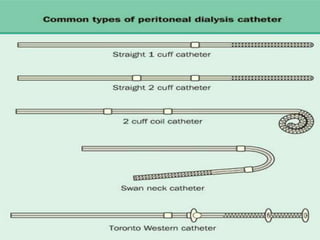
• Straight Tenckhoff
• Curled Tenckhoff
• Swan-neck
• T- fluted
• Midline: 3 cm below umbilicus
• Lateral site: At the lateral border of the
rectus muscles.
• A trocar is used to puncture the
peritoneum as the patient
tightens the abdominal muscles
by raising the head.
• The catheter is threaded
through the trocar and
positioned.
• Previously prepared dialysate is infused
into the peritoneal cavity, pushing the
omentum (peritoneal lining extending
from the abdominal organs) away from
the catheter.
• The physician may then secure the
catheter with a purse-string suture and
apply antibacterial ointment and a sterile
dressing over the site.
• Na -132 mmol/l
• Mg -0.5mmol/l
• Ca -1.25mmol/l
• Cl -100mmol/l
• Lactate -35mmol/l
• Glucose -1.36-4.25g/dl
• Osmolarity -347-486
• Ph -5.2
• Assemble the equipment needed
• Check physician’s order for the
concentration of dialysate and
medications to be added
• Heparin : to prevent clotting
• KCl: to prevent hypokalaemia
• Antibiotics : peritonitis
• Insulin : for diabetic patients
• Warm the dialysate solution to
body temperature
• Dry heating should be done
• Too cold solution causes pain,
cramping, and reduce clearance
• PD is accomplished by putting
dialysis solution into the peritoneal
space. The three phases of the PD
cycle are inflow (fill), dwell
(equilibration), and drain. The three
phases are called an exchange.
• During inflow, a prescribed amount of
solution, usually 2 L, is infused through an
established catheter over about 10
minutes. The flow rate may be decreased if
the patient has pain. After the solution has
been infused, the inflow clamp is closed
before air enters the tubing.
• The next part of the cycle is the
dwell phase, or equilibration,
during which diffusion and
osmosis occur between the
patient’s blood and the
peritoneal cavity. The duration
of the dwell time can last from
20 or 30 minutes to 8 or more
hours, depending on the
method of PD.
• Drain time takes 15 to 30 minutes and may
be facilitated by gently massaging the
abdomen or changing position. The cycle
starts again with the infusion of another 2
L of solution. For manual PD, a period of
about 30 to 50 minutes is required to
complete an exchange.
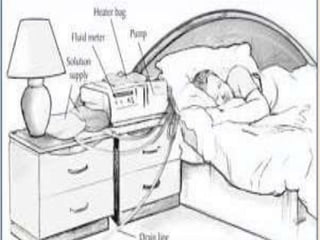
• Automated Peritoneal Dialysis:
Automated peritoneal
dialysis (APD) is the most popular
form of PD because it allows
patients to do dialysis while they
sleep. An automated device called
a cycler is used to deliver the
dialysate for APD
• Continuous ambulatory peritoneal
dialysis (CAPD) is done while the
patient is awake during the day.
Exchanges are carried out
manually by exchanging 1.5 to 3 L
of peritoneal dialysate at least
four times daily, with dwell times
averaging 4 hours.
• Exit Site Infection.
• Peritonitis.
• Hernias.
• Lower Back Problems. Increased
intraabdominal pressure can cause or
aggravate lower back pain.
• Bleeding.
• Pulmonary Complications. Atelectasis,
pneumonia, and Bronchitis may occur
from repeated upward displacement of the
diaphragm, resulting in decreased lung
expansion.
• Protein Loss: The amount of loss is usually
about 0.5 g/L of dialysate drainage, but it
can be as high as 10 to 20 g/day.
• Potential for developing infection related
to the catheter
• Potential for developing cardiac and
respiratory complications related to the
uremic state and presence of fluid in the
peritoneum.
• Acute pain and abdominal discomfort
related to the dialysate infusion
• Altered nutrition less than body
requirement related to the
protein loss
• Knowledge deficit related to care
of catheter site
• Altered body image related to the
abdominal catheter and bag and
tubing

Peritoneal dialysis

  • 2.
    Dialysis is themovement of fluid and molecules across a semi- permeable membrane from one compartment to another. Clinically, dialysis is a technique in which substances move from the blood through a semipermeable membrane and into a dialysis solution (dialysate).
  • 3.
    • Diffusion isthe movement of solutes from an area of greater concentration to an area of lesser concentration. • Osmosis is the movement of fluid from an area of lesser concentration to an area of greater concentration of solutes. • Ultrafiltration (water and fluid removal) results when there is an osmotic gradient or pressure gradient across the membrane.
  • 4.
    • Peritoneal dialysis(PD) is a treatment for patients with severe chronic kidney disease. • A dialysis technique that uses the patient's own body tissue-peritoneal membrane inside the abdominal cavity as a filter.
  • 5.
    • Remove toxicsubstances and metabolic wastes • Re-establish normal fluid and electrolyte balance • Maintain a positive nitrogen balance • Prolong life • Have the maximum level of quality of life
  • 6.
    • Peritoneal fibrosisand adhesions following intra-abdominal operations • Inflammatory gut diseases • Hernias • Significant loin pain • Psychosis • Diverticulosis • Colostomy • Obesity • Significant decrease of lung functions
  • 7.
    • Straight Tenckhoff •Curled Tenckhoff • Swan-neck • T- fluted
  • 9.
    • Midline: 3cm below umbilicus • Lateral site: At the lateral border of the rectus muscles.
  • 10.
    • A trocaris used to puncture the peritoneum as the patient tightens the abdominal muscles by raising the head. • The catheter is threaded through the trocar and positioned.
  • 11.
    • Previously prepareddialysate is infused into the peritoneal cavity, pushing the omentum (peritoneal lining extending from the abdominal organs) away from the catheter. • The physician may then secure the catheter with a purse-string suture and apply antibacterial ointment and a sterile dressing over the site.
  • 12.
    • Na -132mmol/l • Mg -0.5mmol/l • Ca -1.25mmol/l • Cl -100mmol/l • Lactate -35mmol/l • Glucose -1.36-4.25g/dl • Osmolarity -347-486 • Ph -5.2
  • 13.
    • Assemble theequipment needed • Check physician’s order for the concentration of dialysate and medications to be added • Heparin : to prevent clotting • KCl: to prevent hypokalaemia • Antibiotics : peritonitis • Insulin : for diabetic patients
  • 14.
    • Warm thedialysate solution to body temperature • Dry heating should be done • Too cold solution causes pain, cramping, and reduce clearance • PD is accomplished by putting dialysis solution into the peritoneal space. The three phases of the PD cycle are inflow (fill), dwell (equilibration), and drain. The three phases are called an exchange.
  • 15.
    • During inflow,a prescribed amount of solution, usually 2 L, is infused through an established catheter over about 10 minutes. The flow rate may be decreased if the patient has pain. After the solution has been infused, the inflow clamp is closed before air enters the tubing.
  • 16.
    • The nextpart of the cycle is the dwell phase, or equilibration, during which diffusion and osmosis occur between the patient’s blood and the peritoneal cavity. The duration of the dwell time can last from 20 or 30 minutes to 8 or more hours, depending on the method of PD.
  • 17.
    • Drain timetakes 15 to 30 minutes and may be facilitated by gently massaging the abdomen or changing position. The cycle starts again with the infusion of another 2 L of solution. For manual PD, a period of about 30 to 50 minutes is required to complete an exchange.
  • 18.
    • Automated PeritonealDialysis: Automated peritoneal dialysis (APD) is the most popular form of PD because it allows patients to do dialysis while they sleep. An automated device called a cycler is used to deliver the dialysate for APD
  • 20.
    • Continuous ambulatoryperitoneal dialysis (CAPD) is done while the patient is awake during the day. Exchanges are carried out manually by exchanging 1.5 to 3 L of peritoneal dialysate at least four times daily, with dwell times averaging 4 hours.
  • 21.
    • Exit SiteInfection. • Peritonitis. • Hernias. • Lower Back Problems. Increased intraabdominal pressure can cause or aggravate lower back pain. • Bleeding.
  • 22.
    • Pulmonary Complications.Atelectasis, pneumonia, and Bronchitis may occur from repeated upward displacement of the diaphragm, resulting in decreased lung expansion. • Protein Loss: The amount of loss is usually about 0.5 g/L of dialysate drainage, but it can be as high as 10 to 20 g/day.
  • 23.
    • Potential fordeveloping infection related to the catheter • Potential for developing cardiac and respiratory complications related to the uremic state and presence of fluid in the peritoneum. • Acute pain and abdominal discomfort related to the dialysate infusion
  • 24.
    • Altered nutritionless than body requirement related to the protein loss • Knowledge deficit related to care of catheter site • Altered body image related to the abdominal catheter and bag and tubing