DIALYSIS
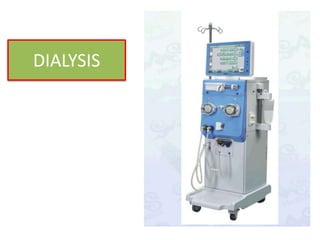
HD
• It is a technique of artificial filtration and
removal of waste products
Dialysis acts upon 3 principles:
1. Diffusion
2. Osmosis
3. Ultrafiltration
1. Diffusion: The solute particle movement from
higher concentration to lower concentration
is called diffusion. E.g. Creatinine, urea, K+,
PO4, Uric acid.
2. Osmosis: The solvent particle movement from
lower concentration to higher concentration.
E.g. Glucose, water, heparin, Antibiotic, Na+.
3. Ultrafiltration: the fluid movement from
higher pressure to lower pressure through a
semipermeable membrane is called
ultrafiltration.
• There are two type od dialysis:
• Hemodialysis
• Peritoneal dialysis
• HD is performed by the help of artery and veins by
making fistula and graft known as a.v fistula or a.v
graft.
• * Most common use artery and veins are radial artery
and cephalic vein.
Complication
• Hypotension
• Septic shock
• Disequilibrium syndrome: N/V, restlessness,
confusion
Some Important Points
₰ Don’t take temperature from affected extremities
₰ Don’t take BP from affected arms.
₰ Don’t infuse any type of drug in graft and fistula.
₰ HD commonly performed between radial artery and cephalic
vein.
₰ It may be performed between femoral catheter and
subclavian vein for temporary.
₰ Graft is reliable for 1-2 year.
₰ Glucose is added in dialysate solution to increase the removal
of waste products.
₰ HD in a week 3 times
₰ HD maximum 4hours because it cause hypotension.
Peritoneal Dialysis
• PD is commonly used for short term.
• It is used for drug toxicity.
• The semipermeable membrane is peritoneum.
• Peritoneum is very rich in blood supply.
Continuous ambulatory peritoneal dialysis (CAPD)
You fill your abdomen with dialysate, let it remain
there for a prescribed dwell time, then drain the
fluid. Gravity moves the fluid through the catheter
and into and out of your abdomen.
• You may need three to five exchanges during the
day and one with a longer dwell time while you
sleep
• You can do the exchanges at home, work or any
clean place
• You're free to go about your normal activities
while the dialysate dwells in your abdomen
Continuous cycling peritoneal dialysis (CCPD)
• Also known as automated peritoneal dialysis (APD), this
method uses a machine (automated cycler) that performs
multiple exchanges at night while you sleep. The cycler
automatically fills your abdomen with dialysate, allows it
to dwell there and then drains it to a sterile bag that you
empty in the morning.
• You must remain attached to the machine for about 10 to
12 hours at night.
• You aren't connected to the machine during the day. But
in the morning you begin one exchange with a dwell time
that lasts the entire day.
Complication
• Peritonitis
• Bladder Perforation
• Bowel Perforation
• Chronic abdominal pain
• Bleeding
• Septicemia
Dialysis

Dialysis

  • 1.
  • 2.
    HD • It isa technique of artificial filtration and removal of waste products Dialysis acts upon 3 principles: 1. Diffusion 2. Osmosis 3. Ultrafiltration
  • 3.
    1. Diffusion: Thesolute particle movement from higher concentration to lower concentration is called diffusion. E.g. Creatinine, urea, K+, PO4, Uric acid. 2. Osmosis: The solvent particle movement from lower concentration to higher concentration. E.g. Glucose, water, heparin, Antibiotic, Na+. 3. Ultrafiltration: the fluid movement from higher pressure to lower pressure through a semipermeable membrane is called ultrafiltration.
  • 4.
    • There aretwo type od dialysis: • Hemodialysis • Peritoneal dialysis
  • 5.
    • HD isperformed by the help of artery and veins by making fistula and graft known as a.v fistula or a.v graft. • * Most common use artery and veins are radial artery and cephalic vein.
  • 7.
    Complication • Hypotension • Septicshock • Disequilibrium syndrome: N/V, restlessness, confusion
  • 8.
    Some Important Points ₰Don’t take temperature from affected extremities ₰ Don’t take BP from affected arms. ₰ Don’t infuse any type of drug in graft and fistula. ₰ HD commonly performed between radial artery and cephalic vein. ₰ It may be performed between femoral catheter and subclavian vein for temporary. ₰ Graft is reliable for 1-2 year. ₰ Glucose is added in dialysate solution to increase the removal of waste products. ₰ HD in a week 3 times ₰ HD maximum 4hours because it cause hypotension.
  • 9.
    Peritoneal Dialysis • PDis commonly used for short term. • It is used for drug toxicity. • The semipermeable membrane is peritoneum. • Peritoneum is very rich in blood supply.
  • 12.
    Continuous ambulatory peritonealdialysis (CAPD) You fill your abdomen with dialysate, let it remain there for a prescribed dwell time, then drain the fluid. Gravity moves the fluid through the catheter and into and out of your abdomen. • You may need three to five exchanges during the day and one with a longer dwell time while you sleep • You can do the exchanges at home, work or any clean place • You're free to go about your normal activities while the dialysate dwells in your abdomen
  • 13.
    Continuous cycling peritonealdialysis (CCPD) • Also known as automated peritoneal dialysis (APD), this method uses a machine (automated cycler) that performs multiple exchanges at night while you sleep. The cycler automatically fills your abdomen with dialysate, allows it to dwell there and then drains it to a sterile bag that you empty in the morning. • You must remain attached to the machine for about 10 to 12 hours at night. • You aren't connected to the machine during the day. But in the morning you begin one exchange with a dwell time that lasts the entire day.
  • 14.
    Complication • Peritonitis • BladderPerforation • Bowel Perforation • Chronic abdominal pain • Bleeding • Septicemia