







DEFINITION:
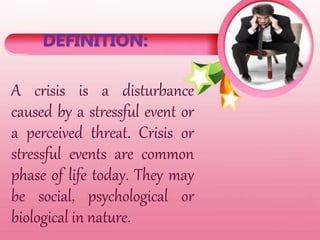
A crisis is a disturbance
caused by a stressful event or
a perceived threat. Crisis or
stressful events are common
phase of life today. They may
be social, psychological or
biological in nature.
CHARACTERSTICS
Crisis occurs in all individuals at
one time or another
Crises are acute, not chronic, and
will be resolved in one way or
another within a brief period.
A crisis situation contains the
potential for psychological
growth or deterioration.
Time limited: Generally lasting
no more than six weeks
CAUSES OF CRISES:
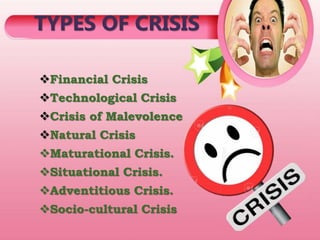
TYPES OF CRISIS
Financial Crisis
Technological Crisis
Crisis of Malevolence
Natural Crisis
Maturational Crisis.
Situational Crisis.
Adventitious Crisis.
Socio-cultural Crisis
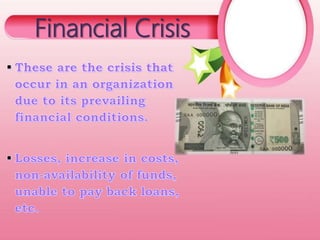
Financial Crisis
Financial Crisis
On 8 November 2016,
the Government of
India announced
the demonetisation
Of all ₹500 (US$7.40)
and ₹1,000 (US$15)
banknotes of
the Mahatma Gandhi
Series.
 Technological crisis are
caused by human
application of science and
technology. This occurs
when technology becomes
complex and the system
breaks down.
 Software failures,
Industrial accidents etc.
Technological Crisis
Examples of Technological Crisis
Natural Crisis
Natural crisis, are natural
disasters considered as 'acts of
God,' are such environmental
phenomena.
Earthquakes, volcanic
eruptions, tornadoes and
hurricanes, floods, landslides,
tsunamis, storms, and droughts
Examples of Natural Crisis
The Indian Ocean
earthquake (Tsunami) ,
in 2004.
Maturational Crisis
For e.g. : successful progression from early
childhood to middle childhood requires the
child to become socially involved with people
outside the family with the more from
adolescence to adulthood, financial
responsibility in expected. Both social and
biological pressure to change can
precipitate a crisis.
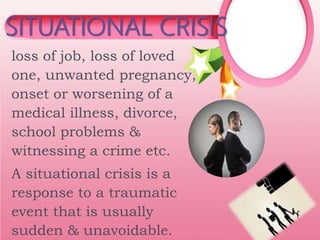
loss of job, loss of loved
one, unwanted pregnancy,
onset or worsening of a
medical illness, divorce,
school problems &
witnessing a crime etc.
A situational crisis is a
response to a traumatic
event that is usually
sudden & unavoidable.
SITUATIONAL CRISIS
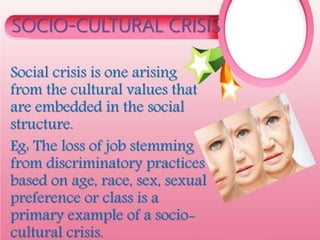
SOCIO-CULTURAL CRISIS
Social crisis is one arising
from the cultural values that
are embedded in the social
structure.
Eg: The loss of job stemming
from discriminatory practices
based on age, race, sex, sexual
preference or class is a
primary example of a socio-
cultural crisis.
CRISIS INTERVENTION
Crisisintervention refers to the methods
used to offer immediate, short term
help to individual who experience an
event that produces emotional, mental,
physical and behavioural distress or
problems.
PRINCIPLES OF CRISIS
INTERVENTION:
 Be specific, use concise statements, and avoid over
whelming the patient with irrelevant questions or
excessive detail.
 Encourage the expression of feelings.
 A calm, controlled presence reassures the person
that the nurse can help.
 Listen for facts and feelings, seeking clarification,
paraphrasing and reflection are effective strategies.
 Allow sufficient time for the individuals involved to
process information and ask questions.
(1) To reduce the intensity of an
individual’s emotional, mental,
Physical and behavioural reaction to a
crisis.
(2) To help the individuals return to
their level of functioning before the
crisis.
1.To decrease emotional
stress and protect the crisis
victim from additional stress.
2.To assist the victim in
organizing and mobilizing
resources or support system
to meet unique needs and
reach a solution for the
particular situation that
precipitated the crisis.
AIMS
To assist the individual in recovery
from the crisis and to prevent serious
long term problem.
STEP IN CRISIS INTERVENTION
–They are follows:-
Assessment
Planning therapeutic intervention
Implementing techniques of
intervention
Resolution of the crisis
Aguilera (1982) list four steps in the process
of crisis intervention.
ASSESSMENT
The assessment process attempts to
answer questions such as-
What has happened?
(Identification of problem)
Who is involved?
What is the cause?
How serious is the problem?
Cont.....
The crisis worker determines the following
during the assessment process.
Onset of the crisis
Precipitating factors (including who, what,
when and where) of the situation.
 E.g.: An Over weight adolescent girl may be
the only girl in the class not invited to a dance.
This may have threatened her self esteem.
Coping Mechanism:
In this step the nurse assess the patient‘s
strengths and previous coping mechanisms.
How has the patient handled other crisis?
How was anxiety relieved? Besides exploring
the previous coping mechanisms, the nurse
should also note the absence of other
possible successful mechanisms.
PLANNING THERAPEUTIC
INTERVENTION
 The person should be involved in the choice of
alternative coping methods.
The needs and reactions of significant other
must be considered.
 This process is outlined in the patient
education plan for coping with crisis.
 The expected outcome if the nursing care
is that the patient will recover from crisis
event and return to a pre crisis level of
functioning and improved quality of life.
PLANNING THERAPEUTIC
INTERVENTION
THERAPEUTIC
INTERVENTION
Therapeutic intervention depends on
prelisting skills, the creativity and
flexibility of the crisis worker and
rapidity of the person’s response.
Cont.....
The crisis worker helps the
person to establish an intellectual
understanding of the crisis by
noting the relationship between
the precipitating factors and the
crisis.
RESOLUTION AND
ANTICIPATORY PLANNING
During the evaluation phase or step of
crisis intervention, reassessment must
occur to ascertain that the intervention
is reducing tension and anxiety.
TECHNIQUES USED IN
INTERVENTION:
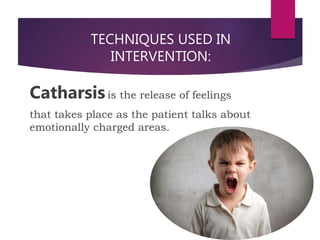
Catharsisis the release of feelings
that takes place as the patient talks about
emotionally charged areas.
 Clarification is used when the nurse helps
the patient identify the relationship between
events, behaviors, and feelings. For example,
helping a patient see that it was after being
passed over for a promotion that he or she felt
too sick to go to work is clarification.
Suggestion is influencing a person
to accept an idea or belief. In crisis
intervention the patient is influenced
to see the nurse as a confident,
calm, hopeful, empathic person who
can help.
Reinforcement of behaviour occurs
when healthy, adaptive behaviour of the
patient is reinforced by the nurse,
strengthens positive responses made by
the patient by agreeing with or positively
acknowledging those responses
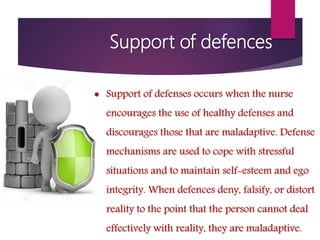
Support of defences
 Support of defenses occurs when the nurse
encourages the use of healthy defenses and
discourages those that are maladaptive. Defense
mechanisms are used to cope with stressful
situations and to maintain self-esteem and ego
integrity. When defences deny, falsify, or distort
reality to the point that the person cannot deal
effectively with reality, they are maladaptive.
Raising self-esteem
Raising self-esteem is a
particularly important
technique. The patient in
a crisis feels helpless and
may be overwhelmed
with feelings of
inadequacy.
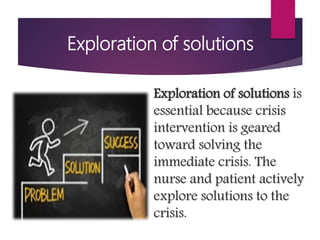
Exploration of solutions
Exploration of solutions is
essential because crisis
intervention is geared
toward solving the
immediate crisis. The
nurse and patient actively
explore solutions to the
crisis.
MODALITIES OF CRISIS
INTERVENTION:
Mobile Crisis Programs:
Mobile crisis teams provide front line inter
disciplinary crisis intervention to individuals,
families and communities. The nurse who is a
member of a mobile crisis team may respond to a
desperate person threatening to jump off a bridge
in a suicide attempt, an angry person who is
becoming violent toward family members at home
etc.
Telephone Contacts
Crisis intervention
to sometimes practice by
telephone rather than through
face to face contacts. Listening
skills must therefore be
emphasised in the nurse‘s role.
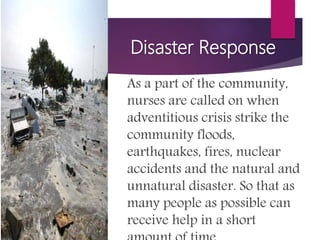
Disaster Response
As a part of the community,
nurses are called on when
adventitious crisis strike the
community floods,
earthquakes, fires, nuclear
accidents and the natural and
unnatural disaster. So that as
many people as possible can
receive help in a short
CRISIS INTERVENTION TEAM
PROGRAME:
The Crisis Intervention Team
program is a community effort
enjoining both the police and the
community together for common
goals of safety, understanding, and
service to the mentally ill and their
families.
PROGRAM BENEFITS:
 Arrests and use of force has decreased.
 Underserved consumers are identified by officers
and provided with care.
 Officer‘s injuries during crisis events have declined.
 Officer Recognition and appreciation by the
community has increased.
 Less ―victimless / crime arrests.
 Decrease in liability for health care issues in the
jail.
 Cost saving.
HEALTH EDUCATION:
The nurse plans the
intervention to teach the
patient how to avoid other
similar crisis. Eg: The nurse
helps the patent to identify
the feelings thoughts, and
behaviours experienced
following the stressful event.
During The evaluation period the nurse &
the patient summarize what has occurred
during the intervention. The review what
the individual has learnt & anticipate how
he or she will respond in the future. a
determination is made regarding follow up
therapy, if needed the nurse provides
referral information.

Crisis intervention

  • 2.
    DEFINITION: A crisis isa disturbance caused by a stressful event or a perceived threat. Crisis or stressful events are common phase of life today. They may be social, psychological or biological in nature.
  • 5.
    CHARACTERSTICS Crisis occurs inall individuals at one time or another Crises are acute, not chronic, and will be resolved in one way or another within a brief period. A crisis situation contains the potential for psychological growth or deterioration. Time limited: Generally lasting no more than six weeks
  • 6.
  • 7.
    TYPES OF CRISIS FinancialCrisis Technological Crisis Crisis of Malevolence Natural Crisis Maturational Crisis. Situational Crisis. Adventitious Crisis. Socio-cultural Crisis
  • 8.
  • 9.
    Financial Crisis On 8November 2016, the Government of India announced the demonetisation Of all ₹500 (US$7.40) and ₹1,000 (US$15) banknotes of the Mahatma Gandhi Series.
  • 10.
     Technological crisisare caused by human application of science and technology. This occurs when technology becomes complex and the system breaks down.  Software failures, Industrial accidents etc. Technological Crisis
  • 11.
  • 12.
    Natural Crisis Natural crisis,are natural disasters considered as 'acts of God,' are such environmental phenomena. Earthquakes, volcanic eruptions, tornadoes and hurricanes, floods, landslides, tsunamis, storms, and droughts
  • 13.
    Examples of NaturalCrisis The Indian Ocean earthquake (Tsunami) , in 2004.
  • 14.
    Maturational Crisis For e.g.: successful progression from early childhood to middle childhood requires the child to become socially involved with people outside the family with the more from adolescence to adulthood, financial responsibility in expected. Both social and biological pressure to change can precipitate a crisis.
  • 15.
    loss of job,loss of loved one, unwanted pregnancy, onset or worsening of a medical illness, divorce, school problems & witnessing a crime etc. A situational crisis is a response to a traumatic event that is usually sudden & unavoidable. SITUATIONAL CRISIS
  • 16.
    SOCIO-CULTURAL CRISIS Social crisisis one arising from the cultural values that are embedded in the social structure. Eg: The loss of job stemming from discriminatory practices based on age, race, sex, sexual preference or class is a primary example of a socio- cultural crisis.
  • 18.
    CRISIS INTERVENTION Crisisintervention refersto the methods used to offer immediate, short term help to individual who experience an event that produces emotional, mental, physical and behavioural distress or problems.
  • 19.
    PRINCIPLES OF CRISIS INTERVENTION: Be specific, use concise statements, and avoid over whelming the patient with irrelevant questions or excessive detail.  Encourage the expression of feelings.  A calm, controlled presence reassures the person that the nurse can help.  Listen for facts and feelings, seeking clarification, paraphrasing and reflection are effective strategies.  Allow sufficient time for the individuals involved to process information and ask questions.
  • 20.
    (1) To reducethe intensity of an individual’s emotional, mental, Physical and behavioural reaction to a crisis. (2) To help the individuals return to their level of functioning before the crisis.
  • 21.
    1.To decrease emotional stressand protect the crisis victim from additional stress. 2.To assist the victim in organizing and mobilizing resources or support system to meet unique needs and reach a solution for the particular situation that precipitated the crisis.
  • 22.
    AIMS To assist theindividual in recovery from the crisis and to prevent serious long term problem.
  • 23.
    STEP IN CRISISINTERVENTION –They are follows:- Assessment Planning therapeutic intervention Implementing techniques of intervention Resolution of the crisis Aguilera (1982) list four steps in the process of crisis intervention.
  • 24.
    ASSESSMENT The assessment processattempts to answer questions such as- What has happened? (Identification of problem) Who is involved? What is the cause? How serious is the problem?
  • 25.
    Cont..... The crisis workerdetermines the following during the assessment process. Onset of the crisis Precipitating factors (including who, what, when and where) of the situation.  E.g.: An Over weight adolescent girl may be the only girl in the class not invited to a dance. This may have threatened her self esteem.
  • 26.
    Coping Mechanism: In thisstep the nurse assess the patient‘s strengths and previous coping mechanisms. How has the patient handled other crisis? How was anxiety relieved? Besides exploring the previous coping mechanisms, the nurse should also note the absence of other possible successful mechanisms.
  • 27.
    PLANNING THERAPEUTIC INTERVENTION  Theperson should be involved in the choice of alternative coping methods. The needs and reactions of significant other must be considered.
  • 28.
     This processis outlined in the patient education plan for coping with crisis.  The expected outcome if the nursing care is that the patient will recover from crisis event and return to a pre crisis level of functioning and improved quality of life. PLANNING THERAPEUTIC INTERVENTION
  • 29.
    THERAPEUTIC INTERVENTION Therapeutic intervention dependson prelisting skills, the creativity and flexibility of the crisis worker and rapidity of the person’s response.
  • 30.
    Cont..... The crisis workerhelps the person to establish an intellectual understanding of the crisis by noting the relationship between the precipitating factors and the crisis.
  • 31.
    RESOLUTION AND ANTICIPATORY PLANNING Duringthe evaluation phase or step of crisis intervention, reassessment must occur to ascertain that the intervention is reducing tension and anxiety.
  • 32.
    TECHNIQUES USED IN INTERVENTION: Catharsisisthe release of feelings that takes place as the patient talks about emotionally charged areas.
  • 33.
     Clarification isused when the nurse helps the patient identify the relationship between events, behaviors, and feelings. For example, helping a patient see that it was after being passed over for a promotion that he or she felt too sick to go to work is clarification.
  • 34.
    Suggestion is influencinga person to accept an idea or belief. In crisis intervention the patient is influenced to see the nurse as a confident, calm, hopeful, empathic person who can help.
  • 35.
    Reinforcement of behaviouroccurs when healthy, adaptive behaviour of the patient is reinforced by the nurse, strengthens positive responses made by the patient by agreeing with or positively acknowledging those responses
  • 36.
    Support of defences Support of defenses occurs when the nurse encourages the use of healthy defenses and discourages those that are maladaptive. Defense mechanisms are used to cope with stressful situations and to maintain self-esteem and ego integrity. When defences deny, falsify, or distort reality to the point that the person cannot deal effectively with reality, they are maladaptive.
  • 37.
    Raising self-esteem Raising self-esteemis a particularly important technique. The patient in a crisis feels helpless and may be overwhelmed with feelings of inadequacy.
  • 38.
    Exploration of solutions Explorationof solutions is essential because crisis intervention is geared toward solving the immediate crisis. The nurse and patient actively explore solutions to the crisis.
  • 39.
    MODALITIES OF CRISIS INTERVENTION: MobileCrisis Programs: Mobile crisis teams provide front line inter disciplinary crisis intervention to individuals, families and communities. The nurse who is a member of a mobile crisis team may respond to a desperate person threatening to jump off a bridge in a suicide attempt, an angry person who is becoming violent toward family members at home etc.
  • 40.
    Telephone Contacts Crisis intervention tosometimes practice by telephone rather than through face to face contacts. Listening skills must therefore be emphasised in the nurse‘s role.
  • 41.
    Disaster Response As apart of the community, nurses are called on when adventitious crisis strike the community floods, earthquakes, fires, nuclear accidents and the natural and unnatural disaster. So that as many people as possible can receive help in a short
  • 42.
    CRISIS INTERVENTION TEAM PROGRAME: TheCrisis Intervention Team program is a community effort enjoining both the police and the community together for common goals of safety, understanding, and service to the mentally ill and their families.
  • 43.
    PROGRAM BENEFITS:  Arrestsand use of force has decreased.  Underserved consumers are identified by officers and provided with care.  Officer‘s injuries during crisis events have declined.  Officer Recognition and appreciation by the community has increased.  Less ―victimless / crime arrests.  Decrease in liability for health care issues in the jail.  Cost saving.
  • 44.
    HEALTH EDUCATION: The nurseplans the intervention to teach the patient how to avoid other similar crisis. Eg: The nurse helps the patent to identify the feelings thoughts, and behaviours experienced following the stressful event.
  • 45.
    During The evaluationperiod the nurse & the patient summarize what has occurred during the intervention. The review what the individual has learnt & anticipate how he or she will respond in the future. a determination is made regarding follow up therapy, if needed the nurse provides referral information.