

May I
help
u
INTRODUCTION
• Computers influence every sphere of human
activity and bring in many changes in industry,
education, health care, scientific research, social
service, law and even in arts, music and painting.
• The computer revolutionized the nursing
profession. Clinical and technological
advancements led to a nursing specialty called
nursing informatics the application of computer
and information science to promote and support
the practice of nursing and the delivery of
nursing care.
HISTORICALPERSPECTIVESOFCOMPUTERS
ANDNURSING
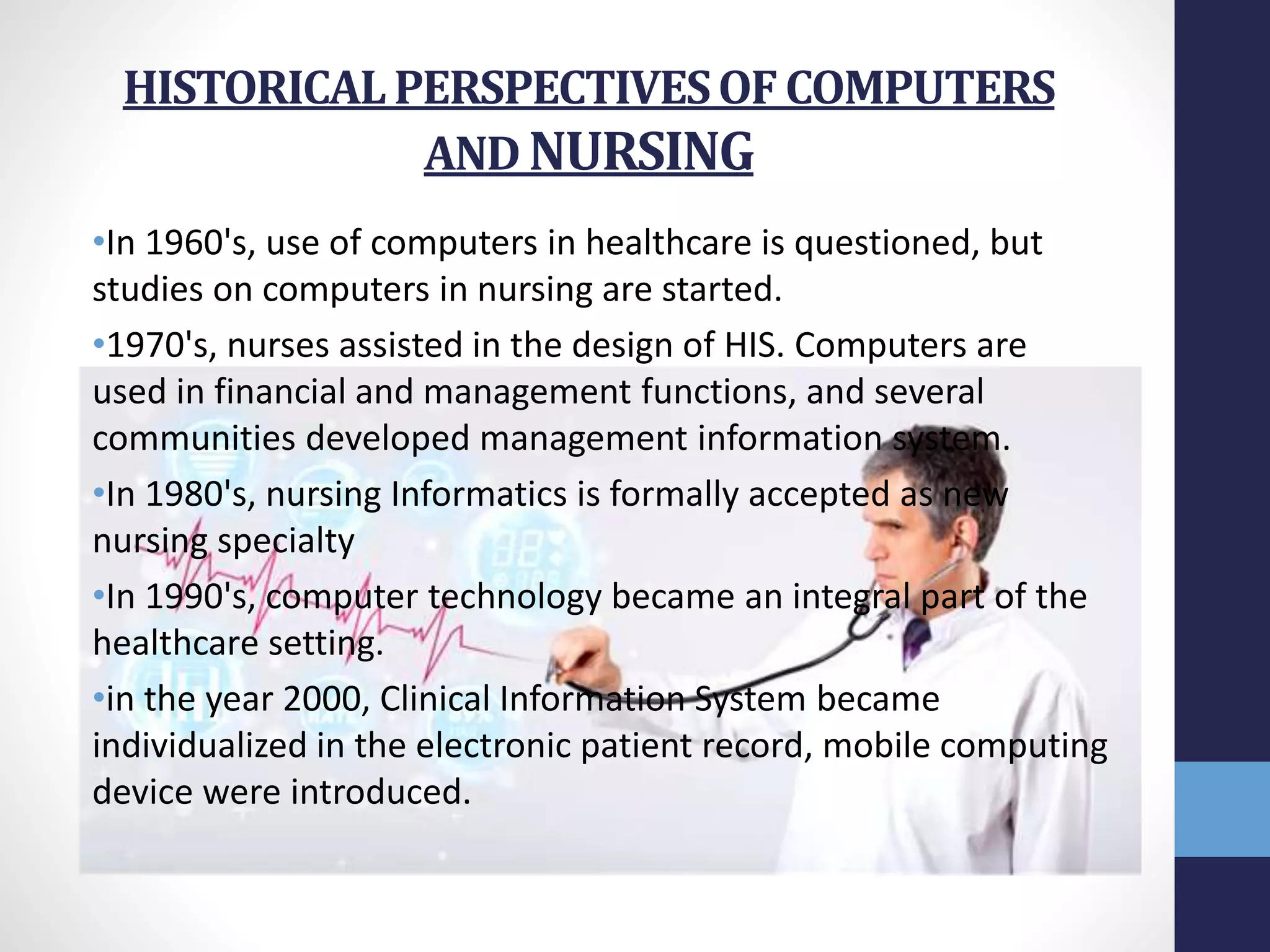
•In 1960's, use of computers in healthcare is questioned, but
studies on computers in nursing are started.
•1970's, nurses assisted in the design of HIS. Computers are
used in financial and management functions, and several
communities developed management information system.
•In 1980's, nursing Informatics is formally accepted as new
nursing specialty
•In 1990's, computer technology became an integral part of the
healthcare setting.
•in the year 2000, Clinical Information System became
individualized in the electronic patient record, mobile computing
device were introduced.
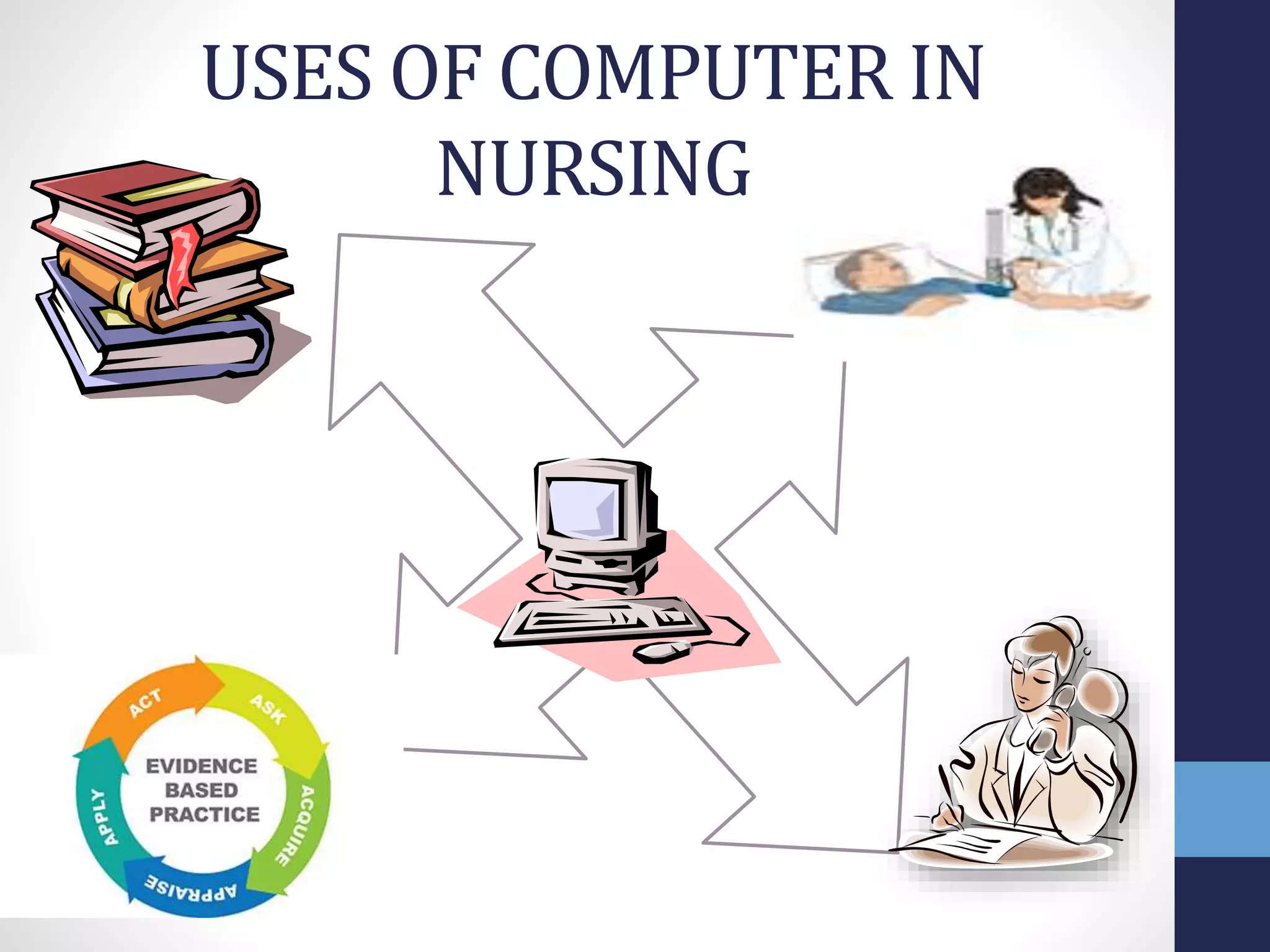
USES OF COMPUTER IN
NURSING
USES OF COMPUTERS IN
CLINICAL NURSING PRACTICE:
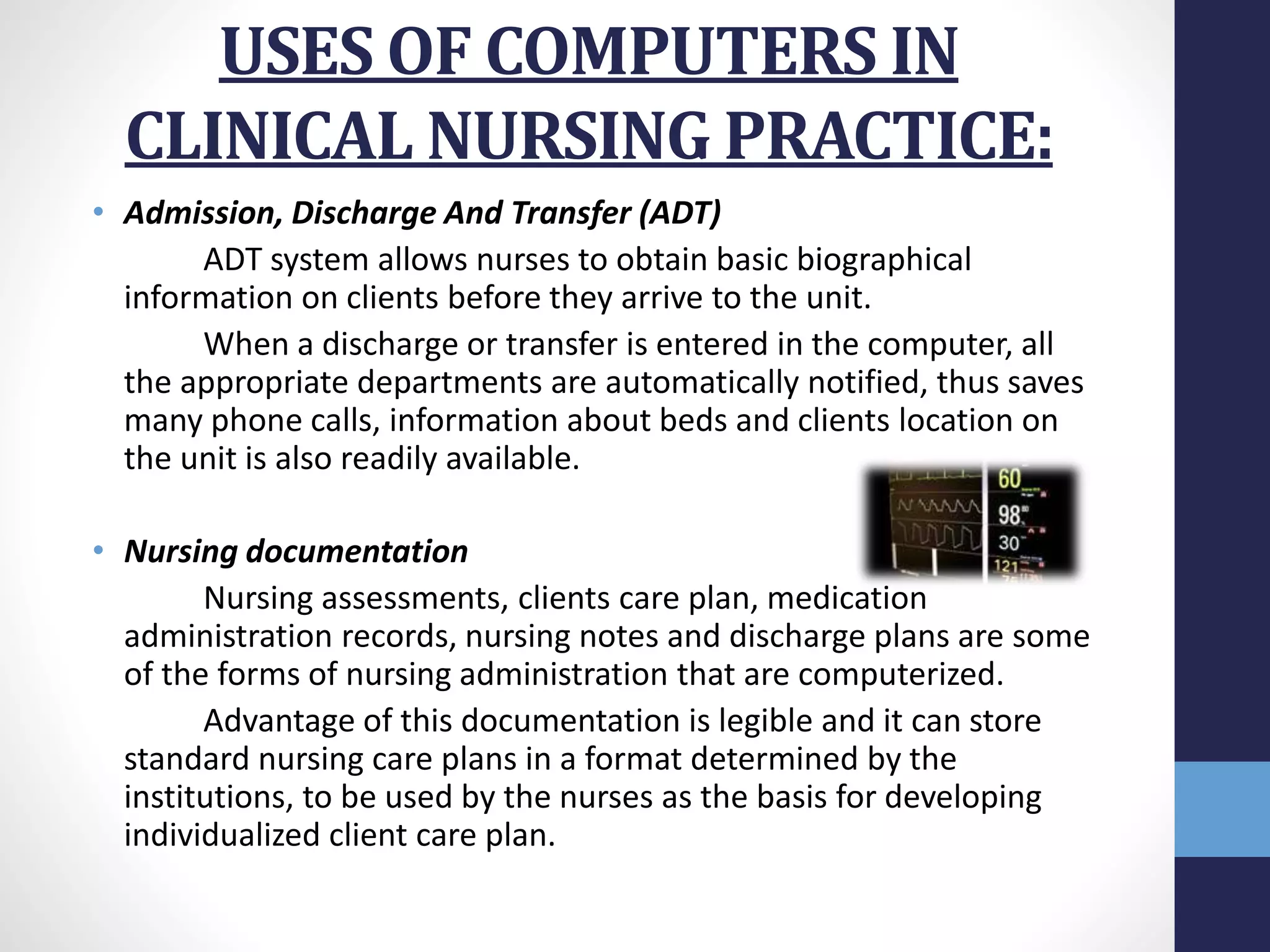
• Admission, Discharge And Transfer (ADT)
ADT system allows nurses to obtain basic biographical
information on clients before they arrive to the unit.
When a discharge or transfer is entered in the computer, all
the appropriate departments are automatically notified, thus saves
many phone calls, information about beds and clients location on
the unit is also readily available.
• Nursing documentation
Nursing assessments, clients care plan, medication
administration records, nursing notes and discharge plans are some
of the forms of nursing administration that are computerized.
Advantage of this documentation is legible and it can store
standard nursing care plans in a format determined by the
institutions, to be used by the nurses as the basis for developing
individualized client care plan.
TEACHING LEARNING PROCESS:
• Instructing the students using PowerPoint slides, word
documents or web pages and using hyperlinks for better
concept daily.
• Readymade software could give practice material to students.
• Collecting notes from web pages for detailed information and
projects/ assignments.
• Saving the documents as soft copy for future use.
• Learning through animations, as they are much near to the
students.
• E-books/online libraries/online encyclopedia helps to guide in
minutes and saves precious time and resources.
• Publications of pamphlets brochures for awareness with
institutions and among community members.
REAL LIFE USES OF COMPUTER IN
EDUCATION:
Testing And Evaluation Process:
• Keeping records of students for their academic scores.
• Keeping records in relation to personal history.
• Creating question bank for students.
• Online testing and evaluation.
• Analysis and interpretation of the data.
Guidance purposes:
Testing for aptitude, interest, psychology using computers data
bases and interest.
Library:
• Documents stored as soft copy for students/ faculty members use.
• Online magazines, journals, brochures, research articles.
• Records of the books, record of the books maintained using special
library software.
• Records of the issues and returns of the books.
School Administration:
• Records of students( personal/academic)
• Records of employee of school.
• Accounts of the institutions.
• Aid to memory with minimum paper work.
• Circulation of instructions/notices and getting it in printed form.
NURSING SOFTWARES:
• Probably the most overlooked and underappreciated resource
in the operating room which nursing professionals require is
nursing that performs multiple services. It minimizes non-
clinical time, improves time management and facilitates
access to information allowing then to do the job they were
trained to do that is deliver patient care.
SIS nursing software includes a series of modules that
address each nursing related phases of the surgery case and
more. It includes,
• Pre-admission testing
• Pre-operative
• Intra-operative
• Post-operative
7 Tech Breakthroughs that
will make You a Better
Nurse:
• Better communication systems- Some hospitals are
incorporating advanced Communication Systems, in which
nurses and other members of the health care team can text
message, speak, and receive patient alarms through their
smart phone devices using specialized apps. This concept
replaces antiquated paging systems, and helps the whole
nursing unit stay in touch and work more efficiently with each
other.
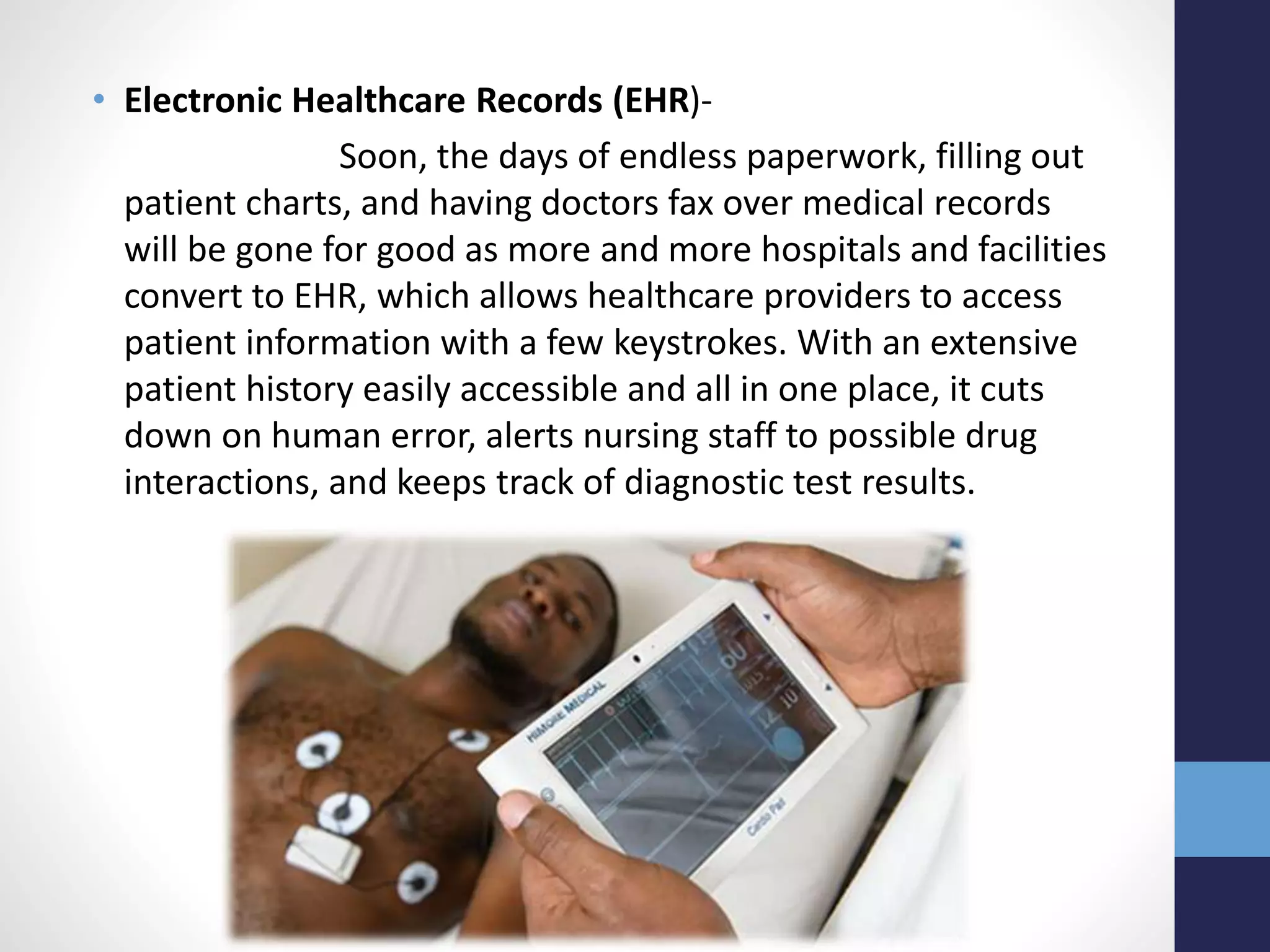
• Electronic Healthcare Records (EHR)-
Soon, the days of endless paperwork, filling out
patient charts, and having doctors fax over medical records
will be gone for good as more and more hospitals and facilities
convert to EHR, which allows healthcare providers to access
patient information with a few keystrokes. With an extensive
patient history easily accessible and all in one place, it cuts
down on human error, alerts nursing staff to possible drug
interactions, and keeps track of diagnostic test results.
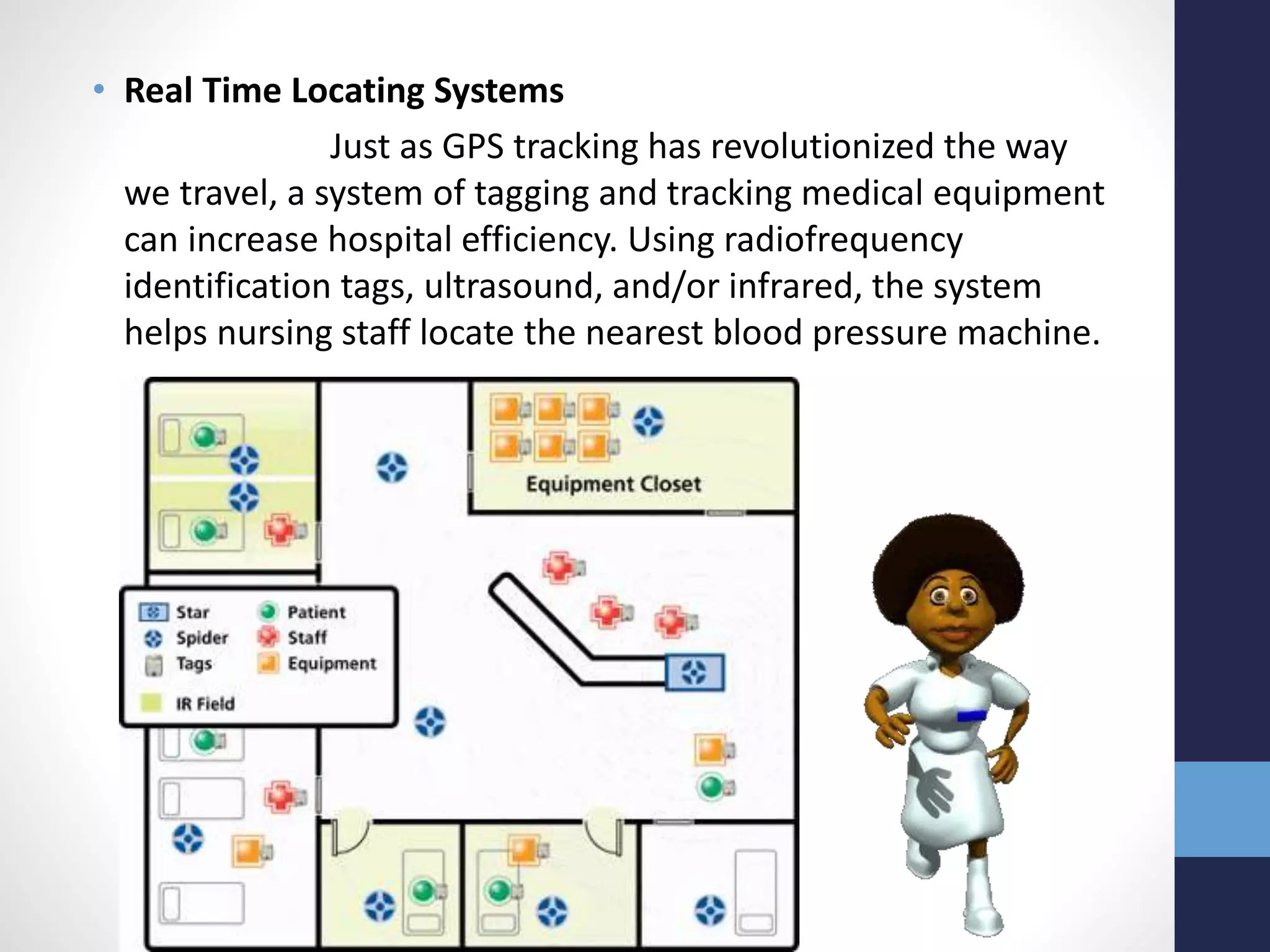
• Real Time Locating Systems
Just as GPS tracking has revolutionized the way
we travel, a system of tagging and tracking medical equipment
can increase hospital efficiency. Using radiofrequency
identification tags, ultrasound, and/or infrared, the system
helps nursing staff locate the nearest blood pressure machine.
• Better diagnostic tools
It makes everyone’s life easier – both RNs and
patients – when diagnostic exams can be performed non-
invasively. Thanks to new technologies, there are more
options available now to perform minimally invasive tests and
treatments. This helps lower risk of infection, and over time, is
more cost effective. Some examples include nanotechnology
like handheld biosensors that can detect a range of diseases
from miniscule body specimens. Another example is Texas
Children’s Hospital’s use of ultrasound technology to place
peripheral IV (PIV).
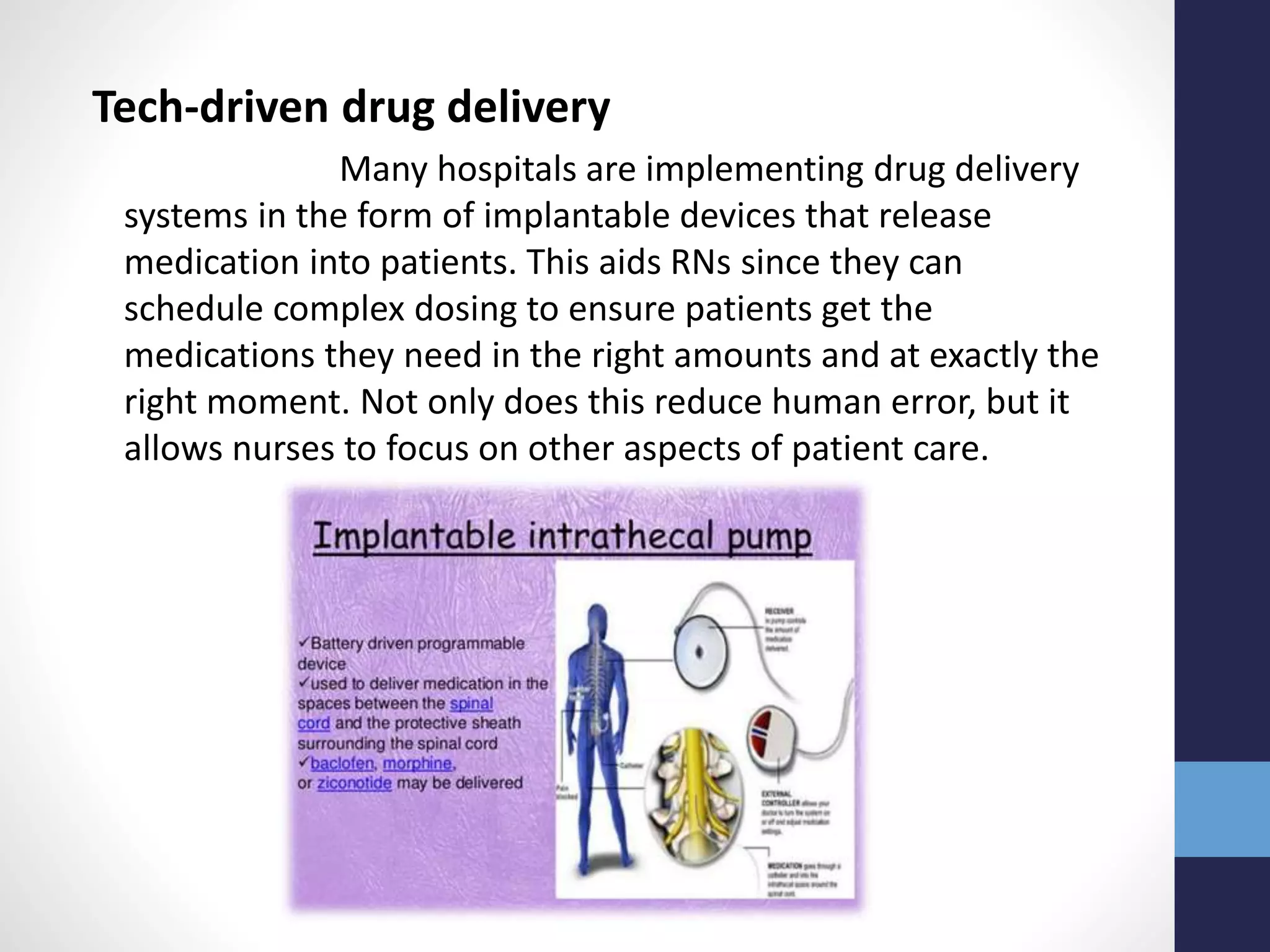
Tech-driven drug delivery
Many hospitals are implementing drug delivery
systems in the form of implantable devices that release
medication into patients. This aids RNs since they can
schedule complex dosing to ensure patients get the
medications they need in the right amounts and at exactly the
right moment. Not only does this reduce human error, but it
allows nurses to focus on other aspects of patient care.
Patient lifting technology
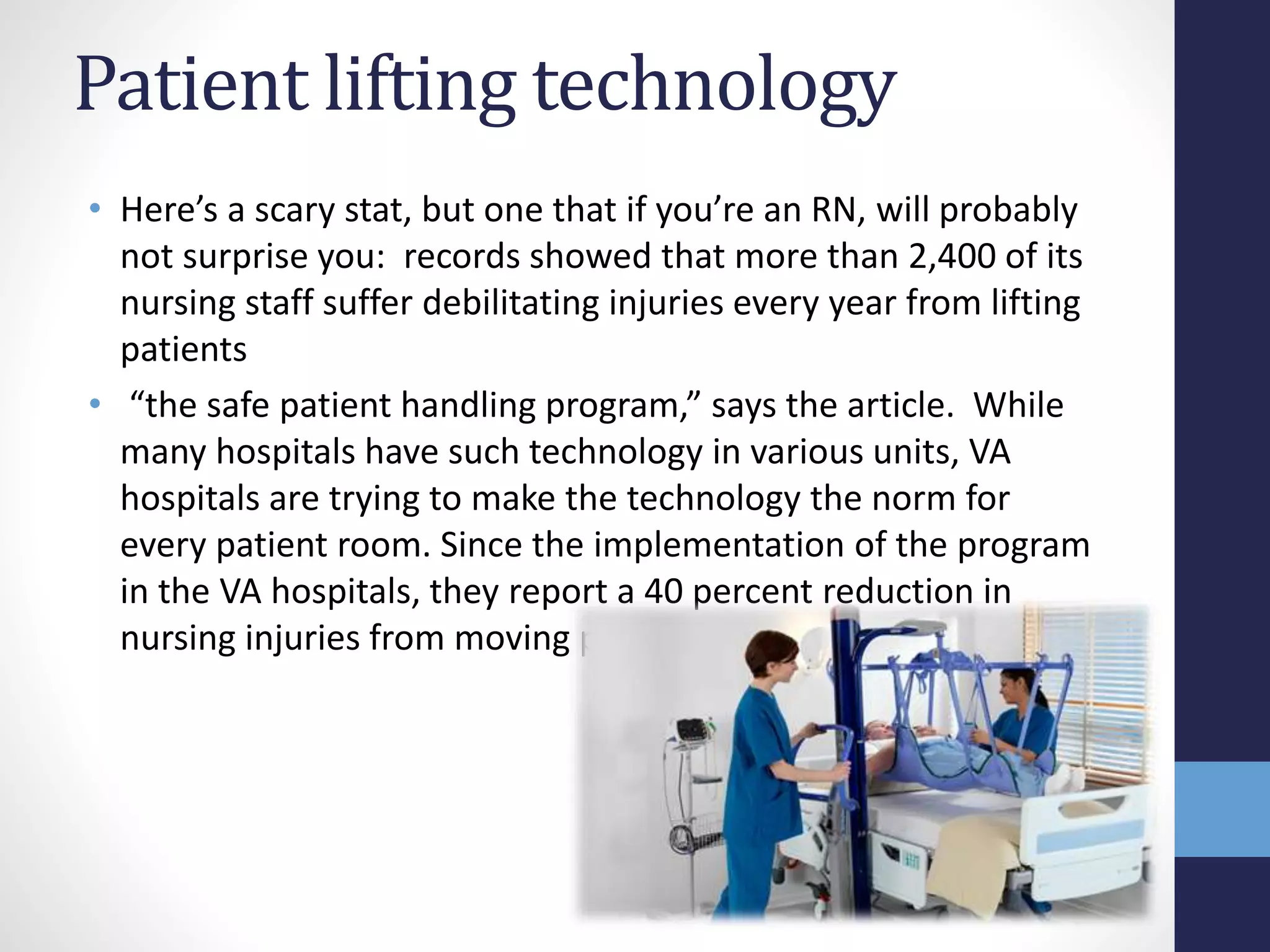
• Here’s a scary stat, but one that if you’re an RN, will probably
not surprise you: records showed that more than 2,400 of its
nursing staff suffer debilitating injuries every year from lifting
patients
• “the safe patient handling program,” says the article. While
many hospitals have such technology in various units, VA
hospitals are trying to make the technology the norm for
every patient room. Since the implementation of the program
in the VA hospitals, they report a 40 percent reduction in
nursing injuries from moving patients.
Summary
CONCLUSION
REFERENCES:
BOOK REFERANCES:
• Shebeer.P.Basheer,S.Yaseen khan , a consise text book oof
advanced nursing practice. 1st edition, 2012 published by
EMMESS medical publishers. Pg.No. 780-809
• NC.Jain&MS.Sakshi. Computer for nurses. 2004. AIBS
publishers. India. Pg.no:1-8, 26-28.
JOURNAL REFERANCES:
• (International Journal of Research in Science and Technology
http://www.ijrst.com (IJRST) 2014, Vol. No. 3, Issue No. V,
October-December ISSN: 2249-0604)
NET REFERANCES:
• WWW.asrn.org/advancedpractice in nursing
• www.ncbi.nlm.nih.gov
• www.nursing-informatics.com/kwantle
Computer in nursing
Computer in nursing

Computer in nursing

  • 1.
  • 2.
    INTRODUCTION • Computers influenceevery sphere of human activity and bring in many changes in industry, education, health care, scientific research, social service, law and even in arts, music and painting. • The computer revolutionized the nursing profession. Clinical and technological advancements led to a nursing specialty called nursing informatics the application of computer and information science to promote and support the practice of nursing and the delivery of nursing care.
  • 3.
    HISTORICALPERSPECTIVESOFCOMPUTERS ANDNURSING •In 1960's, useof computers in healthcare is questioned, but studies on computers in nursing are started. •1970's, nurses assisted in the design of HIS. Computers are used in financial and management functions, and several communities developed management information system. •In 1980's, nursing Informatics is formally accepted as new nursing specialty •In 1990's, computer technology became an integral part of the healthcare setting. •in the year 2000, Clinical Information System became individualized in the electronic patient record, mobile computing device were introduced.
  • 5.
    USES OF COMPUTERIN NURSING
  • 6.
    USES OF COMPUTERSIN CLINICAL NURSING PRACTICE: • Admission, Discharge And Transfer (ADT) ADT system allows nurses to obtain basic biographical information on clients before they arrive to the unit. When a discharge or transfer is entered in the computer, all the appropriate departments are automatically notified, thus saves many phone calls, information about beds and clients location on the unit is also readily available. • Nursing documentation Nursing assessments, clients care plan, medication administration records, nursing notes and discharge plans are some of the forms of nursing administration that are computerized. Advantage of this documentation is legible and it can store standard nursing care plans in a format determined by the institutions, to be used by the nurses as the basis for developing individualized client care plan.
  • 7.
    TEACHING LEARNING PROCESS: •Instructing the students using PowerPoint slides, word documents or web pages and using hyperlinks for better concept daily. • Readymade software could give practice material to students. • Collecting notes from web pages for detailed information and projects/ assignments. • Saving the documents as soft copy for future use. • Learning through animations, as they are much near to the students. • E-books/online libraries/online encyclopedia helps to guide in minutes and saves precious time and resources. • Publications of pamphlets brochures for awareness with institutions and among community members. REAL LIFE USES OF COMPUTER IN EDUCATION:
  • 8.
    Testing And EvaluationProcess: • Keeping records of students for their academic scores. • Keeping records in relation to personal history. • Creating question bank for students. • Online testing and evaluation. • Analysis and interpretation of the data.
  • 9.
    Guidance purposes: Testing foraptitude, interest, psychology using computers data bases and interest. Library: • Documents stored as soft copy for students/ faculty members use. • Online magazines, journals, brochures, research articles. • Records of the books, record of the books maintained using special library software. • Records of the issues and returns of the books. School Administration: • Records of students( personal/academic) • Records of employee of school. • Accounts of the institutions. • Aid to memory with minimum paper work. • Circulation of instructions/notices and getting it in printed form.
  • 10.
    NURSING SOFTWARES: • Probablythe most overlooked and underappreciated resource in the operating room which nursing professionals require is nursing that performs multiple services. It minimizes non- clinical time, improves time management and facilitates access to information allowing then to do the job they were trained to do that is deliver patient care. SIS nursing software includes a series of modules that address each nursing related phases of the surgery case and more. It includes, • Pre-admission testing • Pre-operative • Intra-operative • Post-operative
  • 12.
    7 Tech Breakthroughsthat will make You a Better Nurse: • Better communication systems- Some hospitals are incorporating advanced Communication Systems, in which nurses and other members of the health care team can text message, speak, and receive patient alarms through their smart phone devices using specialized apps. This concept replaces antiquated paging systems, and helps the whole nursing unit stay in touch and work more efficiently with each other.
  • 13.
    • Electronic HealthcareRecords (EHR)- Soon, the days of endless paperwork, filling out patient charts, and having doctors fax over medical records will be gone for good as more and more hospitals and facilities convert to EHR, which allows healthcare providers to access patient information with a few keystrokes. With an extensive patient history easily accessible and all in one place, it cuts down on human error, alerts nursing staff to possible drug interactions, and keeps track of diagnostic test results.
  • 14.
    • Real TimeLocating Systems Just as GPS tracking has revolutionized the way we travel, a system of tagging and tracking medical equipment can increase hospital efficiency. Using radiofrequency identification tags, ultrasound, and/or infrared, the system helps nursing staff locate the nearest blood pressure machine.
  • 15.
    • Better diagnostictools It makes everyone’s life easier – both RNs and patients – when diagnostic exams can be performed non- invasively. Thanks to new technologies, there are more options available now to perform minimally invasive tests and treatments. This helps lower risk of infection, and over time, is more cost effective. Some examples include nanotechnology like handheld biosensors that can detect a range of diseases from miniscule body specimens. Another example is Texas Children’s Hospital’s use of ultrasound technology to place peripheral IV (PIV).
  • 16.
    Tech-driven drug delivery Manyhospitals are implementing drug delivery systems in the form of implantable devices that release medication into patients. This aids RNs since they can schedule complex dosing to ensure patients get the medications they need in the right amounts and at exactly the right moment. Not only does this reduce human error, but it allows nurses to focus on other aspects of patient care.
  • 17.
    Patient lifting technology •Here’s a scary stat, but one that if you’re an RN, will probably not surprise you: records showed that more than 2,400 of its nursing staff suffer debilitating injuries every year from lifting patients • “the safe patient handling program,” says the article. While many hospitals have such technology in various units, VA hospitals are trying to make the technology the norm for every patient room. Since the implementation of the program in the VA hospitals, they report a 40 percent reduction in nursing injuries from moving patients.
  • 19.
  • 20.
  • 22.
    REFERENCES: BOOK REFERANCES: • Shebeer.P.Basheer,S.Yaseenkhan , a consise text book oof advanced nursing practice. 1st edition, 2012 published by EMMESS medical publishers. Pg.No. 780-809 • NC.Jain&MS.Sakshi. Computer for nurses. 2004. AIBS publishers. India. Pg.no:1-8, 26-28. JOURNAL REFERANCES: • (International Journal of Research in Science and Technology http://www.ijrst.com (IJRST) 2014, Vol. No. 3, Issue No. V, October-December ISSN: 2249-0604)
  • 23.
    NET REFERANCES: • WWW.asrn.org/advancedpracticein nursing • www.ncbi.nlm.nih.gov • www.nursing-informatics.com/kwantle