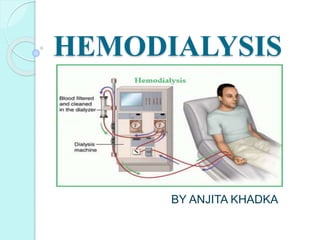
HEMODIALYSIS
BY ANJITA KHADKA
Hemodialysis:
 Hemodialysis is one of three renal
replacement therapies (the other two being
kidney transplant and peritoneal dialysis).
 It is a medical procedure to remove fluid and
waste products from blood and to correct
electrolyte imbalance.
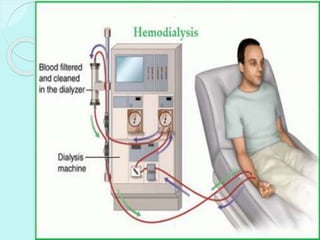
 Hemodialysis is done using a hemodialysis
machine and dialyzer aslo called as
‘Artificial kidney’
 It can be an outpatient or inpatient therapy.
 Hemodialysis is an extracorporeal process
(dialysis membrane is outside of the
body).
Indication For dialysis:
• Acidosis (pH <7.1)
• Electrolyte imbalance (k+ >6.5 mEq/L)
• GFR<10ml/min
• Overload of Fluids (pulmonary Oedema)
• Uremic Symptoms (increased level of
nitrogenous waste products)
Principle of Haemodialysis
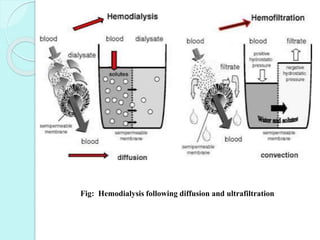
1. Diffusion: Passive movement of
solute across a semipermeable
membrane.
2. Ultra filtration: solute + Fluid removal
across semipermeable membrane
down a pressure gradient.
Fig: Hemodialysis following diffusion and ultrafiltration
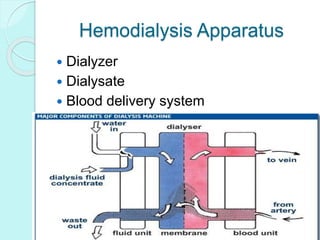
Hemodialysis Apparatus
 Dialyzer
 Dialysate
 Blood delivery system
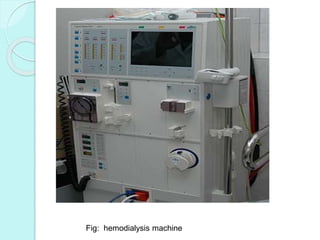
Fig: hemodialysis machine
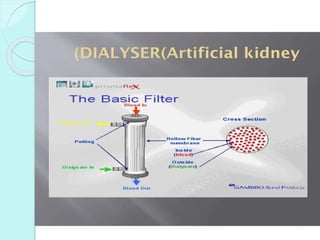
1. Dialyzer (Artificial kidney):
 Plastic chamber that contains bundles of
capillary tube through which blood
circulates while dialysis solution travels
outside the bundle in opposite counter
current direction.
 Diffusion and Ultrafiltration happens
here.
 Membranes using in dialyser:
◦ Cellulose
◦ Substituted cellulose: Cellulose acetate
◦ Cellulosynthetic: Cellosyn/Hemophan
◦ Synthetics: Polyacrylonitrile, polysulfone,
polymethyl methacrylate
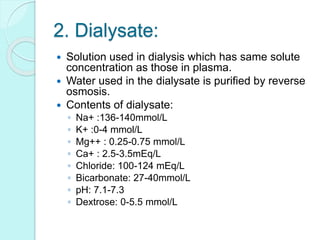
2. Dialysate:
 Solution used in dialysis which has same solute
concentration as those in plasma.
 Water used in the dialysate is purified by reverse
osmosis.
 Contents of dialysate:
◦ Na+ :136-140mmol/L
◦ K+ :0-4 mmol/L
◦ Mg++ : 0.25-0.75 mmol/L
◦ Ca+ : 2.5-3.5mEq/L
◦ Chloride: 100-124 mEq/L
◦ Bicarbonate: 27-40mmol/L
◦ pH: 7.1-7.3
◦ Dextrose: 0-5.5 mmol/L
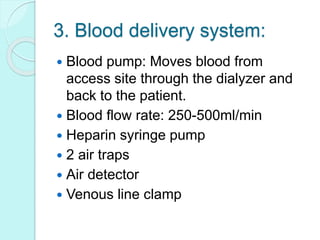
3. Blood delivery system:
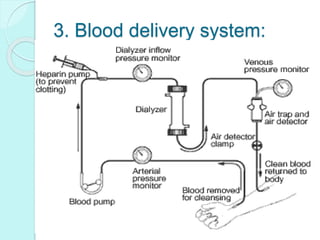
 Blood pump: Moves blood from
access site through the dialyzer and
back to the patient.
 Blood flow rate: 250-500ml/min
 Heparin syringe pump
 2 air traps
 Air detector
 Venous line clamp
3. Blood delivery system:
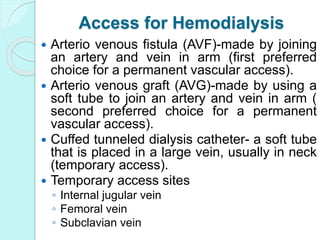
Access for Hemodialysis
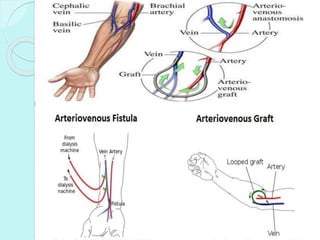
 Arterio venous fistula (AVF)-made by joining
an artery and vein in arm (first preferred
choice for a permanent vascular access).
 Arterio venous graft (AVG)-made by using a
soft tube to join an artery and vein in arm (
second preferred choice for a permanent
vascular access).
 Cuffed tunneled dialysis catheter- a soft tube
that is placed in a large vein, usually in neck
(temporary access).
 Temporary access sites
◦ Internal jugular vein
◦ Femoral vein
◦ Subclavian vein
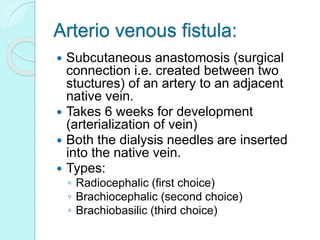
Arterio venous fistula:
 Subcutaneous anastomosis (surgical
connection i.e. created between two
stuctures) of an artery to an adjacent
native vein.
 Takes 6 weeks for development
(arterialization of vein)
 Both the dialysis needles are inserted
into the native vein.
 Types:
◦ Radiocephalic (first choice)
◦ Brachiocephalic (second choice)
◦ Brachiobasilic (third choice)
Procedure
 Blood flow rate: 300-500 ml/min
 Dialysate : 500-800 ml/min
 Usually done 3 times a week and each dialysis lasts for 4 hours.
Complications of
Hemodialysis
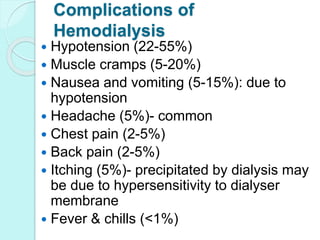
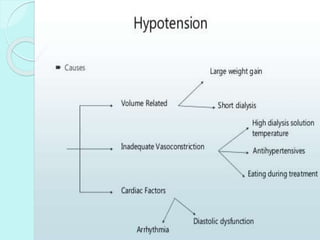
 Hypotension (22-55%)
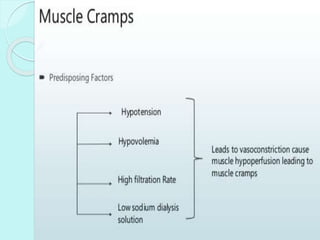
 Muscle cramps (5-20%)
 Nausea and vomiting (5-15%): due to
hypotension
 Headache (5%)- common
 Chest pain (2-5%)
 Back pain (2-5%)
 Itching (5%)- precipitated by dialysis may
be due to hypersensitivity to dialyser
membrane
 Fever & chills (<1%)
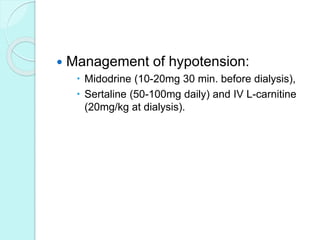
 Management of hypotension:
 Midodrine (10-20mg 30 min. before dialysis),
 Sertaline (50-100mg daily) and IV L-carnitine
(20mg/kg at dialysis).
 Management of muscle cramps:
 Reduced ultrafiltration and infusion of
hypertonic saline or glucose to improve
circulation, exercise/stretching of affectef limb,
or vitamin E 400IU at bedtime with vitamin C
250mg daily for prevention.
Less common but serious complication
 Disequilibrium Syndrome:
Set of systemic and neurologic symptoms with
characteristics electroencephalographic findings occur
either during/following dialysis
- Early manifestation: nausea, vomiting, restlessness and
headache
- Serious manifestation: seizure, obtundation, coma
 Cause:
Acute increase in brain water content.
 Treatment:
-aimed at prevention by initiating dialysis gradually.
- direct treatment involves IV hypertonic saline or
mannitol.
 Aluminum toxicity (dementia, bone
disease, anemia): deferoxamine can
be used to chelate serum aluminum.
Extra information:
 Government of Nepal provides Deprived citizen
fund through Department of health services
under Ministry of health and population in the
name of “Bipanna Nagarik Kosh”.
The service included for kidney treatment
are:
1. Free hemodialysis for Lifetime - CKD
2. Service upto 4 lakh from hospital ,1 lakh cash
for medication and 50 thousand cash for SLE
test after transplant from DoHS -kidney
tansplant
3. Free peritoneal dialysis for 2 yrs
4. Free hemodialysis for temporary time- ARF
5. Medication upto 1 lakh – Acute glumerulo
nephritis and nephritis syndrome, SLE
THANK YOU


Hemodialysis

  • 1.
  • 2.
    Hemodialysis:  Hemodialysis isone of three renal replacement therapies (the other two being kidney transplant and peritoneal dialysis).  It is a medical procedure to remove fluid and waste products from blood and to correct electrolyte imbalance.  Hemodialysis is done using a hemodialysis machine and dialyzer aslo called as ‘Artificial kidney’  It can be an outpatient or inpatient therapy.
  • 3.
     Hemodialysis isan extracorporeal process (dialysis membrane is outside of the body). Indication For dialysis: • Acidosis (pH <7.1) • Electrolyte imbalance (k+ >6.5 mEq/L) • GFR<10ml/min • Overload of Fluids (pulmonary Oedema) • Uremic Symptoms (increased level of nitrogenous waste products)
  • 4.
    Principle of Haemodialysis 1.Diffusion: Passive movement of solute across a semipermeable membrane. 2. Ultra filtration: solute + Fluid removal across semipermeable membrane down a pressure gradient.
  • 5.
    Fig: Hemodialysis followingdiffusion and ultrafiltration
  • 6.
    Hemodialysis Apparatus  Dialyzer Dialysate  Blood delivery system
  • 7.
  • 8.
    1. Dialyzer (Artificialkidney):  Plastic chamber that contains bundles of capillary tube through which blood circulates while dialysis solution travels outside the bundle in opposite counter current direction.  Diffusion and Ultrafiltration happens here.  Membranes using in dialyser: ◦ Cellulose ◦ Substituted cellulose: Cellulose acetate ◦ Cellulosynthetic: Cellosyn/Hemophan ◦ Synthetics: Polyacrylonitrile, polysulfone, polymethyl methacrylate
  • 10.
    2. Dialysate:  Solutionused in dialysis which has same solute concentration as those in plasma.  Water used in the dialysate is purified by reverse osmosis.  Contents of dialysate: ◦ Na+ :136-140mmol/L ◦ K+ :0-4 mmol/L ◦ Mg++ : 0.25-0.75 mmol/L ◦ Ca+ : 2.5-3.5mEq/L ◦ Chloride: 100-124 mEq/L ◦ Bicarbonate: 27-40mmol/L ◦ pH: 7.1-7.3 ◦ Dextrose: 0-5.5 mmol/L
  • 11.
    3. Blood deliverysystem:  Blood pump: Moves blood from access site through the dialyzer and back to the patient.  Blood flow rate: 250-500ml/min  Heparin syringe pump  2 air traps  Air detector  Venous line clamp
  • 12.
  • 13.
    Access for Hemodialysis Arterio venous fistula (AVF)-made by joining an artery and vein in arm (first preferred choice for a permanent vascular access).  Arterio venous graft (AVG)-made by using a soft tube to join an artery and vein in arm ( second preferred choice for a permanent vascular access).  Cuffed tunneled dialysis catheter- a soft tube that is placed in a large vein, usually in neck (temporary access).  Temporary access sites ◦ Internal jugular vein ◦ Femoral vein ◦ Subclavian vein
  • 14.
    Arterio venous fistula: Subcutaneous anastomosis (surgical connection i.e. created between two stuctures) of an artery to an adjacent native vein.  Takes 6 weeks for development (arterialization of vein)  Both the dialysis needles are inserted into the native vein.  Types: ◦ Radiocephalic (first choice) ◦ Brachiocephalic (second choice) ◦ Brachiobasilic (third choice)
  • 16.
    Procedure  Blood flowrate: 300-500 ml/min  Dialysate : 500-800 ml/min  Usually done 3 times a week and each dialysis lasts for 4 hours.
  • 18.
    Complications of Hemodialysis  Hypotension(22-55%)  Muscle cramps (5-20%)  Nausea and vomiting (5-15%): due to hypotension  Headache (5%)- common  Chest pain (2-5%)  Back pain (2-5%)  Itching (5%)- precipitated by dialysis may be due to hypersensitivity to dialyser membrane  Fever & chills (<1%)
  • 20.
     Management ofhypotension:  Midodrine (10-20mg 30 min. before dialysis),  Sertaline (50-100mg daily) and IV L-carnitine (20mg/kg at dialysis).
  • 22.
     Management ofmuscle cramps:  Reduced ultrafiltration and infusion of hypertonic saline or glucose to improve circulation, exercise/stretching of affectef limb, or vitamin E 400IU at bedtime with vitamin C 250mg daily for prevention.
  • 23.
    Less common butserious complication  Disequilibrium Syndrome: Set of systemic and neurologic symptoms with characteristics electroencephalographic findings occur either during/following dialysis - Early manifestation: nausea, vomiting, restlessness and headache - Serious manifestation: seizure, obtundation, coma  Cause: Acute increase in brain water content.  Treatment: -aimed at prevention by initiating dialysis gradually. - direct treatment involves IV hypertonic saline or mannitol.
  • 24.
     Aluminum toxicity(dementia, bone disease, anemia): deferoxamine can be used to chelate serum aluminum.
  • 25.
    Extra information:  Governmentof Nepal provides Deprived citizen fund through Department of health services under Ministry of health and population in the name of “Bipanna Nagarik Kosh”. The service included for kidney treatment are: 1. Free hemodialysis for Lifetime - CKD 2. Service upto 4 lakh from hospital ,1 lakh cash for medication and 50 thousand cash for SLE test after transplant from DoHS -kidney tansplant 3. Free peritoneal dialysis for 2 yrs 4. Free hemodialysis for temporary time- ARF 5. Medication upto 1 lakh – Acute glumerulo nephritis and nephritis syndrome, SLE
  • 26.

Editor's Notes

  • #14 Cuffed tunneled dialysis catheter- can be used for longer than 3 weeks when: An AV fistula or graft has been placed but is not yet ready for use. There are no other options for permanent access. For example, when a patient’s blood vessels are not strong enough for a fistula or graft.