.
SEMINAR
ON
HEMODIALYSIS
Hemodialysis is a treatment to filter wastes and water from blood, as kidneys
did when they were healthy. Hemodialysis helps control blood pressure and
balance important minerals, such as potassium, sodium, and calcium, in
blood. Hemodialysis can help to feel better and live longer, but it’s not a cure
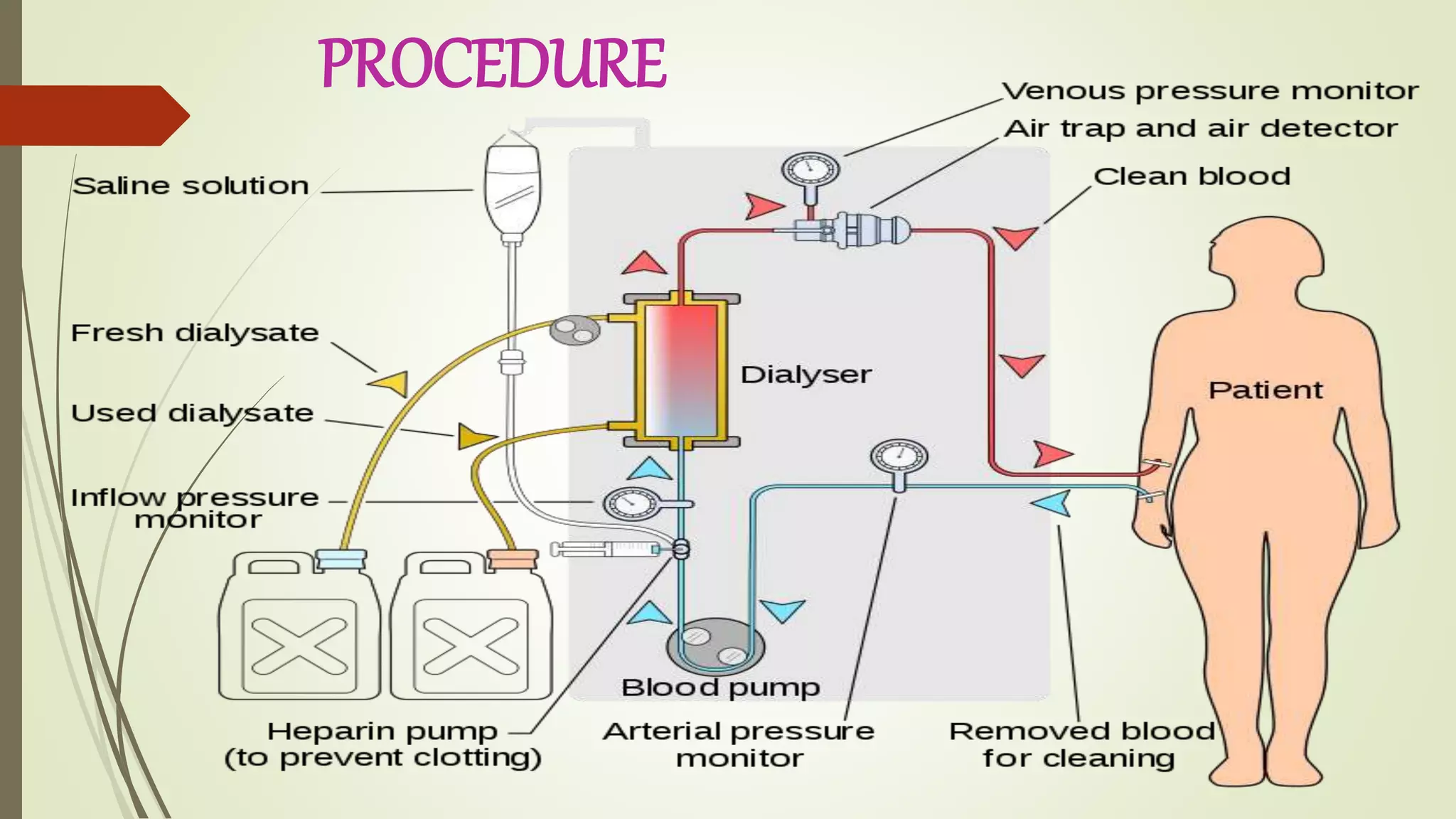
for kidney failure. During hemodialysis, blood goes through a filter, called a
dialyzer, outside the body. The dialysis machine pumps blood through the
filter and returns the blood to patient’s body.
INTRODUCTION
Haemodialysis is the most common renal replacement therapy used with ESKD and kidney
failure. dialysis remove excess fluids and waste products & chemical and electrolyte
balance.
( Iganativicous)
Hemodialysis is a medical procedure to remove fluid and waste products from the blood
and to correct electrolyte imbalances. This is accomplished using a machine and a
dialyzer, also referred to as an "artificial kidney.“
( Medicinenet)
DEFINITION
Acute kidney injury (AKI)
chronic kidney injury (CKD)
Encephalopathy
neuropathy
uncontrolled Hyperkalaemia
INDICATIONS
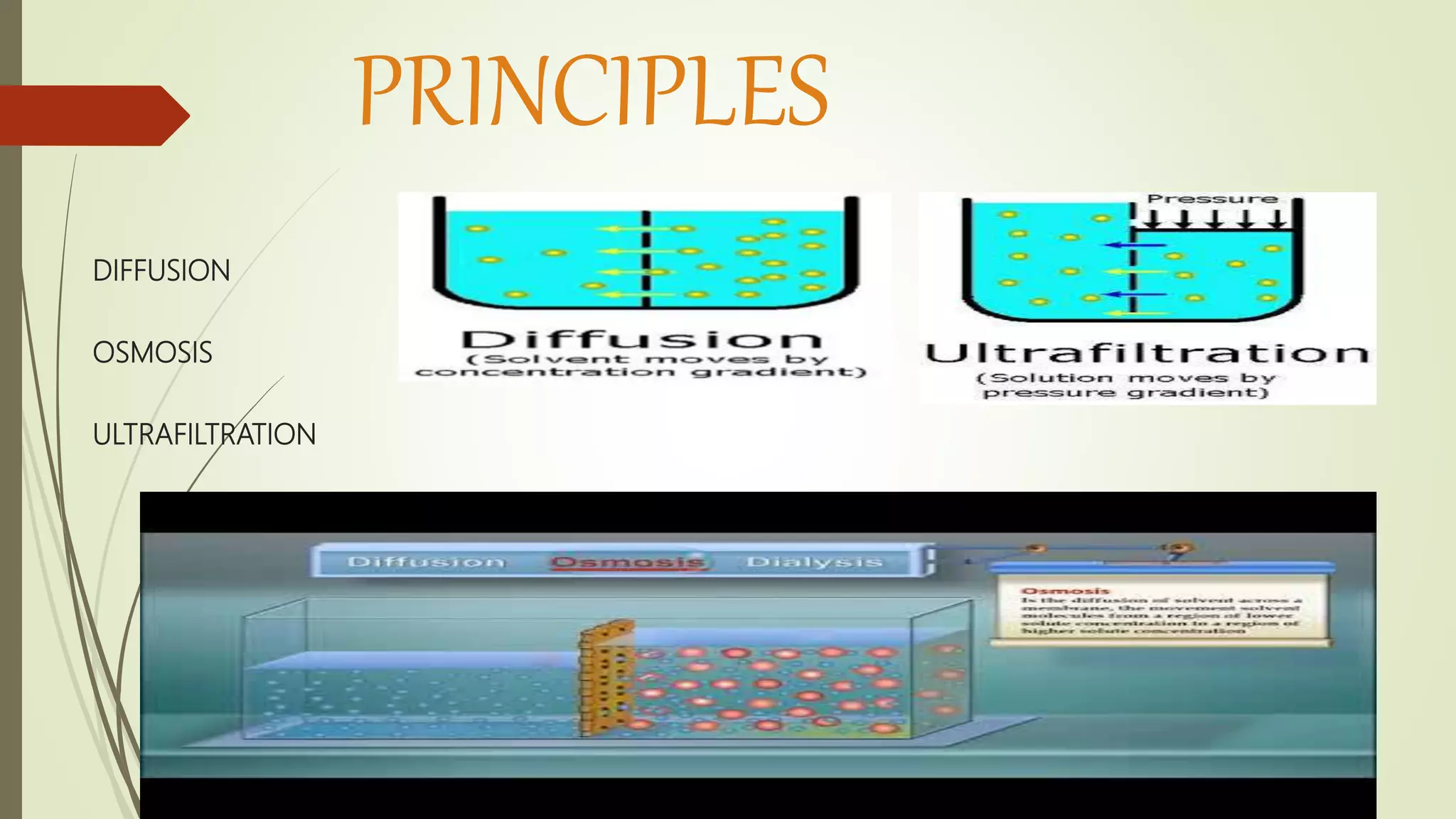
DIFFUSION
OSMOSIS
ULTRAFILTRATION
PRINCIPLES
VASCULAR ACESS
PERMENTANT TYPE
 AV FISTULA
 AV GRAFT
TEMPORARY TYPE
 Haemodialysis catheter mainly subclavian,
jugular and femoral catheter.
 Sub cutaneous device.
PERMENTANT VASCULAR ACCESS
AV FISTULA
 An arteriovenous fistula (AV) Fistula is an internal access surgically created by a vascular
surgeon using the patient’s own blood vessel.
 AV fistula is created by adjoining artery and vein
 2 blood vessels are joined in a side to side or end to end connection.
 The diversion of arterial blood into the vein causes the vein to become enlarged ,distended
and prominent, allowing placement of large gauge needles for the dialysis treatment.
 Access will be able to deliver a blood flow of 300 to 500ml /mt.
 Maturation occur when there is dilation and thickening of the venous segment occurred.
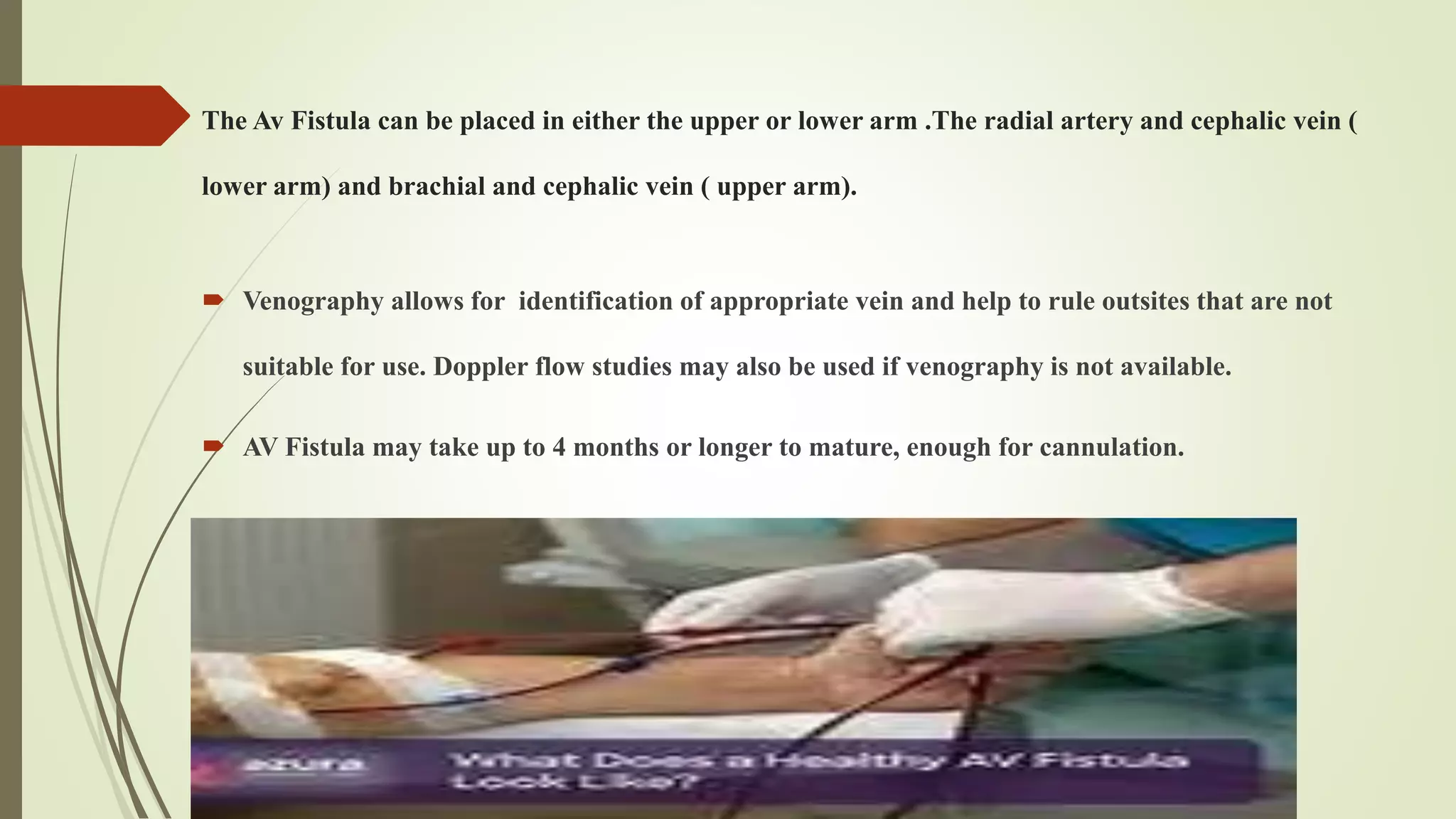
The Av Fistula can be placed in either the upper or lower arm .The radial artery and cephalic vein (
lower arm) and brachial and cephalic vein ( upper arm).
 Venography allows for identification of appropriate vein and help to rule outsites that are not
suitable for use. Doppler flow studies may also be used if venography is not available.
 AV Fistula may take up to 4 months or longer to mature, enough for cannulation.
AV GRAFT
 Generally called as arteriovenous graft.
 When a patient is not a candidate for native AV-Fistula, a Vascular graft is substituted. It can
be biological or synthetic material.
 Graft material is implanted subcutaneously into either forearm or upper arm.
 The Graft bridges an artery on one end and a vein on the other end.
 The blood flow is from artery to vein with the AV Graft.
 The graft may be placed in several configuration.eg straight ,loopsed or curved.
 Duration taken for maturation is 2 to 6 weeks after graft placement.
CONTINUE…..
CONTINUE…..
ADVANTAGES
 Large surface area for
cannulation.
 Easy to cannulate
 Little time required for
maturation.
 Variety of shapes and
configuration
 Easy for surgical
implantation.
DISADVANTAGES
 Higher rate of infection
 May reject graft materials
 Higher rate of infection.
 Stenosis at the venous
anastomosis, from intimal
hyperplasia.
 No development of collateral
circulation.
TEMPORARY VASCULAR ACCESS
INDICATIONS
1. An access for acute dialysis
2. Plasmapheresis
3. Patients waiting for kidney transplantation.
4. Patients receiving venovenous continuous renal replacement therapy.
5. Patients on peritoneal dialysis requiring temporary haemodialysis because of peritonitis.
TEMPORARY VASCULAR ACCESS
HEMODIALYSIS CATHETER
1. Subclavian Catheter.
2. Jugular Catheter
3. Femoral Catheter
SUBCUTANEOUS DEVICE
HEMODIALYSIS CATHETER
 Subclavian vein ,jugular vein and femoral vein are the vessels accessed for using double lumen
catheter.
 Haemodialysis catheter has replaced, the use of AV Shunt for patients receiving immediate
haemodialysis.
 A catheter designed for H.D may be inserted into subclavian, internal jugular or femoral vein
 The lumen of these catheters are much smaller than the permentant access and more time is
required for complete each dialysis.(4 to8 hours).
Continue…
COMPLICATIONS
 Pneumothorax
 Hemothorax
 Airembolism
 Bleeding
 Retroperitoneal haemorrhage from the puncture of vein during insertion
SUBCUTANEOUS DEVICE
 Subcutaneous device the implanted beneath the skin.
 These devices are composed of 2 small metallic ports with attached catheters that are
inserted into large central vein.
 The ports of subcutaneous devices have internal mechanism that opens when needles
are removed.
 The blood from one port flows from the body to the H.D machine and return via the
other port.
Continue….
PROCEDURE
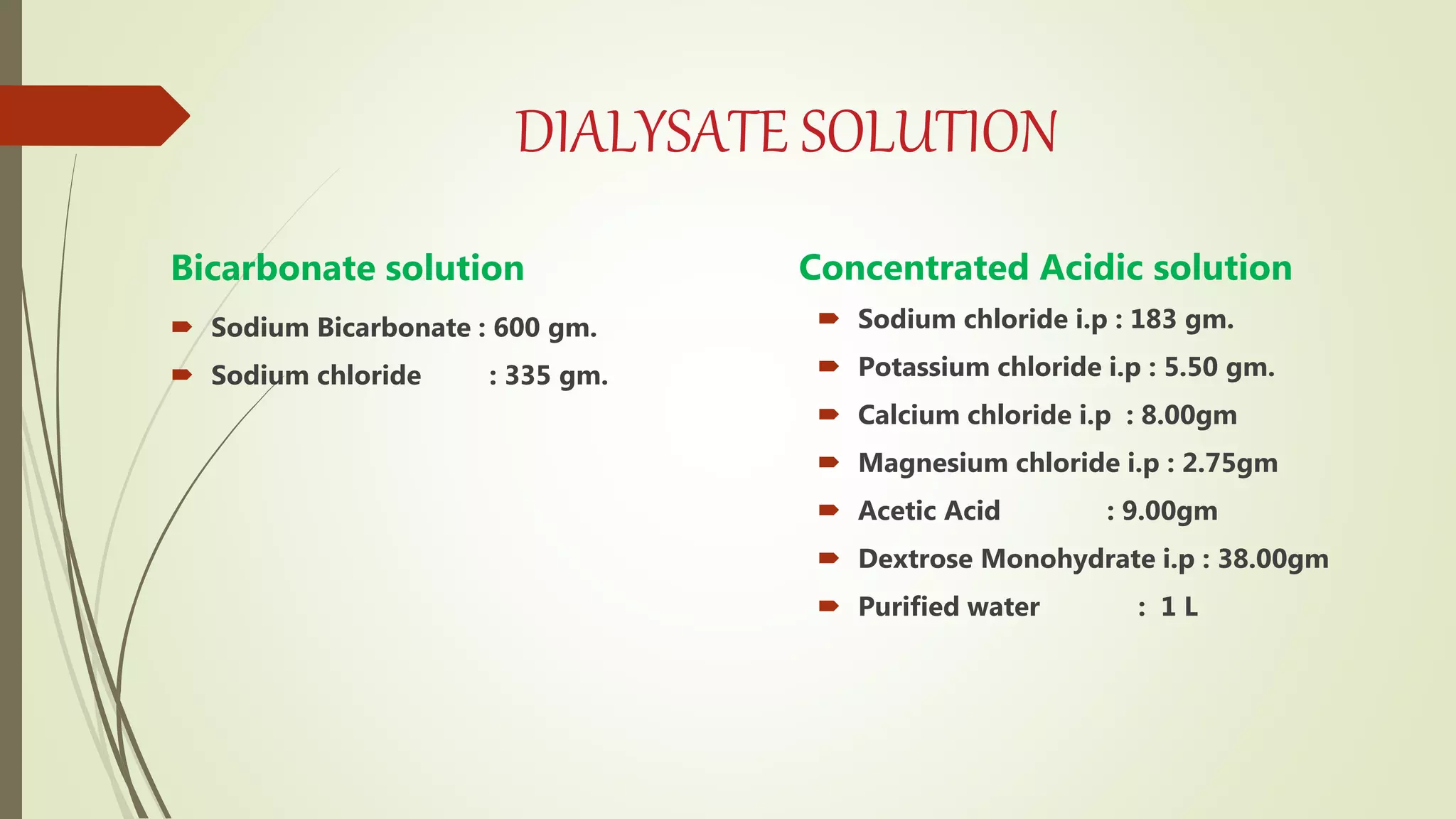
DIALYSATE SOLUTION
Bicarbonate solution
 Sodium Bicarbonate : 600 gm.
 Sodium chloride : 335 gm.
Concentrated Acidic solution
 Sodium chloride i.p : 183 gm.
 Potassium chloride i.p : 5.50 gm.
 Calcium chloride i.p : 8.00gm
 Magnesium chloride i.p : 2.75gm
 Acetic Acid : 9.00gm
 Dextrose Monohydrate i.p : 38.00gm
 Purified water : 1 L
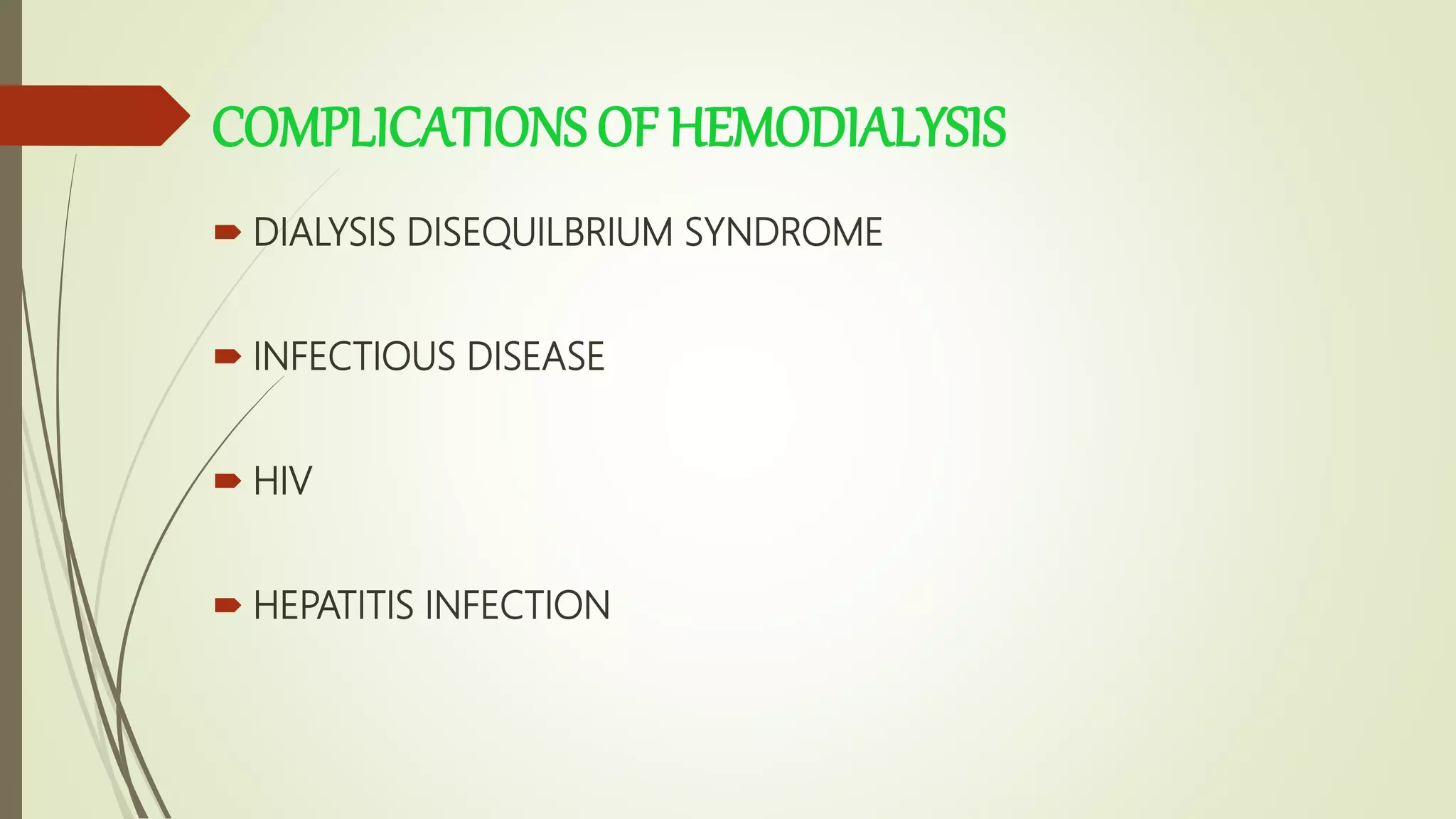
COMPLICATIONS OF HEMODIALYSIS
 DIALYSIS DISEQUILBRIUM SYNDROME
 INFECTIOUS DISEASE
 HIV
 HEPATITIS INFECTION
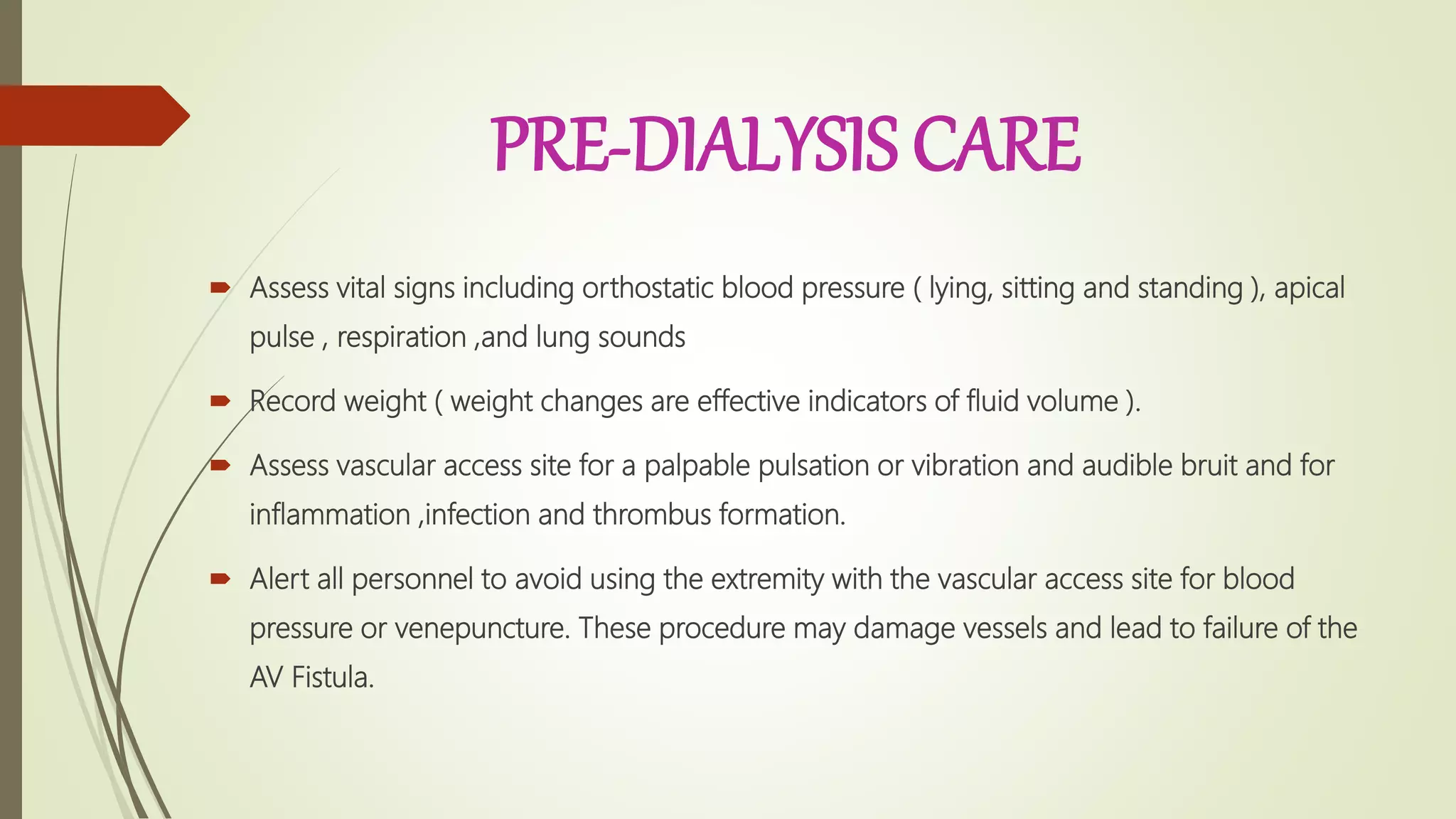
PRE-DIALYSIS CARE
 Assess vital signs including orthostatic blood pressure ( lying, sitting and standing ), apical
pulse , respiration ,and lung sounds
 Record weight ( weight changes are effective indicators of fluid volume ).
 Assess vascular access site for a palpable pulsation or vibration and audible bruit and for
inflammation ,infection and thrombus formation.
 Alert all personnel to avoid using the extremity with the vascular access site for blood
pressure or venepuncture. These procedure may damage vessels and lead to failure of the
AV Fistula.
POST-DIALYSIS CARE
 Assess and document vital-signs, weight and vascular access site condition. Rapid fluid and solute
removal may leads to orthostatic hypotension ,cardiopulmonary changes and weight loss.
 Monitor BUN ,Serum Creatinine, serum electrolyte and haematocrit levels between dialysis treatment.
 Assess for dialysis disequilibrium syndrome with headache, nausea and vomiting, altered level of
consciousness and hypertension.
 Assess for nausea, vomiting, muscle cramp and seizure activity.
 Assess for bleeding at the access site. Use standard precautions at all times.
 If transfusion is given during dialysis monitor for possible transfusion reaction.
 Provide psychological support and listen actively.
 Refer to social service and counselling as indicated, clients with renal failure may need additional
support services to help them to adopt to and live with their disease.
CONCLUSION
Haemodialysis is used for clients with acute or chronic renal failure, fluid and electrolyte and
imbalances etc. It is usually the treatment of choice, when toxic agents such as barbiturates,
after an overdose needed to be removed from the body quickly, in this process the clients
toxin-laden blood is diverted into dialyzer, cleaned and returned to the client.
BIBLIOGRAPHY
1. Joyce M Black , “Textbook of Medical –Surgical Nursing”, Elsevier Publications,8th
Edition,2010, pg no 823 -824.
2. Lippincott Williams & Wikins Hand book of Dialysis ,Wolters Kluwers Publications ,Fifth
Edition, 2015 ,Pg no:392 -400.
3. Iganativicious “Text book of Medical Surgical Nursing”, Elsevier Publications,7th
Edition,2009, pg no 612 -614.
..

Hemodialysis

  • 1.
  • 2.
    Hemodialysis is atreatment to filter wastes and water from blood, as kidneys did when they were healthy. Hemodialysis helps control blood pressure and balance important minerals, such as potassium, sodium, and calcium, in blood. Hemodialysis can help to feel better and live longer, but it’s not a cure for kidney failure. During hemodialysis, blood goes through a filter, called a dialyzer, outside the body. The dialysis machine pumps blood through the filter and returns the blood to patient’s body. INTRODUCTION
  • 3.
    Haemodialysis is themost common renal replacement therapy used with ESKD and kidney failure. dialysis remove excess fluids and waste products & chemical and electrolyte balance. ( Iganativicous) Hemodialysis is a medical procedure to remove fluid and waste products from the blood and to correct electrolyte imbalances. This is accomplished using a machine and a dialyzer, also referred to as an "artificial kidney.“ ( Medicinenet) DEFINITION
  • 4.
    Acute kidney injury(AKI) chronic kidney injury (CKD) Encephalopathy neuropathy uncontrolled Hyperkalaemia INDICATIONS
  • 5.
  • 6.
    VASCULAR ACESS PERMENTANT TYPE AV FISTULA  AV GRAFT TEMPORARY TYPE  Haemodialysis catheter mainly subclavian, jugular and femoral catheter.  Sub cutaneous device.
  • 7.
    PERMENTANT VASCULAR ACCESS AVFISTULA  An arteriovenous fistula (AV) Fistula is an internal access surgically created by a vascular surgeon using the patient’s own blood vessel.  AV fistula is created by adjoining artery and vein  2 blood vessels are joined in a side to side or end to end connection.  The diversion of arterial blood into the vein causes the vein to become enlarged ,distended and prominent, allowing placement of large gauge needles for the dialysis treatment.  Access will be able to deliver a blood flow of 300 to 500ml /mt.  Maturation occur when there is dilation and thickening of the venous segment occurred.
  • 8.
    The Av Fistulacan be placed in either the upper or lower arm .The radial artery and cephalic vein ( lower arm) and brachial and cephalic vein ( upper arm).  Venography allows for identification of appropriate vein and help to rule outsites that are not suitable for use. Doppler flow studies may also be used if venography is not available.  AV Fistula may take up to 4 months or longer to mature, enough for cannulation.
  • 9.
    AV GRAFT  Generallycalled as arteriovenous graft.  When a patient is not a candidate for native AV-Fistula, a Vascular graft is substituted. It can be biological or synthetic material.  Graft material is implanted subcutaneously into either forearm or upper arm.  The Graft bridges an artery on one end and a vein on the other end.  The blood flow is from artery to vein with the AV Graft.  The graft may be placed in several configuration.eg straight ,loopsed or curved.  Duration taken for maturation is 2 to 6 weeks after graft placement.
  • 10.
  • 11.
    CONTINUE….. ADVANTAGES  Large surfacearea for cannulation.  Easy to cannulate  Little time required for maturation.  Variety of shapes and configuration  Easy for surgical implantation. DISADVANTAGES  Higher rate of infection  May reject graft materials  Higher rate of infection.  Stenosis at the venous anastomosis, from intimal hyperplasia.  No development of collateral circulation.
  • 12.
    TEMPORARY VASCULAR ACCESS INDICATIONS 1.An access for acute dialysis 2. Plasmapheresis 3. Patients waiting for kidney transplantation. 4. Patients receiving venovenous continuous renal replacement therapy. 5. Patients on peritoneal dialysis requiring temporary haemodialysis because of peritonitis.
  • 13.
    TEMPORARY VASCULAR ACCESS HEMODIALYSISCATHETER 1. Subclavian Catheter. 2. Jugular Catheter 3. Femoral Catheter SUBCUTANEOUS DEVICE
  • 14.
    HEMODIALYSIS CATHETER  Subclavianvein ,jugular vein and femoral vein are the vessels accessed for using double lumen catheter.  Haemodialysis catheter has replaced, the use of AV Shunt for patients receiving immediate haemodialysis.  A catheter designed for H.D may be inserted into subclavian, internal jugular or femoral vein  The lumen of these catheters are much smaller than the permentant access and more time is required for complete each dialysis.(4 to8 hours).
  • 15.
  • 16.
    COMPLICATIONS  Pneumothorax  Hemothorax Airembolism  Bleeding  Retroperitoneal haemorrhage from the puncture of vein during insertion
  • 17.
    SUBCUTANEOUS DEVICE  Subcutaneousdevice the implanted beneath the skin.  These devices are composed of 2 small metallic ports with attached catheters that are inserted into large central vein.  The ports of subcutaneous devices have internal mechanism that opens when needles are removed.  The blood from one port flows from the body to the H.D machine and return via the other port.
  • 18.
  • 19.
  • 20.
    DIALYSATE SOLUTION Bicarbonate solution Sodium Bicarbonate : 600 gm.  Sodium chloride : 335 gm. Concentrated Acidic solution  Sodium chloride i.p : 183 gm.  Potassium chloride i.p : 5.50 gm.  Calcium chloride i.p : 8.00gm  Magnesium chloride i.p : 2.75gm  Acetic Acid : 9.00gm  Dextrose Monohydrate i.p : 38.00gm  Purified water : 1 L
  • 21.
    COMPLICATIONS OF HEMODIALYSIS DIALYSIS DISEQUILBRIUM SYNDROME  INFECTIOUS DISEASE  HIV  HEPATITIS INFECTION
  • 22.
    PRE-DIALYSIS CARE  Assessvital signs including orthostatic blood pressure ( lying, sitting and standing ), apical pulse , respiration ,and lung sounds  Record weight ( weight changes are effective indicators of fluid volume ).  Assess vascular access site for a palpable pulsation or vibration and audible bruit and for inflammation ,infection and thrombus formation.  Alert all personnel to avoid using the extremity with the vascular access site for blood pressure or venepuncture. These procedure may damage vessels and lead to failure of the AV Fistula.
  • 23.
    POST-DIALYSIS CARE  Assessand document vital-signs, weight and vascular access site condition. Rapid fluid and solute removal may leads to orthostatic hypotension ,cardiopulmonary changes and weight loss.  Monitor BUN ,Serum Creatinine, serum electrolyte and haematocrit levels between dialysis treatment.  Assess for dialysis disequilibrium syndrome with headache, nausea and vomiting, altered level of consciousness and hypertension.  Assess for nausea, vomiting, muscle cramp and seizure activity.  Assess for bleeding at the access site. Use standard precautions at all times.  If transfusion is given during dialysis monitor for possible transfusion reaction.  Provide psychological support and listen actively.  Refer to social service and counselling as indicated, clients with renal failure may need additional support services to help them to adopt to and live with their disease.
  • 24.
    CONCLUSION Haemodialysis is usedfor clients with acute or chronic renal failure, fluid and electrolyte and imbalances etc. It is usually the treatment of choice, when toxic agents such as barbiturates, after an overdose needed to be removed from the body quickly, in this process the clients toxin-laden blood is diverted into dialyzer, cleaned and returned to the client.
  • 25.
    BIBLIOGRAPHY 1. Joyce MBlack , “Textbook of Medical –Surgical Nursing”, Elsevier Publications,8th Edition,2010, pg no 823 -824. 2. Lippincott Williams & Wikins Hand book of Dialysis ,Wolters Kluwers Publications ,Fifth Edition, 2015 ,Pg no:392 -400. 3. Iganativicious “Text book of Medical Surgical Nursing”, Elsevier Publications,7th Edition,2009, pg no 612 -614.
  • 26.