Dr. Osama El-ShahatDr. Osama El-Shahat
Consultant Nephrologist
Head of Nephrology Department
New Mansoura General Hospital (international(
ISN Educational Ambassador
 Basics of hemodialysis:Basics of hemodialysis:
◦ Definition.Definition.
◦ Technique of hemodialysis:Technique of hemodialysis:
◦ Main principles:Main principles:
 Diffusion.Diffusion.
 Osmosis.Osmosis.
 Filtration.Filtration.
 Convection.Convection.
◦ Varieties of hemodialysis.Varieties of hemodialysis.
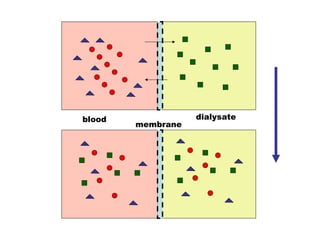
 When a semi permeable membrane is placed between different
solutions the solutes move across this membrane until they
reach equilibrium
 This is the theory by which dialysis is based on
 Difussion:
The process by which particles, atoms or molecule move from
area of higher concentration to lower concentration across
semipermeable membrane.
Factors affecting :Factors affecting :
Concentration gradient
MW of solutes.
blood
membrane
dialysate
solutesolute bloodblood dialysatedialysate directiondirection
UREAUREA highhigh zerozero To DxTo Dx
OTHER TOXINSOTHER TOXINS highhigh zerozero To DxTo Dx
SodiumSodium 135-140135-140 135-140135-140 NONO
PotassiumPotassium Above 5Above 5 1.4-3.01.4-3.0 To DxTo Dx
MagnesiumMagnesium Above 1Above 1 0.5-1.00.5-1.0 To DxTo Dx
glucoseglucose +/-140 (8)+/-140 (8) 180 (10)180 (10) +/-+/-
chloridechloride 100-119100-119 100-119100-119 NONO
Ionized CalciumIonized Calcium 4.5-5 mg/dl4.5-5 mg/dl
2-2.5mEq/L2-2.5mEq/L
5-6 mg/dl5-6 mg/dl
2.5-3 mEq/L2.5-3 mEq/L
+/-+/-
 Dialysate delivered at a rate of 500ml/min
◦ 120 liters of dialysate / 4-hour session!!
 Concentrated solutions mixed with water
 Usually 1:34 or 1:40
 Conductivity is a measurement of electric conductivity of Na to check
if dilution is correct
 With proper dilution conductivity = 13-15
 Serious hyponatremia or hypernatremia occurs if dilution is incorrect
 H+ neutralized by Na HCO3 in the body
 Acetate
◦ Transformed in LIVER to HCO3 (10-15 min)
◦ BUT is a potent vasodilator
 Hypotension especially with liver disease
 Acetate intolerance in high flux dialyzers
 Bicarbonate
◦ Immediately neutralizes H+
◦ BUT precipitates Calcium salts (CaCO3)
 Should be delivered separately as NaHCO3
 Short life span of machine
 Needs a strong post dialysis acid rinse (citric acid)
 Attempts are made to increase the surface area of
contact between dialysate and dialyzer
◦ The Hollow fiber
◦ The parallel plate dialyzer
 TypesTypes
◦ Surface area.
◦ Low flux vs high flux.
◦ Biocompatibility.
◦ Technique of manufacture including hemo- adsorption.
 Cellulose membrane (Cuprophan)
◦ Is the first membrane to be used
◦ Contains free hydroxyl radicals
 They are able to activate complement  inflammatory reaction
chronic inflammation  protein catabolism + anorexia + malnutrition
 Cardiovascular accidents
 Cause dialysis related Amyloidosis
 Increased incidence of infection
 Rapid loss of residual kidney function
 Substituted Cellulose
◦ Chemically bonding the free hydroxyl group
 Cellulose di acetate
 Cellulose Triacetate
◦ Addition of a synthetic material to cellulose
 Hemophane (semi synthetic)
 Synthetic modified cellulose (SMC)
 Synthetic material
◦ Contains no cellulose
 Polysolphone
 PMMA
 PAN
 There is no definite techniques for biocompatibility
measurement
 There is no clear evidence for its superiority except in
AKI
 Ability of the dialyzer to clear urea from blood
 The more clearance the better the dialyzer
 Clearance can be calculated in vivo=
Qb x [BUN ART – BUN VEN]
BUN ART
 Clearance is closely related to the surface area of HF
 HF with a high urea clearance
◦ They contain pores bigger in number and size
◦ Must be with bicarbonate dialysis
◦ They perform more adequate dialysis
◦ Clearance of bigger molecules toxins e.g. (B2 microglobulin)
◦ expensive
 The more the patient’s weight the larger surface area (and clearance)
you need
 Patients with increased weight gain (volume overload) need a dialyzer
with high KUF
 Much debate is present with use of biocompatible membrane EXCEPT
in AKI
 High Flux dialyzer gives a better adequacy but is expensive
 ESRD patients are frequently oliguric
 If excess water is ingested 
accumulation of water in body 
edema, hypertension, pulmonary edema
 To remove water  Ultrafiltration
 Addition of hydrostatic force  squeezing out water from dialysate!!!
 may be –ve (machine UF)
 Or +ve (partial venous clamping)
 The net force is reflected by the transmembrane pressure (TMP)
500 ml/min
700 ml/min
+ve
pressure
-ve
pressure
TMP
Problems with conventional diffusive hemodialysis
 Excessive cardiovascular mortality
 Insufficient removal of middle molecules
 Insufficient removal of phosphate
 High risk of intradialytic hypotension
 Suboptimal dialysate quality
 Chronic inflammation and protein-energy wasting
 FiltrationFiltration::
Is movement of fluid through a filter as a result of hydraulic
pressure.
In hemodialysis, ultrafiltration , is movement of water from
blood under pressure gradient effect.
 ConvectionConvection:
Transfer of heat and solute by
physical circulation or or movement
of parts of gas or liquid.
 Countercurrent circulationCountercurrent circulation
Hemoperfusion therapy (DHP) is a method of treatment to
eliminate causal substances of disease in the blood by adsorption
that takes place by passing the blood directly through an adsorbent.
DHP is characterized by a simple extracorporeal blood circuit and
easy operation. Activated charcoal, and either polymyxin B or
hexadecyl alkyl compound immobilized adsorbents, are clinically
available at present.
The DHP using activated charcoal is mainly applied in cases of
intoxication with either toxic substances or a drug overdose.
Hemodialysis or plasma exchange is also applied in these situations.
.
Application of either DHP, hemodialysis or plasma
exchange is done according to the characteristics of the
toxins or drugs.
DHP using PMX is applied in cases of septic shock, and
its efficiency is suggested to be due to the removal of
anandamide in addition to endotoxins in the blood.
DHP using BM-01 is applied to a specific disease, dialysis
related amyloidosis, for the purpose of elimination of β2-
microglobulin.
 Varieties of hemodialysis techniques:Varieties of hemodialysis techniques:
◦ Conventional hemodialysis.
◦ Online hemodiafilteration.
◦ SLEDD.
◦ CRRT.
◦ Hemo-adsorption.
HDFHDF is a blood purification therapy combining
diffusive and convective solute transport using a high-flux
membrane characterized by an ultrafiltration coefficient greater
than 2020 mL/h/mm Hg/m2 and a sieving coefficient (S) for β2-
microglobulin of greater than 0.6.
Convective transport is achieved by an effective convection
volume of at least 20%20% of the total blood volume processed.
Appropriate fluid balance is maintained by external infusion of
a sterile, non-pyrogenic solution into the patient's blood.
 Kt/VKt/V is a number used to quantify hemodialysis andis a number used to quantify hemodialysis and
peritoneal dialysis treatment adequacy.peritoneal dialysis treatment adequacy.
K - dialyzer clearance of urea
t - dialysis time
V - volume of distribution of urea, approximately equal to patient's
total body water
◦ Kt/V target is ≥ 1.3, so that one can be sure that the
delivered dose is at least 1.2. In peritoneal dialysis the target
is ≥ 1.7/week.
©

Principles of-hemodialysis

  • 1.
    Dr. Osama El-ShahatDr.Osama El-Shahat Consultant Nephrologist Head of Nephrology Department New Mansoura General Hospital (international( ISN Educational Ambassador
  • 2.
     Basics ofhemodialysis:Basics of hemodialysis: ◦ Definition.Definition. ◦ Technique of hemodialysis:Technique of hemodialysis: ◦ Main principles:Main principles:  Diffusion.Diffusion.  Osmosis.Osmosis.  Filtration.Filtration.  Convection.Convection. ◦ Varieties of hemodialysis.Varieties of hemodialysis.
  • 3.
     When asemi permeable membrane is placed between different solutions the solutes move across this membrane until they reach equilibrium  This is the theory by which dialysis is based on
  • 4.
     Difussion: The processby which particles, atoms or molecule move from area of higher concentration to lower concentration across semipermeable membrane. Factors affecting :Factors affecting : Concentration gradient MW of solutes.
  • 5.
  • 7.
    solutesolute bloodblood dialysatedialysatedirectiondirection UREAUREA highhigh zerozero To DxTo Dx OTHER TOXINSOTHER TOXINS highhigh zerozero To DxTo Dx SodiumSodium 135-140135-140 135-140135-140 NONO PotassiumPotassium Above 5Above 5 1.4-3.01.4-3.0 To DxTo Dx MagnesiumMagnesium Above 1Above 1 0.5-1.00.5-1.0 To DxTo Dx glucoseglucose +/-140 (8)+/-140 (8) 180 (10)180 (10) +/-+/- chloridechloride 100-119100-119 100-119100-119 NONO Ionized CalciumIonized Calcium 4.5-5 mg/dl4.5-5 mg/dl 2-2.5mEq/L2-2.5mEq/L 5-6 mg/dl5-6 mg/dl 2.5-3 mEq/L2.5-3 mEq/L +/-+/-
  • 8.
     Dialysate deliveredat a rate of 500ml/min ◦ 120 liters of dialysate / 4-hour session!!  Concentrated solutions mixed with water  Usually 1:34 or 1:40  Conductivity is a measurement of electric conductivity of Na to check if dilution is correct  With proper dilution conductivity = 13-15  Serious hyponatremia or hypernatremia occurs if dilution is incorrect
  • 9.
     H+ neutralizedby Na HCO3 in the body  Acetate ◦ Transformed in LIVER to HCO3 (10-15 min) ◦ BUT is a potent vasodilator  Hypotension especially with liver disease  Acetate intolerance in high flux dialyzers  Bicarbonate ◦ Immediately neutralizes H+ ◦ BUT precipitates Calcium salts (CaCO3)  Should be delivered separately as NaHCO3  Short life span of machine  Needs a strong post dialysis acid rinse (citric acid)
  • 10.
     Attempts aremade to increase the surface area of contact between dialysate and dialyzer ◦ The Hollow fiber ◦ The parallel plate dialyzer
  • 12.
     TypesTypes ◦ Surfacearea. ◦ Low flux vs high flux. ◦ Biocompatibility. ◦ Technique of manufacture including hemo- adsorption.
  • 13.
     Cellulose membrane(Cuprophan) ◦ Is the first membrane to be used ◦ Contains free hydroxyl radicals  They are able to activate complement  inflammatory reaction chronic inflammation  protein catabolism + anorexia + malnutrition  Cardiovascular accidents  Cause dialysis related Amyloidosis  Increased incidence of infection  Rapid loss of residual kidney function
  • 14.
     Substituted Cellulose ◦Chemically bonding the free hydroxyl group  Cellulose di acetate  Cellulose Triacetate ◦ Addition of a synthetic material to cellulose  Hemophane (semi synthetic)  Synthetic modified cellulose (SMC)  Synthetic material ◦ Contains no cellulose  Polysolphone  PMMA  PAN
  • 15.
     There isno definite techniques for biocompatibility measurement  There is no clear evidence for its superiority except in AKI
  • 16.
     Ability ofthe dialyzer to clear urea from blood  The more clearance the better the dialyzer  Clearance can be calculated in vivo= Qb x [BUN ART – BUN VEN] BUN ART  Clearance is closely related to the surface area of HF
  • 17.
     HF witha high urea clearance ◦ They contain pores bigger in number and size ◦ Must be with bicarbonate dialysis ◦ They perform more adequate dialysis ◦ Clearance of bigger molecules toxins e.g. (B2 microglobulin) ◦ expensive
  • 18.
     The morethe patient’s weight the larger surface area (and clearance) you need  Patients with increased weight gain (volume overload) need a dialyzer with high KUF  Much debate is present with use of biocompatible membrane EXCEPT in AKI  High Flux dialyzer gives a better adequacy but is expensive
  • 19.
     ESRD patientsare frequently oliguric  If excess water is ingested  accumulation of water in body  edema, hypertension, pulmonary edema  To remove water  Ultrafiltration  Addition of hydrostatic force  squeezing out water from dialysate!!!  may be –ve (machine UF)  Or +ve (partial venous clamping)  The net force is reflected by the transmembrane pressure (TMP)
  • 20.
  • 22.
    Problems with conventionaldiffusive hemodialysis  Excessive cardiovascular mortality  Insufficient removal of middle molecules  Insufficient removal of phosphate  High risk of intradialytic hypotension  Suboptimal dialysate quality  Chronic inflammation and protein-energy wasting
  • 27.
     FiltrationFiltration:: Is movementof fluid through a filter as a result of hydraulic pressure. In hemodialysis, ultrafiltration , is movement of water from blood under pressure gradient effect.
  • 29.
     ConvectionConvection: Transfer ofheat and solute by physical circulation or or movement of parts of gas or liquid.  Countercurrent circulationCountercurrent circulation
  • 31.
    Hemoperfusion therapy (DHP)is a method of treatment to eliminate causal substances of disease in the blood by adsorption that takes place by passing the blood directly through an adsorbent. DHP is characterized by a simple extracorporeal blood circuit and easy operation. Activated charcoal, and either polymyxin B or hexadecyl alkyl compound immobilized adsorbents, are clinically available at present. The DHP using activated charcoal is mainly applied in cases of intoxication with either toxic substances or a drug overdose. Hemodialysis or plasma exchange is also applied in these situations. .
  • 32.
    Application of eitherDHP, hemodialysis or plasma exchange is done according to the characteristics of the toxins or drugs. DHP using PMX is applied in cases of septic shock, and its efficiency is suggested to be due to the removal of anandamide in addition to endotoxins in the blood. DHP using BM-01 is applied to a specific disease, dialysis related amyloidosis, for the purpose of elimination of β2- microglobulin.
  • 35.
     Varieties ofhemodialysis techniques:Varieties of hemodialysis techniques: ◦ Conventional hemodialysis. ◦ Online hemodiafilteration. ◦ SLEDD. ◦ CRRT. ◦ Hemo-adsorption.
  • 36.
    HDFHDF is ablood purification therapy combining diffusive and convective solute transport using a high-flux membrane characterized by an ultrafiltration coefficient greater than 2020 mL/h/mm Hg/m2 and a sieving coefficient (S) for β2- microglobulin of greater than 0.6. Convective transport is achieved by an effective convection volume of at least 20%20% of the total blood volume processed. Appropriate fluid balance is maintained by external infusion of a sterile, non-pyrogenic solution into the patient's blood.
  • 39.
     Kt/VKt/V isa number used to quantify hemodialysis andis a number used to quantify hemodialysis and peritoneal dialysis treatment adequacy.peritoneal dialysis treatment adequacy. K - dialyzer clearance of urea t - dialysis time V - volume of distribution of urea, approximately equal to patient's total body water ◦ Kt/V target is ≥ 1.3, so that one can be sure that the delivered dose is at least 1.2. In peritoneal dialysis the target is ≥ 1.7/week.
  • 40.

Editor's Notes

  • #24 The patients blood contains a high concentration of unwanted solutes that can be effectively removed by diffusion. Diffusions key mechanism is to move a solute from a higher concentration gradient to a lower concentration gradient. For example, let us assume the blood in the filter has a high concentration of potassium molecules and on the fluid/dialysate compartment has a low concentration of potassium. The potassium gradually diffuses through the membrane from the area of a higher potassium concentration to the area of a lower potassium concentration until it is evenly distributed.
  • #27 Remember the transport of a molecule through a membrane is governed largely by its molecular weight. Generally, the more a molecule weighs, the larger it is in size and the more resistant it is to transport. The chart gives an indication of relative molecular weights for some of the common molecules that we are concerned with in CRRT. Molecular weights are measured in units called Daltons. Small molecules <300 Daltons, e.g. urea, creatinine, Na+, electrolytes Intermediate or middle molecules 500-5000 Daltons e.g. B12 Large molecules 5000-50000 Daltons e.g. LMW proteins, beta 2 micro globulins, cytokines, myoglobin
  • #29 Here is a visual example of how ultrafiltration works. On the blood side of the hemofilter you have a positive pressure gradient. on the fluid side of the hemofilter you have a negative pressure gradient. The effluent pump applies pressure on the membrane causing the fluid to move from the positive pressure gradient to the lower pressure gradient.
  • #31 This visual will provide you with a better understanding of how convection works. From the picture you can see a faucet which represents replacement solution. The top faucet is an example of pre-filter dilution, which means that the replacement solution mixes with the blood as it enters the filter. The bottom faucet is an example of post-filter dilution and is delivered as the blood is returning to the patient. Now the effluent pump is removing ultrafiltration (just like SCUF), or patient plasma water and replacement solution.
  • #35 This picture gives you a great visual picture of how adsorption occurs during CRRT. some molecules will attach to the membrane surface. While other molecules may permeate the membrane, but become stuck within the fibers. It is believed that inflammatory mediators are effectively removed via adsorption.