Kidney Transplantation
Seragaldin M.Seragaldin M.
School of Nursing, University ofSchool of Nursing, University of
Raparin. 9.5.2015Raparin. 9.5.20151
Objects
ď‚—Definition
ď‚—Source of kidney donner
ď‚—Criteria of Donner
ď‚—Criteria of Recipient
ď‚—Nursing care for patient having
Kidney Transplantation
ď‚—Rejection of Kidney Transplantation
ď‚—Complications of the Rejection
ď‚—Interventions for the patient and family
2
Definition
A kidney transplant is a procedure in which a donor healthy
kidney is placed in the abdomen of a patient with chronic
renal failure.
Donner:
The person who give his/her kidney in order to save the
patient life who suffering from end stage renal disease.
Recipient:
The person receive transplant kidney from the donner
due to end stage renal disease.
3
Source of kidney donner
ď‚—Related donnder;
o Sibling
o Identical twin
o Natural parents
• Non Related donnder
ď‚—Cadaveric donner
Note:
The related donner more possible physiologically. Because he/she has the same
body tissue structure. While psychologically it is impossible. Because the
recipient discomfort due to prauding of donner.
4
Criteria of Donner
• Age is not criteria
• The donner should be free from systemic disease such
as hypertension(HTN) or diabetes mellitus (MD)
• Free from infections such as: Tuberculosis (TB)
or Urinary Tract Infection (UTI)
• Free from malignancy
5
Criteria of Recipient
ď‚—Age of recipient is between 5 to 55 years
ď‚—The recipient should be free from systemic disease
such as hypertension(HTN) or diabetes mellitus (MD)
ď‚—Free from malignancy
ď‚—Free from infections
ď‚—The recipient must have irreversible kidney damage
ď‚—Inability of the patient to adjust to the hemodialysis
6
Criteria of brain death
7
• Apnea
• Deep coma
• Hypothermia
• Absents of cephalic reflex
• Fully dilated and fixed pupil
Nursing care for patient having
Kidney Transplantation
Pre operative care
ď‚—Assess knowledge and feelings about the procedure
ď‚—Continue dialysis as ordered and prevent uremia
prior to surgery
ď‚—Administer immunosuppressive drugs as ordered
before surgery to prevent immediate graft rejection
8
Nursing care for patient having
Kidney Transplantation
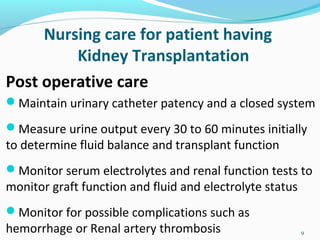
Post operative care
ď‚—Maintain urinary catheter patency and a closed system
ď‚—Measure urine output every 30 to 60 minutes initially
to determine fluid balance and transplant function
ď‚—Monitor serum electrolytes and renal function tests to
monitor graft function and fluid and electrolyte status
ď‚—Monitor for possible complications such as
hemorrhage or Renal artery thrombosis 9
Nursing care for patient having
Kidney Transplantation
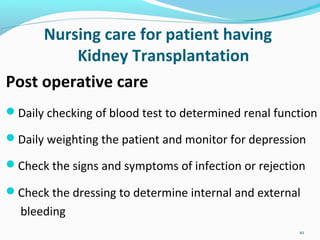
Post operative care
ď‚—Daily checking of blood test to determined renal function
ď‚—Daily weighting the patient and monitor for depression
ď‚—Check the signs and symptoms of infection or rejection
ď‚—Check the dressing to determine internal and external
bleeding
10
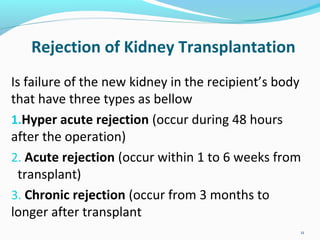
Rejection of Kidney Transplantation
Is failure of the new kidney in the recipient’s body
that have three types as bellow
1.Hyper acute rejection (occur during 48 hours
after the operation)
2. Acute rejection (occur within 1 to 6 weeks from
transplant)
3. Chronic rejection (occur from 3 months to
longer after transplant
11
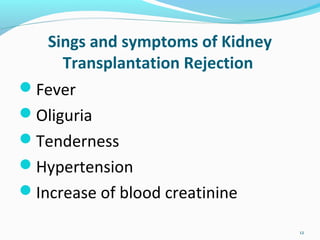
Sings and symptoms of Kidney
Transplantation Rejection
ď‚—Fever
ď‚—Oliguria
ď‚—Tenderness
ď‚—Hypertension
ď‚—Increase of blood creatinine
12
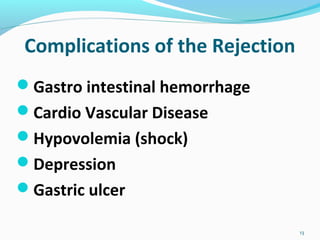
Complications of the Rejection
ď‚—Gastro intestinal hemorrhage
ď‚—Cardio Vascular Disease
ď‚—Hypovolemia (shock)
ď‚—Depression
ď‚—Gastric ulcer
13
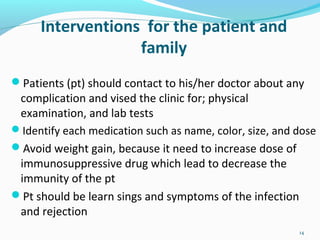
Interventions for the patient and
family
ď‚—Patients (pt) should contact to his/her doctor about any
complication and vised the clinic for; physical
examination, and lab tests
ď‚—Identify each medication such as name, color, size, and dose
ď‚—Avoid weight gain, because it need to increase dose of
immunosuppressive drug which lead to decrease the
immunity of the pt
ď‚—Pt should be learn sings and symptoms of the infection
and rejection
14
References
ď‚—Linda S. Williams and Paula D. Hopper. (2003).
Understanding Medical Surgical Nursing (2nd
ed.).
Philadelphia: PA 19103.
ď‚—Sylvia S. Mader. (2004). Understanding Human Anatomy
and Physiology (5th
ed.). New York: McGraw-Hill.
ď‚—Amy M. (2011). Focus on Nursing Pharmacology (5th ed.).
New York: McGraw-Hill.
15

Kidney transplantaion 2

  • 1.
    Kidney Transplantation Seragaldin M.SeragaldinM. School of Nursing, University ofSchool of Nursing, University of Raparin. 9.5.2015Raparin. 9.5.20151
  • 2.
    Objects ď‚—Definition ď‚—Source of kidneydonner ď‚—Criteria of Donner ď‚—Criteria of Recipient ď‚—Nursing care for patient having Kidney Transplantation ď‚—Rejection of Kidney Transplantation ď‚—Complications of the Rejection ď‚—Interventions for the patient and family 2
  • 3.
    Definition A kidney transplantis a procedure in which a donor healthy kidney is placed in the abdomen of a patient with chronic renal failure. Donner: The person who give his/her kidney in order to save the patient life who suffering from end stage renal disease. Recipient: The person receive transplant kidney from the donner due to end stage renal disease. 3
  • 4.
    Source of kidneydonner Related donnder; o Sibling o Identical twin o Natural parents • Non Related donnder Cadaveric donner Note: The related donner more possible physiologically. Because he/she has the same body tissue structure. While psychologically it is impossible. Because the recipient discomfort due to prauding of donner. 4
  • 5.
    Criteria of Donner •Age is not criteria • The donner should be free from systemic disease such as hypertension(HTN) or diabetes mellitus (MD) • Free from infections such as: Tuberculosis (TB) or Urinary Tract Infection (UTI) • Free from malignancy 5
  • 6.
    Criteria of Recipient ď‚—Ageof recipient is between 5 to 55 years ď‚—The recipient should be free from systemic disease such as hypertension(HTN) or diabetes mellitus (MD) ď‚—Free from malignancy ď‚—Free from infections ď‚—The recipient must have irreversible kidney damage ď‚—Inability of the patient to adjust to the hemodialysis 6
  • 7.
    Criteria of braindeath 7 • Apnea • Deep coma • Hypothermia • Absents of cephalic reflex • Fully dilated and fixed pupil
  • 8.
    Nursing care forpatient having Kidney Transplantation Pre operative care ď‚—Assess knowledge and feelings about the procedure ď‚—Continue dialysis as ordered and prevent uremia prior to surgery ď‚—Administer immunosuppressive drugs as ordered before surgery to prevent immediate graft rejection 8
  • 9.
    Nursing care forpatient having Kidney Transplantation Post operative care ď‚—Maintain urinary catheter patency and a closed system ď‚—Measure urine output every 30 to 60 minutes initially to determine fluid balance and transplant function ď‚—Monitor serum electrolytes and renal function tests to monitor graft function and fluid and electrolyte status ď‚—Monitor for possible complications such as hemorrhage or Renal artery thrombosis 9
  • 10.
    Nursing care forpatient having Kidney Transplantation Post operative care ď‚—Daily checking of blood test to determined renal function ď‚—Daily weighting the patient and monitor for depression ď‚—Check the signs and symptoms of infection or rejection ď‚—Check the dressing to determine internal and external bleeding 10
  • 11.
    Rejection of KidneyTransplantation Is failure of the new kidney in the recipient’s body that have three types as bellow 1.Hyper acute rejection (occur during 48 hours after the operation) 2. Acute rejection (occur within 1 to 6 weeks from transplant) 3. Chronic rejection (occur from 3 months to longer after transplant 11
  • 12.
    Sings and symptomsof Kidney Transplantation Rejection ď‚—Fever ď‚—Oliguria ď‚—Tenderness ď‚—Hypertension ď‚—Increase of blood creatinine 12
  • 13.
    Complications of theRejection ď‚—Gastro intestinal hemorrhage ď‚—Cardio Vascular Disease ď‚—Hypovolemia (shock) ď‚—Depression ď‚—Gastric ulcer 13
  • 14.
    Interventions for thepatient and family ď‚—Patients (pt) should contact to his/her doctor about any complication and vised the clinic for; physical examination, and lab tests ď‚—Identify each medication such as name, color, size, and dose ď‚—Avoid weight gain, because it need to increase dose of immunosuppressive drug which lead to decrease the immunity of the pt ď‚—Pt should be learn sings and symptoms of the infection and rejection 14
  • 15.
    References ď‚—Linda S. Williamsand Paula D. Hopper. (2003). Understanding Medical Surgical Nursing (2nd ed.). Philadelphia: PA 19103. ď‚—Sylvia S. Mader. (2004). Understanding Human Anatomy and Physiology (5th ed.). New York: McGraw-Hill. ď‚—Amy M. (2011). Focus on Nursing Pharmacology (5th ed.). New York: McGraw-Hill. 15