Peritoneal dialysis Jana Fialová Martina Peiskerová  Klinika nefrologie 1. LF a VFN  Praha 10/2007
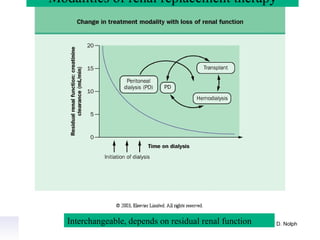
Ramesh Khanna & Karl D. Nolph   Modalities of renal replacement therapy Interchangeable, depends on residual renal function
Peritoneal dialysis - outline Principles of PD PD solutions PD catheter Indication / contraindication of PD PD schemes : CAPD, CCPD Assessement of PD adequacy, ultrafiltration Assessement of peritoneal function Complications  Perspectives – new dialysis solutions
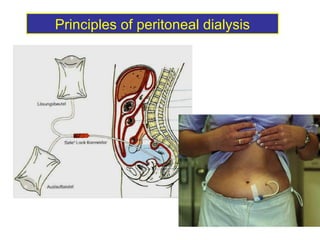
Peritoneal dialysis – introduction   method of RRT for 100.000 patients worldwide complementary to hemodialysis Principles:  peritoneum (capillary endothelium, matrix, mesothelium) = semipermeable dialysis membrane through which fluid and solute move  from blood to dialysis solution via diffusion and convection effective peritoneal surface area = perfused capillaries closed to peritoneum ( ↓ in peritonitis) ultrafiltration (movement of water) enabled by osmotic gradient generated by glucose or glucose polymers (isodextrin)
Principles of peritoneal dialysis
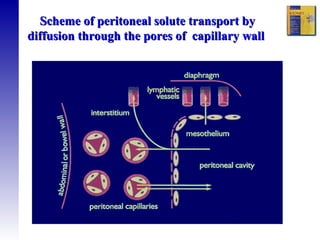
Scheme of peritoneal solute transport by diffusion through the pores of  capillary wall
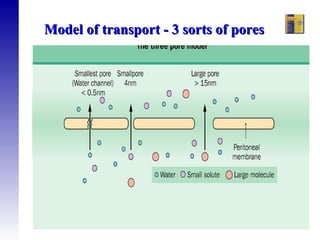
Ramesh Khanna & Karl D. Nolph   Model of transport - 3 sorts of pores
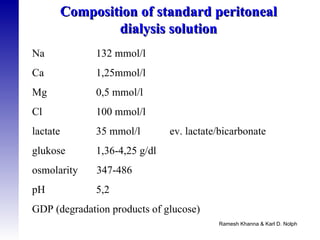
Ramesh Khanna & Karl D. Nolph   Na  132 mmol/l Ca  1,25mmol/l Mg  0,5 mmol/l Cl  100 mmol/l lactate  35 mmol/l  ev. lactate/bicarbonate glukose  1,36-4,25 g/dl osmolarity  347-486 pH 5,2 GDP (degradation products of glucose) Composition of standard peritoneal dialysis solution
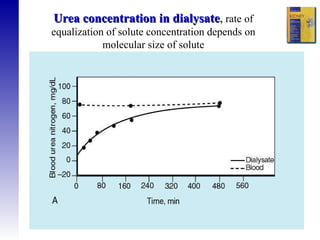
Urea concentration in dialysate ,  rate of equalization of solute concentration depends on molecular size of solute
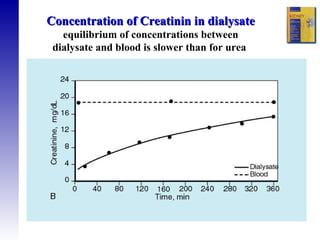
Concentration of Creatinin in dialysate  equilibrium of concentrations between dialysate and blood is slower than for urea
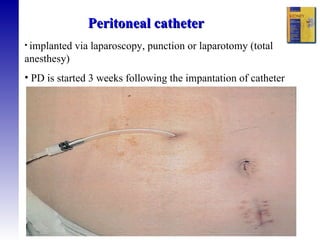
Peritoneal catheter implanted via laparoscopy, punction or laparotomy (total  anesthesy) PD is started 3 weeks following the impantation of catheter
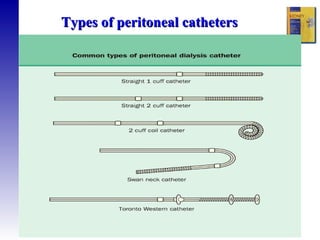
Types of peritoneal catheters
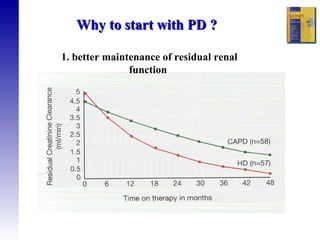
Why to start with PD ? 1. better maintenance of residual renal function
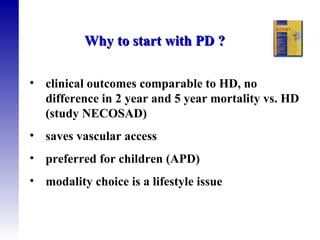
Why to start with PD ? clinical outcomes comparable to HD, no difference in 2 year and 5 year mortality vs. HD (study NECOSAD) saves vascular access  preferred for children (APD) modality choice is a lifestyle issue
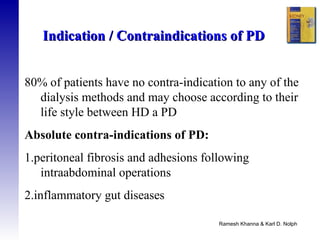
Ramesh Khanna & Karl D. Nolph   80% of patients have no contra-indication to any of the dialysis methods and may choose according to their life style between HD a PD Absolute contra-indications of PD:  1.peritoneal fibrosis and adhesions following intraabdominal operations  2.inflammatory gut diseases  Indication / Contraindications of PD
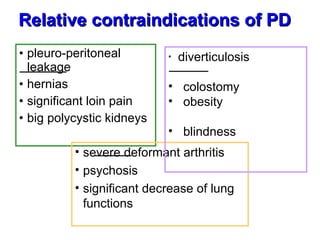
pleuro-peritoneal leakage  hernias significant loin pain big polycystic kidneys  Relative contraindications of PD   severe deformant arthritis  psychosis significant decrease of lung functions  *  diverticulosis  colostomy  obesity  blindness
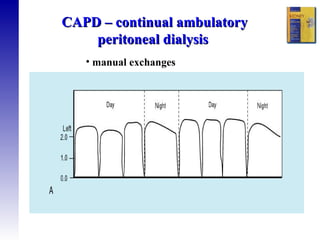
CAPD – continual ambulatory peritoneal dialysis  manual exchanges
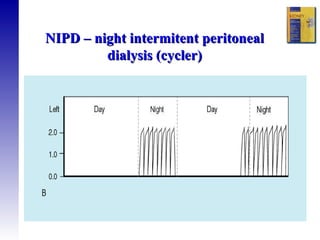
NIPD – night intermitent peritoneal dialysis (cycler)
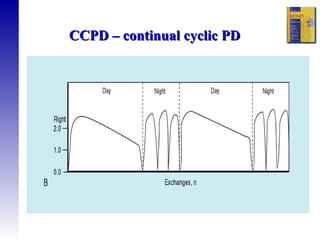
CCPD – continual cyclic PD
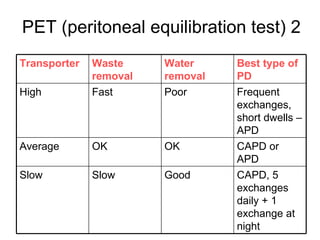
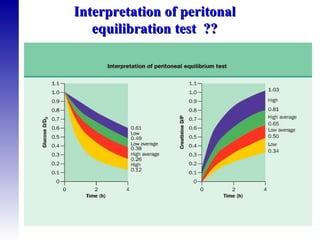
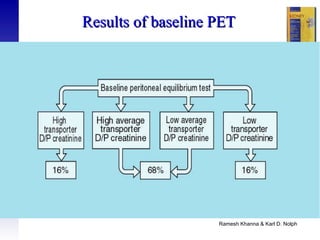
Assessement of PD adequacy PET (peritoneal equilibrium test) 1 determines quick or slow passage of toxins from the blood into the dialysis fluid ‘ high-fast transporters’ v.s. ‘low-slow transporters’ helps to decide about the PD scheme (dwell duration and intervals, CAPD vs. CCPD)  performed in hospital, takes 5 hours involves doing a CAPD exchange using a 2.27% G, samples of PD fluid and blood are taken at set times
PET (peritoneal equilibration test) 2 CAPD, 5 exchanges daily + 1 exchange at night Good Slow Slow CAPD or APD  OK OK Average Frequent exchanges, short dwells – APD  Poor  Fast High Best type of PD Water removal Waste removal Transporter
Interpretation of peritonal equilibration test  ??
Ramesh Khanna & Karl D. Nolph   Results of baseline PET
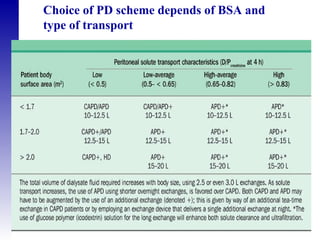
Choice of PD scheme depends of BSA and type of transport
PET- peritoneal equilibration test (type of transport and ultrafiltration after 4 hours) weekly clearance of creatinine and urea  daily UF dicrease of Na in dialysis fluid after 60 minutes using 3,8% G (test of aquaporines) Assessement of peritoneal function
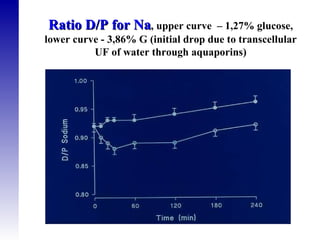
Ratio D/P for Na , upper curve  – 1,27% glucose, lower curve - 3,86% G (initial drop due to transcellular UF of water through aquaporins)
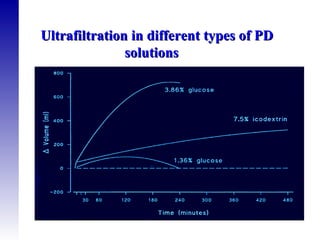
Depends on: - type of transporter – low transporters have better UF - concentration and type of osmotic agent in PD fluid: Fluids with glucosis (1,27%, 2,5% a 3,8% ), higher concentration – higher osmotic pressure and UF Fluid with icodextrin (Extraneal) = glucose polymer with a large molecule, resorbs only 10-20%, offers longtime UF, suitable for long night exchanges, 8-12 hours) - time between exchanges, using glucose-based fluids, maximal  UF obtained after 2-3 hours, using longer spaces UF dicreases. Ultrafiltration during PD
Ultrafiltration in different types of PD solutions
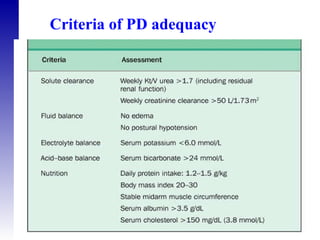
Criteria of PD adequacy
Infectious: exit-site inflammation (flare, suppurative secretion, granulation) peritonitis (turbid dialysate, abdominal pain, fever) Non-infectious: hernias hydrothorax sclerosing encapsulating peritonitis (rare, life threatening  complication, mostly after  ≥  6 years on PD, peritoneum is massively thickened and calcificated, leading to intestinal obstruction) Complications of PD 1
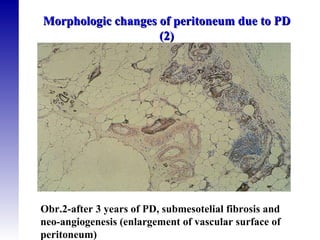
Non-infectious: Leakage of dialysate along the peritoneal catheter  Drainage failure of dialysate (dislocation or catheter obstruction by fibrin) Morphologic changes of peritoneum following long-lasting PD (peritoneal fibrisis, mesotelial damage, vasculopathy and neo-angiogenesis) leading to loss of UF capacity – reason for PD cessation in 24% of all patients, and in 51% of patients treated above 6 years.  Complications of PD  2
Large vascular surface of peritoneum (due to neo-angiogenesis, vasodilation), leading to high (fast) type of transport including fast loss of osmotic glucose pressure  Decreased function of aquaporins High lymfatic absorption  Causes of UF failure
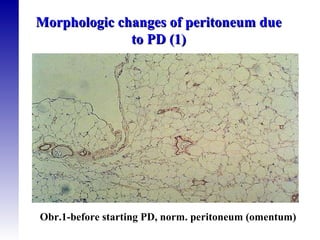
Morphologic changes of peritoneum due to PD (1) Obr.1-before starting PD, norm. peritoneum (omentum)
Morphologic changes of peritoneum due to PD (2) Obr.2-after 3 years of PD, submesotelial fibrosis and neo-angiogenesis (enlargement of vascular surface of peritoneum)
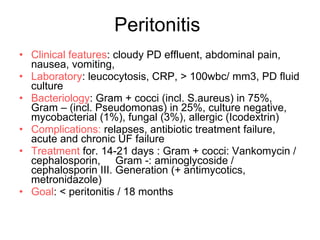
Peritonitis  Clinical features : cloudy PD effluent, abdominal pain, nausea, vomiting,  Laboratory : leucocytosis, CRP,  >  100wbc/ mm3, PD fluid culture Bacteriology : Gram  +  cocci (incl. S.aureus) in 75%, Gram – (incl. Pseudomonas) in 25%, culture negative, mycobacterial (1%), fungal (3%), allergic (Icodextrin) Complications:  relapses, antibiotic treatment failure, acute and chronic UF failure Treatment  for. 14-21 days : Gram  +  cocci: Vankomycin / cephalosporin,  Gram -: aminoglycoside / cephalosporin III. Generation (+ antimycotics, metronidazole) Goal :  <  peritonitis / 18 months
From PD gudelines (ISPD) biocompatible PD solutions - normal pH, low concentration of glucose insertion of PD catheter – 10 days-6 weeks before RRT urea / creatinine clearance measured every 6 months PET: 6 weeks after commencing treatment + annually avoid routine use of high glucose concentrations )use of icodextrin, aminoacids instead) preserve residual diuresis, obtain UF above 750 ml/day peritonitis and exit-site infection rates, regular revision of technique invasive procedures cover by ATB prophylaxis topical ATB administration if needed (S.aureus, Ps. aeruginosa) beware central obesity
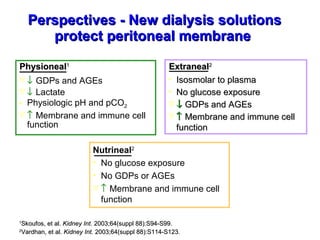
   GDPs and AGEs    Lactate Physiologic pH and pCO 2    Membrane and immune cell function Perspectives - New dialysis solutions protect peritoneal membrane  Physioneal 1 1 Skoufos, et al.  Kidney Int . 2003;64(suppl 88):S94-S99. 2 Vardhan, et al.  Kidney Int.  2003;64(suppl 88):S114-S123.   Nutrineal 2 No glucose exposure No GDPs or AGEs    Membrane and immune cell function Isosmolar to plasma No glucose exposure    GDPs and AGEs    Membrane and immune cell function Extraneal 2
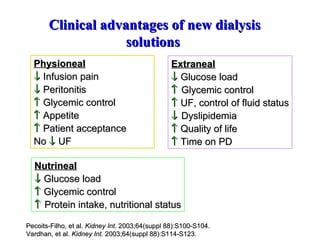
Physioneal    Infusion pain    Peritonitis    Glycemic control    Appetite    Patient acceptance No    UF Clinical advantages of new dialysis solutions  Extraneal    Glucose load   Glycemic control    UF, control of fluid status    Dyslipidemia    Quality of life    Time on PD Pecoits-Filho, et al.  Kidney Int . 2003;64(suppl 88):S100-S104. Vardhan, et al.  Kidney Int.  2003;64(suppl 88):S114-S123.  Nutrineal    Glucose load    Glycemic control    Protein intake, nutritional status
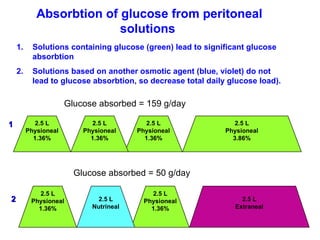
Absorbtion of glucose from peritoneal solutions  Solutions containing glucose (green) lead to significant glucose absorbtion  Solutions based on another osmotic agent (blue, violet) do not lead to glucose absorbtion, so decrease total daily glucose load).  1 2 2.5 L Physioneal 1.36% 2.5 L Physioneal 1.36% 2.5 L Physioneal 1.36% 2.5 L Physioneal 3.86% Glucose absorbed = 159 g/day 2.5 L Physioneal 1.36% 2.5 L Nutrineal 2.5 L Physioneal 1.36% 2.5 L Extraneal Glucose absorbed = 50 g/day

11 Peritoneal Dialysis

  • 1.
    Peritoneal dialysis JanaFialová Martina Peiskerová Klinika nefrologie 1. LF a VFN Praha 10/2007
  • 2.
    Ramesh Khanna &Karl D. Nolph Modalities of renal replacement therapy Interchangeable, depends on residual renal function
  • 3.
    Peritoneal dialysis -outline Principles of PD PD solutions PD catheter Indication / contraindication of PD PD schemes : CAPD, CCPD Assessement of PD adequacy, ultrafiltration Assessement of peritoneal function Complications Perspectives – new dialysis solutions
  • 4.
    Peritoneal dialysis –introduction method of RRT for 100.000 patients worldwide complementary to hemodialysis Principles: peritoneum (capillary endothelium, matrix, mesothelium) = semipermeable dialysis membrane through which fluid and solute move from blood to dialysis solution via diffusion and convection effective peritoneal surface area = perfused capillaries closed to peritoneum ( ↓ in peritonitis) ultrafiltration (movement of water) enabled by osmotic gradient generated by glucose or glucose polymers (isodextrin)
  • 5.
  • 6.
    Scheme of peritonealsolute transport by diffusion through the pores of capillary wall
  • 7.
    Ramesh Khanna &Karl D. Nolph Model of transport - 3 sorts of pores
  • 8.
    Ramesh Khanna &Karl D. Nolph Na 132 mmol/l Ca 1,25mmol/l Mg 0,5 mmol/l Cl 100 mmol/l lactate 35 mmol/l ev. lactate/bicarbonate glukose 1,36-4,25 g/dl osmolarity 347-486 pH 5,2 GDP (degradation products of glucose) Composition of standard peritoneal dialysis solution
  • 9.
    Urea concentration indialysate , rate of equalization of solute concentration depends on molecular size of solute
  • 10.
    Concentration of Creatininin dialysate equilibrium of concentrations between dialysate and blood is slower than for urea
  • 11.
    Peritoneal catheter implantedvia laparoscopy, punction or laparotomy (total anesthesy) PD is started 3 weeks following the impantation of catheter
  • 12.
  • 13.
    Why to startwith PD ? 1. better maintenance of residual renal function
  • 14.
    Why to startwith PD ? clinical outcomes comparable to HD, no difference in 2 year and 5 year mortality vs. HD (study NECOSAD) saves vascular access preferred for children (APD) modality choice is a lifestyle issue
  • 15.
    Ramesh Khanna &Karl D. Nolph 80% of patients have no contra-indication to any of the dialysis methods and may choose according to their life style between HD a PD Absolute contra-indications of PD: 1.peritoneal fibrosis and adhesions following intraabdominal operations 2.inflammatory gut diseases Indication / Contraindications of PD
  • 16.
    pleuro-peritoneal leakage hernias significant loin pain big polycystic kidneys Relative contraindications of PD severe deformant arthritis psychosis significant decrease of lung functions * diverticulosis colostomy obesity blindness
  • 17.
    CAPD – continualambulatory peritoneal dialysis manual exchanges
  • 18.
    NIPD – nightintermitent peritoneal dialysis (cycler)
  • 19.
  • 20.
    Assessement of PDadequacy PET (peritoneal equilibrium test) 1 determines quick or slow passage of toxins from the blood into the dialysis fluid ‘ high-fast transporters’ v.s. ‘low-slow transporters’ helps to decide about the PD scheme (dwell duration and intervals, CAPD vs. CCPD) performed in hospital, takes 5 hours involves doing a CAPD exchange using a 2.27% G, samples of PD fluid and blood are taken at set times
  • 21.
    PET (peritoneal equilibrationtest) 2 CAPD, 5 exchanges daily + 1 exchange at night Good Slow Slow CAPD or APD OK OK Average Frequent exchanges, short dwells – APD Poor Fast High Best type of PD Water removal Waste removal Transporter
  • 22.
    Interpretation of peritonalequilibration test ??
  • 23.
    Ramesh Khanna &Karl D. Nolph Results of baseline PET
  • 24.
    Choice of PDscheme depends of BSA and type of transport
  • 25.
    PET- peritoneal equilibrationtest (type of transport and ultrafiltration after 4 hours) weekly clearance of creatinine and urea daily UF dicrease of Na in dialysis fluid after 60 minutes using 3,8% G (test of aquaporines) Assessement of peritoneal function
  • 26.
    Ratio D/P forNa , upper curve – 1,27% glucose, lower curve - 3,86% G (initial drop due to transcellular UF of water through aquaporins)
  • 27.
    Depends on: -type of transporter – low transporters have better UF - concentration and type of osmotic agent in PD fluid: Fluids with glucosis (1,27%, 2,5% a 3,8% ), higher concentration – higher osmotic pressure and UF Fluid with icodextrin (Extraneal) = glucose polymer with a large molecule, resorbs only 10-20%, offers longtime UF, suitable for long night exchanges, 8-12 hours) - time between exchanges, using glucose-based fluids, maximal UF obtained after 2-3 hours, using longer spaces UF dicreases. Ultrafiltration during PD
  • 28.
    Ultrafiltration in differenttypes of PD solutions
  • 29.
  • 30.
    Infectious: exit-site inflammation(flare, suppurative secretion, granulation) peritonitis (turbid dialysate, abdominal pain, fever) Non-infectious: hernias hydrothorax sclerosing encapsulating peritonitis (rare, life threatening complication, mostly after ≥ 6 years on PD, peritoneum is massively thickened and calcificated, leading to intestinal obstruction) Complications of PD 1
  • 31.
    Non-infectious: Leakage ofdialysate along the peritoneal catheter Drainage failure of dialysate (dislocation or catheter obstruction by fibrin) Morphologic changes of peritoneum following long-lasting PD (peritoneal fibrisis, mesotelial damage, vasculopathy and neo-angiogenesis) leading to loss of UF capacity – reason for PD cessation in 24% of all patients, and in 51% of patients treated above 6 years. Complications of PD 2
  • 32.
    Large vascular surfaceof peritoneum (due to neo-angiogenesis, vasodilation), leading to high (fast) type of transport including fast loss of osmotic glucose pressure Decreased function of aquaporins High lymfatic absorption Causes of UF failure
  • 33.
    Morphologic changes ofperitoneum due to PD (1) Obr.1-before starting PD, norm. peritoneum (omentum)
  • 34.
    Morphologic changes ofperitoneum due to PD (2) Obr.2-after 3 years of PD, submesotelial fibrosis and neo-angiogenesis (enlargement of vascular surface of peritoneum)
  • 35.
    Peritonitis Clinicalfeatures : cloudy PD effluent, abdominal pain, nausea, vomiting, Laboratory : leucocytosis, CRP, > 100wbc/ mm3, PD fluid culture Bacteriology : Gram + cocci (incl. S.aureus) in 75%, Gram – (incl. Pseudomonas) in 25%, culture negative, mycobacterial (1%), fungal (3%), allergic (Icodextrin) Complications: relapses, antibiotic treatment failure, acute and chronic UF failure Treatment for. 14-21 days : Gram + cocci: Vankomycin / cephalosporin, Gram -: aminoglycoside / cephalosporin III. Generation (+ antimycotics, metronidazole) Goal : < peritonitis / 18 months
  • 36.
    From PD gudelines(ISPD) biocompatible PD solutions - normal pH, low concentration of glucose insertion of PD catheter – 10 days-6 weeks before RRT urea / creatinine clearance measured every 6 months PET: 6 weeks after commencing treatment + annually avoid routine use of high glucose concentrations )use of icodextrin, aminoacids instead) preserve residual diuresis, obtain UF above 750 ml/day peritonitis and exit-site infection rates, regular revision of technique invasive procedures cover by ATB prophylaxis topical ATB administration if needed (S.aureus, Ps. aeruginosa) beware central obesity
  • 37.
    GDPs and AGEs  Lactate Physiologic pH and pCO 2  Membrane and immune cell function Perspectives - New dialysis solutions protect peritoneal membrane Physioneal 1 1 Skoufos, et al. Kidney Int . 2003;64(suppl 88):S94-S99. 2 Vardhan, et al. Kidney Int. 2003;64(suppl 88):S114-S123. Nutrineal 2 No glucose exposure No GDPs or AGEs  Membrane and immune cell function Isosmolar to plasma No glucose exposure  GDPs and AGEs  Membrane and immune cell function Extraneal 2
  • 38.
    Physioneal  Infusion pain  Peritonitis  Glycemic control  Appetite  Patient acceptance No  UF Clinical advantages of new dialysis solutions Extraneal  Glucose load  Glycemic control  UF, control of fluid status  Dyslipidemia  Quality of life  Time on PD Pecoits-Filho, et al. Kidney Int . 2003;64(suppl 88):S100-S104. Vardhan, et al. Kidney Int. 2003;64(suppl 88):S114-S123. Nutrineal  Glucose load  Glycemic control  Protein intake, nutritional status
  • 39.
    Absorbtion of glucosefrom peritoneal solutions Solutions containing glucose (green) lead to significant glucose absorbtion Solutions based on another osmotic agent (blue, violet) do not lead to glucose absorbtion, so decrease total daily glucose load). 1 2 2.5 L Physioneal 1.36% 2.5 L Physioneal 1.36% 2.5 L Physioneal 1.36% 2.5 L Physioneal 3.86% Glucose absorbed = 159 g/day 2.5 L Physioneal 1.36% 2.5 L Nutrineal 2.5 L Physioneal 1.36% 2.5 L Extraneal Glucose absorbed = 50 g/day

Editor's Notes

  • #2 Název Autor Pracoviště Datum zpracování přednášky
  • #17 Category: Peritoneal Membrane Preservation This slide shows the beneficial effects of the newer PD solutions containing alternate buffers and osmotic agents. All three solutions reduce levels of GDPs and AGEs. With Physioneal, it is because glucose is sterilized at a very low pH. With Extraneal and Nutrineal, it is because there is no glucose in either solution. Additional benefits of Physioneal : Physiologic pH and pCO 2 , reduced lactate levels. Additional benefit of Extraneal: Same osmolarity as plasma. As a result of its unique properties, each solution has been shown to improve membrane and peritoneal immune cell function. Skoufos L, Topley N, Cooker L, et al. The in vitro biocompatibility performance of a 25 mmol/L bicarbonate/10 mmol/L lactate-buffered peritoneal dialysis fluid. Kidney Int . 2003;64(suppl 88):S94-S99. Vardhan A, Zweers MM, Gokal R, Krediet RT. A solutions portfolio approach in peritoneal dialysis. Kidney Int . 2003;64(suppl 88):S114-S123.
  • #38 Category: Peritoneal Membrane Preservation This slide shows the beneficial effects of the newer PD solutions containing alternate buffers and osmotic agents. All three solutions reduce levels of GDPs and AGEs. With Physioneal, it is because glucose is sterilized at a very low pH. With Extraneal and Nutrineal, it is because there is no glucose in either solution. Additional benefits of Physioneal : Physiologic pH and pCO 2 , reduced lactate levels. Additional benefit of Extraneal: Same osmolarity as plasma. As a result of its unique properties, each solution has been shown to improve membrane and peritoneal immune cell function. Skoufos L, Topley N, Cooker L, et al. The in vitro biocompatibility performance of a 25 mmol/L bicarbonate/10 mmol/L lactate-buffered peritoneal dialysis fluid. Kidney Int . 2003;64(suppl 88):S94-S99. Vardhan A, Zweers MM, Gokal R, Krediet RT. A solutions portfolio approach in peritoneal dialysis. Kidney Int . 2003;64(suppl 88):S114-S123.
  • #39 This slide summarizes the clinical benefits of Physioneal, Extraneal, and Nutrineal as described in the articles by Pecoits-Filho, et al (S100) and Vardhan, et al (S114). Pecoits-Filho R, Tranaeus A, Lindholm B. Clinical trial experiences with Physioneal™. Kidney Int . 2003;64(suppl 88):S100-S104. Vardhan A, Zweers MM, Gokal R, Krediet RT. A solutions portfolio approach in peritoneal dialysis. Kidney Int . 2003;64(suppl 88):S114-S123.