


PRESENTATION PRICE DISCRIMINATION
AND DUMPING
PRESENTED BY- PANDU RAJ BASNET
CANARA BANK SCHOOL OF BUSINESS
STUDIES
ECONOMICS FOR MANAGER
PRICE DISCRIMINATION
 In general Price discrimination is a microeconomic pricing
strategy where identical or largely similar goods or services
are transacted at different prices by the same provider in
different markets
 According to Joan Robinson, “Price discrimination is the
act of selling the same article produced under single
control at a different price to different buyers.”
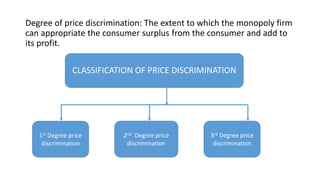
Degree of price discrimination: The extent to which the monopoly firm
can appropriate the consumer surplus from the consumer and add to
its profit.
CLASSIFICATION OF PRICE DISCRIMINATION
1st Degree price
discrimination
2nd Degree price
discrimination
3rd Degree price
discrimination
1ST DEGREE PRICE DISCRIMINATION
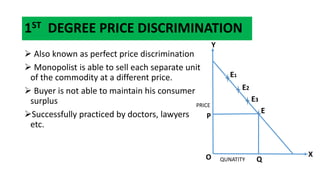
 Also known as perfect price discrimination
 Monopolist is able to sell each separate unit
of the commodity at a different price.
 Buyer is not able to maintain his consumer
surplus
Successfully practiced by doctors, lawyers
etc.
E
E3
E2
E1
PRICE
QUNATITY QO
P
Y
X
2ND DEGREE PRICE DISCRIMINATION
 Seller divides buyer in different groups.
Each groups are charged with different price for same product
 Price which seller charges for each group is that which the marginal
buyer is willing to pay.
 It leaves some surplus to consumer.
 Eg : Railway tickets, airways classes etc
3RD DEGREE PRICE DISCRIMINATION
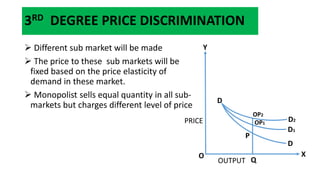
 Different sub market will be made
 The price to these sub markets will be
fixed based on the price elasticity of
demand in these market.
 Monopolist sells equal quantity in all sub-
markets but charges different level of price
D
D1
D2
P
OP1
OP2
D
Q
X
Y
OUTPUT
O
PRICE
ESSENTIAL CONDITION FOR PRICE
DISCRIMINATION
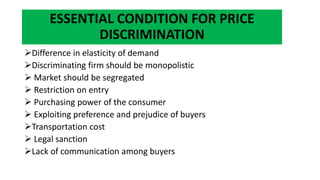
Difference in elasticity of demand
Discriminating firm should be monopolistic
 Market should be segregated
 Restriction on entry
 Purchasing power of the consumer
 Exploiting preference and prejudice of buyers
Transportation cost
 Legal sanction
Lack of communication among buyers
DUMPING:
A standard technical definition of dumping is the act of charging a
lower price for the like goods in a foreign market than one charges for
the same good in a domestic market for consumption in the home
market of the exporter.
 According to Heberler, “Dumping is price discrimination between
two markets in which the monopolist sells a portion of his products at
a low price and remaining part at a high price in a domestic market
FORMS OF DUMPING
 Persistent dumping: Resulting from international price discrimination.
 Predatory dumping: Temporary sale of a commodity at below cost or at a
lower price abroad in order to drive foreign producer out of business, after which
price are raised abroad to take advantage of the newly acquired monopoly
power.
 Sporadic dumping: Occasional sale of commodity at below cost or at a lower
price abroad than domestically in order to unload an unforeseen and temporary
surplus of a commodity without having to reduce domestic prices.
Price Determination under Dumping:
Conditions
 Aim of the monopolist is to maximize his profit :Produces that
output at which his marginal revenue equals marginal cost.
i.e. Dumping profit = MRH + MRF = MC
 The elasticity’s of demand must be different in the two markets: The
demand should be less elastic in the domestic market and perfectly
elastic in the foreign market.
 The foreign market should be perfectly competitive and the
domestic market is monopolistic
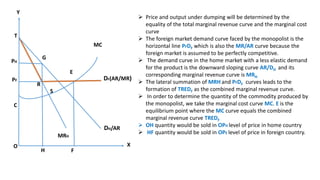
P  Price and output under dumping will be determined by the
equality of the total marginal revenue curve and the marginal cost
curve
 The foreign market demand curve faced by the monopolist is the
horizontal line PFDF which is also the MR/AR curve because the
foreign market is assumed to be perfectly competitive.
 The demand curve in the home market with a less elastic demand
for the product is the downward sloping curve AR/DH and its
corresponding marginal revenue curve is MRH
 The lateral summation of MRH and PFDF curves leads to the
formation of TREDF as the combined marginal revenue curve.
 In order to determine the quantity of the commodity produced by
the monopolist, we take the marginal cost curve MC. E is the
equilibrium point where the MC curve equals the combined
marginal revenue curve TREDF
 OH quantity would be sold in OPH level of price in home country
 HF quantity would be sold in OPE level of price in foreign country.
T
PF
C
O
H
R
E
MC
DF(AR/MR)
S
MRH
F
DH/AR
Y
X
PH
G
EFFECT OF DUMPING
 Decline in output
Loss in sales
 Decline in capacity utilization
 Price effects
 Reduction of market share
 Decline in productivity
 Reduce return on investment
 Loss of market share
Adverse effect on cash flow, inventories, employment, wages, etc.
Price Discrimination & Dumping

Price Discrimination & Dumping

  • 1.
    PRESENTATION PRICE DISCRIMINATION ANDDUMPING PRESENTED BY- PANDU RAJ BASNET CANARA BANK SCHOOL OF BUSINESS STUDIES ECONOMICS FOR MANAGER
  • 2.
    PRICE DISCRIMINATION  Ingeneral Price discrimination is a microeconomic pricing strategy where identical or largely similar goods or services are transacted at different prices by the same provider in different markets  According to Joan Robinson, “Price discrimination is the act of selling the same article produced under single control at a different price to different buyers.”
  • 3.
    Degree of pricediscrimination: The extent to which the monopoly firm can appropriate the consumer surplus from the consumer and add to its profit. CLASSIFICATION OF PRICE DISCRIMINATION 1st Degree price discrimination 2nd Degree price discrimination 3rd Degree price discrimination
  • 4.
    1ST DEGREE PRICEDISCRIMINATION  Also known as perfect price discrimination  Monopolist is able to sell each separate unit of the commodity at a different price.  Buyer is not able to maintain his consumer surplus Successfully practiced by doctors, lawyers etc. E E3 E2 E1 PRICE QUNATITY QO P Y X
  • 5.
    2ND DEGREE PRICEDISCRIMINATION  Seller divides buyer in different groups. Each groups are charged with different price for same product  Price which seller charges for each group is that which the marginal buyer is willing to pay.  It leaves some surplus to consumer.  Eg : Railway tickets, airways classes etc
  • 6.
    3RD DEGREE PRICEDISCRIMINATION  Different sub market will be made  The price to these sub markets will be fixed based on the price elasticity of demand in these market.  Monopolist sells equal quantity in all sub- markets but charges different level of price D D1 D2 P OP1 OP2 D Q X Y OUTPUT O PRICE
  • 7.
    ESSENTIAL CONDITION FORPRICE DISCRIMINATION Difference in elasticity of demand Discriminating firm should be monopolistic  Market should be segregated  Restriction on entry  Purchasing power of the consumer  Exploiting preference and prejudice of buyers Transportation cost  Legal sanction Lack of communication among buyers
  • 8.
    DUMPING: A standard technicaldefinition of dumping is the act of charging a lower price for the like goods in a foreign market than one charges for the same good in a domestic market for consumption in the home market of the exporter.  According to Heberler, “Dumping is price discrimination between two markets in which the monopolist sells a portion of his products at a low price and remaining part at a high price in a domestic market
  • 9.
    FORMS OF DUMPING Persistent dumping: Resulting from international price discrimination.  Predatory dumping: Temporary sale of a commodity at below cost or at a lower price abroad in order to drive foreign producer out of business, after which price are raised abroad to take advantage of the newly acquired monopoly power.  Sporadic dumping: Occasional sale of commodity at below cost or at a lower price abroad than domestically in order to unload an unforeseen and temporary surplus of a commodity without having to reduce domestic prices.
  • 10.
    Price Determination underDumping: Conditions  Aim of the monopolist is to maximize his profit :Produces that output at which his marginal revenue equals marginal cost. i.e. Dumping profit = MRH + MRF = MC  The elasticity’s of demand must be different in the two markets: The demand should be less elastic in the domestic market and perfectly elastic in the foreign market.  The foreign market should be perfectly competitive and the domestic market is monopolistic
  • 11.
    P  Priceand output under dumping will be determined by the equality of the total marginal revenue curve and the marginal cost curve  The foreign market demand curve faced by the monopolist is the horizontal line PFDF which is also the MR/AR curve because the foreign market is assumed to be perfectly competitive.  The demand curve in the home market with a less elastic demand for the product is the downward sloping curve AR/DH and its corresponding marginal revenue curve is MRH  The lateral summation of MRH and PFDF curves leads to the formation of TREDF as the combined marginal revenue curve.  In order to determine the quantity of the commodity produced by the monopolist, we take the marginal cost curve MC. E is the equilibrium point where the MC curve equals the combined marginal revenue curve TREDF  OH quantity would be sold in OPH level of price in home country  HF quantity would be sold in OPE level of price in foreign country. T PF C O H R E MC DF(AR/MR) S MRH F DH/AR Y X PH G
  • 12.
    EFFECT OF DUMPING Decline in output Loss in sales  Decline in capacity utilization  Price effects  Reduction of market share  Decline in productivity  Reduce return on investment  Loss of market share Adverse effect on cash flow, inventories, employment, wages, etc.