Price Determination under Monopoly
JITHIN K THOMAS
BERCHMANS INSTITUTE OF MANAGEMENT STUDIES
Monopoly
• Monopoly is a market situation where there is
a single seller. There are no close substitute of
the commodity it produces, there are barriers
to entry
• .
Features
• Single seller and large number of Buyers
• No Close substitute
• Firm is the Industry
• Barriers on entry of new firms
• Producer is price maker
Types of Monopoly
• Natural Monopoly
• Pure Monopoly
• Imperfect Monopoly
• Legal Monopoly
• Public Monopoly
• General Monopoly
• Discriminating Monopoly
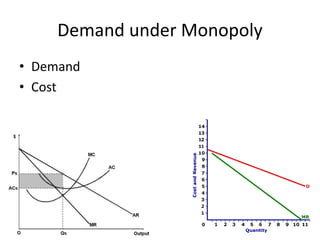
Demand under Monopoly
• Demand
• Cost
Equilibrium & Price Determination
• A monopolist is in Equilibrium when he
produces that much amount of output which
yields maximum total profit.
– MR must be equal to MC
– MC must cut MR from below
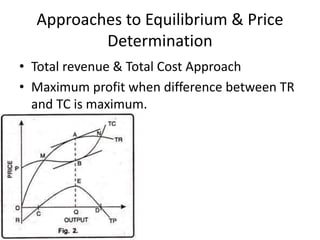
Approaches to Equilibrium & Price
Determination
• Total revenue & Total Cost Approach
• Maximum profit when difference between TR
and TC is maximum.
Marginal Revenue and Marginal Cost
Approach
• A monopolist is in equilibrium when
– MC = MR
– MC cut MR from Below
• Analysis can be conducted in two time periods
– The short run
– The long run
Marginal Revenue and Marginal Cost
Approach
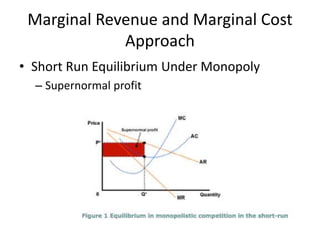
• Short Run Equilibrium Under Monopoly
– Supernormal profit
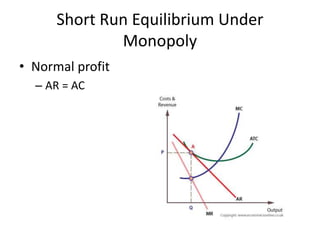
Short Run Equilibrium Under
Monopoly
• Normal profit
– AR = AC
Short Run Equilibrium Under
Monopoly
• Minimum Loss
– Due to depression
– Fall in demand
• Continue to produce AR=AVC
Long Run Equilibrium Under Monopoly
• All factors are variable
• LMC cuts MR from below
Elasticity of Demand and Monopoly
Price
• Monopoly Equilibrium and Lows of costs
– Elasticity of demand
• Inelastic Demand - Fix high price
• Elastic Demand - Fix law price
Effects of laws of Costs
• Diminishing Costs
• Constant Costs
• Increasing costs
Degree of Monopoly Power
• Concentration Ratio
• Profit rate
• Leaners measure
– Degree of Monopoly Power =
𝑃−𝑀𝐶
𝑃
Misconceptions
• Prices under free competition are lower than
Monopoly.
• Monopolist seek maximum per unit profit
Misconceptions
• Maximum profit, not maximum price
• Maximum total profit, not maximum profit
per unit
• Economies of scale
• Law of increasing return
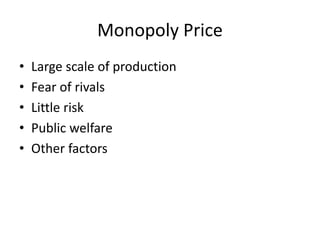
Monopoly Price
• Large scale of production
• Fear of rivals
• Little risk
• Public welfare
• Other factors
Price determination under monopoly

Price determination under monopoly

  • 1.
    Price Determination underMonopoly JITHIN K THOMAS BERCHMANS INSTITUTE OF MANAGEMENT STUDIES
  • 2.
    Monopoly • Monopoly isa market situation where there is a single seller. There are no close substitute of the commodity it produces, there are barriers to entry • .
  • 3.
    Features • Single sellerand large number of Buyers • No Close substitute • Firm is the Industry • Barriers on entry of new firms • Producer is price maker
  • 4.
    Types of Monopoly •Natural Monopoly • Pure Monopoly • Imperfect Monopoly • Legal Monopoly • Public Monopoly • General Monopoly • Discriminating Monopoly
  • 5.
  • 6.
    Equilibrium & PriceDetermination • A monopolist is in Equilibrium when he produces that much amount of output which yields maximum total profit. – MR must be equal to MC – MC must cut MR from below
  • 7.
    Approaches to Equilibrium& Price Determination • Total revenue & Total Cost Approach • Maximum profit when difference between TR and TC is maximum.
  • 8.
    Marginal Revenue andMarginal Cost Approach • A monopolist is in equilibrium when – MC = MR – MC cut MR from Below • Analysis can be conducted in two time periods – The short run – The long run
  • 9.
    Marginal Revenue andMarginal Cost Approach • Short Run Equilibrium Under Monopoly – Supernormal profit
  • 10.
    Short Run EquilibriumUnder Monopoly • Normal profit – AR = AC
  • 11.
    Short Run EquilibriumUnder Monopoly • Minimum Loss – Due to depression – Fall in demand • Continue to produce AR=AVC
  • 12.
    Long Run EquilibriumUnder Monopoly • All factors are variable • LMC cuts MR from below
  • 13.
    Elasticity of Demandand Monopoly Price • Monopoly Equilibrium and Lows of costs – Elasticity of demand • Inelastic Demand - Fix high price • Elastic Demand - Fix law price
  • 14.
    Effects of lawsof Costs • Diminishing Costs • Constant Costs • Increasing costs
  • 15.
    Degree of MonopolyPower • Concentration Ratio • Profit rate • Leaners measure – Degree of Monopoly Power = 𝑃−𝑀𝐶 𝑃
  • 16.
    Misconceptions • Prices underfree competition are lower than Monopoly. • Monopolist seek maximum per unit profit
  • 17.
    Misconceptions • Maximum profit,not maximum price • Maximum total profit, not maximum profit per unit • Economies of scale • Law of increasing return
  • 18.
    Monopoly Price • Largescale of production • Fear of rivals • Little risk • Public welfare • Other factors