ECONOMICS
Market structures – Perfect
competition
Short revision series
Market Structures
Market structure refers to the number and
size of buyers and sellers in the market for a
good or service.
A market can be defined as a group of firms
willing and able to sell a similar product or
service to the same potential buyers.
Classification of market structures
 4 broad categories –
1. Perfect competition
2. Monopoly
3. Monopolistic competition
4. Oligopoly
Major features that determine market
structure
Number of sellers
Product differentiation
Entry and exit conditions
What we analyze in all Market
Structures…
AR, MR
AC, MC
The point where MR = MC ( Profit
maximum )
Q* ( Equilibrium Output )
P* ( Equilibrium Price )
Profit
Normal Profit : That part of the cost that is
paid to the entrepreneur as a part of his
compensation.
Super-normal Profit : The profit that the
entrepreneur may get over and above the
compensation he gets from the firm, for his
contribution.
Perfect competition
 Features –
1. Large number of buyers and sellers
2. Products are perfect substitutes of each
other; homogeneous products
3. Free entry and exit from the market
4. Perfect knowledge of the market to both
buyers and sellers
5. No govt. intervention
6. Transport cost are negligible hence
don’t affect pricing.
The Meaning of Competition
As a result of its characteristics, the
perfectly competitive market has the
following outcomes:
The actions of any single buyer or
seller in the market have a
negligible impact on the market
price.
Each buyer and seller takes the
market price as given.
The Meaning of Competition
Buyers and sellers in
competitive markets are said to
be price takers.
Buyers and sellers must accept
the price determined by the
market.
Revenue of a Competitive Firm
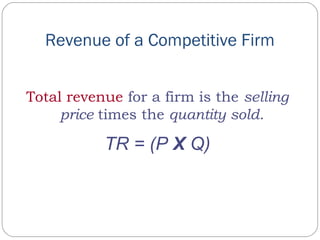
Total revenue for a firm is the selling
price times the quantity sold.
TR = (P X Q)
Revenue of a Competitive Firm
Average revenue tells us how
much revenue a firm receives
for the typical unit sold.
Revenue of a Competitive Firm
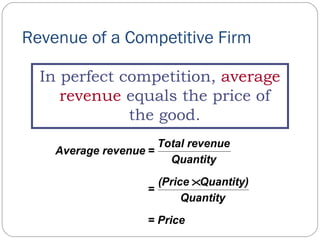
In perfect competition, average
revenue equals the price of
the good.
Average revenue =
Total revenue
Quantity
=
(Price Quantity)
Quantity
= Price
×
Revenue of a Competitive Firm
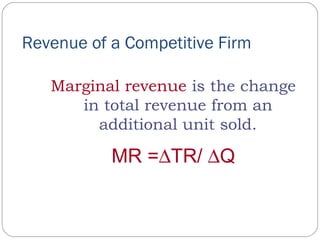
Marginal revenue is the change
in total revenue from an
additional unit sold.
MR =∆TR/ ∆Q
Revenue of a Competitive Firm
For competitive firms, marginal
revenue equals the price of the
good.
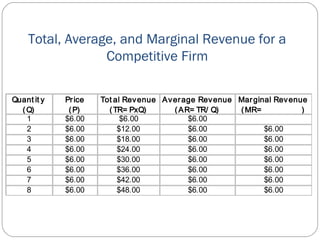
Total, Average, and Marginal Revenue for a
Competitive Firm
Quant it y
(Q)
Price
(P)
Tot al Revenue
(TR= PxQ)
Average Revenue
(AR= TR/ Q)
Marginal Revenue
(MR= )
1 $6.00 $6.00 $6.00
2 $6.00 $12.00 $6.00 $6.00
3 $6.00 $18.00 $6.00 $6.00
4 $6.00 $24.00 $6.00 $6.00
5 $6.00 $30.00 $6.00 $6.00
6 $6.00 $36.00 $6.00 $6.00
7 $6.00 $42.00 $6.00 $6.00
8 $6.00 $48.00 $6.00 $6.00
Profit Maximization for the Competitive
Firm
The goal of a competitive firm is
to maximize profit.
This means that the firm will
want to produce the quantity
that maximizes the difference
between total revenue and total
cost.
Short run price and output
determination
In SR a firm has to decide about the
output it should produce at the market
price so that profit is maximum.
Some inputs are fixed=> fixed costs
A firm may stay in business to cover
these costs even if it incurs losses in SR
Cost functions of firms are different as
factors of production are not
homogeneous
Hence each firm has different profit
levels.
Conditions for Profit Maximization
MR = MC ( Necessary condition )
MCC should intersect MRC from below or
MCC should be rising
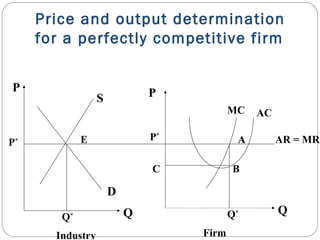
Price and output determination
for a perfectly competitive firm
D
S
Q Q
PP
Industry Firm
P* P*
ACMC
Q* Q*
E
C B
A AR = MR
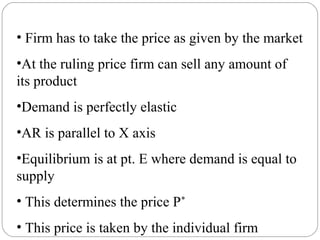
• Firm has to take the price as given by the market
•At the ruling price firm can sell any amount of
its product
•Demand is perfectly elastic
•AR is parallel to X axis
•Equilibrium is at pt. E where demand is equal to
supply
• This determines the price P*
• This price is taken by the individual firm
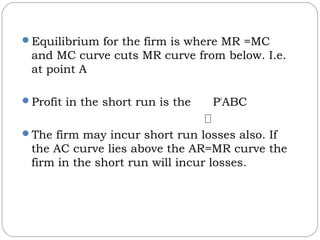
Equilibrium for the firm is where MR =MC
and MC curve cuts MR curve from below. I.e.
at point A
Profit in the short run is the P*
ABC
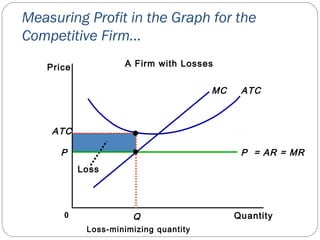
The firm may incur short run losses also. If
the AC curve lies above the AR=MR curve the
firm in the short run will incur losses.
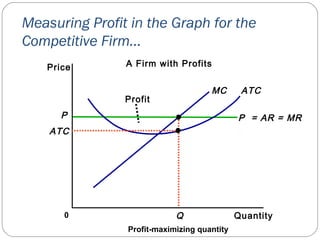
Profit
Q
Measuring Profit in the Graph for the
Competitive Firm...
Quantity0
Price
P = AR = MR
ATCMC
P
ATC
Profit-maximizing quantity
A Firm with Profits
Loss
Measuring Profit in the Graph for the
Competitive Firm...
Quantity0
Price
P = AR = MR
ATCMC
P
Q
Loss-minimizing quantity
ATC
A Firm with Losses
Long run equilibrium of the firm and
industry
All factors are variable in the long run
Hence all costs are variable
Firm can change the plant and adjust the
capacity according to the requirements of
production
If profits are supernormal, more firms
enter the market and vice versa.
Entry and exit of firms is possible
Long run equilibrium of the firm and
industry
If the number of firms increase, ( because
they might be attracted towards the
supernormal profits ), or the same firms
increase their production, the supply
curve moves to the right. At the same
demand, this results in a decrease in
price.
If the number of firms decrease,
( because of losses ), or the same firms
decrease production, the supply curve
shifts to the left. At the same demand,
this results in an increase in price.
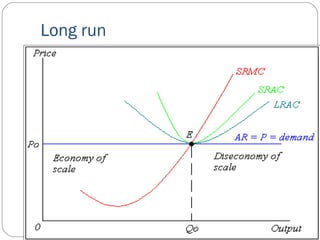
Long run equilibrium of the firm and
industry
Hence, in the long run, supernormal
profit is not possible and all firms have to
survive at a Normal profit.
This means that all the firms will stop
production at the point where AC is
lowest. This is also the price they will sell
the goods at.
Hence in the long run, firms have no
incentive to expand or contract their
production capacity or leave the industry
and new firms have no incentive to enter
the industry.
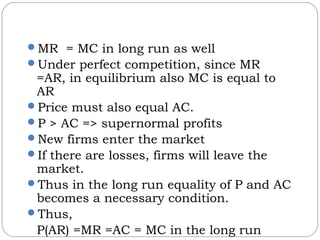
MR = MC in long run as well
Under perfect competition, since MR
=AR, in equilibrium also MC is equal to
AR
Price must also equal AC.
P > AC => supernormal profits
New firms enter the market
If there are losses, firms will leave the
market.
Thus in the long run equality of P and AC
becomes a necessary condition.
Thus,
P(AR) =MR =AC = MC in the long run
Long run
Economic Efficiency
 The fundamental economic problem is a
scarcity of resources.
Definition of Efficiency
Efficiency is concerned with the optimal
production and distribution or these scarce
resources.
Types of Efficiencies
There are different types of efficiency
1. Productive efficiency.
This occurs when the maximum number of
goods and services are produced with a given
amount of inputs. This will occur on the
production possibility frontier.
ON the curve it is impossible to produce more
goods without producing less services.
Productive efficiency will also occur at the lowest
point on the firms average costs curve
 
Types of Efficiencies
2. Allocative efficiency
This occurs when goods and services are
distributed according to consumer
preferences. An economy could be
productively efficient but produce goods
people don’t need this would be allocative
inefficient.
Allocative efficiency occurs when the
price of the good = the MC of production
 
Types of Efficiencies
3. X inefficiency:
This occurs when firms do not have
incentives to cut costs, for example a
monopoly which makes supernormal profits
may have little incentive to get rid of surplus
labor. Therefore a firms average cost may be
higher than necessary
 
Types of Efficiencies
4. Efficiencies of scale
This occurs when the firms produces on the
lowest point of its Long run average cost and
therefore benefits fully from economies of
scale
 
Types of Efficiencies
5. Dynamic efficiency This refers to
efficiency over time for example a Ford
factory in 1920 would be very efficient for
the time period but would now be inefficient
by comparison therefore it is necessary for
firms to constantly introduce new technology
and reduce costs over time
Types of Efficiencies
6. Social efficiency
This occurs when externalities are taken into
consideration and the social cost of
production (SMC) = the social benefit (SMB)
 
Types of Efficiencies
7. Technical Efficiency
Optimum combination of factor inputs to
produce a good: related to productive
efficiency.
Efficiency of Perfect Competition
1. Allocative Efficient. This is because P =
MC
2. Productive Efficient. This is because firms
produce at the lowest point on the AC
3. X Efficient. Competition between firms will
act as a spur to increase efficiency
4. Resources will not be wasted through
advertising because products are
homogenous
5. Normal profit means consumers are
getting the lowest price.
This also leads to greater equality in society
Disadvantages of Perfect Competition
 1. No scope for economies of Scale, this is because there
are many small firms producing relatively small amounts.
Industries with high fixed costs would be particularly
unsuitable to perfect competition.
· This is one reason why p.c. is unlikely in the real world
 2. Undifferentiated products is boring giving little choice
to consumers. Differentiated products are very important
in industries such as clothing and cars
 3. Lack of supernormal profit may make investment in
R&D unlikely this would be important in an industry such
as pharmaceuticals which require significant investment
 4. With perfect knowledge there is no incentive to develop
new technology because it would be shared with other
companied
 5. If there are externalities in production or consumption
there is likely to be market failure without govt
intervention
Competitive Markets
 In the real world perfect competition is very rare and the
model is more theoretical than practical.
 However in general economists often talk about competitive
markets which do not require the strict criteria of perfect
competition.
 A competitive market is one where no one firm has a
dominant position but the consumer has plenty of choice
when buying goods or services. Therefore in competitive
markets we would expect
 1. Firms to have a small share of the market
2. Few barriers to entry
3. Low prices for consumers
4. Allocative efficiency
5. Incentives for firms to cut costs and develop new products
6. Profits will be lower than in markets with Monopoly power
 · This is linked closely to the idea of Contestable markets
which is concerned with low barriers to entry and freedom of
entry.
Monopoly
A monopoly has only one seller, who is able
to influence the total supply and price of the
goods and services. Further, there are no
close substitutes for the goods produced by
the monopolist and there are barriers to
entry.
 Main factors that lead to monopoly
are:
Ownership of strategic raw materials and
exclusive technical know-how
Possession of product/process patent rights
Acquisition of government license to procure
certain goods
High entry costs
The size of the market may not allow more than
one firm to exist. Hence, the market creates a
natural monopoly. Thus, the government usually
supplies and produces the commodity to avoid
consumer exploitation
End

Marketstructures

  • 1.
    ECONOMICS Market structures –Perfect competition Short revision series
  • 2.
    Market Structures Market structurerefers to the number and size of buyers and sellers in the market for a good or service. A market can be defined as a group of firms willing and able to sell a similar product or service to the same potential buyers.
  • 3.
    Classification of marketstructures  4 broad categories – 1. Perfect competition 2. Monopoly 3. Monopolistic competition 4. Oligopoly
  • 4.
    Major features thatdetermine market structure Number of sellers Product differentiation Entry and exit conditions
  • 5.
    What we analyzein all Market Structures… AR, MR AC, MC The point where MR = MC ( Profit maximum ) Q* ( Equilibrium Output ) P* ( Equilibrium Price )
  • 6.
    Profit Normal Profit :That part of the cost that is paid to the entrepreneur as a part of his compensation. Super-normal Profit : The profit that the entrepreneur may get over and above the compensation he gets from the firm, for his contribution.
  • 7.
    Perfect competition  Features– 1. Large number of buyers and sellers 2. Products are perfect substitutes of each other; homogeneous products 3. Free entry and exit from the market 4. Perfect knowledge of the market to both buyers and sellers 5. No govt. intervention 6. Transport cost are negligible hence don’t affect pricing.
  • 8.
    The Meaning ofCompetition As a result of its characteristics, the perfectly competitive market has the following outcomes: The actions of any single buyer or seller in the market have a negligible impact on the market price. Each buyer and seller takes the market price as given.
  • 9.
    The Meaning ofCompetition Buyers and sellers in competitive markets are said to be price takers. Buyers and sellers must accept the price determined by the market.
  • 10.
    Revenue of aCompetitive Firm Total revenue for a firm is the selling price times the quantity sold. TR = (P X Q)
  • 11.
    Revenue of aCompetitive Firm Average revenue tells us how much revenue a firm receives for the typical unit sold.
  • 12.
    Revenue of aCompetitive Firm In perfect competition, average revenue equals the price of the good. Average revenue = Total revenue Quantity = (Price Quantity) Quantity = Price ×
  • 13.
    Revenue of aCompetitive Firm Marginal revenue is the change in total revenue from an additional unit sold. MR =∆TR/ ∆Q
  • 14.
    Revenue of aCompetitive Firm For competitive firms, marginal revenue equals the price of the good.
  • 15.
    Total, Average, andMarginal Revenue for a Competitive Firm Quant it y (Q) Price (P) Tot al Revenue (TR= PxQ) Average Revenue (AR= TR/ Q) Marginal Revenue (MR= ) 1 $6.00 $6.00 $6.00 2 $6.00 $12.00 $6.00 $6.00 3 $6.00 $18.00 $6.00 $6.00 4 $6.00 $24.00 $6.00 $6.00 5 $6.00 $30.00 $6.00 $6.00 6 $6.00 $36.00 $6.00 $6.00 7 $6.00 $42.00 $6.00 $6.00 8 $6.00 $48.00 $6.00 $6.00
  • 16.
    Profit Maximization forthe Competitive Firm The goal of a competitive firm is to maximize profit. This means that the firm will want to produce the quantity that maximizes the difference between total revenue and total cost.
  • 17.
    Short run priceand output determination In SR a firm has to decide about the output it should produce at the market price so that profit is maximum. Some inputs are fixed=> fixed costs A firm may stay in business to cover these costs even if it incurs losses in SR Cost functions of firms are different as factors of production are not homogeneous Hence each firm has different profit levels.
  • 18.
    Conditions for ProfitMaximization MR = MC ( Necessary condition ) MCC should intersect MRC from below or MCC should be rising
  • 19.
    Price and outputdetermination for a perfectly competitive firm D S Q Q PP Industry Firm P* P* ACMC Q* Q* E C B A AR = MR
  • 20.
    • Firm hasto take the price as given by the market •At the ruling price firm can sell any amount of its product •Demand is perfectly elastic •AR is parallel to X axis •Equilibrium is at pt. E where demand is equal to supply • This determines the price P* • This price is taken by the individual firm
  • 21.
    Equilibrium for thefirm is where MR =MC and MC curve cuts MR curve from below. I.e. at point A Profit in the short run is the P* ABC The firm may incur short run losses also. If the AC curve lies above the AR=MR curve the firm in the short run will incur losses.
  • 22.
    Profit Q Measuring Profit inthe Graph for the Competitive Firm... Quantity0 Price P = AR = MR ATCMC P ATC Profit-maximizing quantity A Firm with Profits
  • 23.
    Loss Measuring Profit inthe Graph for the Competitive Firm... Quantity0 Price P = AR = MR ATCMC P Q Loss-minimizing quantity ATC A Firm with Losses
  • 24.
    Long run equilibriumof the firm and industry All factors are variable in the long run Hence all costs are variable Firm can change the plant and adjust the capacity according to the requirements of production If profits are supernormal, more firms enter the market and vice versa. Entry and exit of firms is possible
  • 25.
    Long run equilibriumof the firm and industry If the number of firms increase, ( because they might be attracted towards the supernormal profits ), or the same firms increase their production, the supply curve moves to the right. At the same demand, this results in a decrease in price. If the number of firms decrease, ( because of losses ), or the same firms decrease production, the supply curve shifts to the left. At the same demand, this results in an increase in price.
  • 26.
    Long run equilibriumof the firm and industry Hence, in the long run, supernormal profit is not possible and all firms have to survive at a Normal profit. This means that all the firms will stop production at the point where AC is lowest. This is also the price they will sell the goods at. Hence in the long run, firms have no incentive to expand or contract their production capacity or leave the industry and new firms have no incentive to enter the industry.
  • 27.
    MR = MCin long run as well Under perfect competition, since MR =AR, in equilibrium also MC is equal to AR Price must also equal AC. P > AC => supernormal profits New firms enter the market If there are losses, firms will leave the market. Thus in the long run equality of P and AC becomes a necessary condition. Thus, P(AR) =MR =AC = MC in the long run
  • 28.
  • 29.
    Economic Efficiency  The fundamentaleconomic problem is a scarcity of resources. Definition of Efficiency Efficiency is concerned with the optimal production and distribution or these scarce resources.
  • 30.
    Types of Efficiencies Thereare different types of efficiency 1. Productive efficiency. This occurs when the maximum number of goods and services are produced with a given amount of inputs. This will occur on the production possibility frontier. ON the curve it is impossible to produce more goods without producing less services. Productive efficiency will also occur at the lowest point on the firms average costs curve  
  • 31.
    Types of Efficiencies 2.Allocative efficiency This occurs when goods and services are distributed according to consumer preferences. An economy could be productively efficient but produce goods people don’t need this would be allocative inefficient. Allocative efficiency occurs when the price of the good = the MC of production  
  • 32.
    Types of Efficiencies 3.X inefficiency: This occurs when firms do not have incentives to cut costs, for example a monopoly which makes supernormal profits may have little incentive to get rid of surplus labor. Therefore a firms average cost may be higher than necessary  
  • 33.
    Types of Efficiencies 4.Efficiencies of scale This occurs when the firms produces on the lowest point of its Long run average cost and therefore benefits fully from economies of scale  
  • 34.
    Types of Efficiencies 5.Dynamic efficiency This refers to efficiency over time for example a Ford factory in 1920 would be very efficient for the time period but would now be inefficient by comparison therefore it is necessary for firms to constantly introduce new technology and reduce costs over time
  • 35.
    Types of Efficiencies 6.Social efficiency This occurs when externalities are taken into consideration and the social cost of production (SMC) = the social benefit (SMB)  
  • 36.
    Types of Efficiencies 7.Technical Efficiency Optimum combination of factor inputs to produce a good: related to productive efficiency.
  • 37.
    Efficiency of PerfectCompetition 1. Allocative Efficient. This is because P = MC 2. Productive Efficient. This is because firms produce at the lowest point on the AC 3. X Efficient. Competition between firms will act as a spur to increase efficiency 4. Resources will not be wasted through advertising because products are homogenous 5. Normal profit means consumers are getting the lowest price. This also leads to greater equality in society
  • 38.
    Disadvantages of PerfectCompetition  1. No scope for economies of Scale, this is because there are many small firms producing relatively small amounts. Industries with high fixed costs would be particularly unsuitable to perfect competition. · This is one reason why p.c. is unlikely in the real world  2. Undifferentiated products is boring giving little choice to consumers. Differentiated products are very important in industries such as clothing and cars  3. Lack of supernormal profit may make investment in R&D unlikely this would be important in an industry such as pharmaceuticals which require significant investment  4. With perfect knowledge there is no incentive to develop new technology because it would be shared with other companied  5. If there are externalities in production or consumption there is likely to be market failure without govt intervention Competitive Markets
  • 39.
     In thereal world perfect competition is very rare and the model is more theoretical than practical.  However in general economists often talk about competitive markets which do not require the strict criteria of perfect competition.  A competitive market is one where no one firm has a dominant position but the consumer has plenty of choice when buying goods or services. Therefore in competitive markets we would expect  1. Firms to have a small share of the market 2. Few barriers to entry 3. Low prices for consumers 4. Allocative efficiency 5. Incentives for firms to cut costs and develop new products 6. Profits will be lower than in markets with Monopoly power  · This is linked closely to the idea of Contestable markets which is concerned with low barriers to entry and freedom of entry.
  • 40.
    Monopoly A monopoly hasonly one seller, who is able to influence the total supply and price of the goods and services. Further, there are no close substitutes for the goods produced by the monopolist and there are barriers to entry.
  • 41.
     Main factors thatlead to monopoly are: Ownership of strategic raw materials and exclusive technical know-how Possession of product/process patent rights Acquisition of government license to procure certain goods High entry costs The size of the market may not allow more than one firm to exist. Hence, the market creates a natural monopoly. Thus, the government usually supplies and produces the commodity to avoid consumer exploitation
  • 42.