

Branch - MBA
International Business Management
DR. APJ ABDUL KALAM TECHNICAL UNIVERSITY
By
Dr. B. B.Tiwari
Professor
Department of Management
Shri Ramswaroop Memorial Group of Professional Colleges, Lucknow
Lecture – 3
International Trade Theories:
Comparative Cost Advantage Theory
Origin of the theory:
Introduction•The original description of the idea can be found in “An Essay on
the External Corn Trade” by Robert Torrens in 1815.
•David Ricardo formalized the idea using a compelling, yet simple,
numerical example in his 1817 book titled, “On the Principles of
Political Economy and Taxation”.
•The idea appeared again in James Mill's “Elements of Political
Economy” in 1821. Finally, the concept became a key feature of
international political economy upon the publication of “Principles
of Political Economy” by John Stuart Mill in 1848.
Comparative Advantage Theory:
Ricardo
• Ricardo's Law of Comparative Advantage improved upon
the earlier Law of Absolute Advantage. How?
• If A (Advanced land) is more productive than B (Backward
land) in every productive activity, would both countries
benefit from trade?
• The law of absolute advantage has no answer to this question.
• Ricardo's law of comparative advantage showed that the
answer is yes.
Comparative
Advantage•If one nation is less efficient in the production of a good than
another nation, there is still a basis of gains from trade
•A nation should specialize in production and export the good for
which its relative (comparative) advantage is greatest
•A nation should specialize in production and export the good for
which it has the least relative disadvantage
•A nation should import the good for which its relative
(comparative) advantage is the least
•A nation should import the good for which it has the greatest
relative disadvantage
1. There are two countries and two commodities.
2. There is a perfect competition both in commodity and factor
market.
3. Cost of production is expressed in terms of labour i.e. value of a
commodity is measured in terms of labour hours/days required
to produce it. Commodities are also exchanged on the basis of
labour content of each good.
4. Labour is the only factor of production other than natural
resources.
5. Labour is homogeneous i.e. identical in efficiency, in a particular
country.
6. Labour is perfectly mobile within a country but perfectly immobile
Assumptions
Cont…..
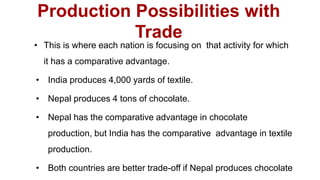
• There is free trade i.e. the movement of goods between
countries is not hindered by any restrictions.
• Production is subject to constant returns to scale.
• There is no technological change.
• Trade between two countries takes place on barter system.
• Full employment exists in both countries.
• There is no transport cost.
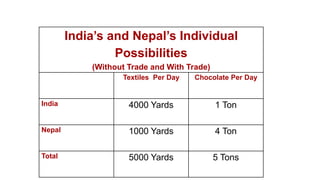
India’s and Nepal’s Individual
Possibilities
(Without Trade and With Trade)
Textiles Per Day Chocolate Per Day
India 4000 Yards 1 Ton
Nepal 1000 Yards 4 Ton
Total 5000 Yards 5 Tons
Production Possibilities with
Trade
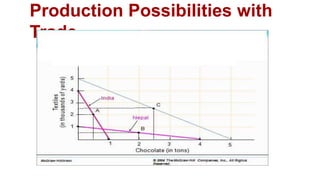
Production Possibilities with
Trade
• This is where each nation is focusing on that activity for which
it has a comparative advantage.
• India produces 4,000 yards of textile.
• Nepal produces 4 tons of chocolate.
• Nepal has the comparative advantage in chocolate
production, but India has the comparative advantage in textile
production.
• Both countries are better trade-off if Nepal produces chocolate
Limitations
• It is possible for a nation not to have an absolute advantage in
anything but it is not possible for one nation to have a
comparative advantage in everything and the other nation to
have a comparative advantage in nothing. That's because
comparative advantage depends on relative costs.
• We have used trading models in which only two goods are
produced and consumed and in which trade is confined to two
countries the real world of international trade involves more than
two products and two countries; each country produces
thousands of products and trades with many countries
Conclusion:
• When a large number of goods is produced by two
countries, operation of comparative advantage requires that
the goods be ranked by the degree of comparative cost.
• Each country exports the product(s) in which it has the
greatest comparative advantage.
• Conversely, each country imports the product(s) in which
it has greatest comparative disadvantage.
THANK YOU

Unit- 2 Lecture-3 (comparative advantage theory)

  • 1.
    Branch - MBA InternationalBusiness Management DR. APJ ABDUL KALAM TECHNICAL UNIVERSITY By Dr. B. B.Tiwari Professor Department of Management Shri Ramswaroop Memorial Group of Professional Colleges, Lucknow Lecture – 3 International Trade Theories: Comparative Cost Advantage Theory
  • 2.
    Origin of thetheory: Introduction•The original description of the idea can be found in “An Essay on the External Corn Trade” by Robert Torrens in 1815. •David Ricardo formalized the idea using a compelling, yet simple, numerical example in his 1817 book titled, “On the Principles of Political Economy and Taxation”. •The idea appeared again in James Mill's “Elements of Political Economy” in 1821. Finally, the concept became a key feature of international political economy upon the publication of “Principles of Political Economy” by John Stuart Mill in 1848.
  • 3.
    Comparative Advantage Theory: Ricardo •Ricardo's Law of Comparative Advantage improved upon the earlier Law of Absolute Advantage. How? • If A (Advanced land) is more productive than B (Backward land) in every productive activity, would both countries benefit from trade? • The law of absolute advantage has no answer to this question. • Ricardo's law of comparative advantage showed that the answer is yes.
  • 4.
    Comparative Advantage•If one nationis less efficient in the production of a good than another nation, there is still a basis of gains from trade •A nation should specialize in production and export the good for which its relative (comparative) advantage is greatest •A nation should specialize in production and export the good for which it has the least relative disadvantage •A nation should import the good for which its relative (comparative) advantage is the least •A nation should import the good for which it has the greatest relative disadvantage
  • 5.
    1. There aretwo countries and two commodities. 2. There is a perfect competition both in commodity and factor market. 3. Cost of production is expressed in terms of labour i.e. value of a commodity is measured in terms of labour hours/days required to produce it. Commodities are also exchanged on the basis of labour content of each good. 4. Labour is the only factor of production other than natural resources. 5. Labour is homogeneous i.e. identical in efficiency, in a particular country. 6. Labour is perfectly mobile within a country but perfectly immobile Assumptions
  • 6.
    Cont….. • There isfree trade i.e. the movement of goods between countries is not hindered by any restrictions. • Production is subject to constant returns to scale. • There is no technological change. • Trade between two countries takes place on barter system. • Full employment exists in both countries. • There is no transport cost.
  • 7.
    India’s and Nepal’sIndividual Possibilities (Without Trade and With Trade) Textiles Per Day Chocolate Per Day India 4000 Yards 1 Ton Nepal 1000 Yards 4 Ton Total 5000 Yards 5 Tons
  • 8.
  • 9.
    Production Possibilities with Trade •This is where each nation is focusing on that activity for which it has a comparative advantage. • India produces 4,000 yards of textile. • Nepal produces 4 tons of chocolate. • Nepal has the comparative advantage in chocolate production, but India has the comparative advantage in textile production. • Both countries are better trade-off if Nepal produces chocolate
  • 10.
    Limitations • It ispossible for a nation not to have an absolute advantage in anything but it is not possible for one nation to have a comparative advantage in everything and the other nation to have a comparative advantage in nothing. That's because comparative advantage depends on relative costs. • We have used trading models in which only two goods are produced and consumed and in which trade is confined to two countries the real world of international trade involves more than two products and two countries; each country produces thousands of products and trades with many countries
  • 11.
    Conclusion: • When alarge number of goods is produced by two countries, operation of comparative advantage requires that the goods be ranked by the degree of comparative cost. • Each country exports the product(s) in which it has the greatest comparative advantage. • Conversely, each country imports the product(s) in which it has greatest comparative disadvantage.
  • 12.