







A market is a system by which buyers and
sellers transact their business.
The price of a commodity traded in the
market is determined by the number of
buyers and sellers.
The number of sellers of a product in the
market determine the nature and degree of
competition.
The nature and degree of competition make
the market structure.




It is a market form in which there are large
number of sellers and buyers of
homogeneous product. There is freedom of
entry into and exit from the industry, and all
firms in the industry are price takers.
Uniform price prevails in the market, and
buyers and sellers possess perfect knowledge
of market conditions.
(Note: A firm is an individual producing unit,
while a group of firms producing a particular
commodity make up an industry.)





Many small firms, each of whom produces an
insignificant percentage of total market
output and thus exercises no control over the
ruling market price.
Many individual buyers, none of whom has
any control over the market price.
Perfect freedom of entry and exit from the
industry. Entry and exit from the market is
feasible in the long run. This assumption
ensures all firms make normal profits in the
long run








Homogeneous products are supplied to the
markets that are perfect substitutes. Hence
firms are “price takers” and face a perfectly
elastic demand curve for their product
Perfect knowledge – consumers have readily
available information about prices and
products from competing suppliers and can
access this at zero cost.
Perfect mobility of goods and factors among
firms and even different industries
No transport cost for carrying the product.
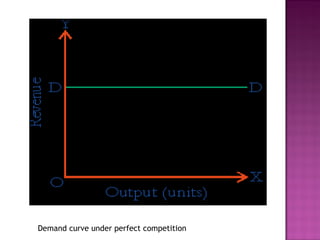
1. Firm’s Demand Curve under Perfect
Competition
Demand curve of the firm under perfect
competition is perfectly elastic as price of
the product is fixed by industry and firm is
just price taker. So demand curve is parallel
to X-axis .The firm has just to take the
decision regarding the level of output it
wants to produce at the price which is fixed
by industry.
Demand curve under perfect competition
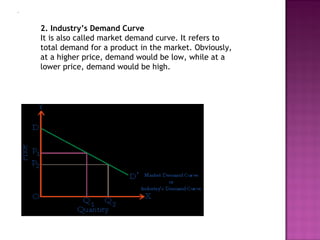
2. Industry’s Demand Curve
It is also called market demand curve. It refers to
total demand for a product in the market. Obviously,
at a higher price, demand would be low, while at a
lower price, demand would be high.
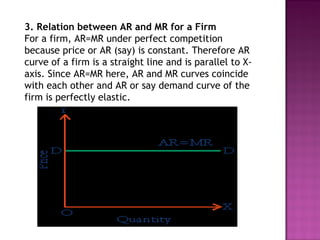
3. Relation between AR and MR for a Firm
For a firm, AR=MR under perfect competition
because price or AR (say) is constant. Therefore AR
curve of a firm is a straight line and is parallel to Xaxis. Since AR=MR here, AR and MR curves coincide
with each other and AR or say demand curve of the
firm is perfectly elastic.
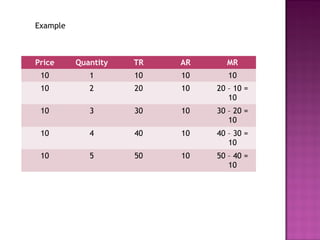
Example

Price

Quantity

TR

AR

MR

10

1

10

10

10

10

2

20

10

20 – 10 =
10

10

3

30

10

30 – 20 =
10

10

4

40

10

40 – 30 =
10

10

5

50

10

50 – 40 =
10
With increase in demand because of
reasons other than price, the price of the
commodity increases for the same supply.
 With decrease in supply because of
reasons other than price, the reduced
quantity is supplied at a higher price.
(Graph)
e.g. – daily vegetable market, milk market,
stock market etc.

Price determination in market period (very
short run):
 Output (supply) is assumed to be fixed
considering the time period. Hence supply
curve is perfectly inelastic.
 In such a case, price is determined by
demand conditions.
 The point at which the demand for a product
meets its supply , price related to that point
is fixed as market price.






Short run is a functional time period during
which a firm cannot change its size as
certain fixed factors and the plant cannot be
altered.
Since the firm is a price taker, it has a
perfectly elastic demand for its product so it
can sell whatever it produced at a given
price.
Since the price is predetermined, the firm
can only decide about the optimum quantity
at equilibrium point where profit is
maximised.
A firm will go on expanding its output as long
as every additional unit produced adds more
to its total revenues than what it adds to its
total costs..
 The firm will not produce a unit which adds
more to its total costs than what I adds to its
total revenue.
 This means the firm will be increasing its
profits by expanding its output to the level
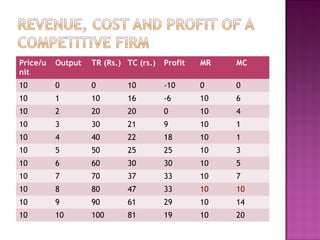
at which the MR just equals MC.
Let’s understand this with an example

Price/u
nit

Output

TR (Rs.) TC (rs.)

Profit

MR

MC

10

0

0

10

-10

0

0

10

1

10

16

-6

10

6

10

2

20

20

0

10

4

10

3

30

21

9

10

1

10

4

40

22

18

10

1

10

5

50

25

25

10

3

10

6

60

30

30

10

5

10

7

70

37

33

10

7

10

8

80

47

33

10

10

10

9

90

61

29

10

14

10

10

100

81

19

10

20





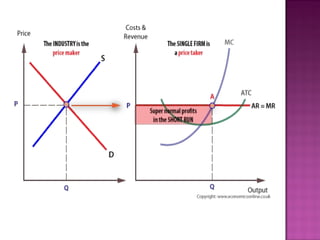
The equilibrium level of output at a
given price is determined by
comparing SMC with SMR.
In the short run MR depends on the
price of the product.
Price of the product is market
determined by the intersection of
short period demand and supply
curves. (refer graph)






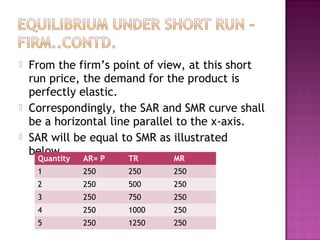
From the firm’s point of view, at this short
run price, the demand for the product is
perfectly elastic.
Correspondingly, the SAR and SMR curve shall
be a horizontal line parallel to the x-axis.
SAR will be equal to SMR as illustrated
below.
Quantity

AR= P

TR

MR

1

250

250

250

2

250

500

250

3

250

750

250

4

250

1000

250

5

250

1250

250
Along with this, the SAC and SMC are drawn
in comparison.
 Point of equilibrium : SMC= SMR
(refer graph)










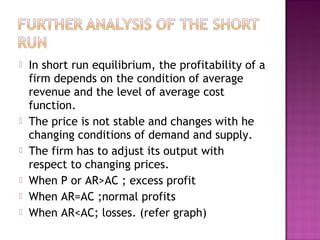
In short run equilibrium, the profitability of a
firm depends on the condition of average
revenue and the level of average cost
function.
The price is not stable and changes with he
changing conditions of demand and supply.
The firm has to adjust its output with
respect to changing prices.
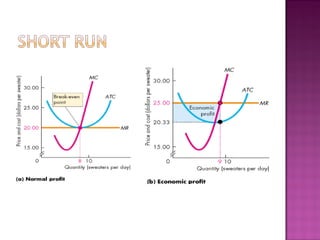
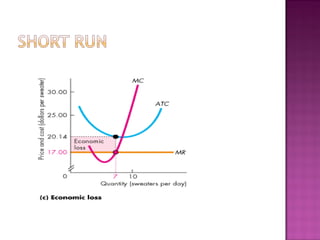
When P or AR>AC ; excess profit
When AR=AC ;normal profits
When AR<AC; losses. (refer graph)








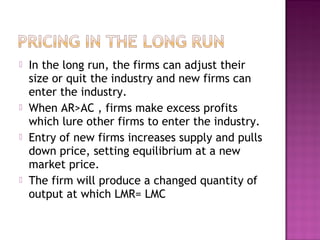
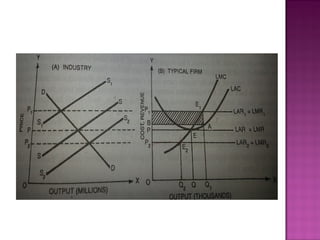
In the long run, the firms can adjust their
size or quit the industry and new firms can
enter the industry.
When AR>AC , firms make excess profits
which lure other firms to enter the industry.
Entry of new firms increases supply and pulls
down price, setting equilibrium at a new
market price.
The firm will produce a changed quantity of
output at which LMR= LMC







At this level, the LAR can be greater than
LAC, can be equal to LAC or can be lower
than LAC.
In the latter 2 conditions, the firm will earn
normal profits or will incur losses.
Firms earning normal profits is the most ideal
situation in Long run.
If they face losses, they quit the industry.





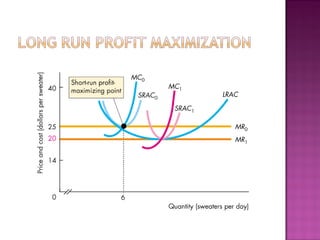
LMC= LMR, profit is maximized
LAR (Price) = LAC, normal
profits
LMR = LAR, firm is a price taker
LMC= LAC, the firm is operating
at minimum average cost.
Market structure final  perfect competition

Market structure final perfect competition

  • 2.
        A market isa system by which buyers and sellers transact their business. The price of a commodity traded in the market is determined by the number of buyers and sellers. The number of sellers of a product in the market determine the nature and degree of competition. The nature and degree of competition make the market structure.
  • 4.
      It is amarket form in which there are large number of sellers and buyers of homogeneous product. There is freedom of entry into and exit from the industry, and all firms in the industry are price takers. Uniform price prevails in the market, and buyers and sellers possess perfect knowledge of market conditions. (Note: A firm is an individual producing unit, while a group of firms producing a particular commodity make up an industry.)
  • 5.
       Many small firms,each of whom produces an insignificant percentage of total market output and thus exercises no control over the ruling market price. Many individual buyers, none of whom has any control over the market price. Perfect freedom of entry and exit from the industry. Entry and exit from the market is feasible in the long run. This assumption ensures all firms make normal profits in the long run
  • 6.
        Homogeneous products aresupplied to the markets that are perfect substitutes. Hence firms are “price takers” and face a perfectly elastic demand curve for their product Perfect knowledge – consumers have readily available information about prices and products from competing suppliers and can access this at zero cost. Perfect mobility of goods and factors among firms and even different industries No transport cost for carrying the product.
  • 7.
    1. Firm’s DemandCurve under Perfect Competition Demand curve of the firm under perfect competition is perfectly elastic as price of the product is fixed by industry and firm is just price taker. So demand curve is parallel to X-axis .The firm has just to take the decision regarding the level of output it wants to produce at the price which is fixed by industry.
  • 8.
    Demand curve underperfect competition
  • 9.
    2. Industry’s DemandCurve It is also called market demand curve. It refers to total demand for a product in the market. Obviously, at a higher price, demand would be low, while at a lower price, demand would be high.
  • 10.
    3. Relation betweenAR and MR for a Firm For a firm, AR=MR under perfect competition because price or AR (say) is constant. Therefore AR curve of a firm is a straight line and is parallel to Xaxis. Since AR=MR here, AR and MR curves coincide with each other and AR or say demand curve of the firm is perfectly elastic.
  • 11.
    Example Price Quantity TR AR MR 10 1 10 10 10 10 2 20 10 20 – 10= 10 10 3 30 10 30 – 20 = 10 10 4 40 10 40 – 30 = 10 10 5 50 10 50 – 40 = 10
  • 12.
    With increase indemand because of reasons other than price, the price of the commodity increases for the same supply.  With decrease in supply because of reasons other than price, the reduced quantity is supplied at a higher price. (Graph) e.g. – daily vegetable market, milk market, stock market etc. 
  • 13.
    Price determination inmarket period (very short run):  Output (supply) is assumed to be fixed considering the time period. Hence supply curve is perfectly inelastic.  In such a case, price is determined by demand conditions.  The point at which the demand for a product meets its supply , price related to that point is fixed as market price.
  • 14.
       Short run isa functional time period during which a firm cannot change its size as certain fixed factors and the plant cannot be altered. Since the firm is a price taker, it has a perfectly elastic demand for its product so it can sell whatever it produced at a given price. Since the price is predetermined, the firm can only decide about the optimum quantity at equilibrium point where profit is maximised.
  • 15.
    A firm willgo on expanding its output as long as every additional unit produced adds more to its total revenues than what it adds to its total costs..  The firm will not produce a unit which adds more to its total costs than what I adds to its total revenue.  This means the firm will be increasing its profits by expanding its output to the level at which the MR just equals MC. Let’s understand this with an example 
  • 16.
    Price/u nit Output TR (Rs.) TC(rs.) Profit MR MC 10 0 0 10 -10 0 0 10 1 10 16 -6 10 6 10 2 20 20 0 10 4 10 3 30 21 9 10 1 10 4 40 22 18 10 1 10 5 50 25 25 10 3 10 6 60 30 30 10 5 10 7 70 37 33 10 7 10 8 80 47 33 10 10 10 9 90 61 29 10 14 10 10 100 81 19 10 20
  • 17.
       The equilibrium levelof output at a given price is determined by comparing SMC with SMR. In the short run MR depends on the price of the product. Price of the product is market determined by the intersection of short period demand and supply curves. (refer graph)
  • 18.
       From the firm’spoint of view, at this short run price, the demand for the product is perfectly elastic. Correspondingly, the SAR and SMR curve shall be a horizontal line parallel to the x-axis. SAR will be equal to SMR as illustrated below. Quantity AR= P TR MR 1 250 250 250 2 250 500 250 3 250 750 250 4 250 1000 250 5 250 1250 250
  • 19.
    Along with this,the SAC and SMC are drawn in comparison.  Point of equilibrium : SMC= SMR (refer graph) 
  • 21.
          In short runequilibrium, the profitability of a firm depends on the condition of average revenue and the level of average cost function. The price is not stable and changes with he changing conditions of demand and supply. The firm has to adjust its output with respect to changing prices. When P or AR>AC ; excess profit When AR=AC ;normal profits When AR<AC; losses. (refer graph)
  • 24.
        In the longrun, the firms can adjust their size or quit the industry and new firms can enter the industry. When AR>AC , firms make excess profits which lure other firms to enter the industry. Entry of new firms increases supply and pulls down price, setting equilibrium at a new market price. The firm will produce a changed quantity of output at which LMR= LMC
  • 25.
        At this level,the LAR can be greater than LAC, can be equal to LAC or can be lower than LAC. In the latter 2 conditions, the firm will earn normal profits or will incur losses. Firms earning normal profits is the most ideal situation in Long run. If they face losses, they quit the industry.
  • 27.
        LMC= LMR, profitis maximized LAR (Price) = LAC, normal profits LMR = LAR, firm is a price taker LMC= LAC, the firm is operating at minimum average cost.