PEACE THEME 2:
CHALLENGING PREJUDICE
AND BUILDING TOLERANCE
:
Paras, Liezel H.Reported By:
Introduction
 Gordon Allport (1958)
 Asserts that human have a propensity towards
prejudice. This propensity lies in normal
tendency to form generalizations and categories
whose content represents an
oversimplifications of their world of experience.
Definition of terms
1. Prejudice
 is the negative feeling or attitude towards a
person or a group even if it lacks basis.
2. Stereotype
 Refers to the negative opinion about a person or
a group based on incomplete knowledge.
3. Discrimination
 Refers to negative actions toward members of a
specific social group that may be manifested in
avoidance, aversion or even violence
Types of Prejudice
 Racism
 the belief that one’s own cultural or racial heritage is
innately superior to that of others, hence, the lack of
respect or appreciation for those who belong to a
“different race”
 Sexism
 a system of attitudes, actions and structures that
subordinates others on the basis of their sex where
the usual victims are women.
Types of Prejudice
 Heterosexism
 Negative attitudes towards lesbian and gay
men.
 Classism
 Distancing from and perceiving the poor as “the
other” (Lott, 1995)
Types of Prejudice
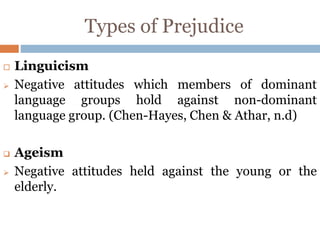
 Linguicism
 Negative attitudes which members of dominant
language groups hold against non-dominant
language group. (Chen-Hayes, Chen & Athar, n.d)
 Ageism
 Negative attitudes held against the young or the
elderly.
Types of Prejudice
 Looksism
 Prejudice against those who do not measure up to set
standards of beauty. The usual victims are the over-
weight, the undersized, and the dark-skinned.
(Nario-Galace, 2003)
 Religious intolerance
 Prejudice against those who are followers of religions
other that one’s own.
Education for Tolerance and Respect
AIMS to:
 Counter influences that lead to fear , discrimination
and exclusion of others. Tolerance recognizes that
others have the right to be who they are.
Educating for tolerance is a practical alternative.
Effects of Prejudice in School
1. Victims are more likely to drop out school. (Kistner,
et al., 1993)
2. It negatively influences the psychological health of
the victims because of feelings of isolation and
alienation. (Neville et Al, 1997)
3. Negative effects on physical health.
4. Victims internalize the very negative views on their
abilities that others hold of them and do not live up
to their potentials.
5. Victims are normally excluded, taunted or
physically harmed.
PEACE THEME 3:
PROMOTING NONVIOLENCE
Paras, Liezel H.Reported
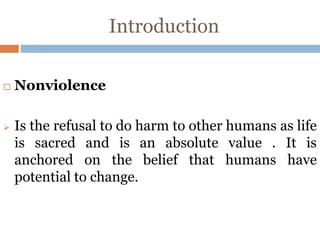
Introduction
 Nonviolence
 Is the refusal to do harm to other humans as life
is sacred and is an absolute value . It is
anchored on the belief that humans have
potential to change.
Different beliefs about nonviolence
 Mohandas Gandhi
 The man who led the people of India out of British
subjugation held the following beliefs about
nonviolence:
1. As long as people accept exploitation, both exploiter
and exploited will be entangled in injustice but once
the exploited refuse to accept the relationship,
refuse to cooperate with it, they are already free.
Mohandas Gandhi beliefs
2. Nonviolence and cowardice do not go together.
Possession of arms implies an element of fear, if not
cowardice.
3. A person and his/her deeds are two distinct things.
Hate the sin but not the sinner.
4. If we fight back (in a violent way), we will become
the vandal and they (oppressors) will become the
law.
5. An eye for an eye makes the whole world blind.
Mohandas Gandhi beliefs
6. Nonviolence is more powerful for converting the
opponent and opening his ears which are otherwise
shut to the voice of reason.
7. Nonviolence demands that the means used should
be as pure as the ends sought. Two wrongs will not
make one right. “If the end is good the means must
also be good.”
Different beliefs about nonviolence
 Martin Luther King Jr.
 Believe in the same principles of Gandhi held on to.
Below are additional beliefs of MLK, Jr. held with
regard to nonviolence:
1. Nonviolence does not seek to defeat or humiliate
the opponent but to win friendship and
understanding.
Martin Luther King Jr. beliefs
2. Nonviolence seeks to defeat injustice, not people.
3. Nonviolence thrives on love rather than hatred.
4. Nonviolence requires willingness to suffer and
amazing discipline in the midst of provocation.
5. Nonviolence holds that suffering can educate and
transform.
Why Nonviolence?
1. It is both an ethical and moral choice.
 Major religious and philosophical traditions teach
about respect for life.
Jainism- it is taught that a wise person “does not kill,
nor cause others to kill, nor consent to the killings
by others.”
Lao Tzu, founder of Taoism taught that “weapons
are instrument of evil and not of a good ruler.”
Why Nonviolence?
In Buddhism, the precept “not to kill” is the
foundation for all Buddhist action. Everyone is
believed to have been born with a Buddha nature so
“no one has the right to take the life of another”.
2. Destruction is not the law of humans
 Theory of Bandura & Ross – aggression is not
inherent but it is learned in the process of
socialization and thus, may be unlearned.
Why Nonviolence?
3. Nonviolence is a practical choice. Tools
and effects of violence are costly.
- examples: Large amount of money buying war
crafts and different fire arms.
4. Nonviolence works
- Examples : EDSA People Power and the Speech of
Martin Luther King Jr. about equality between
white and black Americans.
Nonviolent Direct Action
 Gene Sharp (2005)
 Identified 198 methods of nonviolent action.
 Nonviolent action
 Refers to efforts to persuade with action via methods
of protests , noncooperation and intervention
without using physical violence.
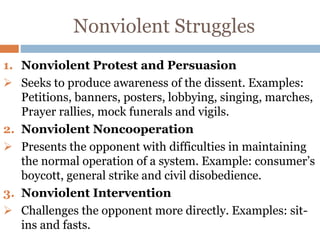
Nonviolent Struggles
1. Nonviolent Protest and Persuasion
 Seeks to produce awareness of the dissent. Examples:
Petitions, banners, posters, lobbying, singing, marches,
Prayer rallies, mock funerals and vigils.
2. Nonviolent Noncooperation
 Presents the opponent with difficulties in maintaining
the normal operation of a system. Example: consumer’s
boycott, general strike and civil disobedience.
3. Nonviolent Intervention
 Challenges the opponent more directly. Examples: sit-
ins and fasts.
Goals of Nonviolent Actions
 According to Martin Luther King Jr:
 Nonviolent actions seek to dramatize the issue and to
put pressure on the adversary to confront the issue.
 Nonviolent direct actions seeks to create
tension/crisis that would force the adversary to open
the door to negotiation.
 Nonviolent direct actions seeks to create a situation
that would liberate victims from silence and
hopelessness.
 Nonviolent direct actions also seeks to gain
attention, and consequently, support from the larger
community.
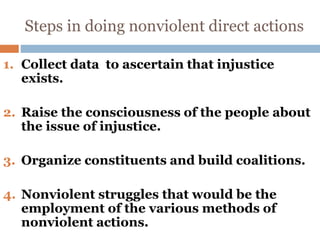
Steps in doing nonviolent direct actions
1. Collect data to ascertain that injustice
exists.
2. Raise the consciousness of the people about
the issue of injustice.
3. Organize constituents and build coalitions.
4. Nonviolent struggles that would be the
employment of the various methods of
nonviolent actions.
PEACE THEME 4:
CHALLENGING THE WAR
SYSTEM
Monajan, Heidi G.Reported By:
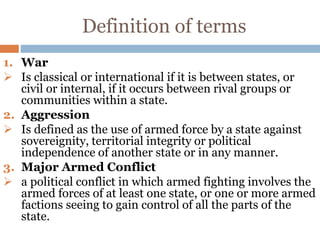
Definition of terms
1. War
 Is classical or international if it is between states, or
civil or internal, if it occurs between rival groups or
communities within a state.
2. Aggression
 Is defined as the use of armed force by a state against
sovereignity, territorial integrity or political
independence of another state or in any manner.
3. Major Armed Conflict
 a political conflict in which armed fighting involves the
armed forces of at least one state, or one or more armed
factions seeing to gain control of all the parts of the
state.
Possible Causes of War
1. Territorial Disputes
2. Lack of tolerance for differences
3. Ideological or power struggles
4. Categorical inequality
5. Deprivation and injustice
6. History of colonialism and process of
decolonization
7. Competition for resources
Effects of War
1. Massive deaths
2. Commitment of atrocities
3. Causes the people to flee their homes
4. Causes weapons to proliferate
5. Holds back development because of huge
amounts for fire arms.
6. Cause the children to join battle zones
instead of playing in safe areas.
7. People will lost livelihood, investments,
food supplies and raze opportunity for
tourism.
Peace Education and War System
 Peace education seeks to develop a global perspective
on the problems and an understanding that humans
are a single species.
 Peace education can help challenge thoughts that the
world id divided into “good guys and bad guys” and
that winning over the bad guys is the way to go.
 Peace education seeks to teach the concept of
oneness of the human race.
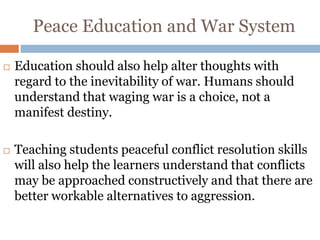
Peace Education and War System
 Education should also help alter thoughts with
regard to the inevitability of war. Humans should
understand that waging war is a choice, not a
manifest destiny.
 Teaching students peaceful conflict resolution skills
will also help the learners understand that conflicts
may be approached constructively and that there are
better workable alternatives to aggression.

Peace theme 2

  • 1.
    PEACE THEME 2: CHALLENGINGPREJUDICE AND BUILDING TOLERANCE : Paras, Liezel H.Reported By:
  • 2.
    Introduction  Gordon Allport(1958)  Asserts that human have a propensity towards prejudice. This propensity lies in normal tendency to form generalizations and categories whose content represents an oversimplifications of their world of experience.
  • 3.
    Definition of terms 1.Prejudice  is the negative feeling or attitude towards a person or a group even if it lacks basis. 2. Stereotype  Refers to the negative opinion about a person or a group based on incomplete knowledge. 3. Discrimination  Refers to negative actions toward members of a specific social group that may be manifested in avoidance, aversion or even violence
  • 4.
    Types of Prejudice Racism  the belief that one’s own cultural or racial heritage is innately superior to that of others, hence, the lack of respect or appreciation for those who belong to a “different race”  Sexism  a system of attitudes, actions and structures that subordinates others on the basis of their sex where the usual victims are women.
  • 5.
    Types of Prejudice Heterosexism  Negative attitudes towards lesbian and gay men.  Classism  Distancing from and perceiving the poor as “the other” (Lott, 1995)
  • 6.
    Types of Prejudice Linguicism  Negative attitudes which members of dominant language groups hold against non-dominant language group. (Chen-Hayes, Chen & Athar, n.d)  Ageism  Negative attitudes held against the young or the elderly.
  • 7.
    Types of Prejudice Looksism  Prejudice against those who do not measure up to set standards of beauty. The usual victims are the over- weight, the undersized, and the dark-skinned. (Nario-Galace, 2003)  Religious intolerance  Prejudice against those who are followers of religions other that one’s own.
  • 8.
    Education for Toleranceand Respect AIMS to:  Counter influences that lead to fear , discrimination and exclusion of others. Tolerance recognizes that others have the right to be who they are. Educating for tolerance is a practical alternative.
  • 9.
    Effects of Prejudicein School 1. Victims are more likely to drop out school. (Kistner, et al., 1993) 2. It negatively influences the psychological health of the victims because of feelings of isolation and alienation. (Neville et Al, 1997) 3. Negative effects on physical health. 4. Victims internalize the very negative views on their abilities that others hold of them and do not live up to their potentials. 5. Victims are normally excluded, taunted or physically harmed.
  • 10.
    PEACE THEME 3: PROMOTINGNONVIOLENCE Paras, Liezel H.Reported
  • 11.
    Introduction  Nonviolence  Isthe refusal to do harm to other humans as life is sacred and is an absolute value . It is anchored on the belief that humans have potential to change.
  • 12.
    Different beliefs aboutnonviolence  Mohandas Gandhi  The man who led the people of India out of British subjugation held the following beliefs about nonviolence: 1. As long as people accept exploitation, both exploiter and exploited will be entangled in injustice but once the exploited refuse to accept the relationship, refuse to cooperate with it, they are already free.
  • 13.
    Mohandas Gandhi beliefs 2.Nonviolence and cowardice do not go together. Possession of arms implies an element of fear, if not cowardice. 3. A person and his/her deeds are two distinct things. Hate the sin but not the sinner. 4. If we fight back (in a violent way), we will become the vandal and they (oppressors) will become the law. 5. An eye for an eye makes the whole world blind.
  • 14.
    Mohandas Gandhi beliefs 6.Nonviolence is more powerful for converting the opponent and opening his ears which are otherwise shut to the voice of reason. 7. Nonviolence demands that the means used should be as pure as the ends sought. Two wrongs will not make one right. “If the end is good the means must also be good.”
  • 15.
    Different beliefs aboutnonviolence  Martin Luther King Jr.  Believe in the same principles of Gandhi held on to. Below are additional beliefs of MLK, Jr. held with regard to nonviolence: 1. Nonviolence does not seek to defeat or humiliate the opponent but to win friendship and understanding.
  • 16.
    Martin Luther KingJr. beliefs 2. Nonviolence seeks to defeat injustice, not people. 3. Nonviolence thrives on love rather than hatred. 4. Nonviolence requires willingness to suffer and amazing discipline in the midst of provocation. 5. Nonviolence holds that suffering can educate and transform.
  • 17.
    Why Nonviolence? 1. Itis both an ethical and moral choice.  Major religious and philosophical traditions teach about respect for life. Jainism- it is taught that a wise person “does not kill, nor cause others to kill, nor consent to the killings by others.” Lao Tzu, founder of Taoism taught that “weapons are instrument of evil and not of a good ruler.”
  • 18.
    Why Nonviolence? In Buddhism,the precept “not to kill” is the foundation for all Buddhist action. Everyone is believed to have been born with a Buddha nature so “no one has the right to take the life of another”. 2. Destruction is not the law of humans  Theory of Bandura & Ross – aggression is not inherent but it is learned in the process of socialization and thus, may be unlearned.
  • 19.
    Why Nonviolence? 3. Nonviolenceis a practical choice. Tools and effects of violence are costly. - examples: Large amount of money buying war crafts and different fire arms. 4. Nonviolence works - Examples : EDSA People Power and the Speech of Martin Luther King Jr. about equality between white and black Americans.
  • 20.
    Nonviolent Direct Action Gene Sharp (2005)  Identified 198 methods of nonviolent action.  Nonviolent action  Refers to efforts to persuade with action via methods of protests , noncooperation and intervention without using physical violence.
  • 21.
    Nonviolent Struggles 1. NonviolentProtest and Persuasion  Seeks to produce awareness of the dissent. Examples: Petitions, banners, posters, lobbying, singing, marches, Prayer rallies, mock funerals and vigils. 2. Nonviolent Noncooperation  Presents the opponent with difficulties in maintaining the normal operation of a system. Example: consumer’s boycott, general strike and civil disobedience. 3. Nonviolent Intervention  Challenges the opponent more directly. Examples: sit- ins and fasts.
  • 22.
    Goals of NonviolentActions  According to Martin Luther King Jr:  Nonviolent actions seek to dramatize the issue and to put pressure on the adversary to confront the issue.  Nonviolent direct actions seeks to create tension/crisis that would force the adversary to open the door to negotiation.  Nonviolent direct actions seeks to create a situation that would liberate victims from silence and hopelessness.  Nonviolent direct actions also seeks to gain attention, and consequently, support from the larger community.
  • 23.
    Steps in doingnonviolent direct actions 1. Collect data to ascertain that injustice exists. 2. Raise the consciousness of the people about the issue of injustice. 3. Organize constituents and build coalitions. 4. Nonviolent struggles that would be the employment of the various methods of nonviolent actions.
  • 24.
    PEACE THEME 4: CHALLENGINGTHE WAR SYSTEM Monajan, Heidi G.Reported By:
  • 25.
    Definition of terms 1.War  Is classical or international if it is between states, or civil or internal, if it occurs between rival groups or communities within a state. 2. Aggression  Is defined as the use of armed force by a state against sovereignity, territorial integrity or political independence of another state or in any manner. 3. Major Armed Conflict  a political conflict in which armed fighting involves the armed forces of at least one state, or one or more armed factions seeing to gain control of all the parts of the state.
  • 26.
    Possible Causes ofWar 1. Territorial Disputes 2. Lack of tolerance for differences 3. Ideological or power struggles 4. Categorical inequality 5. Deprivation and injustice 6. History of colonialism and process of decolonization 7. Competition for resources
  • 27.
    Effects of War 1.Massive deaths 2. Commitment of atrocities 3. Causes the people to flee their homes 4. Causes weapons to proliferate 5. Holds back development because of huge amounts for fire arms. 6. Cause the children to join battle zones instead of playing in safe areas. 7. People will lost livelihood, investments, food supplies and raze opportunity for tourism.
  • 28.
    Peace Education andWar System  Peace education seeks to develop a global perspective on the problems and an understanding that humans are a single species.  Peace education can help challenge thoughts that the world id divided into “good guys and bad guys” and that winning over the bad guys is the way to go.  Peace education seeks to teach the concept of oneness of the human race.
  • 29.
    Peace Education andWar System  Education should also help alter thoughts with regard to the inevitability of war. Humans should understand that waging war is a choice, not a manifest destiny.  Teaching students peaceful conflict resolution skills will also help the learners understand that conflicts may be approached constructively and that there are better workable alternatives to aggression.