Sentence
Prepared by: Ms. Liezel H. Paras
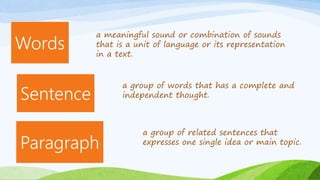
Words
Sentence
Paragraph
a meaningful sound or combination of sounds
that is a unit of language or its representation
in a text.
a group of words that has a complete and
independent thought.
a group of related sentences that
expresses one single idea or main topic.
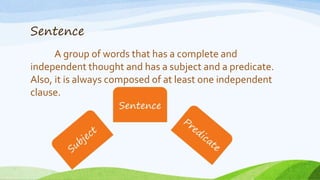
Sentence
A group of words that has a complete and
independent thought and has a subject and a predicate.
Also, it is always composed of at least one independent
clause.
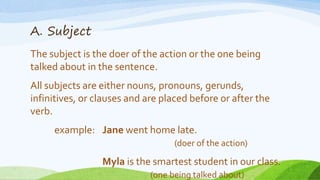
A. Subject
The subject is the doer of the action or the one being
talked about in the sentence.
All subjects are either nouns, pronouns, gerunds,
infinitives, or clauses and are placed before or after the
verb.
example: Jane went home late.
(doer of the action)
Myla is the smartest student in our class.
(one being talked about)
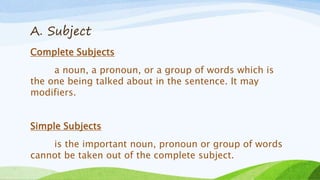
A. Subject
Complete Subjects
a noun, a pronoun, or a group of words which is
the one being talked about in the sentence. It may
modifiers.
Simple Subjects
is the important noun, pronoun or group of words
cannot be taken out of the complete subject.
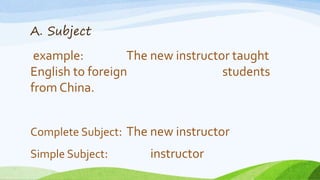
A. Subject
example: The new instructor taught
English to foreign students
from China.
Complete Subject: The new instructor
Simple Subject: instructor
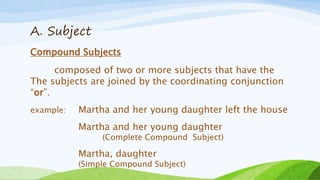
A. Subject
Compound Subjects
composed of two or more subjects that have the
The subjects are joined by the coordinating conjunction
“or”.
example: Martha and her young daughter left the house
Martha and her young daughter
(Complete Compound Subject)
Martha, daughter
(Simple Compound Subject)
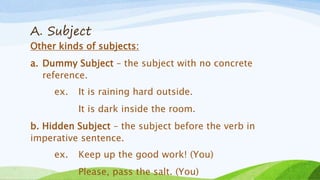
A. Subject
Other kinds of subjects:
a. Dummy Subject – the subject with no concrete
reference.
ex. It is raining hard outside.
It is dark inside the room.
b. Hidden Subject – the subject before the verb in
imperative sentence.
ex. Keep up the good work! (You)
Please, pass the salt. (You)
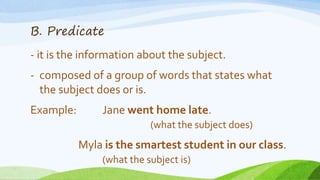
B. Predicate
- it is the information about the subject.
- composed of a group of words that states what
the subject does or is.
Example: Jane went home late.
(what the subject does)
Myla is the smartest student in our class.
(what the subject is)
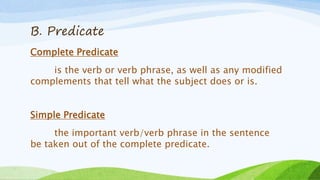
B. Predicate
Complete Predicate
is the verb or verb phrase, as well as any modified
complements that tell what the subject does or is.
Simple Predicate
the important verb/verb phrase in the sentence
be taken out of the complete predicate.
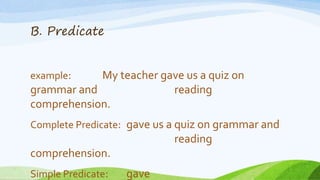
B. Predicate
example: My teacher gave us a quiz on
grammar and reading
comprehension.
Complete Predicate: gave us a quiz on grammar and
reading
comprehension.
Simple Predicate: gave
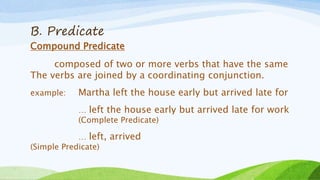
B. Predicate
Compound Predicate
composed of two or more verbs that have the same
The verbs are joined by a coordinating conjunction.
example: Martha left the house early but arrived late for
… left the house early but arrived late for work
(Complete Predicate)
… left, arrived
(Simple Predicate)
Elliptical
A word or group of words that do not express a subject or
predicate or both, but the thought is complete if it is in relation with
relation with the previous statement.
Example:
1. Who called? Marta. (predicate)
[ Marta called. ]
2. What did you do? Asked her to come in. (subject)
[ I asked her to come in ]
3. What did she want?Tickets for the concert. (s&p)
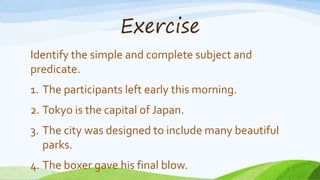
Exercise
Identify the simple and complete subject and
predicate.
1. The participants left early this morning.
2. Tokyo is the capital of Japan.
3. The city was designed to include many beautiful
parks.
4. The boxer gave his final blow.
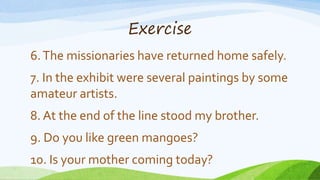
Exercise
6.The missionaries have returned home safely.
7. In the exhibit were several paintings by some
amateur artists.
8. At the end of the line stood my brother.
9. Do you like green mangoes?
10. Is your mother coming today?
Complements
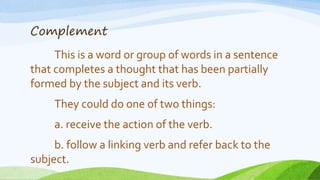
Complement
This is a word or group of words in a sentence
that completes a thought that has been partially
formed by the subject and its verb.
They could do one of two things:
a. receive the action of the verb.
b. follow a linking verb and refer back to the
subject.
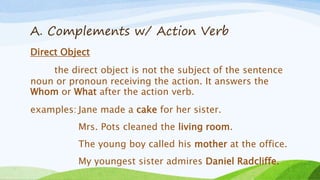
A. Complements w/ Action Verb
Direct Object
the direct object is not the subject of the sentence
noun or pronoun receiving the action. It answers the
Whom or What after the action verb.
examples: Jane made a cake for her sister.
Mrs. Pots cleaned the living room.
The young boy called his mother at the office.
My youngest sister admires Daniel Radcliffe.
Exercise
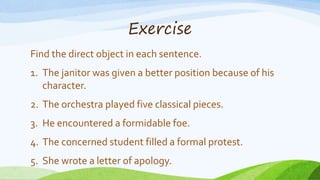
Find the direct object in each sentence.
1. The janitor was given a better position because of his
character.
2. The orchestra played five classical pieces.
3. He encountered a formidable foe.
4. The concerned student filled a formal protest.
5. She wrote a letter of apology.
A. Complements w/ Action Verb
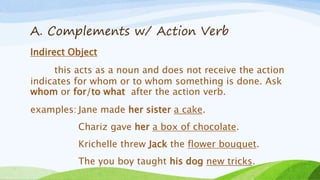
Indirect Object
this acts as a noun and does not receive the action
indicates for whom or to whom something is done. Ask
whom or for/to what after the action verb.
examples: Jane made her sister a cake.
Chariz gave her a box of chocolate.
Krichelle threw Jack the flower bouquet.
The you boy taught his dog new tricks.
Exercise
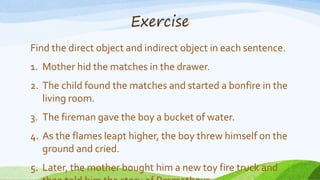
Find the direct object and indirect object in each sentence.
1. Mother hid the matches in the drawer.
2. The child found the matches and started a bonfire in the
living room.
3. The fireman gave the boy a bucket of water.
4. As the flames leapt higher, the boy threw himself on the
ground and cried.
5. Later, the mother bought him a new toy fire truck and
A. Complements w/ Action Verb
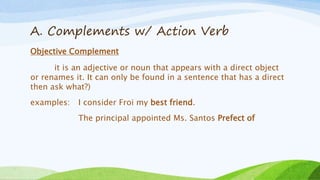
Objective Complement
it is an adjective or noun that appears with a direct object
or renames it. It can only be found in a sentence that has a direct
then ask what?)
examples: I consider Froi my best friend.
The principal appointed Ms. Santos Prefect of
Exercise
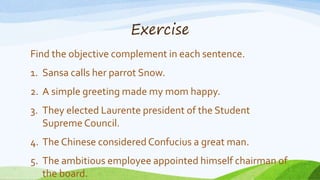
Find the objective complement in each sentence.
1. Sansa calls her parrot Snow.
2. A simple greeting made my mom happy.
3. They elected Laurente president of the Student
Supreme Council.
4. The Chinese considered Confucius a great man.
5. The ambitious employee appointed himself chairman of
the board.
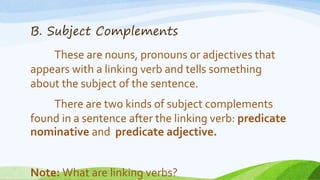
B. Subject Complements
These are nouns, pronouns or adjectives that
appears with a linking verb and tells something
about the subject of the sentence.
There are two kinds of subject complements
found in a sentence after the linking verb: predicate
nominative and predicate adjective.
Note: What are linking verbs?
B. Subject Complements
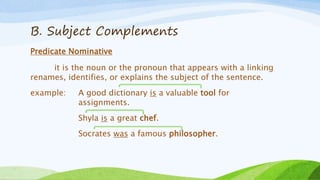
Predicate Nominative
it is the noun or the pronoun that appears with a linking
renames, identifies, or explains the subject of the sentence.
example: A good dictionary is a valuable tool for
assignments.
Shyla is a great chef.
Socrates was a famous philosopher.
B. Subject Complements
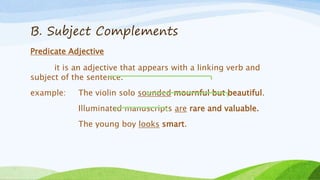
Predicate Adjective
it is an adjective that appears with a linking verb and
subject of the sentence.
example: The violin solo sounded mournful but beautiful.
Illuminated manuscripts are rare and valuable.
The young boy looks smart.
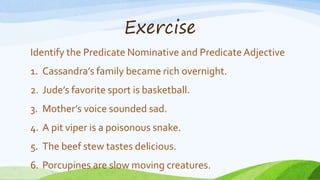
Exercise
Identify the Predicate Nominative and PredicateAdjective
1. Cassandra’s family became rich overnight.
2. Jude’s favorite sport is basketball.
3. Mother’s voice sounded sad.
4. A pit viper is a poisonous snake.
5. The beef stew tastes delicious.
6. Porcupines are slow moving creatures.
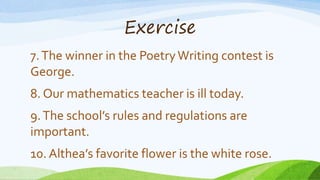
Exercise
7.The winner in the PoetryWriting contest is
George.
8. Our mathematics teacher is ill today.
9.The school’s rules and regulations are
important.
10. Althea’s favorite flower is the white rose.
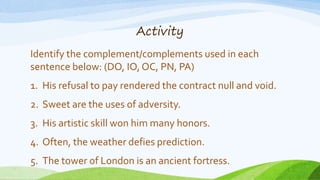
Activity
Identify the complement/complements used in each
sentence below: (DO, IO, OC, PN, PA)
1. His refusal to pay rendered the contract null and void.
2. Sweet are the uses of adversity.
3. His artistic skill won him many honors.
4. Often, the weather defies prediction.
5. The tower of London is an ancient fortress.
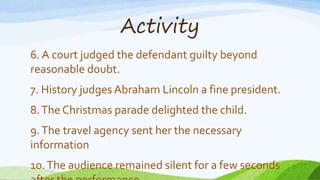
Activity
6. A court judged the defendant guilty beyond
reasonable doubt.
7. History judges Abraham Lincoln a fine president.
8.The Christmas parade delighted the child.
9.The travel agency sent her the necessary
information
10.The audience remained silent for a few seconds
Basic Sentence Structure
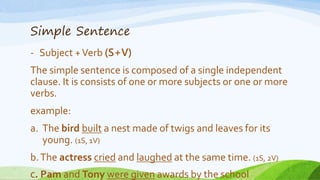
Simple Sentence
- Subject +Verb (S+V)
The simple sentence is composed of a single independent
clause. It is consists of one or more subjects or one or more
verbs.
example:
a. The bird built a nest made of twigs and leaves for its
young. (1S, 1V)
b.The actress cried and laughed at the same time. (1S, 2V)
C. Pam and Tony were given awards by the school
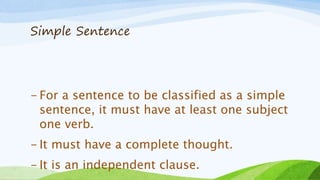
Simple Sentence
- For a sentence to be classified as a simple
sentence, it must have at least one subject
one verb.
- It must have a complete thought.
- It is an independent clause.
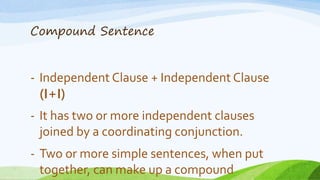
Compound Sentence
- Independent Clause + Independent Clause
(I+I)
- It has two or more independent clauses
joined by a coordinating conjunction.
- Two or more simple sentences, when put
together, can make up a compound
Compound Sentence
example:
a. She dictated, and I typed. (I+I)
[the coordinating conjunction and joins the two independent
clauses]
b.The meal was expensive, but it was spoiled, so I threw it.
[the coordinating conjunction but and so join the three
independent clauses.]
* For a sentence to be classified as a compound sentence it must
Compound Sentence
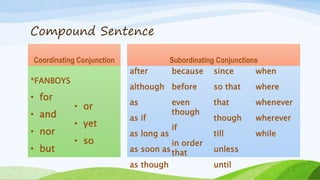
Coordinating Conjunction
*FANBOYS
• for
• and
• nor
• but
• or
• yet
• so
Subordinating Conjunctions
after
although
as
as if
as long as
as soon as
as though
because
before
even
though
if
in order
that
since
so that
that
though
till
unless
until
when
where
whenever
wherever
while
Complex Sentence
- Independent Clause + Dependent Clause (I+D)
- It contains one independent clause (I) and one or more
dependent clauses (D) joined by a subordinating conjunction.
Example #1
[complex] He went abroad because he wanted to earn
money.
[independent] He went abroad
[dependent] because he wanted to earn money.
Complex Sentence
Example #2
[complex] The school which was built ten years ago
was already renovated when I saw it.
[independent] The school was already renovated
[dependent] which was built the years ago
[dependent] when I saw it
Compound Complex Sentences
- Independent Clause + Independent Clause + Dependent Clause
(I+I+D)
- This contains two or more independent clauses and one or more
dependent clauses.
Example #1
[compound complex] We can talk about anything, and we will
go anywhere just as long as we are
together.
[independent] We can talk about anything
Compound Complex Sentences
Example #2
[compound complex] When afternoon comes, most
employees chat in the Internet and
write e-mail, but others prefer to eat
their snack.
[dependent] When afternoon comes
[independent] most employees chat in the Internet and
write e-mail.
Compound Complex Sentences
Example #3
[compound complex] The school, which was built
ten years ago, was very popular, yet I
saw it torn down.
[independent] The school was very popular
[dependent] which was built ten years ago
[independent] I saw it torn down.
Compound Complex Sentences
Example #4
[compound complex] I danced while he sang, but they won
because also played the piano.
[independent] The school was very popular
[dependent] which was built ten years ago
[independent] I saw it torn down.
* Compound complex sentences must contain at least two
independent clauses and one dependent clause.

English

  • 1.
  • 2.
    Words Sentence Paragraph a meaningful soundor combination of sounds that is a unit of language or its representation in a text. a group of words that has a complete and independent thought. a group of related sentences that expresses one single idea or main topic.
  • 3.
    Sentence A group ofwords that has a complete and independent thought and has a subject and a predicate. Also, it is always composed of at least one independent clause.
  • 4.
    A. Subject The subjectis the doer of the action or the one being talked about in the sentence. All subjects are either nouns, pronouns, gerunds, infinitives, or clauses and are placed before or after the verb. example: Jane went home late. (doer of the action) Myla is the smartest student in our class. (one being talked about)
  • 5.
    A. Subject Complete Subjects anoun, a pronoun, or a group of words which is the one being talked about in the sentence. It may modifiers. Simple Subjects is the important noun, pronoun or group of words cannot be taken out of the complete subject.
  • 6.
    A. Subject example: Thenew instructor taught English to foreign students from China. Complete Subject: The new instructor Simple Subject: instructor
  • 7.
    A. Subject Compound Subjects composedof two or more subjects that have the The subjects are joined by the coordinating conjunction “or”. example: Martha and her young daughter left the house Martha and her young daughter (Complete Compound Subject) Martha, daughter (Simple Compound Subject)
  • 8.
    A. Subject Other kindsof subjects: a. Dummy Subject – the subject with no concrete reference. ex. It is raining hard outside. It is dark inside the room. b. Hidden Subject – the subject before the verb in imperative sentence. ex. Keep up the good work! (You) Please, pass the salt. (You)
  • 9.
    B. Predicate - itis the information about the subject. - composed of a group of words that states what the subject does or is. Example: Jane went home late. (what the subject does) Myla is the smartest student in our class. (what the subject is)
  • 10.
    B. Predicate Complete Predicate isthe verb or verb phrase, as well as any modified complements that tell what the subject does or is. Simple Predicate the important verb/verb phrase in the sentence be taken out of the complete predicate.
  • 11.
    B. Predicate example: Myteacher gave us a quiz on grammar and reading comprehension. Complete Predicate: gave us a quiz on grammar and reading comprehension. Simple Predicate: gave
  • 12.
    B. Predicate Compound Predicate composedof two or more verbs that have the same The verbs are joined by a coordinating conjunction. example: Martha left the house early but arrived late for … left the house early but arrived late for work (Complete Predicate) … left, arrived (Simple Predicate)
  • 13.
    Elliptical A word orgroup of words that do not express a subject or predicate or both, but the thought is complete if it is in relation with relation with the previous statement. Example: 1. Who called? Marta. (predicate) [ Marta called. ] 2. What did you do? Asked her to come in. (subject) [ I asked her to come in ] 3. What did she want?Tickets for the concert. (s&p)
  • 14.
    Exercise Identify the simpleand complete subject and predicate. 1. The participants left early this morning. 2. Tokyo is the capital of Japan. 3. The city was designed to include many beautiful parks. 4. The boxer gave his final blow.
  • 15.
    Exercise 6.The missionaries havereturned home safely. 7. In the exhibit were several paintings by some amateur artists. 8. At the end of the line stood my brother. 9. Do you like green mangoes? 10. Is your mother coming today?
  • 16.
  • 17.
    Complement This is aword or group of words in a sentence that completes a thought that has been partially formed by the subject and its verb. They could do one of two things: a. receive the action of the verb. b. follow a linking verb and refer back to the subject.
  • 18.
    A. Complements w/Action Verb Direct Object the direct object is not the subject of the sentence noun or pronoun receiving the action. It answers the Whom or What after the action verb. examples: Jane made a cake for her sister. Mrs. Pots cleaned the living room. The young boy called his mother at the office. My youngest sister admires Daniel Radcliffe.
  • 19.
    Exercise Find the directobject in each sentence. 1. The janitor was given a better position because of his character. 2. The orchestra played five classical pieces. 3. He encountered a formidable foe. 4. The concerned student filled a formal protest. 5. She wrote a letter of apology.
  • 20.
    A. Complements w/Action Verb Indirect Object this acts as a noun and does not receive the action indicates for whom or to whom something is done. Ask whom or for/to what after the action verb. examples: Jane made her sister a cake. Chariz gave her a box of chocolate. Krichelle threw Jack the flower bouquet. The you boy taught his dog new tricks.
  • 21.
    Exercise Find the directobject and indirect object in each sentence. 1. Mother hid the matches in the drawer. 2. The child found the matches and started a bonfire in the living room. 3. The fireman gave the boy a bucket of water. 4. As the flames leapt higher, the boy threw himself on the ground and cried. 5. Later, the mother bought him a new toy fire truck and
  • 22.
    A. Complements w/Action Verb Objective Complement it is an adjective or noun that appears with a direct object or renames it. It can only be found in a sentence that has a direct then ask what?) examples: I consider Froi my best friend. The principal appointed Ms. Santos Prefect of
  • 23.
    Exercise Find the objectivecomplement in each sentence. 1. Sansa calls her parrot Snow. 2. A simple greeting made my mom happy. 3. They elected Laurente president of the Student Supreme Council. 4. The Chinese considered Confucius a great man. 5. The ambitious employee appointed himself chairman of the board.
  • 24.
    B. Subject Complements Theseare nouns, pronouns or adjectives that appears with a linking verb and tells something about the subject of the sentence. There are two kinds of subject complements found in a sentence after the linking verb: predicate nominative and predicate adjective. Note: What are linking verbs?
  • 25.
    B. Subject Complements PredicateNominative it is the noun or the pronoun that appears with a linking renames, identifies, or explains the subject of the sentence. example: A good dictionary is a valuable tool for assignments. Shyla is a great chef. Socrates was a famous philosopher.
  • 26.
    B. Subject Complements PredicateAdjective it is an adjective that appears with a linking verb and subject of the sentence. example: The violin solo sounded mournful but beautiful. Illuminated manuscripts are rare and valuable. The young boy looks smart.
  • 27.
    Exercise Identify the PredicateNominative and PredicateAdjective 1. Cassandra’s family became rich overnight. 2. Jude’s favorite sport is basketball. 3. Mother’s voice sounded sad. 4. A pit viper is a poisonous snake. 5. The beef stew tastes delicious. 6. Porcupines are slow moving creatures.
  • 28.
    Exercise 7.The winner inthe PoetryWriting contest is George. 8. Our mathematics teacher is ill today. 9.The school’s rules and regulations are important. 10. Althea’s favorite flower is the white rose.
  • 29.
    Activity Identify the complement/complementsused in each sentence below: (DO, IO, OC, PN, PA) 1. His refusal to pay rendered the contract null and void. 2. Sweet are the uses of adversity. 3. His artistic skill won him many honors. 4. Often, the weather defies prediction. 5. The tower of London is an ancient fortress.
  • 30.
    Activity 6. A courtjudged the defendant guilty beyond reasonable doubt. 7. History judges Abraham Lincoln a fine president. 8.The Christmas parade delighted the child. 9.The travel agency sent her the necessary information 10.The audience remained silent for a few seconds
  • 31.
  • 32.
    Simple Sentence - Subject+Verb (S+V) The simple sentence is composed of a single independent clause. It is consists of one or more subjects or one or more verbs. example: a. The bird built a nest made of twigs and leaves for its young. (1S, 1V) b.The actress cried and laughed at the same time. (1S, 2V) C. Pam and Tony were given awards by the school
  • 33.
    Simple Sentence - Fora sentence to be classified as a simple sentence, it must have at least one subject one verb. - It must have a complete thought. - It is an independent clause.
  • 34.
    Compound Sentence - IndependentClause + Independent Clause (I+I) - It has two or more independent clauses joined by a coordinating conjunction. - Two or more simple sentences, when put together, can make up a compound
  • 35.
    Compound Sentence example: a. Shedictated, and I typed. (I+I) [the coordinating conjunction and joins the two independent clauses] b.The meal was expensive, but it was spoiled, so I threw it. [the coordinating conjunction but and so join the three independent clauses.] * For a sentence to be classified as a compound sentence it must
  • 36.
    Compound Sentence Coordinating Conjunction *FANBOYS •for • and • nor • but • or • yet • so Subordinating Conjunctions after although as as if as long as as soon as as though because before even though if in order that since so that that though till unless until when where whenever wherever while
  • 37.
    Complex Sentence - IndependentClause + Dependent Clause (I+D) - It contains one independent clause (I) and one or more dependent clauses (D) joined by a subordinating conjunction. Example #1 [complex] He went abroad because he wanted to earn money. [independent] He went abroad [dependent] because he wanted to earn money.
  • 38.
    Complex Sentence Example #2 [complex]The school which was built ten years ago was already renovated when I saw it. [independent] The school was already renovated [dependent] which was built the years ago [dependent] when I saw it
  • 39.
    Compound Complex Sentences -Independent Clause + Independent Clause + Dependent Clause (I+I+D) - This contains two or more independent clauses and one or more dependent clauses. Example #1 [compound complex] We can talk about anything, and we will go anywhere just as long as we are together. [independent] We can talk about anything
  • 40.
    Compound Complex Sentences Example#2 [compound complex] When afternoon comes, most employees chat in the Internet and write e-mail, but others prefer to eat their snack. [dependent] When afternoon comes [independent] most employees chat in the Internet and write e-mail.
  • 41.
    Compound Complex Sentences Example#3 [compound complex] The school, which was built ten years ago, was very popular, yet I saw it torn down. [independent] The school was very popular [dependent] which was built ten years ago [independent] I saw it torn down.
  • 42.
    Compound Complex Sentences Example#4 [compound complex] I danced while he sang, but they won because also played the piano. [independent] The school was very popular [dependent] which was built ten years ago [independent] I saw it torn down. * Compound complex sentences must contain at least two independent clauses and one dependent clause.