Ms. Apple Guanzon
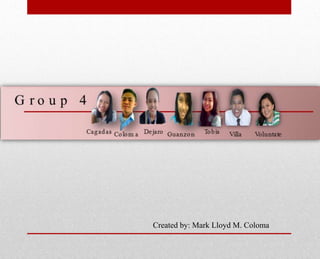
Group Leader: Mark Lloyd Coloma
Members:
Dallin Villa
Sheila Mae Ruth Cagadas
Analyn Dejaro
Jane Katherine Tobis
Nerise Jean Voluntate
Teacher: Mr. Ursecio “Urs” Inodeo
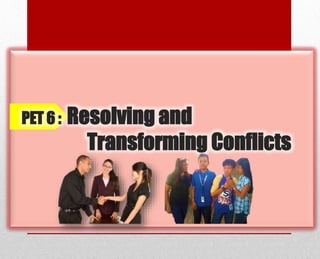
PET 6 :Resolving a n d Transforming
Conflicts
Group 4
PET 5 : Sharing the
Ea rth’sResources
SirInodeo
Special Topics Course
September 28, 2015
Audio-Visual Room
Binalbagan Catholic College
Cagadas
Coloma
Dejaro
Guanzom Tobis Villa Voluntate
with
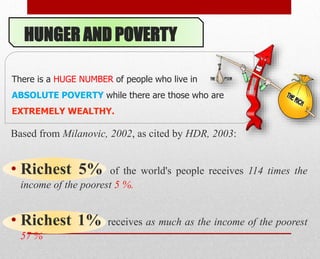
HUNGER AND POVERTY
Basedfrom Milanovic, 2002, as cited by HDR, 2003:
• Richest 5% of the world's people receives 114 times the
income of the poorest 5 %.
• Richest 1% receives as much as the income of the poorest
57 %
There is a HUGE NUMBER of people who live in
ABSOLUTE POVERTY while there are those who are
EXTREMELY WEALTHY.
4.
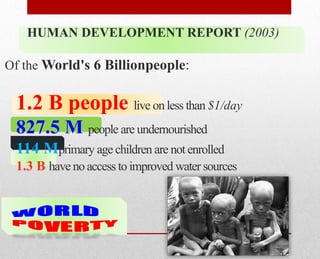
HUMAN DEVELOPMENT REPORT(2003)
Of the World's 6 Billionpeople:
1.2 B people live on less than $1/day
827.5 M people are undernourished
114 Mprimary age children are not enrolled
1.3 B have no access to improved water sources
5.
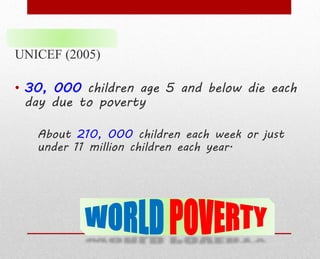
UNICEF (2005)
• 30,000 children age 5 and below die each
day due to poverty
About 210, 000 children each week or just
under 11 million children each year.
6.
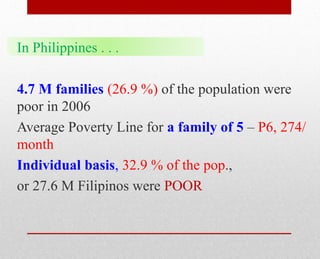
In Philippines .. .
4.7 M families (26.9 %) of the population were
poor in 2006
Average Poverty Line for a family of 5 – P6, 274/
month
Individual basis, 32.9 % of the pop.,
or 27.6 M Filipinos were POOR
7.
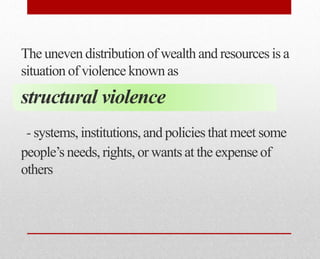
The uneven distributionofwealth and resources is a
situation of violence knownas
structural violence
- systems, institutions,and policies that meet some
people’s needs, rights, or wants at the expenseof
others
War andarmed conflicts disrupt the people’s
livelihood and all productive activities.
Political systems created by local political elite
that have combined
12.
with profit-motivated economicsystems
that reduce opportunities for most people
to earn enough to meet their basic needs.
13.
Inequitable distribution ofwealth
resources much of which has begun in colonial
history.
Environmental conditions.
Lack of opportunities such as employment.
Global
1. Establish anew international and political
economic order that is fair.
2. Wealthy countries should open up their markets
to poor countries without conditionality.
17.
3. Development countriesshould provide
unconditional debt relief as it the foreign debt
burden that compels most developing countries
to reduce allocations for basic social and
economic services. The developing world spend
$1 it receives in grants
(World Bank, 1999)
Global
18.
4. Assistance givento
developing nations should be in
the form of grants without
conditions that further push the
country in the bottom of the
poverty cauldron. Currently,
the world’s developing
countries owe creditors roughly
US $1.5 trillion (Stiglitz, 2007)
Global
19.
• Rich countriesshould open access to
technologies as technology helps
propel development.
• Reduce military expenditures so that
more resources would be made
available for basic services and
productive activities.
Global
20.
National
1. A genuineand comprehensive agrarian reform
program should be implemented.
2. Government should increase subsidy for
education which helps even the playing field.
3. Government private lending institutions should
institute credit reforms that will support small and
medium scale entrepreneurs.
21.
4. Government shouldprovide training skills
programs such as livelihood and marketing
programs.
5. Progressive taxation reforms should be
instituted to increase the purchasing power of the
poor
6. Rural infrastructure, such as farm, to market
roads and drying facilities for harvest should be
developed.
National
22.
7. The governmentshould make itself more
accessible and visible to the people
decentralization.
8. Transnational corporation should be obliged to
make contributions to community development
and environmental protection.
9. A code of conduct should be set for
transnational corporations to follow.
National
23.
10 . Reducemilitary expenditures
so that more resources would be
made available for basic services
and productive activities.
CONFLICT
Conflict is anatural part of life.
Fortunately, conflicts can be managed and
resolved constructively.
Resolving conflicts constructively is a skill
that can be taught and learned.
26.
Conflict is fromLatin word conflictus which
means striking together with force.
It occurs when one’s action or beliefs are
unacceptable to and resisted by the other (Forsyth,
1990).
Conflict occurs in dyads, groups or larger societal
structures.
28.
Why Do ConflictArise …
In the national or global levels,
they maybe caused by territorial disputes,
ethnic and religious animosities, ideological
and power struggles, social injustice, search
for statehood, trade and market
competitions, and contests over economic
resources among others.
29.
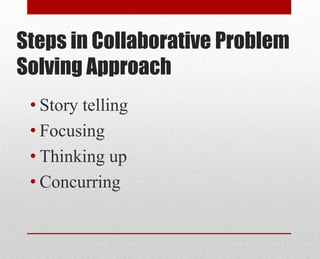
Steps in CollaborativeProblem
Solving Approach
• Story telling
• Focusing
• Thinking up
• Concurring
30.
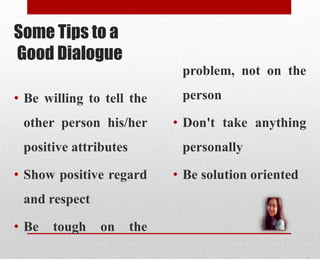
Some Tips toa
Good Dialogue
• Be willing to tell the
other person his/her
positive attributes
• Show positive regard
and respect
• Be tough on the
problem, not on the
person
• Don't take anything
personally
• Be solution oriented
31.
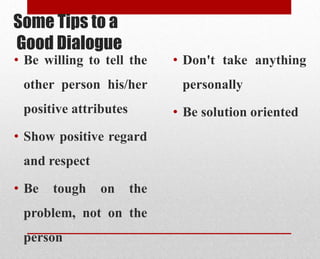
Some Tips toa
Good Dialogue
• Be willing to tell the
other person his/her
positive attributes
• Show positive regard
and respect
• Be tough on the
problem, not on the
person
• Don't take anything
personally
• Be solution oriented
32.
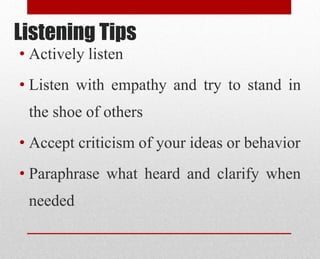
Listening Tips
• Activelylisten
• Listen with empathy and try to stand in
the shoe of others
• Accept criticism of your ideas or behavior
• Paraphrase what heard and clarify when
needed
33.
ANGER
One of thecommonly
experienced emotions
when parties are in
conflict is . . .
34.
Suggestions on howyou can
express your anger in a non
threatening way:
• •First, describe the behavior that
angers you.
• •Second, describe how you feel about
the behavior.
• •Third, describe the reason for your
feeling.
35.
How Do WeDeal With Other
People's Anger?
Johnson and Johnson (1995) nd FSR Associates provide
some tips on how we can handle angry confrontations
constructively.
•Allow expression. Listen
• Do not counter-attack
•Stand in the shoe of the other
•Help him/her to calm down
•Paraphrase / Clarify
•Explain your situation
•Look into options together
•If you can't deal with the other person's
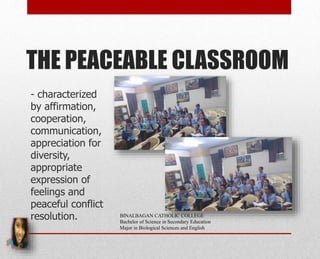
THE PEACEABLE CLASSROOM
-characterized
by affirmation,
cooperation,
communication,
appreciation for
diversity,
appropriate
expression of
feelings and
peaceful conflict
resolution. BINALBAGAN CATHOLIC COLLEGE
Bachelor of Science in Secondary Education
Major in Biological Sciences and English
38.
Ways To CreateThe Atmosphere Of Love
And Acceptance In The Classroom
Declare your classroom a zone of peace and establish
rules to achieve it.
As the teacher, let this peace begin with you.
Affirm your student
Express feelings appropriately & encourage student to do
so.
Encourage respect for and acceptance of differences.
Employ more cooperative than competitive activities.
Teach students how to resolve conflicts peacefully &
constructively
Practice students skills of communication.
39.
Teaching Learning Strategies
Discussion
Pair Share
Visualization/Imaginati
on Exercise
Role-playing
Problem solving
Web-charting
Telling stories
Interviews/Research
Expert Resources
Use of Film &
Photograph
Use of globes and map
Brainstorming
Reading quotations
Charts & Graphs
Collage-making
Show and Tell
Dialogues
Case Studies
40.
Attributes Of APeace Educator
The teacher of peace is a responsible global citizens
S/he is motivated by service and is actively involved in
the community
S/he is both a transmitter and transformer of cultures
S/he is a seeker of mutually enhancing relationships
S/he is gender sensitive and alert to any possibility of
gender bias in self or students.
S/he is an inquirer.
A teacher of peace inspires understanding of alternative
possibilities for the future and for a culture of peace.