STERILE PROCESS
VALIDATION
1
Contents
Introduction
Four pillars
Validation plan
Major steps
Basic principles
Sterilization methods
Validation of support system and facilities
Media fills
Conclusion
References
2
Introduction 1-3
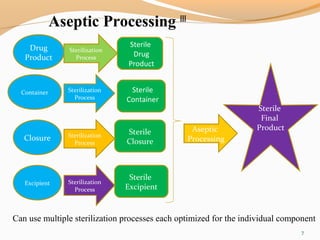
Aseptic / sterile - “ A state of control attained by using an
aseptic work area and performing activities in a manner that
precludes microbiological contamination of the exposed sterile
product”
Validation of aseptic process should be designed to provide
assurance through appropriate testing that all phases and
activities of the process remain sterile and it is controlled
within the predetermined parameters.
Drug product, container, and closure are subject to sterilization
separately, and then brought together.
3
Aseptic Processing – Overview 1,2
Certain pharmaceutical products must be sterile
– injections, ophthalmic preparations, irrigations
solutions, haemodialysis solutions.
Two categories of sterile products
– those that can be sterilized in final container
– those that cannot be terminally sterilized and must be
aseptically prepared.
SAL achieved in an aseptic operation depend on aseptic
technique.
(SAL:- sterility assurance level)
4
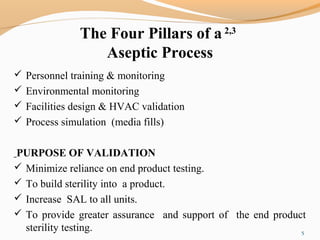
The Four Pillars of a 2,3
Aseptic Process
 Personnel training & monitoring
 Environmental monitoring
 Facilities design & HVAC validation
 Process simulation (media fills)
PURPOSE OF VALIDATION
 Minimize reliance on end product testing.
 To build sterility into a product.
 Increase SAL to all units.
 To provide greater assurance and support of the end product
sterility testing. 5
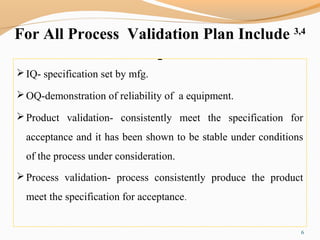
For All Process Validation Plan Include 3,4
IQ- specification set by mfg.
OQ-demonstration of reliability of a equipment.
Product validation- consistently meet the specification for
acceptance and it has been shown to be stable under conditions
of the process under consideration.
Process validation- process consistently produce the product
meet the specification for acceptance.
6
Aseptic Processing III
Drug
Product
Sterilization
Process
Container
Closure
Excipient
Sterilization
Process
Sterilization
Process
Sterilization
Process
Sterile
Closure
Sterile
Excipient
Aseptic
Processing
Sterile
Drug
Product
Sterile
Container
Sterile
Final
Product
Can use multiple sterilization processes each optimized for the individual component
7
8
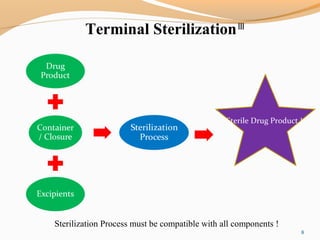
Terminal SterilizationIII
Sterile Drug Product !
Sterilization Process must be compatible with all components !
Basic Principles In Validation Of Any
Process 1
 Written documentation
 Mfg parameters
 Testing parameters
 In-process control
 Final product testing
9
Major steps 1
 Select or define the desired attributes of the product.
 Determine specification.
 Select the appropriate processes and equipment.
 Develop and conduct the tests that evaluate process,
equipment and personnel.
 Examine the test procedure to ensure accuracy and
reliability.
10
D,F and Z values- 1
D value- Time required for 90% reduction in microbial
population.
Z value- A Z-value is defined as the number of degrees
(Celsius or Fahrenheit) required to change a D-value by
one factor of ten.
F value- It measures equivalent time that monitored article is
exposed to desired temp.
11
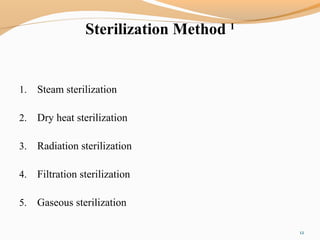
Sterilization Method 1
1. Steam sterilization
2. Dry heat sterilization
3. Radiation sterilization
4. Filtration sterilization
5. Gaseous sterilization
12
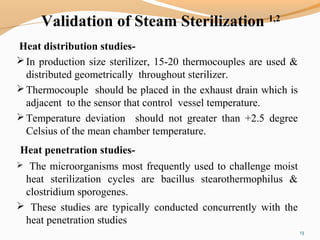
Validation of Steam Sterilization 1,2
Heat distribution studies-
In production size sterilizer, 15-20 thermocouples are used &
distributed geometrically throughout sterilizer.
Thermocouple should be placed in the exhaust drain which is
adjacent to the sensor that control vessel temperature.
Temperature deviation should not greater than +2.5 degree
Celsius of the mean chamber temperature.
Heat penetration studies-
 The microorganisms most frequently used to challenge moist
heat sterilization cycles are bacillus stearothermophilus &
clostridium sporogenes.
 These studies are typically conducted concurrently with the
heat penetration studies
13
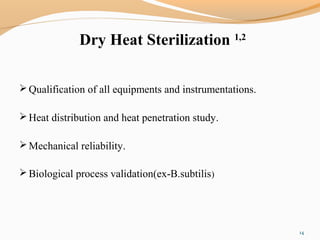
Dry Heat Sterilization 1,2
Qualification of all equipments and instrumentations.
Heat distribution and heat penetration study.
Mechanical reliability.
Biological process validation(ex-B.subtilis)
14
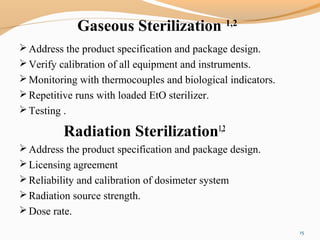
Gaseous Sterilization 1,2
Address the product specification and package design.
Verify calibration of all equipment and instruments.
Monitoring with thermocouples and biological indicators.
Repetitive runs with loaded EtO sterilizer.
Testing .
Radiation Sterilization1,2
Address the product specification and package design.
Licensing agreement
Reliability and calibration of dosimeter system
Radiation source strength.
Dose rate.
15
Filtration Sterilization 1,2
Filter Validation
Filter must be validated to demonstrate ability to remove
bacteria(Bacterial challenge test).
 most common method is to show that filter can retain a
microbiological challenge of 107
CFU of Brevundimonas
diminuta per cm2
of the filter surface
 preferably the microbial challenge is added to the fully
formulated product which is then passed through the filter.
16
Conti……….
if the product is bactericidal, product should be passed
through the filter first followed by modified product
containing the microbial challenge (after removing any
bactericidal activity remaining on the filter)
filter validation should be carried out under worst case
conditions e.g. maximum allowed filtration time and
maximum pressure
17
18
Aseptic Processing 1,2
Filter integrity
• Filters of 0.22μm or less should be used for filtration of
liquids and gasses (if applicable)
– filters for gasses that may be used for purging or
overlaying of filled containers or to release vacuum in
lyophilization chamber
• filter integrity should be verified before filtration and
confirmed after filtration
– bubble point
– pressure hold
• methods are defined by filter manufacturers and limits
determined during filter validation
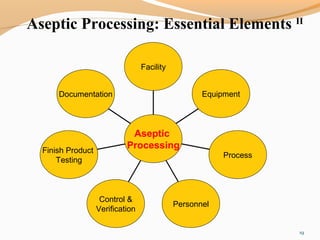
Aseptic Processing: Essential Elements II
Documentation
Finish Product
Testing
Control &
Verification
Personnel
Process
Equipment
Facility
Aseptic
Processing
19
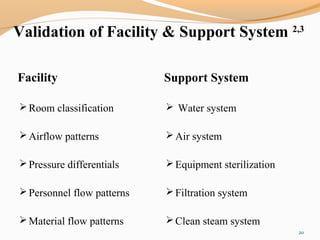
Validation of Facility & Support System 2,3
Facility Support System
Room classification
Airflow patterns
Pressure differentials
Personnel flow patterns
Material flow patterns
 Water system
Air system
Equipment sterilization
Filtration system
Clean steam system
20
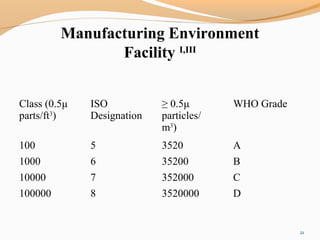
Class (0.5μ
parts/ft3
)
ISO
Designation
≥ 0.5μ
particles/
m3
)
WHO Grade
100 5 3520 A
1000 6 35200 B
10000 7 352000 C
100000 8 3520000 D
21
Manufacturing Environment
Facility I,III
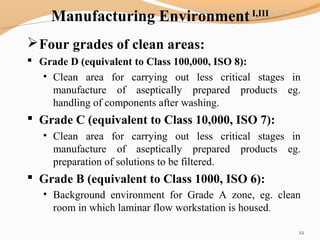
Manufacturing Environment I,III
Four grades of clean areas:
 Grade D (equivalent to Class 100,000, ISO 8):
• Clean area for carrying out less critical stages in
manufacture of aseptically prepared products eg.
handling of components after washing.
 Grade C (equivalent to Class 10,000, ISO 7):
• Clean area for carrying out less critical stages in
manufacture of aseptically prepared products eg.
preparation of solutions to be filtered.
 Grade B (equivalent to Class 1000, ISO 6):
• Background environment for Grade A zone, eg. clean
room in which laminar flow workstation is housed.
22
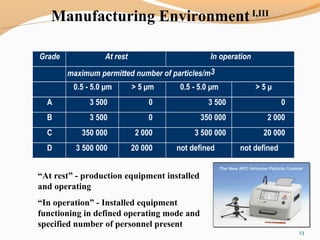
Manufacturing Environment I,III
Grade At rest In operation
maximum permitted number of particles/m3
0.5 - 5.0 µm > 5 µm 0.5 - 5.0 µm > 5 µ
A 3 500 0 3 500 0
B 3 500 0 350 000 2 000
C 350 000 2 000 3 500 000 20 000
D 3 500 000 20 000 not defined not defined
“At rest” - production equipment installed
and operating
“In operation” - Installed equipment
functioning in defined operating mode and
specified number of personnel present
23
Manufacturing Environment I,III
• Grade A (equivalent to Class 100 , ISO 5) :
– Local zone for high risk operations eg. product filling, stopper
bowls, open vials, handling sterile materials, aseptic connections,
transfer of partially stoppered containers to be lyophilized.
– Conditions usually provided by laminar air flow workstation.
24
Manufacturing Environment 2,3
Environmental Monitoring - Physical
• Air Changes/Airflow patterns
– Air flow over critical areas should be uni-directional
(laminar flow) at a velocity sufficient to sweep particles
away from filling/closing area
– for B, C and D rooms at least 20 volume changes per hour
are usually required.
• Clean up time/recovery
– Particulate levels for the Grade A “at rest” state should be
achieved after a short “clean-up” period of 20 minutes after
completion of operations (guidance value)
– Particle counts for Grade A “in operation” state should be
maintained whenever product or open container is exposed 25
Manufacturing Environment 2,3
Environmental Monitoring - Physical
• Temperature and Relative Humidity
– Ambient temperature and humidity should not be
uncomfortably high (18-22°C) & 30-60 % RH.
• Airflow velocity
– Laminar airflow workstation air speed of approx 0.45m/s
± 20% (80-120ft/min) at working position (guidance
value)
26
Manufacturing Environment 2,3
Environmental Monitoring - Physical
• Differential pressures
– Positive pressure differential of 10-15 Pascal's should
be maintained between adjacent rooms of different
classification (with door closed)+ve
pressure should be
0.2-0.3 water gauge.
– Most critical area should have the highest pressure
– Pressures should be continuously monitored and
frequently recorded.
– Alarms should sound if pressures deviate.
27
Manufacturing Environment 3
Personnel
• Minimum number of personnel in clean areas
– especially during aseptic processing
• Inspections and controls from outside
• Training to all including cleaning and maintenance staff
– initial and regular
– manufacturing, hygiene, microbiology
– should be formally validated and authorized to enter aseptic
area
• Special cases
– supervision in case of outside staff
– decontamination procedures (e.g. staff who worked with
animal tissue materials)
28
Manufacturing Environment 3
Personnel
• Outdoor clothing not in change rooms leading to Grade B
and C rooms
• Change at every working session, or once a day
• Change gloves and masks at every working session
• Frequent disinfection of gloves during operations
• Washing of garments – separate laundry facility
– No damage, and according to validated procedures
(washing and sterilization)
• Regular microbiological monitoring of operators 29
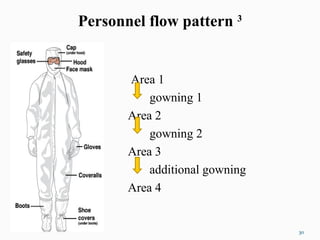
Personnel flow pattern 3
Area 1
gowning 1
Area 2
gowning 2
Area 3
additional gowning
Area 4
30
Personnel monitoring 3
Gowning process must be validated.
Done by Glove fingertips into Petri dish containing agar
media.
Material Flow3
Entry through air lock system or sterilizing ovens or filters.
Contact plate testing should be done for assurance.
31
Nonviable Particulate Monitoring I
HVAC Validation and Maintenance
Considerations:
Air velocity, airflow patterns and turbulence should be
validated; smoke studies to determine flow patterns during
static and dynamic conditions
High pressure drop across the filters shows blocked.
HEPA filter integrity testing
HEPA filter efficiency testing
Air pressure differentials
32
Nonviable Particulate Monitoring I
Airborne cleanliness classifications should be met during
operations
Nonviable monitoring should occur routinely during operations
33
Validation of Support System 3
Water system:-
Objective-
To provide assurance that the system eliminates endotoxins
from incoming water and prevention of endotoxins
formation.
Validation-
1. System description including specifications.
2. Installation qualification.
3. Operational qualification.
4. To prove that system delivers the WFI.
34
Validation of Water System 3
To monitor water system for both microorganisms and
endotoxins.
Validation report include description of system along with blue
print.
Report should contain a diagram showing all sampling points.
35
Filtration system 1,2
All process gases/liquid entering into the aseptic core must be
validated as sterile and particle and pyrogen free.
The validation protocol consider not only bioburden of
incoming solutions but also effect of viscosity,pH,ionic
strength, flow rate, temperature & pressure on the ability of
the filter to remove microorganisms.
Filtration should be carried out under positive pressure.
36
Air System 3
HEPA filter system validated by introducing a DOP(Dioctyl
Phthalate) aerosol into duct system
The conc. Of DOP should be in 80-100mcg/lit of air per min.
The validation protocol include the capability of filter to
remove appropriate amount of particles.
37
Equipment Sterilization 1,2
• Equipment includes tanks, centrifuges and dryers is intended to
be sterilize before use.
• The validation program should show the effectiveness of
disinfecting program.
• It must prove that steam being delivered meets criteria for
WFI, pyrogens,and bioload.
• It also prove that steam is sterilizing all surfaces.
• Heat distribution study should be done to determine the cold
spots where condensate could accumulate.
38
Media Fill Trials 1,III
Verification of medium sterility
Aseptic filling operation
Challenge unit incubation
Evaluation of result
Media used:-
Soybean casein digest media
Fluid thioglycolate media
Media fill frequency:-
 6 months interval.
If change in aseptic process
Acceptance criteria:-
 Historically 0.3%(as per WHO)
 0.1% as per Parentral Drug Association. (PDA)
39
Conclusion
We have seen that how the validation is being carried out for
aseptic process validation.
To achieve the high standards of purity & quality product.
The definitive concern for aseptic processing is the presence of
personnel to perform complex operations while maintaining a
sterile field.
40
References
41
1. Akers MJ, Anderson NR, Sterilization Validation, In: Nash RA,
Wachter AH, Pharmaceutical Process Validation, 3rd
ed., USA:
Informa Healthcare , 2003, p. 83-157
2. Agalloco J, Akers JE, Validation of Aseptic Processing, In:
Carleton FJ, Agalloco J, Validation of Pharmaceutical Processes:
Sterile Products, 2nd
ed., USA: Informa healthcare, p.669-702
3. Kasubick RV, Validation of Sterile APIs, In: Berry IR, Harpaz D,
Validation of Active Pharmaceutical Ingredients, 2nd
ed. New York:
CRC PRESS, 2001, p. 432-449
4. Potdar MA, Pharmaceutical Quality Assurance, 2nd
ed., Pune:
Nirali Prakashan , 2007, p.8.1-8.22
Resources
I. www.fda.gov/FDA Guidance for Industry.
II. www.validation.org
III. www.biomanufacturing.org
42
THANK
YOU
43

Sterile process validation

  • 1.
  • 2.
    Contents Introduction Four pillars Validation plan Majorsteps Basic principles Sterilization methods Validation of support system and facilities Media fills Conclusion References 2
  • 3.
    Introduction 1-3 Aseptic /sterile - “ A state of control attained by using an aseptic work area and performing activities in a manner that precludes microbiological contamination of the exposed sterile product” Validation of aseptic process should be designed to provide assurance through appropriate testing that all phases and activities of the process remain sterile and it is controlled within the predetermined parameters. Drug product, container, and closure are subject to sterilization separately, and then brought together. 3
  • 4.
    Aseptic Processing –Overview 1,2 Certain pharmaceutical products must be sterile – injections, ophthalmic preparations, irrigations solutions, haemodialysis solutions. Two categories of sterile products – those that can be sterilized in final container – those that cannot be terminally sterilized and must be aseptically prepared. SAL achieved in an aseptic operation depend on aseptic technique. (SAL:- sterility assurance level) 4
  • 5.
    The Four Pillarsof a 2,3 Aseptic Process  Personnel training & monitoring  Environmental monitoring  Facilities design & HVAC validation  Process simulation (media fills) PURPOSE OF VALIDATION  Minimize reliance on end product testing.  To build sterility into a product.  Increase SAL to all units.  To provide greater assurance and support of the end product sterility testing. 5
  • 6.
    For All ProcessValidation Plan Include 3,4 IQ- specification set by mfg. OQ-demonstration of reliability of a equipment. Product validation- consistently meet the specification for acceptance and it has been shown to be stable under conditions of the process under consideration. Process validation- process consistently produce the product meet the specification for acceptance. 6
  • 7.
  • 8.
    8 Terminal SterilizationIII Sterile DrugProduct ! Sterilization Process must be compatible with all components !
  • 9.
    Basic Principles InValidation Of Any Process 1  Written documentation  Mfg parameters  Testing parameters  In-process control  Final product testing 9
  • 10.
    Major steps 1 Select or define the desired attributes of the product.  Determine specification.  Select the appropriate processes and equipment.  Develop and conduct the tests that evaluate process, equipment and personnel.  Examine the test procedure to ensure accuracy and reliability. 10
  • 11.
    D,F and Zvalues- 1 D value- Time required for 90% reduction in microbial population. Z value- A Z-value is defined as the number of degrees (Celsius or Fahrenheit) required to change a D-value by one factor of ten. F value- It measures equivalent time that monitored article is exposed to desired temp. 11
  • 12.
    Sterilization Method 1 1.Steam sterilization 2. Dry heat sterilization 3. Radiation sterilization 4. Filtration sterilization 5. Gaseous sterilization 12
  • 13.
    Validation of SteamSterilization 1,2 Heat distribution studies- In production size sterilizer, 15-20 thermocouples are used & distributed geometrically throughout sterilizer. Thermocouple should be placed in the exhaust drain which is adjacent to the sensor that control vessel temperature. Temperature deviation should not greater than +2.5 degree Celsius of the mean chamber temperature. Heat penetration studies-  The microorganisms most frequently used to challenge moist heat sterilization cycles are bacillus stearothermophilus & clostridium sporogenes.  These studies are typically conducted concurrently with the heat penetration studies 13
  • 14.
    Dry Heat Sterilization1,2 Qualification of all equipments and instrumentations. Heat distribution and heat penetration study. Mechanical reliability. Biological process validation(ex-B.subtilis) 14
  • 15.
    Gaseous Sterilization 1,2 Addressthe product specification and package design. Verify calibration of all equipment and instruments. Monitoring with thermocouples and biological indicators. Repetitive runs with loaded EtO sterilizer. Testing . Radiation Sterilization1,2 Address the product specification and package design. Licensing agreement Reliability and calibration of dosimeter system Radiation source strength. Dose rate. 15
  • 16.
    Filtration Sterilization 1,2 FilterValidation Filter must be validated to demonstrate ability to remove bacteria(Bacterial challenge test).  most common method is to show that filter can retain a microbiological challenge of 107 CFU of Brevundimonas diminuta per cm2 of the filter surface  preferably the microbial challenge is added to the fully formulated product which is then passed through the filter. 16
  • 17.
    Conti………. if the productis bactericidal, product should be passed through the filter first followed by modified product containing the microbial challenge (after removing any bactericidal activity remaining on the filter) filter validation should be carried out under worst case conditions e.g. maximum allowed filtration time and maximum pressure 17
  • 18.
    18 Aseptic Processing 1,2 Filterintegrity • Filters of 0.22μm or less should be used for filtration of liquids and gasses (if applicable) – filters for gasses that may be used for purging or overlaying of filled containers or to release vacuum in lyophilization chamber • filter integrity should be verified before filtration and confirmed after filtration – bubble point – pressure hold • methods are defined by filter manufacturers and limits determined during filter validation
  • 19.
    Aseptic Processing: EssentialElements II Documentation Finish Product Testing Control & Verification Personnel Process Equipment Facility Aseptic Processing 19
  • 20.
    Validation of Facility& Support System 2,3 Facility Support System Room classification Airflow patterns Pressure differentials Personnel flow patterns Material flow patterns  Water system Air system Equipment sterilization Filtration system Clean steam system 20
  • 21.
    Class (0.5μ parts/ft3 ) ISO Designation ≥ 0.5μ particles/ m3 ) WHOGrade 100 5 3520 A 1000 6 35200 B 10000 7 352000 C 100000 8 3520000 D 21 Manufacturing Environment Facility I,III
  • 22.
    Manufacturing Environment I,III Fourgrades of clean areas:  Grade D (equivalent to Class 100,000, ISO 8): • Clean area for carrying out less critical stages in manufacture of aseptically prepared products eg. handling of components after washing.  Grade C (equivalent to Class 10,000, ISO 7): • Clean area for carrying out less critical stages in manufacture of aseptically prepared products eg. preparation of solutions to be filtered.  Grade B (equivalent to Class 1000, ISO 6): • Background environment for Grade A zone, eg. clean room in which laminar flow workstation is housed. 22
  • 23.
    Manufacturing Environment I,III GradeAt rest In operation maximum permitted number of particles/m3 0.5 - 5.0 µm > 5 µm 0.5 - 5.0 µm > 5 µ A 3 500 0 3 500 0 B 3 500 0 350 000 2 000 C 350 000 2 000 3 500 000 20 000 D 3 500 000 20 000 not defined not defined “At rest” - production equipment installed and operating “In operation” - Installed equipment functioning in defined operating mode and specified number of personnel present 23
  • 24.
    Manufacturing Environment I,III •Grade A (equivalent to Class 100 , ISO 5) : – Local zone for high risk operations eg. product filling, stopper bowls, open vials, handling sterile materials, aseptic connections, transfer of partially stoppered containers to be lyophilized. – Conditions usually provided by laminar air flow workstation. 24
  • 25.
    Manufacturing Environment 2,3 EnvironmentalMonitoring - Physical • Air Changes/Airflow patterns – Air flow over critical areas should be uni-directional (laminar flow) at a velocity sufficient to sweep particles away from filling/closing area – for B, C and D rooms at least 20 volume changes per hour are usually required. • Clean up time/recovery – Particulate levels for the Grade A “at rest” state should be achieved after a short “clean-up” period of 20 minutes after completion of operations (guidance value) – Particle counts for Grade A “in operation” state should be maintained whenever product or open container is exposed 25
  • 26.
    Manufacturing Environment 2,3 EnvironmentalMonitoring - Physical • Temperature and Relative Humidity – Ambient temperature and humidity should not be uncomfortably high (18-22°C) & 30-60 % RH. • Airflow velocity – Laminar airflow workstation air speed of approx 0.45m/s ± 20% (80-120ft/min) at working position (guidance value) 26
  • 27.
    Manufacturing Environment 2,3 EnvironmentalMonitoring - Physical • Differential pressures – Positive pressure differential of 10-15 Pascal's should be maintained between adjacent rooms of different classification (with door closed)+ve pressure should be 0.2-0.3 water gauge. – Most critical area should have the highest pressure – Pressures should be continuously monitored and frequently recorded. – Alarms should sound if pressures deviate. 27
  • 28.
    Manufacturing Environment 3 Personnel •Minimum number of personnel in clean areas – especially during aseptic processing • Inspections and controls from outside • Training to all including cleaning and maintenance staff – initial and regular – manufacturing, hygiene, microbiology – should be formally validated and authorized to enter aseptic area • Special cases – supervision in case of outside staff – decontamination procedures (e.g. staff who worked with animal tissue materials) 28
  • 29.
    Manufacturing Environment 3 Personnel •Outdoor clothing not in change rooms leading to Grade B and C rooms • Change at every working session, or once a day • Change gloves and masks at every working session • Frequent disinfection of gloves during operations • Washing of garments – separate laundry facility – No damage, and according to validated procedures (washing and sterilization) • Regular microbiological monitoring of operators 29
  • 30.
    Personnel flow pattern3 Area 1 gowning 1 Area 2 gowning 2 Area 3 additional gowning Area 4 30
  • 31.
    Personnel monitoring 3 Gowningprocess must be validated. Done by Glove fingertips into Petri dish containing agar media. Material Flow3 Entry through air lock system or sterilizing ovens or filters. Contact plate testing should be done for assurance. 31
  • 32.
    Nonviable Particulate MonitoringI HVAC Validation and Maintenance Considerations: Air velocity, airflow patterns and turbulence should be validated; smoke studies to determine flow patterns during static and dynamic conditions High pressure drop across the filters shows blocked. HEPA filter integrity testing HEPA filter efficiency testing Air pressure differentials 32
  • 33.
    Nonviable Particulate MonitoringI Airborne cleanliness classifications should be met during operations Nonviable monitoring should occur routinely during operations 33
  • 34.
    Validation of SupportSystem 3 Water system:- Objective- To provide assurance that the system eliminates endotoxins from incoming water and prevention of endotoxins formation. Validation- 1. System description including specifications. 2. Installation qualification. 3. Operational qualification. 4. To prove that system delivers the WFI. 34
  • 35.
    Validation of WaterSystem 3 To monitor water system for both microorganisms and endotoxins. Validation report include description of system along with blue print. Report should contain a diagram showing all sampling points. 35
  • 36.
    Filtration system 1,2 Allprocess gases/liquid entering into the aseptic core must be validated as sterile and particle and pyrogen free. The validation protocol consider not only bioburden of incoming solutions but also effect of viscosity,pH,ionic strength, flow rate, temperature & pressure on the ability of the filter to remove microorganisms. Filtration should be carried out under positive pressure. 36
  • 37.
    Air System 3 HEPAfilter system validated by introducing a DOP(Dioctyl Phthalate) aerosol into duct system The conc. Of DOP should be in 80-100mcg/lit of air per min. The validation protocol include the capability of filter to remove appropriate amount of particles. 37
  • 38.
    Equipment Sterilization 1,2 •Equipment includes tanks, centrifuges and dryers is intended to be sterilize before use. • The validation program should show the effectiveness of disinfecting program. • It must prove that steam being delivered meets criteria for WFI, pyrogens,and bioload. • It also prove that steam is sterilizing all surfaces. • Heat distribution study should be done to determine the cold spots where condensate could accumulate. 38
  • 39.
    Media Fill Trials1,III Verification of medium sterility Aseptic filling operation Challenge unit incubation Evaluation of result Media used:- Soybean casein digest media Fluid thioglycolate media Media fill frequency:-  6 months interval. If change in aseptic process Acceptance criteria:-  Historically 0.3%(as per WHO)  0.1% as per Parentral Drug Association. (PDA) 39
  • 40.
    Conclusion We have seenthat how the validation is being carried out for aseptic process validation. To achieve the high standards of purity & quality product. The definitive concern for aseptic processing is the presence of personnel to perform complex operations while maintaining a sterile field. 40
  • 41.
    References 41 1. Akers MJ,Anderson NR, Sterilization Validation, In: Nash RA, Wachter AH, Pharmaceutical Process Validation, 3rd ed., USA: Informa Healthcare , 2003, p. 83-157 2. Agalloco J, Akers JE, Validation of Aseptic Processing, In: Carleton FJ, Agalloco J, Validation of Pharmaceutical Processes: Sterile Products, 2nd ed., USA: Informa healthcare, p.669-702 3. Kasubick RV, Validation of Sterile APIs, In: Berry IR, Harpaz D, Validation of Active Pharmaceutical Ingredients, 2nd ed. New York: CRC PRESS, 2001, p. 432-449 4. Potdar MA, Pharmaceutical Quality Assurance, 2nd ed., Pune: Nirali Prakashan , 2007, p.8.1-8.22
  • 42.
    Resources I. www.fda.gov/FDA Guidancefor Industry. II. www.validation.org III. www.biomanufacturing.org 42
  • 43.