


EVALUATION OF PARENTERALS
Presented by:
G.Anjali
12AB1R0022
Guided by:
Mrs.K.Pallavi
madam
1
vignan pharmacy college,vadlamudi,Guntur dist.,A.P.
CONTENTS
 Introduction.
 Routes of administration.
 Advantages and Disadvantages.
• Classification.
• Quality control tests.
• Conclusion.
• References.
• Acknowledgement.
2vignan pharmacy college,vadlamudi,Guntur dist.,A.P.
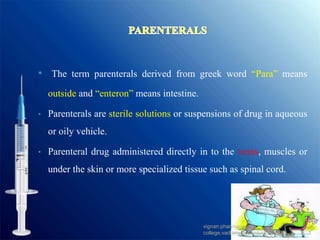
• The term parenterals derived from greek word “Para” means
outside and “enteron” means intestine.
• Parenterals are sterile solutions or suspensions of drug in aqueous
or oily vehicle.
• Parenteral drug administered directly in to the veins, muscles or
under the skin or more specialized tissue such as spinal cord.
3
vignan pharmacy
college,vadlamudi,Guntur dist.,A.P.
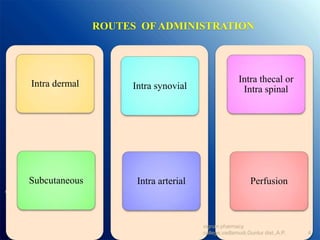
ROUTES OF ADMINISTRATION
Intra dermal
Subcutaneous
Intra synovial
Intra arterial
Intra thecal or
Intra spinal
Perfusion
4
vignan pharmacy
college,vadlamudi,Guntur dist.,A.P.
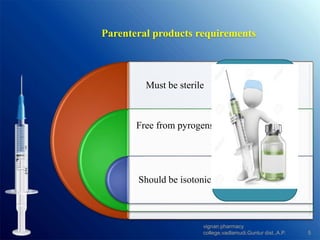
Parenteral products requirements
Must be sterile
Free from pyrogens
Should be isotonic
5
vignan pharmacy
college,vadlamudi,Guntur dist.,A.P.
Advantages
For immediate
physiological response in
conditions of cardiac arrest
asthma, shock.
Insulin and antibiotics are
not effective in oral
administration can be
given.
For unconscious patients.
It gives local effects in
dentistry and in
anesthesiology.
Disadvantages
More expensive.
Psychological distress to
the patients.
Potential for pain up on
injection.
Risk of needle stick
injuries and exposure to
blood borne pathogens by
health care workers.
6
vignan pharmacy
college,vadlamudi,Guntur dist.,A.P.
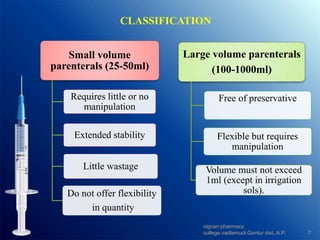
CLASSIFICATION
Small volume
parenterals (25-50ml)
Requires little or no
manipulation
Extended stability
Little wastage
Do not offer flexibility
in quantity
Large volume parenterals
(100-1000ml)
Free of preservative
Flexible but requires
manipulation
Volume must not exceed
1ml (except in irrigation
sols).
7
vignan pharmacy
college,vadlamudi,Guntur dist.,A.P.
QUALITY CONTROL
8
vignan pharmacy
college,vadlamudi,Guntur dist.,A.P.
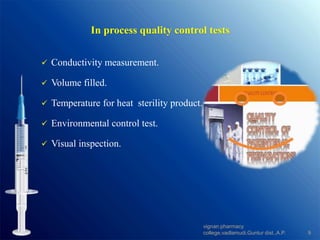
In process quality control tests
 Conductivity measurement.
 Volume filled.
 Temperature for heat sterility product.
 Environmental control test.
 Visual inspection.
9
vignan pharmacy
college,vadlamudi,Guntur dist.,A.P.
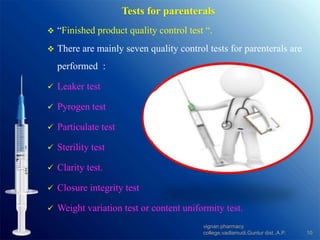
Tests for parenterals
 “Finished product quality control test “.
 There are mainly seven quality control tests for parenterals are
performed :
 Leaker test
 Pyrogen test
 Particulate test
 Sterility test
 Clarity test.
 Closure integrity test
 Weight variation test or content uniformity test.
10
vignan pharmacy
college,vadlamudi,Guntur dist.,A.P.
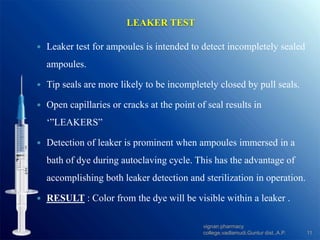
 Leaker test for ampoules is intended to detect incompletely sealed
ampoules.
 Tip seals are more likely to be incompletely closed by pull seals.
 Open capillaries or cracks at the point of seal results in
‘”LEAKERS”
 Detection of leaker is prominent when ampoules immersed in a
bath of dye during autoclaving cycle. This has the advantage of
accomplishing both leaker detection and sterilization in operation.
 RESULT : Color from the dye will be visible within a leaker .
LEAKER TEST
11
vignan pharmacy
college,vadlamudi,Guntur dist.,A.P.
LEAKER TEST APPARATUS
12
vignan pharmacy
college,vadlamudi,Guntur dist.,A.P.
LEAKER TEST PROCEDURE
• Ampoules are placed in vacuum chamber.
• Completely submerged in a deeply colored dye
solution of about 0.5 to 1% methylene blue.
• A negative pressure is applied within the ampoules
subsequent atmospheric pressure causes the dye to
penetrate an opening thus making it visible after the
ampoules has been washed.
13
vignan pharmacy
college,vadlamudi,Guntur dist.,A.P.
Draw backs of leaker test
• Capillaries of1.5µ or smaller
diameter cannot be detected
by this test.
• Vials and bottles are not
subjected to such a leaker
test as the rubber closure is
not rigid.
D
R
A
W
B
A
C
K
S
14
vignan pharmacy
college,vadlamudi,Guntur dist.,A.P.
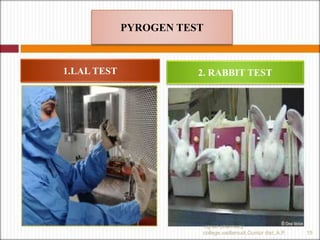
1. LAL TEST
2. RABBIT
TEST2. RABBIT TEST1.LAL TEST
PYROGEN TEST
15
vignan pharmacy
college,vadlamudi,Guntur dist.,A.P.
LAL BACTERIAL ENDOTOXIN TEST
 The LAL (limulus amebocyte lysate) assay is an in vitro assay used
to detect the presence and concentration bacterial endotoxins in
drugs and biological products.
 ENDOTOXINS which a type of pyrogen are lipopolysaccharides
present in the cell wall of gram positive bacteria.
 Pyrogens as a class are fever inducing substance that can be harmful
or even fatal if administered to humans above certain concentration.
 Water can be a source of pyrogens. So it may be import to routinely
monitor water systems using bacterial endotoxin test.
16
vignan pharmacy
college,vadlamudi,Guntur dist.,A.P.
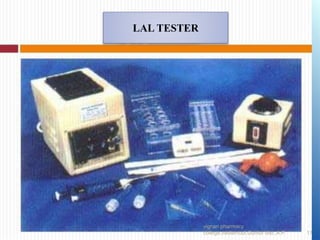
LAL TESTER
17
vignan pharmacy
college,vadlamudi,Guntur dist.,A.P.
PROCEDURE FOR LAL TEST
(BACTERIAL ENDOTOXIN TEST)
In-vitro test method for pyrogen utilizing Gelling property
the combination of 0.1ml of test sample +LAL reagent
After incubation for 1 hour at 37ºC the mixture analysed for
the presence of gel clot.
18
vignan pharmacy
college,vadlamudi,Guntur dist.,A.P.
CRITERIA FOR LIMULUS TEST RESULTS
19
vignan pharmacy
college,vadlamudi,Guntur dist.,A.P.
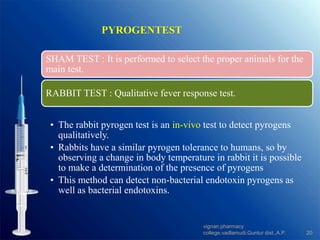
PYROGENTEST
SHAM TEST : It is performed to select the proper animals for the
main test.
RABBIT TEST : Qualitative fever response test.
• The rabbit pyrogen test is an in-vivo test to detect pyrogens
qualitatively.
• Rabbits have a similar pyrogen tolerance to humans, so by
observing a change in body temperature in rabbit it is possible
to make a determination of the presence of pyrogens
• This method can detect non-bacterial endotoxin pyrogens as
well as bacterial endotoxins.
20
vignan pharmacy
college,vadlamudi,Guntur dist.,A.P.
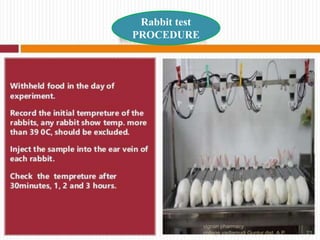
Rabbit test
PROCEDURE
21
vignan pharmacy
college,vadlamudi,Guntur dist.,A.P.
Result for Rabbit Test
Result analysis
Negative:
Increase in
temperature
Positive:
No rise in
temperature
vignan pharmacy
college,vadlamudi,Guntur dist.,A.P. 22
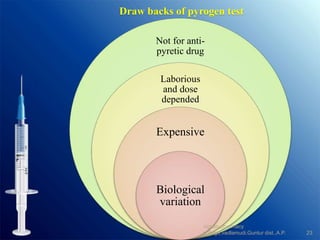
Draw backs of pyrogen test
Not for anti-
pyretic drug
Laborious
and dose
depended
Expensive
Biological
variation
23
vignan pharmacy
college,vadlamudi,Guntur dist.,A.P.
TEST RESULTS
The test is positive when
each rabbit show
increase in temperature.
If only 2 of the 3 rabbits
show increase in
temperature repeat the
using group of 5 and
test will be positive if
the 4 of the 5 rabbit
show increase in
temperature.
24
vignan pharmacy
college,vadlamudi,Guntur dist.,A.P.
Sterility testing
25
vignan pharmacy
college,vadlamudi,Guntur dist.,A.P.
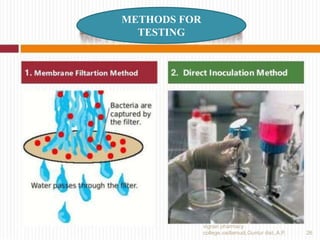
METHODS FOR
TESTING
26
vignan pharmacy
college,vadlamudi,Guntur dist.,A.P.
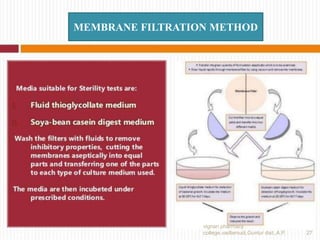
MEMBRANE FILTRATION METHOD
27
vignan pharmacy
college,vadlamudi,Guntur dist.,A.P.
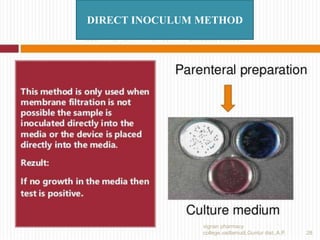
DIRECT INOCULUM METHOD
28
vignan pharmacy
college,vadlamudi,Guntur dist.,A.P.
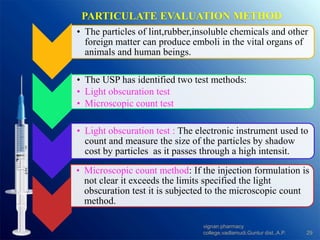
PARTICULATE EVALUATION METHOD
• The particles of lint,rubber,insoluble chemicals and other
foreign matter can produce emboli in the vital organs of
animals and human beings.
• The USP has identified two test methods:
• Light obscuration test
• Microscopic count test
• Light obscuration test : The electronic instrument used to
count and measure the size of the particles by shadow
cost by particles as it passes through a high intensit.
• Microscopic count method: If the injection formulation is
not clear it exceeds the limits specified the light
obscuration test it is subjected to the microscopic count
method.
29
vignan pharmacy
college,vadlamudi,Guntur dist.,A.P.
Weight variation
30
vignan pharmacy
college,vadlamudi,Guntur dist.,A.P.
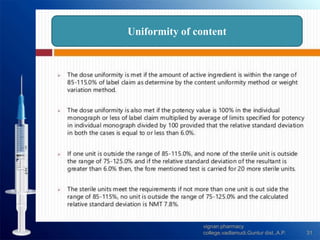
Uniformity of content
31
vignan pharmacy
college,vadlamudi,Guntur dist.,A.P.
Clarity test
All the particulate matter is of primary concern with product
given i.vly . All parenterals products should be free from
insoluble particles.
The USP has established a limit of 50 particles of 10µm and
5particles of 25µm and larger per milliliter.
If the product contain any particulate matter then
it is rejected.
32
vignan pharmacy
college,vadlamudi,Guntur dist.,A.P.
Particulate evaluation test apparatus
33
vignan pharmacy
college,vadlamudi,Guntur dist.,A.P.
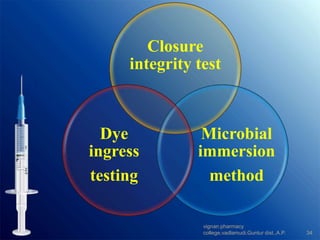
Closure
integrity test
Microbial
immersion
method
Dye
ingress
testing
34
vignan pharmacy
college,vadlamudi,Guntur dist.,A.P.
Dye ingress testing
35
vignan pharmacy
college,vadlamudi,Guntur dist.,A.P.
Key Factors for Microbial Immersion Testing:
 The method that is developed for microbial immersion
testing depends on several factors:
 The type and size of the container will determine
the immersion approach.
 The media fill can determine if dye ingress is
more appropriate than microbial immersion.
Microbial Immersion method
36
vignan pharmacy
college,vadlamudi,Guntur dist.,A.P.
Microbial immersion technique
Standard
Approach
Customized
Approach
Vacuum or Static Vacuum approach
is standard.
Container type
may require static
approach.
Challenge
Organism
Standard method
uses challenge
organism
recommended by
Lancaster Labs.
Client
requested/specifie
d based on need.
37
vignan pharmacy
college,vadlamudi,Guntur dist.,A.P.
 Quality control should be a fundamental segment of parenterals
products manufacturing.
 All of the 7 basic tests which are performed are essential and
have its own importance in parental production.
 All of these tests ensure that product must meet the quality.
 Each test is unique and provides detailed assessment of quality
control for parenterals products.
CONCLUSION
38
vignan pharmacy
college,vadlamudi,Guntur dist.,A.P.
REFERENCES
 Remington ,The science and practice of pharmacy , 21stedition
volume-I,831-833.
 Ajay Semalty , Mona semalty , MSM Rawat , Essentials of
pharmaceutical technology , 258-266.
 Leon Lachman , Herbert A.Lieberman ,The theory and
practice of Industrial pharmacy , Special Indian edition 2009 ,
673-675.
 L.K.Ghosh , Hand book of pharmaceutical technologies ,175-
182.
39
vignan pharmacy
college,vadlamudi,Guntur dist.,A.P.
ACKNOWLEGDMENT
I express my sincere gratitude towards my guide,
Mrs.K.Pallavi mam for encouraging me to complete my
seminar and special thanks to Principal sir Dr. P. Srinivasa
babu sir and seminar committee for giving me this
opportunity.
40
vignan pharmacy
college,vadlamudi,Guntur dist.,A.P.
41
vignan pharmacy
college,vadlamudi,Guntur dist.,A.P.

Evaluation of Parentrals

  • 1.
    EVALUATION OF PARENTERALS Presentedby: G.Anjali 12AB1R0022 Guided by: Mrs.K.Pallavi madam 1 vignan pharmacy college,vadlamudi,Guntur dist.,A.P.
  • 2.
    CONTENTS  Introduction.  Routesof administration.  Advantages and Disadvantages. • Classification. • Quality control tests. • Conclusion. • References. • Acknowledgement. 2vignan pharmacy college,vadlamudi,Guntur dist.,A.P.
  • 3.
    • The termparenterals derived from greek word “Para” means outside and “enteron” means intestine. • Parenterals are sterile solutions or suspensions of drug in aqueous or oily vehicle. • Parenteral drug administered directly in to the veins, muscles or under the skin or more specialized tissue such as spinal cord. 3 vignan pharmacy college,vadlamudi,Guntur dist.,A.P.
  • 4.
    ROUTES OF ADMINISTRATION Intradermal Subcutaneous Intra synovial Intra arterial Intra thecal or Intra spinal Perfusion 4 vignan pharmacy college,vadlamudi,Guntur dist.,A.P.
  • 5.
    Parenteral products requirements Mustbe sterile Free from pyrogens Should be isotonic 5 vignan pharmacy college,vadlamudi,Guntur dist.,A.P.
  • 6.
    Advantages For immediate physiological responsein conditions of cardiac arrest asthma, shock. Insulin and antibiotics are not effective in oral administration can be given. For unconscious patients. It gives local effects in dentistry and in anesthesiology. Disadvantages More expensive. Psychological distress to the patients. Potential for pain up on injection. Risk of needle stick injuries and exposure to blood borne pathogens by health care workers. 6 vignan pharmacy college,vadlamudi,Guntur dist.,A.P.
  • 7.
    CLASSIFICATION Small volume parenterals (25-50ml) Requireslittle or no manipulation Extended stability Little wastage Do not offer flexibility in quantity Large volume parenterals (100-1000ml) Free of preservative Flexible but requires manipulation Volume must not exceed 1ml (except in irrigation sols). 7 vignan pharmacy college,vadlamudi,Guntur dist.,A.P.
  • 8.
  • 9.
    In process qualitycontrol tests  Conductivity measurement.  Volume filled.  Temperature for heat sterility product.  Environmental control test.  Visual inspection. 9 vignan pharmacy college,vadlamudi,Guntur dist.,A.P.
  • 10.
    Tests for parenterals “Finished product quality control test “.  There are mainly seven quality control tests for parenterals are performed :  Leaker test  Pyrogen test  Particulate test  Sterility test  Clarity test.  Closure integrity test  Weight variation test or content uniformity test. 10 vignan pharmacy college,vadlamudi,Guntur dist.,A.P.
  • 11.
     Leaker testfor ampoules is intended to detect incompletely sealed ampoules.  Tip seals are more likely to be incompletely closed by pull seals.  Open capillaries or cracks at the point of seal results in ‘”LEAKERS”  Detection of leaker is prominent when ampoules immersed in a bath of dye during autoclaving cycle. This has the advantage of accomplishing both leaker detection and sterilization in operation.  RESULT : Color from the dye will be visible within a leaker . LEAKER TEST 11 vignan pharmacy college,vadlamudi,Guntur dist.,A.P.
  • 12.
    LEAKER TEST APPARATUS 12 vignanpharmacy college,vadlamudi,Guntur dist.,A.P.
  • 13.
    LEAKER TEST PROCEDURE •Ampoules are placed in vacuum chamber. • Completely submerged in a deeply colored dye solution of about 0.5 to 1% methylene blue. • A negative pressure is applied within the ampoules subsequent atmospheric pressure causes the dye to penetrate an opening thus making it visible after the ampoules has been washed. 13 vignan pharmacy college,vadlamudi,Guntur dist.,A.P.
  • 14.
    Draw backs ofleaker test • Capillaries of1.5µ or smaller diameter cannot be detected by this test. • Vials and bottles are not subjected to such a leaker test as the rubber closure is not rigid. D R A W B A C K S 14 vignan pharmacy college,vadlamudi,Guntur dist.,A.P.
  • 15.
    1. LAL TEST 2.RABBIT TEST2. RABBIT TEST1.LAL TEST PYROGEN TEST 15 vignan pharmacy college,vadlamudi,Guntur dist.,A.P.
  • 16.
    LAL BACTERIAL ENDOTOXINTEST  The LAL (limulus amebocyte lysate) assay is an in vitro assay used to detect the presence and concentration bacterial endotoxins in drugs and biological products.  ENDOTOXINS which a type of pyrogen are lipopolysaccharides present in the cell wall of gram positive bacteria.  Pyrogens as a class are fever inducing substance that can be harmful or even fatal if administered to humans above certain concentration.  Water can be a source of pyrogens. So it may be import to routinely monitor water systems using bacterial endotoxin test. 16 vignan pharmacy college,vadlamudi,Guntur dist.,A.P.
  • 17.
  • 18.
    PROCEDURE FOR LALTEST (BACTERIAL ENDOTOXIN TEST) In-vitro test method for pyrogen utilizing Gelling property the combination of 0.1ml of test sample +LAL reagent After incubation for 1 hour at 37ºC the mixture analysed for the presence of gel clot. 18 vignan pharmacy college,vadlamudi,Guntur dist.,A.P.
  • 19.
    CRITERIA FOR LIMULUSTEST RESULTS 19 vignan pharmacy college,vadlamudi,Guntur dist.,A.P.
  • 20.
    PYROGENTEST SHAM TEST :It is performed to select the proper animals for the main test. RABBIT TEST : Qualitative fever response test. • The rabbit pyrogen test is an in-vivo test to detect pyrogens qualitatively. • Rabbits have a similar pyrogen tolerance to humans, so by observing a change in body temperature in rabbit it is possible to make a determination of the presence of pyrogens • This method can detect non-bacterial endotoxin pyrogens as well as bacterial endotoxins. 20 vignan pharmacy college,vadlamudi,Guntur dist.,A.P.
  • 21.
  • 22.
    Result for RabbitTest Result analysis Negative: Increase in temperature Positive: No rise in temperature vignan pharmacy college,vadlamudi,Guntur dist.,A.P. 22
  • 23.
    Draw backs ofpyrogen test Not for anti- pyretic drug Laborious and dose depended Expensive Biological variation 23 vignan pharmacy college,vadlamudi,Guntur dist.,A.P.
  • 24.
    TEST RESULTS The testis positive when each rabbit show increase in temperature. If only 2 of the 3 rabbits show increase in temperature repeat the using group of 5 and test will be positive if the 4 of the 5 rabbit show increase in temperature. 24 vignan pharmacy college,vadlamudi,Guntur dist.,A.P.
  • 25.
  • 26.
  • 27.
    MEMBRANE FILTRATION METHOD 27 vignanpharmacy college,vadlamudi,Guntur dist.,A.P.
  • 28.
    DIRECT INOCULUM METHOD 28 vignanpharmacy college,vadlamudi,Guntur dist.,A.P.
  • 29.
    PARTICULATE EVALUATION METHOD •The particles of lint,rubber,insoluble chemicals and other foreign matter can produce emboli in the vital organs of animals and human beings. • The USP has identified two test methods: • Light obscuration test • Microscopic count test • Light obscuration test : The electronic instrument used to count and measure the size of the particles by shadow cost by particles as it passes through a high intensit. • Microscopic count method: If the injection formulation is not clear it exceeds the limits specified the light obscuration test it is subjected to the microscopic count method. 29 vignan pharmacy college,vadlamudi,Guntur dist.,A.P.
  • 30.
  • 31.
    Uniformity of content 31 vignanpharmacy college,vadlamudi,Guntur dist.,A.P.
  • 32.
    Clarity test All theparticulate matter is of primary concern with product given i.vly . All parenterals products should be free from insoluble particles. The USP has established a limit of 50 particles of 10µm and 5particles of 25µm and larger per milliliter. If the product contain any particulate matter then it is rejected. 32 vignan pharmacy college,vadlamudi,Guntur dist.,A.P.
  • 33.
    Particulate evaluation testapparatus 33 vignan pharmacy college,vadlamudi,Guntur dist.,A.P.
  • 34.
  • 35.
    Dye ingress testing 35 vignanpharmacy college,vadlamudi,Guntur dist.,A.P.
  • 36.
    Key Factors forMicrobial Immersion Testing:  The method that is developed for microbial immersion testing depends on several factors:  The type and size of the container will determine the immersion approach.  The media fill can determine if dye ingress is more appropriate than microbial immersion. Microbial Immersion method 36 vignan pharmacy college,vadlamudi,Guntur dist.,A.P.
  • 37.
    Microbial immersion technique Standard Approach Customized Approach Vacuumor Static Vacuum approach is standard. Container type may require static approach. Challenge Organism Standard method uses challenge organism recommended by Lancaster Labs. Client requested/specifie d based on need. 37 vignan pharmacy college,vadlamudi,Guntur dist.,A.P.
  • 38.
     Quality controlshould be a fundamental segment of parenterals products manufacturing.  All of the 7 basic tests which are performed are essential and have its own importance in parental production.  All of these tests ensure that product must meet the quality.  Each test is unique and provides detailed assessment of quality control for parenterals products. CONCLUSION 38 vignan pharmacy college,vadlamudi,Guntur dist.,A.P.
  • 39.
    REFERENCES  Remington ,Thescience and practice of pharmacy , 21stedition volume-I,831-833.  Ajay Semalty , Mona semalty , MSM Rawat , Essentials of pharmaceutical technology , 258-266.  Leon Lachman , Herbert A.Lieberman ,The theory and practice of Industrial pharmacy , Special Indian edition 2009 , 673-675.  L.K.Ghosh , Hand book of pharmaceutical technologies ,175- 182. 39 vignan pharmacy college,vadlamudi,Guntur dist.,A.P.
  • 40.
    ACKNOWLEGDMENT I express mysincere gratitude towards my guide, Mrs.K.Pallavi mam for encouraging me to complete my seminar and special thanks to Principal sir Dr. P. Srinivasa babu sir and seminar committee for giving me this opportunity. 40 vignan pharmacy college,vadlamudi,Guntur dist.,A.P.
  • 41.