Inhalation aerosols – propellants used,
packaging and filling technique
Guided By: Dr. Bapurao Tarate Presented By: Salim Mulla
M. Pharm, Ph.D M.Pharm-II
Alard College Of Pharmacy, Pune.
1
INTRODUCTION
2
• Aerosol or Pressurized package is defined as “A system that
depends on the power of a compressed gas or liquefied gas to
expel the contents from the container.”
• Pharmaceutical Aerosol is defined as aerosol product
containing active ingredients dissolved ,suspended or
emulsified in a propellant or a mixture of solvent and
propellant and intended for oral or topical administration or
for administration into the eye, nose ,ear, rectum and vagina.
• In 1942 - First aerosol was developed. (insecticide)
• In1950 - Pharmaceutical aerosol for topical administration
was developed.
• In 1955 - Aerosol for the local activity in the respiratory
tract was developed (Epinephrine).
• A dose can be removed with out contamination of
materials.
• Stability is enhanced for these substances adversely
affected by oxygen and or moisture.
• When sterility is an important factor, it can be maintained
while a dose is being dispensed.
• The medication can be delivered directly to the affected
area in a desired form. (localized action)
• Irritation produced by the mechanical application of topical
medication is reduced or eliminated.
• Ease and convenience of application.
• Application of medication in thin layer .
• Rapid response to the medicament .
• Bypasses First pass effect.
ADVANTAGES OF AEROSOLS
3
DISADVANTAGES OF AEROSOLS
4
• Expensive.
• Chlorofluorocarbon propellants cause Ozone
layer depletion.
• Inflammability
• Toxicity
• Explosivity
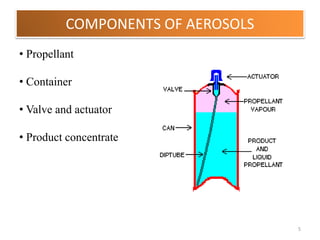
COMPONENTS OF AEROSOLS
5
• Propellant
• Container
• Valve and actuator
• Product concentrate
PROPELLANTS
6
• Responsible for developing proper pressure within the
container.
• Provide driving force to expel the product from the
container.
TYPES OF PROPELLANTS
(a) Liquefied gases Propellants
(b) Compressed gases Propellants
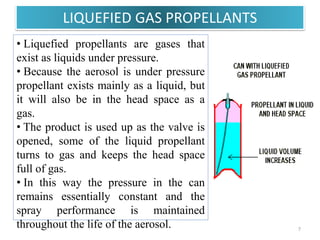
LIQUEFIED GAS PROPELLANTS
7
• Liquefied propellants are gases that
exist as liquids under pressure.
• Because the aerosol is under pressure
propellant exists mainly as a liquid, but
it will also be in the head space as a
gas.
• The product is used up as the valve is
opened, some of the liquid propellant
turns to gas and keeps the head space
full of gas.
• In this way the pressure in the can
remains essentially constant and the
spray performance is maintained
throughout the life of the aerosol.
CHLORO FLUORO CARBONS
8
Advantages
• Chemical inertness
• Lack of toxicity
• Non flammability.
• Lack of explosiveness.
• Propellant of choice for oral and inhalation .
Disadvantages
• High cost
• It depletes the ozone layer
Examples: Trichloromonofluoromethane - Propellant 11
Dichlorodifluoromethane - Propellant 12
Dichlorotetrafluoroethane - Propellant 114
HYDROCARBONS
9
• Can be used for water based aerosols and topical use.
Advantages
• Inexpensive
• Excellent solvents
• It does not cause ozone
depletion
Disadvantages
• Inflammable
• Unknown toxicity
produced
Ex: Propane - Propellant A-108
Isobutane - Propellant A-31
Butane - Propellant A-17
HYDROFLUORO CARBONS AND
HYDRO CHLORO FLUORO CARBONS
10
•These compounds break down in the atmosphere at faster
rate than CFCs.
• Lower ozone destroying effect.
Advantages
• Low inhalation toxicity
• High chemical stability
• High purity
• Not ozone depleting
Disadvantages
• Poor solvent
• High cost
Examples: Heptafluoro propane (HFA-227)
Tetrafluoroethane (HFA-134a)
Difluoroethane - Propellant 152a
Chlorodifluoromethane - Propellant 22
Chlorodifluoroethane - Propellant 142 b
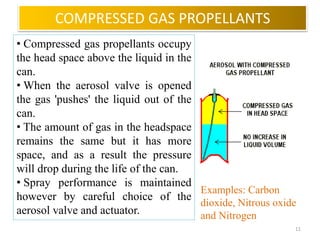
COMPRESSED GAS PROPELLANTS
11
• Compressed gas propellants occupy
the head space above the liquid in the
can.
• When the aerosol valve is opened
the gas 'pushes' the liquid out of the
can.
• The amount of gas in the headspace
remains the same but it has more
space, and as a result the pressure
will drop during the life of the can.
• Spray performance is maintained
however by careful choice of the
aerosol valve and actuator.
Examples: Carbon
dioxide, Nitrous oxide
and Nitrogen
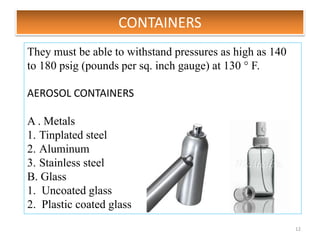
CONTAINERS
12
They must be able to withstand pressures as high as 140
to 180 psig (pounds per sq. inch gauge) at 130 ° F.
AEROSOL CONTAINERS
A . Metals
1. Tinplated steel
2. Aluminum
3. Stainless steel
B. Glass
1. Uncoated glass
2. Plastic coated glass
TIN PLATED STEEL CONTAINERS
13
• It consist of a sheet of steel plate, this sheet is coated with
tin by electrolytic process .
• The coated sheet is cut into three pieces ( top , bottom and
body) .
• The top, bottom are attached to body by soldering .
• When required it is coated with organic material usually
oleoresin, phenolic , vinyl or epoxy coating .
• Welding eliminates soldering process, Saves considerable
manufacturing time and decreases the product/container
interaction.
• Recent developments in welding include Soudronic
system and Conoweld system.
ALUMINIUM CONTAINERS
14
• Used for inhalation and topical aerosols .
• Manufactured by impact extrusion process.
• Light in weight, less fragile, Less incompatibility due to
its seamless nature.
• Greater resistance to corrosion .
• Pure water and pure ethanol cause corrosion to Al
containers.
• Added resistance can be obtained by coating inside of
the container with organic coating like phenolic , vinyl or
epoxy and polyamide resins.
STAINLESS STEEL CONTAINERS
15
Advantage :
• Extremely Strong.
• Resistant to many materials.
• No need for internal coating.
Disadvantage :
• Costly
GLASS CONTAINERS
16
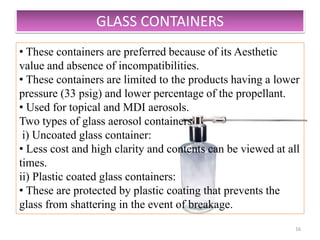
• These containers are preferred because of its Aesthetic
value and absence of incompatibilities.
• These containers are limited to the products having a lower
pressure (33 psig) and lower percentage of the propellant.
• Used for topical and MDI aerosols.
Two types of glass aerosol containers
i) Uncoated glass container:
• Less cost and high clarity and contents can be viewed at all
times.
ii) Plastic coated glass containers:
• These are protected by plastic coating that prevents the
glass from shattering in the event of breakage.
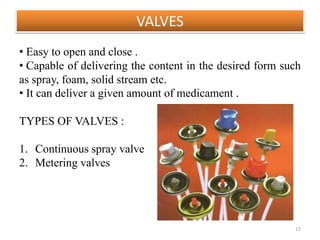
VALVES
17
• Easy to open and close .
• Capable of delivering the content in the desired form such
as spray, foam, solid stream etc.
• It can deliver a given amount of medicament .
TYPES OF VALVES :
1. Continuous spray valve
2. Metering valves
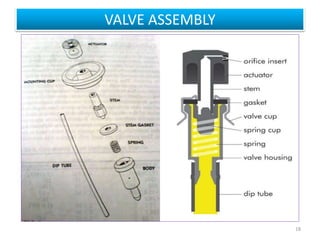
VALVE ASSEMBLY
18
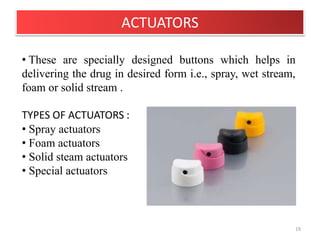
ACTUATORS
19
• These are specially designed buttons which helps in
delivering the drug in desired form i.e., spray, wet stream,
foam or solid stream .
TYPES OF ACTUATORS :
• Spray actuators
• Foam actuators
• Solid steam actuators
• Special actuators
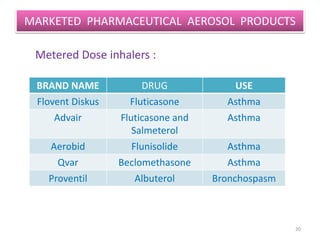
MARKETED PHARMACEUTICAL AEROSOL PRODUCTS
20
Metered Dose inhalers :
BRAND NAME DRUG USE
Flovent Diskus Fluticasone Asthma
Advair Fluticasone and
Salmeterol
Asthma
Aerobid Flunisolide Asthma
Qvar Beclomethasone Asthma
Proventil Albuterol Bronchospasm
MANUFACTURE OF PHARMACEUTICAL AEROSOLS
21
PRESSURE FILLING APPARATUS
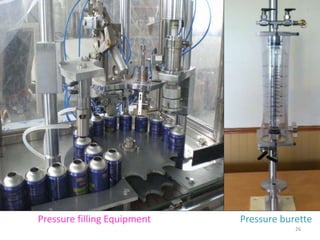
• It consists of a pressure burette capable of metering small
volumes of liquefied gas into the aerosol container under
pressure.
• Propellant is added through an inlet valve located at the
bottom or top of the pressure burette.
• The propellant is allowed to flow with its own vapor
pressure in the container through aerosol valve.
• The trapped air escapes out from the upper valve.
• Pressure filling apparatus
• Cold filling apparatus
• Compressed gas filling apparatus
• The propellant stops flowing when the pressure of
burette and container becomes equal.
• If further propellant is to be added, a hose (rubber pipe)
leading to a cylinder of nitrogen is attached to the upper
valve, the pressure exerted by nitrogen helps in the flow
of the propellant into the container.
• Another pressure filling device makes use of piston
arrangement and is capable of maintaining positive
pressure .
• This type of device cannot be used for filling inhalation
aerosols which have metered valves.
22
PROCEDURE:
•This method involves filling of the concentrate into the
container at the room temperature.
• Then the valve is placed in the container and crimped.
• Through the opening of the valve the propellant are added
or it can be added “under the cap”.
• Since the opening of the valve are smaller in size ranging
from 0.018-0.030 inches, it limits the production and the
process becomes slow.
• But with the use of rotary filling machines and newer filling
heads where the propellants are filled through valve stem, the
production rate is increased.
• The trapped air in the container and air present in head
space is removed before filling the propellant to protect the
products from getting adversely affected.
23
• Various units used in pressure filling line are arranged
in the following order :
Unscrambler , Air cleaner , Concentrate filler , Valve placer ,
Purger ,Valve crimper , Propellant filler ,Water bath ,
Labeler , Coder and Packing table .
• Purger ,vacuum crimper and pressure filler are replaced
with a single unit if filling is carried by ‘under the cap’
method.
24
ADVANTAGES OF PRESSURE FILLING:
• Solutions, emulsions, suspensions can be filled by this
method as chilling does not occur.
• Contamination due to moisture is less.
• High production speed can be achieved.
• Loss of propellant is less.
DISADVANTAGES :
• Certain types of metering valves can be handled only by the
cold filling process or through use of an under the cap filler
and valve crimper.
• Process is slower than Cold filling method.
25
Pressure filling Equipment Pressure burette
26
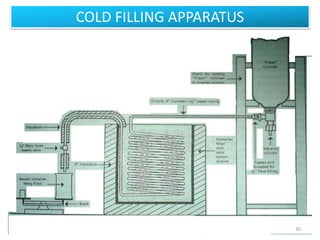
COLD FILLING APPARATUS
27
• It consist of an insulated box fitted with copper tubings and
the tubings are coiled to increase the area exposed to cooling.
• The insulated box should be filled with dry ice or acetone
prior to use.
• The apparatus can be operated with or without metered
valves.
• Hydrocarbon propellant cannot be filled into aerosol
containers using this apparatus because large amount of
propellant escapes out and vaporizes.
• This may lead to formation of an explosive mixture .
• Fluorocarbon vapors do not form any explosive or
flammable mixture though their vapors are heavier than air.
PROCEDURE:
• Non aqueous products and products which can withstand
low temperatures of - 40°F are used in this method.
• The product concentrate is chilled to a temperature of -
40°F and filled into already chilled container.
• Then the chilled propellant is added completely in 1 or 2
stages, depending on the amount.
• Another method is to chill both the product concentrate and
propellant in a separate pressure vessel to - 40 °F and then
filling them into the container.
• The valve is placed and crimped on to the container.
• Then test for leakage and strength of container is carried
out by passing container into a heated water bath, where the
contents of the container are heated to 130°F. After this, the
containers are air dried , capped and labeled.
28
• Various units used in cold filling methods are :
Unscrambler, Air cleaner ,Concentrate filler ,Propellant
filler ,Valve placer ,Valve crimper ,Water bath ,Labeler,
Coder and Packing table .
• The cold filling method is no longer being used, as it has
been replaced by pressure filling method.
Advantage:
• Easy process .
Disadvantages :
• Aqueous products, emulsions and those products
adversely affected by cold temperature cannot be filled by
this method.
29
COLD FILLING APPARATUS
30
COMPRESSED GAS FILLING APPARATUS
31
• Compressed gases have high pressure hence a pressure
reducing valve is required.
• The apparatus consists of delivery gauge.
• A flexible hose pipe which can withstand 150 pounds per
square inch gauge pressure is attached to the delivery gauge
along with the filling head.
• A flow indicator is also present in specialized equipments.
PROCEDURE :
• The product concentrate is filled into the container.
• Valve is placed and crimped on the container.
• With the help of vacuum pump the air is removed from the
container.
• Filling head is put in the opening of the valve and the
valve is depressed and the gas is allowed to flow in to
container.
• The gas stops flowing if the delivery pressure and the
pressure within the container become equal.
• Carbon dioxide and nitrous oxide is used if more amount
of gas is required.
• High solubility of the gas in the product can be achieved
by shaking the container manually or with the help of
mechanical shakers.
32
• At present there is much interest in developing MDIs
for conditions including asthma, COPD, Chronic
bronchitis ,emphysema and other respiratory diseases
etc.
• Many of compounds have been developed using
biotechnology process and their delivery to the
respiratory system via MDI in an extremely challenging
undertaking.
• As Chlorofluorocarbon (CFC) propellants cause ozone
depletion , they are being replaced with acceptable
Hydro fluoro carbons (HFC) propellants.
CONCLUSION
33
References:
• “The Theory & Practice Of Industrial Pharmacy” by Leon
Lachman , H.A.Lieberman.
• Remington’s “The Science & Practice Of Pharmacy” 21st
Edition, Volume-I.
• https://en.wikipedia.org/wiki/Aerosol_spray
34
35

Propellants

  • 1.
    Inhalation aerosols –propellants used, packaging and filling technique Guided By: Dr. Bapurao Tarate Presented By: Salim Mulla M. Pharm, Ph.D M.Pharm-II Alard College Of Pharmacy, Pune. 1
  • 2.
    INTRODUCTION 2 • Aerosol orPressurized package is defined as “A system that depends on the power of a compressed gas or liquefied gas to expel the contents from the container.” • Pharmaceutical Aerosol is defined as aerosol product containing active ingredients dissolved ,suspended or emulsified in a propellant or a mixture of solvent and propellant and intended for oral or topical administration or for administration into the eye, nose ,ear, rectum and vagina. • In 1942 - First aerosol was developed. (insecticide) • In1950 - Pharmaceutical aerosol for topical administration was developed. • In 1955 - Aerosol for the local activity in the respiratory tract was developed (Epinephrine).
  • 3.
    • A dosecan be removed with out contamination of materials. • Stability is enhanced for these substances adversely affected by oxygen and or moisture. • When sterility is an important factor, it can be maintained while a dose is being dispensed. • The medication can be delivered directly to the affected area in a desired form. (localized action) • Irritation produced by the mechanical application of topical medication is reduced or eliminated. • Ease and convenience of application. • Application of medication in thin layer . • Rapid response to the medicament . • Bypasses First pass effect. ADVANTAGES OF AEROSOLS 3
  • 4.
    DISADVANTAGES OF AEROSOLS 4 •Expensive. • Chlorofluorocarbon propellants cause Ozone layer depletion. • Inflammability • Toxicity • Explosivity
  • 5.
    COMPONENTS OF AEROSOLS 5 •Propellant • Container • Valve and actuator • Product concentrate
  • 6.
    PROPELLANTS 6 • Responsible fordeveloping proper pressure within the container. • Provide driving force to expel the product from the container. TYPES OF PROPELLANTS (a) Liquefied gases Propellants (b) Compressed gases Propellants
  • 7.
    LIQUEFIED GAS PROPELLANTS 7 •Liquefied propellants are gases that exist as liquids under pressure. • Because the aerosol is under pressure propellant exists mainly as a liquid, but it will also be in the head space as a gas. • The product is used up as the valve is opened, some of the liquid propellant turns to gas and keeps the head space full of gas. • In this way the pressure in the can remains essentially constant and the spray performance is maintained throughout the life of the aerosol.
  • 8.
    CHLORO FLUORO CARBONS 8 Advantages •Chemical inertness • Lack of toxicity • Non flammability. • Lack of explosiveness. • Propellant of choice for oral and inhalation . Disadvantages • High cost • It depletes the ozone layer Examples: Trichloromonofluoromethane - Propellant 11 Dichlorodifluoromethane - Propellant 12 Dichlorotetrafluoroethane - Propellant 114
  • 9.
    HYDROCARBONS 9 • Can beused for water based aerosols and topical use. Advantages • Inexpensive • Excellent solvents • It does not cause ozone depletion Disadvantages • Inflammable • Unknown toxicity produced Ex: Propane - Propellant A-108 Isobutane - Propellant A-31 Butane - Propellant A-17
  • 10.
    HYDROFLUORO CARBONS AND HYDROCHLORO FLUORO CARBONS 10 •These compounds break down in the atmosphere at faster rate than CFCs. • Lower ozone destroying effect. Advantages • Low inhalation toxicity • High chemical stability • High purity • Not ozone depleting Disadvantages • Poor solvent • High cost Examples: Heptafluoro propane (HFA-227) Tetrafluoroethane (HFA-134a) Difluoroethane - Propellant 152a Chlorodifluoromethane - Propellant 22 Chlorodifluoroethane - Propellant 142 b
  • 11.
    COMPRESSED GAS PROPELLANTS 11 •Compressed gas propellants occupy the head space above the liquid in the can. • When the aerosol valve is opened the gas 'pushes' the liquid out of the can. • The amount of gas in the headspace remains the same but it has more space, and as a result the pressure will drop during the life of the can. • Spray performance is maintained however by careful choice of the aerosol valve and actuator. Examples: Carbon dioxide, Nitrous oxide and Nitrogen
  • 12.
    CONTAINERS 12 They must beable to withstand pressures as high as 140 to 180 psig (pounds per sq. inch gauge) at 130 ° F. AEROSOL CONTAINERS A . Metals 1. Tinplated steel 2. Aluminum 3. Stainless steel B. Glass 1. Uncoated glass 2. Plastic coated glass
  • 13.
    TIN PLATED STEELCONTAINERS 13 • It consist of a sheet of steel plate, this sheet is coated with tin by electrolytic process . • The coated sheet is cut into three pieces ( top , bottom and body) . • The top, bottom are attached to body by soldering . • When required it is coated with organic material usually oleoresin, phenolic , vinyl or epoxy coating . • Welding eliminates soldering process, Saves considerable manufacturing time and decreases the product/container interaction. • Recent developments in welding include Soudronic system and Conoweld system.
  • 14.
    ALUMINIUM CONTAINERS 14 • Usedfor inhalation and topical aerosols . • Manufactured by impact extrusion process. • Light in weight, less fragile, Less incompatibility due to its seamless nature. • Greater resistance to corrosion . • Pure water and pure ethanol cause corrosion to Al containers. • Added resistance can be obtained by coating inside of the container with organic coating like phenolic , vinyl or epoxy and polyamide resins.
  • 15.
    STAINLESS STEEL CONTAINERS 15 Advantage: • Extremely Strong. • Resistant to many materials. • No need for internal coating. Disadvantage : • Costly
  • 16.
    GLASS CONTAINERS 16 • Thesecontainers are preferred because of its Aesthetic value and absence of incompatibilities. • These containers are limited to the products having a lower pressure (33 psig) and lower percentage of the propellant. • Used for topical and MDI aerosols. Two types of glass aerosol containers i) Uncoated glass container: • Less cost and high clarity and contents can be viewed at all times. ii) Plastic coated glass containers: • These are protected by plastic coating that prevents the glass from shattering in the event of breakage.
  • 17.
    VALVES 17 • Easy toopen and close . • Capable of delivering the content in the desired form such as spray, foam, solid stream etc. • It can deliver a given amount of medicament . TYPES OF VALVES : 1. Continuous spray valve 2. Metering valves
  • 18.
  • 19.
    ACTUATORS 19 • These arespecially designed buttons which helps in delivering the drug in desired form i.e., spray, wet stream, foam or solid stream . TYPES OF ACTUATORS : • Spray actuators • Foam actuators • Solid steam actuators • Special actuators
  • 20.
    MARKETED PHARMACEUTICAL AEROSOLPRODUCTS 20 Metered Dose inhalers : BRAND NAME DRUG USE Flovent Diskus Fluticasone Asthma Advair Fluticasone and Salmeterol Asthma Aerobid Flunisolide Asthma Qvar Beclomethasone Asthma Proventil Albuterol Bronchospasm
  • 21.
    MANUFACTURE OF PHARMACEUTICALAEROSOLS 21 PRESSURE FILLING APPARATUS • It consists of a pressure burette capable of metering small volumes of liquefied gas into the aerosol container under pressure. • Propellant is added through an inlet valve located at the bottom or top of the pressure burette. • The propellant is allowed to flow with its own vapor pressure in the container through aerosol valve. • The trapped air escapes out from the upper valve. • Pressure filling apparatus • Cold filling apparatus • Compressed gas filling apparatus
  • 22.
    • The propellantstops flowing when the pressure of burette and container becomes equal. • If further propellant is to be added, a hose (rubber pipe) leading to a cylinder of nitrogen is attached to the upper valve, the pressure exerted by nitrogen helps in the flow of the propellant into the container. • Another pressure filling device makes use of piston arrangement and is capable of maintaining positive pressure . • This type of device cannot be used for filling inhalation aerosols which have metered valves. 22
  • 23.
    PROCEDURE: •This method involvesfilling of the concentrate into the container at the room temperature. • Then the valve is placed in the container and crimped. • Through the opening of the valve the propellant are added or it can be added “under the cap”. • Since the opening of the valve are smaller in size ranging from 0.018-0.030 inches, it limits the production and the process becomes slow. • But with the use of rotary filling machines and newer filling heads where the propellants are filled through valve stem, the production rate is increased. • The trapped air in the container and air present in head space is removed before filling the propellant to protect the products from getting adversely affected. 23
  • 24.
    • Various unitsused in pressure filling line are arranged in the following order : Unscrambler , Air cleaner , Concentrate filler , Valve placer , Purger ,Valve crimper , Propellant filler ,Water bath , Labeler , Coder and Packing table . • Purger ,vacuum crimper and pressure filler are replaced with a single unit if filling is carried by ‘under the cap’ method. 24
  • 25.
    ADVANTAGES OF PRESSUREFILLING: • Solutions, emulsions, suspensions can be filled by this method as chilling does not occur. • Contamination due to moisture is less. • High production speed can be achieved. • Loss of propellant is less. DISADVANTAGES : • Certain types of metering valves can be handled only by the cold filling process or through use of an under the cap filler and valve crimper. • Process is slower than Cold filling method. 25
  • 26.
    Pressure filling EquipmentPressure burette 26
  • 27.
    COLD FILLING APPARATUS 27 •It consist of an insulated box fitted with copper tubings and the tubings are coiled to increase the area exposed to cooling. • The insulated box should be filled with dry ice or acetone prior to use. • The apparatus can be operated with or without metered valves. • Hydrocarbon propellant cannot be filled into aerosol containers using this apparatus because large amount of propellant escapes out and vaporizes. • This may lead to formation of an explosive mixture . • Fluorocarbon vapors do not form any explosive or flammable mixture though their vapors are heavier than air.
  • 28.
    PROCEDURE: • Non aqueousproducts and products which can withstand low temperatures of - 40°F are used in this method. • The product concentrate is chilled to a temperature of - 40°F and filled into already chilled container. • Then the chilled propellant is added completely in 1 or 2 stages, depending on the amount. • Another method is to chill both the product concentrate and propellant in a separate pressure vessel to - 40 °F and then filling them into the container. • The valve is placed and crimped on to the container. • Then test for leakage and strength of container is carried out by passing container into a heated water bath, where the contents of the container are heated to 130°F. After this, the containers are air dried , capped and labeled. 28
  • 29.
    • Various unitsused in cold filling methods are : Unscrambler, Air cleaner ,Concentrate filler ,Propellant filler ,Valve placer ,Valve crimper ,Water bath ,Labeler, Coder and Packing table . • The cold filling method is no longer being used, as it has been replaced by pressure filling method. Advantage: • Easy process . Disadvantages : • Aqueous products, emulsions and those products adversely affected by cold temperature cannot be filled by this method. 29
  • 30.
  • 31.
    COMPRESSED GAS FILLINGAPPARATUS 31 • Compressed gases have high pressure hence a pressure reducing valve is required. • The apparatus consists of delivery gauge. • A flexible hose pipe which can withstand 150 pounds per square inch gauge pressure is attached to the delivery gauge along with the filling head. • A flow indicator is also present in specialized equipments. PROCEDURE : • The product concentrate is filled into the container. • Valve is placed and crimped on the container. • With the help of vacuum pump the air is removed from the container.
  • 32.
    • Filling headis put in the opening of the valve and the valve is depressed and the gas is allowed to flow in to container. • The gas stops flowing if the delivery pressure and the pressure within the container become equal. • Carbon dioxide and nitrous oxide is used if more amount of gas is required. • High solubility of the gas in the product can be achieved by shaking the container manually or with the help of mechanical shakers. 32
  • 33.
    • At presentthere is much interest in developing MDIs for conditions including asthma, COPD, Chronic bronchitis ,emphysema and other respiratory diseases etc. • Many of compounds have been developed using biotechnology process and their delivery to the respiratory system via MDI in an extremely challenging undertaking. • As Chlorofluorocarbon (CFC) propellants cause ozone depletion , they are being replaced with acceptable Hydro fluoro carbons (HFC) propellants. CONCLUSION 33
  • 34.
    References: • “The Theory& Practice Of Industrial Pharmacy” by Leon Lachman , H.A.Lieberman. • Remington’s “The Science & Practice Of Pharmacy” 21st Edition, Volume-I. • https://en.wikipedia.org/wiki/Aerosol_spray 34
  • 35.