10-09-2015 1
INTRODUCTION TO ORDINARY BATTERY
NEED FOR PAPER BATTERY
INTRODUCTION TO PAPER BATTERY
HISTORY
CARBON NANOTUBE
MANUFACTURING
WORKING
APPLICATION
ADVANTAGES & DISADVANTAGES
FUTURE SCOPE
CONCLUSION
REFFERENCE10-09-2015 2
• A battery is a device that converts chemical
energy directly to electrical energy.
• Batteries are classified into two broad
categories, those are :
1. primary battery
2. secondary battery
10-09-2015 3
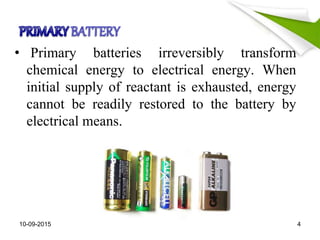
• Primary batteries irreversibly transform
chemical energy to electrical energy. When
initial supply of reactant is exhausted, energy
cannot be readily restored to the battery by
electrical means.
10-09-2015 4
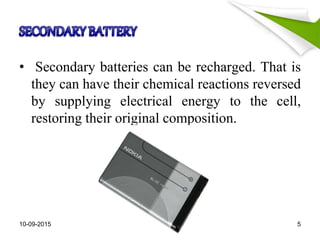
• Secondary batteries can be recharged. That is
they can have their chemical reactions reversed
by supplying electrical energy to the cell,
restoring their original composition.
10-09-2015 5
Due to various disadvantages of ordinary conventional
batteries, we should prefer the paper battery. General
disadvantages of ordinary batteries are:-
a) Limited life-time
b) Explosion, corrosion, leakage
c) High cost
d) Environmental hazards
e) High charging time
f) Weight and size
g) Lower specific power compared to fuels
h) Not easily biodegradable
10-09-2015 6
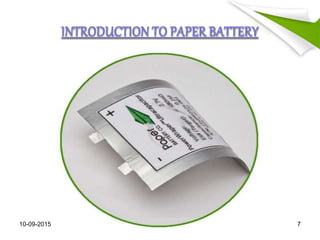
INTRODUCTION TO PAPER BATTERY
10-09-2015 7
. A paper battery is a flexible, ultra-thin energy storage
and production device formed by combining carbon
nanotubes with a conventional sheet of cellulose-based
paper.
• It can be bent and twisted, trimmed with scissors or
molded into any needed shape.
• A paper battery acts as both a high-energy battery. This
combination allows the battery to provide both long-
term, steady power production and bursts of energy.
• It is non toxic, environment friendly and is everything
that a conventional battery is not.
10-09-2015 8
• Can be folded, cut or otherwise shaped for different
applications without any loss of efficiency.
• Can be stacked in multiples of power output.
• 2.5 volts of electricity from a sample the size of a
postage stamp.
10-09-2015 9
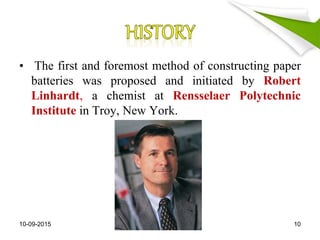
• The first and foremost method of constructing paper
batteries was proposed and initiated by Robert
Linhardt, a chemist at Rensselaer Polytechnic
Institute in Troy, New York.
10-09-2015 10
• A solution was found by Yi Cui, a materials scientist
at Stanford University, Palo Alto ( California ).
10-09-2015 11
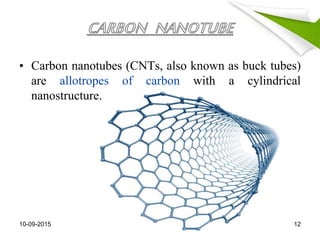
• Carbon nanotubes (CNTs, also known as buck tubes)
are allotropes of carbon with a cylindrical
nanostructure.
10-09-2015 12
10-09-2015 13
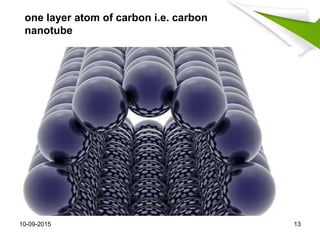
one layer atom of carbon i.e. carbon
nanotube
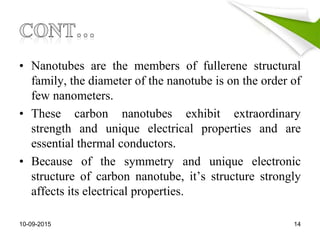
• Nanotubes are the members of fullerene structural
family, the diameter of the nanotube is on the order of
few nanometers.
• These carbon nanotubes exhibit extraordinary
strength and unique electrical properties and are
essential thermal conductors.
• Because of the symmetry and unique electronic
structure of carbon nanotube, it’s structure strongly
affects its electrical properties.
10-09-2015 14
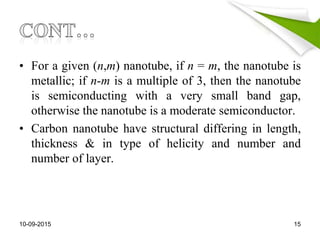
• For a given (n,m) nanotube, if n = m, the nanotube is
metallic; if n-m is a multiple of 3, then the nanotube
is semiconducting with a very small band gap,
otherwise the nanotube is a moderate semiconductor.
• Carbon nanotube have structural differing in length,
thickness & in type of helicity and number and
number of layer.
10-09-2015 15
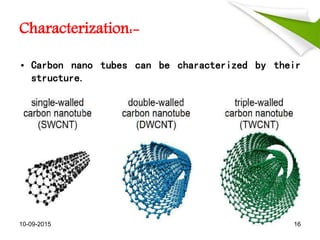
Characterization:-
• Carbon nano tubes can be characterized by their
structure.
10-09-2015 16
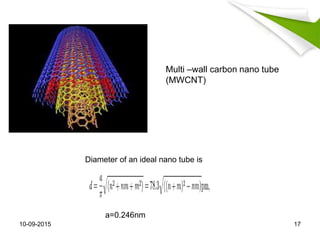
Multi –wall carbon nano tube
(MWCNT)
Diameter of an ideal nano tube is
a=0.246nm
10-09-2015 17
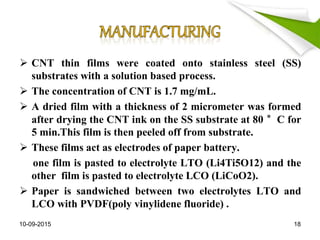
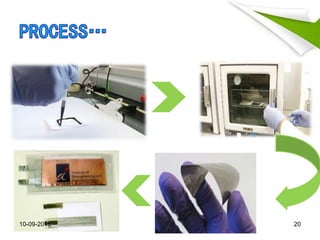
 CNT thin films were coated onto stainless steel (SS)
substrates with a solution based process.
 The concentration of CNT is 1.7 mg/mL.
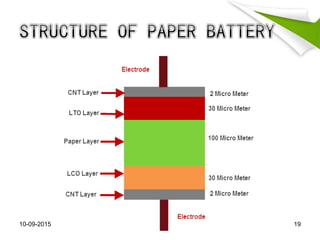
 A dried film with a thickness of 2 micrometer was formed
after drying the CNT ink on the SS substrate at 80 °C for
5 min.This film is then peeled off from substrate.
 These films act as electrodes of paper battery.
one film is pasted to electrolyte LTO (Li4Ti5O12) and the
other film is pasted to electrolyte LCO (LiCoO2).
 Paper is sandwiched between two electrolytes LTO and
LCO with PVDF(poly vinylidene fluoride) .
10-09-2015 18
10-09-2015 19
10-09-2015 20
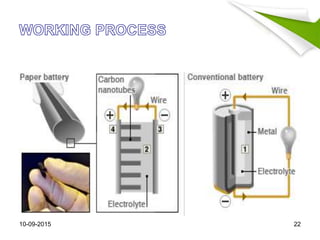
• Batteries produce electrons through a chemical
reaction between electrolyte and metal in the
traditional battery.
• Chemical reaction in the paper battery is between
electrolyte and carbon nanotubes.
• Electrons collect on the negative terminal of the
battery and flow along a connected wire to the
positive terminal.
• Electrons must flow from negative to the positive
terminal for the chemical reaction to continue.
10-09-2015 21
10-09-2015 22
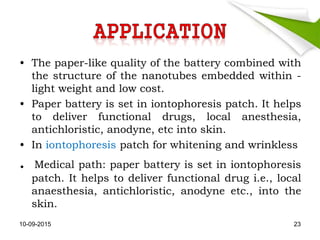
• The paper-like quality of the battery combined with
the structure of the nanotubes embedded within -
light weight and low cost.
• Paper battery is set in iontophoresis patch. It helps
to deliver functional drugs, local anesthesia,
antichloristic, anodyne, etc into skin.
• In iontophoresis patch for whitening and wrinkless
. Medical path: paper battery is set in iontophoresis
patch. It helps to deliver functional drug i.e., local
anaesthesia, antichloristic, anodyne etc., into the
skin.
10-09-2015 23
10-09-2015 24
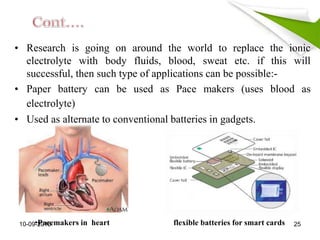
• Research is going on around the world to replace the ionic
electrolyte with body fluids, blood, sweat etc. if this will
successful, then such type of applications can be possible:-
• Paper battery can be used as Pace makers (uses blood as
electrolyte)
• Used as alternate to conventional batteries in gadgets.
•Pacemakers in heart flexible batteries for smart cards10-09-2015 25
10-09-2015 26
10-09-2015 27
• The flexible battery can function even if it is
rolled up, folded or cut.
• We can get 2.5 volts of electricity from a sample
the size of a postage stamp.
• If we stack 500 sheets together in a ream, that's
500 times the voltage. If we rip the paper in half
we cut power by 50%. So we can control the
power and voltage issue.
• Conventional battery contains a number of
separate components, the paper battery integrates
all of the battery components in a single structure,
making it more energy efficient.
10-09-2015 28
CONT…
• It has a more lifetime than the ordinary batteries (at
room temperature). Under extreme conditions it can
operate within -75° to +150°C.
• Less energy lost in an integrated device.
• It is very useful where burst of energy is required for
operation like mostly electric vehicles.
• The electrolyte contains no water, thus there’s
nothing in the batteries to freeze or evaporate,
potentially allowing operation in extreme
temperatures.
• Smooth and fast move of ions can be possible
through the cellulose paper so it could charge 10-20
10-09-2015 29
DISADVANTAGES
• Presently, the devices are only a few inches across
and they have to be scaled up to sheets of newspaper
size to make it commercially viable.
• Carbon nanotubes are expensive.
• The idea is still in the labs and a commercially viable
paper battery will take at least 40-60 years to become
a reality.
• Researches in nanotechnology to mass produce
nanotubes is promising.
• Replacing old batteries results wastage of old
electronic goods creating e-wastage.10-09-2015 30
• A piece of paper can power a small light.
• Flexible paper battery could meet the energy
demand of the next generation of gadgets.
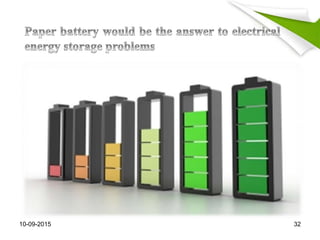
• The paper battery is a glimpse into the future
of power storage.
• The versatile paper, which stores energy like a
conventional battery, can also double as
capacitors of releasing sudden bursts for high
power applications
10-09-2015 31
10-09-2015 32
• The life of battery is an important parameter which
decides the area of application of battery.
• The batteries are rechargeable, and have reduced cost
and weight which in itself may give birth to new
applications.
• High energy storage leads to decrease the charging
time, thus energy can be saved.
• They can be made in virtually any shape and size to
meet the requirements of each application.
• However the reality is still very far away, though the
researches are promising.10-09-2015 33
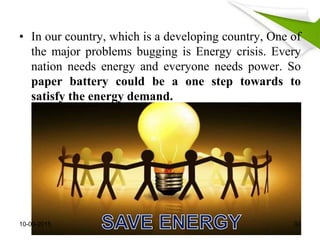
• In our country, which is a developing country, One of
the major problems bugging is Energy crisis. Every
nation needs energy and everyone needs power. So
paper battery could be a one step towards to
satisfy the energy demand.
10-09-2015 34
• http://en.wikipedia.org/wiki/Paper_battery
• http://en.wikipedia.org/wiki/Battery_(electri
city)
• http://www.stanford.edu/group/cui_group/p
apers/87%20paper%20battery.pdf
• The youtube video:
http://www.youtube.com/watch?v=QPTcQJ
PbGHw
10-09-2015 35
10-09-2015 36
10-09-2015 37

PAPER BATTERY BY Ramachandra seminar ppt

  • 1.
  • 2.
    INTRODUCTION TO ORDINARYBATTERY NEED FOR PAPER BATTERY INTRODUCTION TO PAPER BATTERY HISTORY CARBON NANOTUBE MANUFACTURING WORKING APPLICATION ADVANTAGES & DISADVANTAGES FUTURE SCOPE CONCLUSION REFFERENCE10-09-2015 2
  • 3.
    • A batteryis a device that converts chemical energy directly to electrical energy. • Batteries are classified into two broad categories, those are : 1. primary battery 2. secondary battery 10-09-2015 3
  • 4.
    • Primary batteriesirreversibly transform chemical energy to electrical energy. When initial supply of reactant is exhausted, energy cannot be readily restored to the battery by electrical means. 10-09-2015 4
  • 5.
    • Secondary batteriescan be recharged. That is they can have their chemical reactions reversed by supplying electrical energy to the cell, restoring their original composition. 10-09-2015 5
  • 6.
    Due to variousdisadvantages of ordinary conventional batteries, we should prefer the paper battery. General disadvantages of ordinary batteries are:- a) Limited life-time b) Explosion, corrosion, leakage c) High cost d) Environmental hazards e) High charging time f) Weight and size g) Lower specific power compared to fuels h) Not easily biodegradable 10-09-2015 6
  • 7.
    INTRODUCTION TO PAPERBATTERY 10-09-2015 7
  • 8.
    . A paperbattery is a flexible, ultra-thin energy storage and production device formed by combining carbon nanotubes with a conventional sheet of cellulose-based paper. • It can be bent and twisted, trimmed with scissors or molded into any needed shape. • A paper battery acts as both a high-energy battery. This combination allows the battery to provide both long- term, steady power production and bursts of energy. • It is non toxic, environment friendly and is everything that a conventional battery is not. 10-09-2015 8
  • 9.
    • Can befolded, cut or otherwise shaped for different applications without any loss of efficiency. • Can be stacked in multiples of power output. • 2.5 volts of electricity from a sample the size of a postage stamp. 10-09-2015 9
  • 10.
    • The firstand foremost method of constructing paper batteries was proposed and initiated by Robert Linhardt, a chemist at Rensselaer Polytechnic Institute in Troy, New York. 10-09-2015 10
  • 11.
    • A solutionwas found by Yi Cui, a materials scientist at Stanford University, Palo Alto ( California ). 10-09-2015 11
  • 12.
    • Carbon nanotubes(CNTs, also known as buck tubes) are allotropes of carbon with a cylindrical nanostructure. 10-09-2015 12
  • 13.
    10-09-2015 13 one layeratom of carbon i.e. carbon nanotube
  • 14.
    • Nanotubes arethe members of fullerene structural family, the diameter of the nanotube is on the order of few nanometers. • These carbon nanotubes exhibit extraordinary strength and unique electrical properties and are essential thermal conductors. • Because of the symmetry and unique electronic structure of carbon nanotube, it’s structure strongly affects its electrical properties. 10-09-2015 14
  • 15.
    • For agiven (n,m) nanotube, if n = m, the nanotube is metallic; if n-m is a multiple of 3, then the nanotube is semiconducting with a very small band gap, otherwise the nanotube is a moderate semiconductor. • Carbon nanotube have structural differing in length, thickness & in type of helicity and number and number of layer. 10-09-2015 15
  • 16.
    Characterization:- • Carbon nanotubes can be characterized by their structure. 10-09-2015 16
  • 17.
    Multi –wall carbonnano tube (MWCNT) Diameter of an ideal nano tube is a=0.246nm 10-09-2015 17
  • 18.
     CNT thinfilms were coated onto stainless steel (SS) substrates with a solution based process.  The concentration of CNT is 1.7 mg/mL.  A dried film with a thickness of 2 micrometer was formed after drying the CNT ink on the SS substrate at 80 °C for 5 min.This film is then peeled off from substrate.  These films act as electrodes of paper battery. one film is pasted to electrolyte LTO (Li4Ti5O12) and the other film is pasted to electrolyte LCO (LiCoO2).  Paper is sandwiched between two electrolytes LTO and LCO with PVDF(poly vinylidene fluoride) . 10-09-2015 18
  • 19.
  • 20.
  • 21.
    • Batteries produceelectrons through a chemical reaction between electrolyte and metal in the traditional battery. • Chemical reaction in the paper battery is between electrolyte and carbon nanotubes. • Electrons collect on the negative terminal of the battery and flow along a connected wire to the positive terminal. • Electrons must flow from negative to the positive terminal for the chemical reaction to continue. 10-09-2015 21
  • 22.
  • 23.
    • The paper-likequality of the battery combined with the structure of the nanotubes embedded within - light weight and low cost. • Paper battery is set in iontophoresis patch. It helps to deliver functional drugs, local anesthesia, antichloristic, anodyne, etc into skin. • In iontophoresis patch for whitening and wrinkless . Medical path: paper battery is set in iontophoresis patch. It helps to deliver functional drug i.e., local anaesthesia, antichloristic, anodyne etc., into the skin. 10-09-2015 23
  • 24.
  • 25.
    • Research isgoing on around the world to replace the ionic electrolyte with body fluids, blood, sweat etc. if this will successful, then such type of applications can be possible:- • Paper battery can be used as Pace makers (uses blood as electrolyte) • Used as alternate to conventional batteries in gadgets. •Pacemakers in heart flexible batteries for smart cards10-09-2015 25
  • 26.
  • 27.
  • 28.
    • The flexiblebattery can function even if it is rolled up, folded or cut. • We can get 2.5 volts of electricity from a sample the size of a postage stamp. • If we stack 500 sheets together in a ream, that's 500 times the voltage. If we rip the paper in half we cut power by 50%. So we can control the power and voltage issue. • Conventional battery contains a number of separate components, the paper battery integrates all of the battery components in a single structure, making it more energy efficient. 10-09-2015 28

  • 29.
    CONT… • It hasa more lifetime than the ordinary batteries (at room temperature). Under extreme conditions it can operate within -75° to +150°C. • Less energy lost in an integrated device. • It is very useful where burst of energy is required for operation like mostly electric vehicles. • The electrolyte contains no water, thus there’s nothing in the batteries to freeze or evaporate, potentially allowing operation in extreme temperatures. • Smooth and fast move of ions can be possible through the cellulose paper so it could charge 10-20 10-09-2015 29
  • 30.
    DISADVANTAGES • Presently, thedevices are only a few inches across and they have to be scaled up to sheets of newspaper size to make it commercially viable. • Carbon nanotubes are expensive. • The idea is still in the labs and a commercially viable paper battery will take at least 40-60 years to become a reality. • Researches in nanotechnology to mass produce nanotubes is promising. • Replacing old batteries results wastage of old electronic goods creating e-wastage.10-09-2015 30
  • 31.
    • A pieceof paper can power a small light. • Flexible paper battery could meet the energy demand of the next generation of gadgets. • The paper battery is a glimpse into the future of power storage. • The versatile paper, which stores energy like a conventional battery, can also double as capacitors of releasing sudden bursts for high power applications 10-09-2015 31
  • 32.
  • 33.
    • The lifeof battery is an important parameter which decides the area of application of battery. • The batteries are rechargeable, and have reduced cost and weight which in itself may give birth to new applications. • High energy storage leads to decrease the charging time, thus energy can be saved. • They can be made in virtually any shape and size to meet the requirements of each application. • However the reality is still very far away, though the researches are promising.10-09-2015 33
  • 34.
    • In ourcountry, which is a developing country, One of the major problems bugging is Energy crisis. Every nation needs energy and everyone needs power. So paper battery could be a one step towards to satisfy the energy demand. 10-09-2015 34
  • 35.
    • http://en.wikipedia.org/wiki/Paper_battery • http://en.wikipedia.org/wiki/Battery_(electri city) •http://www.stanford.edu/group/cui_group/p apers/87%20paper%20battery.pdf • The youtube video: http://www.youtube.com/watch?v=QPTcQJ PbGHw 10-09-2015 35
  • 36.
  • 37.