PAPER
BATTERY
Presented By
Anbarasu.A
Pre Final year EEE
Excel College of Engineering and Technology
Komarapalayam-637303.
EE 2357-Presentation Skills and Technical Seminar
Laboratory
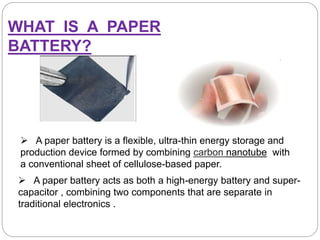
 A paper battery is a flexible, ultra-thin energy storage and
production device formed by combining carbon nanotube with
a conventional sheet of cellulose-based paper.
WHAT IS A PAPER
BATTERY?
 A paper battery acts as both a high-energy battery and super-
capacitor , combining two components that are separate in
traditional electronics .
GENERAL Li-ION BATTERY
 Generally Li-ion re-chargeable batteries are used in
mobiles, laptops and most of the electronic devices.
 During discharge and charging, lithium ions Li+
carry the current from the negative to the positive
electrode and vice-versa respectively, through the
non-aqueous electrolyte .
 3 primary functional component of Li-ion battery are:
1. -ve electrode(graphite)
2. +ve electrode(cobalt oxide)
3.electrolyte( lithium salt in organic solvent)
Disadvantages of Li-Ion
• EXPENSIVE -- 40% more than NiCd.
• DELICATE -- battery temp must be
monitored from within (which raises the
price), and sealed particularly well.
• REGULATIONS -- when shipping Li-Ion
batteries in bulk (which also raises the
price).
Class 9 miscellaneous hazardous material
WHY TO USE PAPER BATTERY?
 Ultra-thin size & flexible structure.
 Exhibits property of super-capacitor(22F-36F per
gram)
 Operating temperature (-75 to 100 degree Celsius)
 Provide both long-term, steady power production and
bursts of energy.
 Cost-effective.
CARBON NANOTUBES
 Carbon nanotube is the main concept behind paper battery
 Carbon nanotube (CNTs; also known as buckytubes)
are allotropes of carbon with a cylindrical nanostructure. Allotropes
are different structural modifications of an element
CNTs exhibit extraordinary strength and
unique electrical properties, and are efficient thermal conductors.
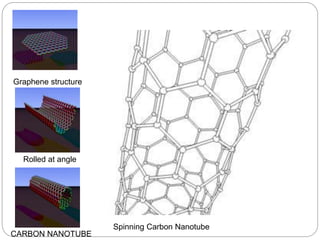
 The diameter of a nanotube is on the order of a few
nanometres Their name is derived from their long, hollow structure
with the walls formed by one-atom-thick sheets of carbon, called
graphene.
Graphene structure
Rolled at angle
CARBON NANOTUBE
Spinning Carbon Nanotube
CONSTRUCTION OF PAPER
BATTERY
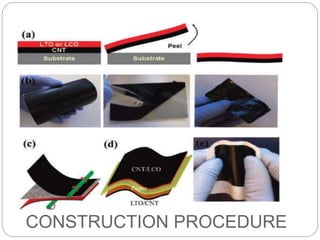
 CNT thin films were coated onto stainless steel (SS)
substrates with a solution based process.
 The concentration of CNT is 1.7 mg/mL.
 A dried film with a thickness of 2 micrometer was
formed after drying the CNT ink on the SS substrate
at 80 °C for 5 min. This film is then peeled off from
substrate. These films act as electrodes of paper battery.
 One film is pasted to electrolyte LTO (Li4Ti5O12) and
the other film is pasted to electrolyte LCO (LiCoO2).
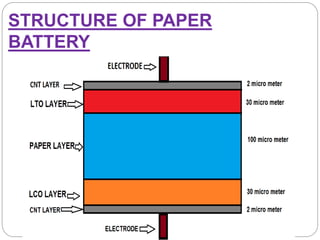
 Paper is sandwiched between two electrolytes LTO
and LCO with PVDF(poly vinylidene fluoride) acting as
glue.
CONSTRUCTION PROCEDURE
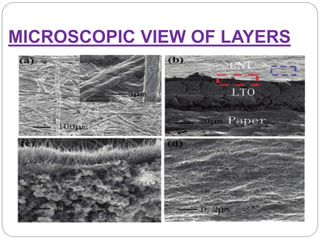
MICROSCOPIC VIEW OF LAYERS
STRUCTURE OF PAPER
BATTERY
WORKING
 Traditional Batteries produce electrons through a chemical reaction
between electrolyte and metal.
 While a conventional battery contains a number of separate
components, the paper battery integrates all of the battery components in
a single structure, making it more energy efficient.
 paper battery produces electrons due to the interaction of
electrolytes LTO & LCO.
 Electrons collect on the negative terminal of the battery and flow
along a connected wire to the positive terminal during discharging.
 Electrons must flow from the negative to the positive terminal for
the chemical reaction to continue.
 The flexible battery can function even if it is rolled up, folded or
cut.
ADVANTAGES
 We can get 2.5 volts of electricity from a sample the size of a
postage stamp.
 "If we stack 500 sheets together in a ream, that's 500 times
the voltage. If we rip the paper in half we cut power by 50%. So
we can control the power and voltage issue."
 Because the battery consists mainly of paper and carbon, it
could be used to power pacemakers within the body where
conventional batteries pose a toxic threat.
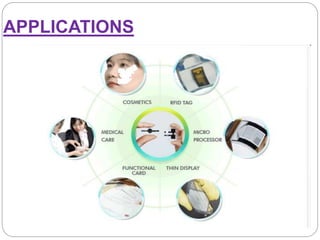
APPLICATIONS
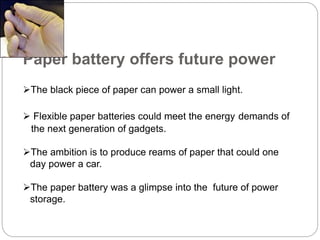
Paper battery offers future power
The black piece of paper can power a small light.
 Flexible paper batteries could meet the energy demands of
the next generation of gadgets.
The ambition is to produce reams of paper that could one
day power a car.
The paper battery was a glimpse into the future of power
storage.
Paperbattery in ppt

Paperbattery in ppt

  • 1.
    PAPER BATTERY Presented By Anbarasu.A Pre Finalyear EEE Excel College of Engineering and Technology Komarapalayam-637303. EE 2357-Presentation Skills and Technical Seminar Laboratory
  • 2.
     A paperbattery is a flexible, ultra-thin energy storage and production device formed by combining carbon nanotube with a conventional sheet of cellulose-based paper. WHAT IS A PAPER BATTERY?  A paper battery acts as both a high-energy battery and super- capacitor , combining two components that are separate in traditional electronics .
  • 3.
    GENERAL Li-ION BATTERY Generally Li-ion re-chargeable batteries are used in mobiles, laptops and most of the electronic devices.  During discharge and charging, lithium ions Li+ carry the current from the negative to the positive electrode and vice-versa respectively, through the non-aqueous electrolyte .  3 primary functional component of Li-ion battery are: 1. -ve electrode(graphite) 2. +ve electrode(cobalt oxide) 3.electrolyte( lithium salt in organic solvent)
  • 4.
    Disadvantages of Li-Ion •EXPENSIVE -- 40% more than NiCd. • DELICATE -- battery temp must be monitored from within (which raises the price), and sealed particularly well. • REGULATIONS -- when shipping Li-Ion batteries in bulk (which also raises the price). Class 9 miscellaneous hazardous material
  • 5.
    WHY TO USEPAPER BATTERY?  Ultra-thin size & flexible structure.  Exhibits property of super-capacitor(22F-36F per gram)  Operating temperature (-75 to 100 degree Celsius)  Provide both long-term, steady power production and bursts of energy.  Cost-effective.
  • 6.
    CARBON NANOTUBES  Carbonnanotube is the main concept behind paper battery  Carbon nanotube (CNTs; also known as buckytubes) are allotropes of carbon with a cylindrical nanostructure. Allotropes are different structural modifications of an element CNTs exhibit extraordinary strength and unique electrical properties, and are efficient thermal conductors.  The diameter of a nanotube is on the order of a few nanometres Their name is derived from their long, hollow structure with the walls formed by one-atom-thick sheets of carbon, called graphene.
  • 7.
    Graphene structure Rolled atangle CARBON NANOTUBE Spinning Carbon Nanotube
  • 8.
    CONSTRUCTION OF PAPER BATTERY CNT thin films were coated onto stainless steel (SS) substrates with a solution based process.  The concentration of CNT is 1.7 mg/mL.  A dried film with a thickness of 2 micrometer was formed after drying the CNT ink on the SS substrate at 80 °C for 5 min. This film is then peeled off from substrate. These films act as electrodes of paper battery.  One film is pasted to electrolyte LTO (Li4Ti5O12) and the other film is pasted to electrolyte LCO (LiCoO2).  Paper is sandwiched between two electrolytes LTO and LCO with PVDF(poly vinylidene fluoride) acting as glue.
  • 9.
  • 10.
  • 11.
  • 12.
    WORKING  Traditional Batteriesproduce electrons through a chemical reaction between electrolyte and metal.  While a conventional battery contains a number of separate components, the paper battery integrates all of the battery components in a single structure, making it more energy efficient.  paper battery produces electrons due to the interaction of electrolytes LTO & LCO.  Electrons collect on the negative terminal of the battery and flow along a connected wire to the positive terminal during discharging.  Electrons must flow from the negative to the positive terminal for the chemical reaction to continue.
  • 13.
     The flexiblebattery can function even if it is rolled up, folded or cut. ADVANTAGES  We can get 2.5 volts of electricity from a sample the size of a postage stamp.  "If we stack 500 sheets together in a ream, that's 500 times the voltage. If we rip the paper in half we cut power by 50%. So we can control the power and voltage issue."  Because the battery consists mainly of paper and carbon, it could be used to power pacemakers within the body where conventional batteries pose a toxic threat.
  • 14.
  • 15.
    Paper battery offersfuture power The black piece of paper can power a small light.  Flexible paper batteries could meet the energy demands of the next generation of gadgets. The ambition is to produce reams of paper that could one day power a car. The paper battery was a glimpse into the future of power storage.