PAPER BATTERY
Submitted by :
Dikhil Lal N.P
Roll no. 20
Reg no. 17080590
WHAT IS PAPER BATTERY
• A paper battery is a flexible, ultra-thin energy storage and production
device formed by combining carbon nanotube with a conventional
sheet of cellulose-based paper.
• A paper battery acts as both a high-energy battery and super- capacitor,
combining two components that are separate in traditional electronics.
GENERAL Li-ION BATTERY
• Generally Li-ion re-chargeable batteries are used in mobiles,laptops
and most of the electronic devices.
• 3 primary functional component of Li-ion battery are:
• 1. -ve electrode(graphite)
• 2. +ve electrode(cobalt oxide)
• 3.electrolyte( lithium salt in organic solvent)
• During discharge and charging, lithium ions Li+ carry the current from
the negative to the positive electrode and vice-versa respectively,
through the non-aqueous electrolyte
DISADVANTAGES OF Li-Ion
• Expansive -- 40% more than NiCd.
• Delicate -- battery temp must be monitored from within (which raises
the price), and sealed particularly well.
• Regulations -- when shipping Li-Ion batteries in bulk (which also
raises the price).
WORKING CONVENTIONAL BATTERY
Vs PAPER BATTERY
• Conventional Battery produce electrons through a chemical reaction
between electrolyte and metal.
• Chemical reaction in Paper Battery is between electrolyte and carbon
nano-tubes. Electrons must flow from negative to positive terminal for
the chemical reaction.
• The Paper electrode stores charge while recharging in 10 seconds
because ions flow through the thin electrode quicklyConventional
Battery produce electrons through a chemical reaction between
electrolyte and metal.
• Chemical reaction in Paper Battery is between electrolyte and carbon
nano-tubes. Electrons must flow from negative to positive terminal for
the chemical reaction.
• The Paper electrode stores charge while recharging in 10 seconds
because ions flow through the thin electrode quickly.
PROCESS OF PREPERING PAPER
BATTERY
• First black carbon ink is applied on a cellulose based paper.
• Black carbon ink is being spread on the paper.
• It is heated so that the carbon nano tubes get attached to the paper.
• Peal it off.
• Connect LED on both the ends…and check it.
WHY TO USE PAPER BATTERY?
• Ultra-thin size & flexible structure.
• Exhibits property of super-capacitor(22F-36F pergram)
• Operating temper ature(-75 to 100 degree celsius)
• provide both long-term, steady power production andbursts of energy.
• Cost-effective.
CONSTRUCTION OF PAPER BATTERY
• CNT thin films were coated onto stainless steel (SS) substrates with a
solution based process.
• The concentration of CNT is 1.7 mg/mL.
• A dried film with a thickness of 2 micrometer wasformed after drying
the CNT ink on the SS substrate at 80 °C for 5 min.This film is then
peeled off from substrate.
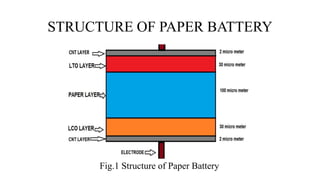
• These films act as electrodes of paper battery.one film is pasted to
electrolyte LTO (Li4Ti5O12) andthe other film is pasted to electrolyte
LCO (LiCoO2).
• Paper is sandwiched between two electrolytes LTO
• and LCO with PVDF(poly vinylidene fluoride) .
STRUCTURE OF PAPER BATTERY
Fig.1 Structure of Paper Battery
MICROSCOPIC VIEW OF LAYERS
Fig.2 Microscopic View of Layers
WORKING OF PAPER BATTERY
• Batteries produce electrons through a chemical reaction between
electrolyte and metal in the traditional battery.
• Chemical reaction in the paper battery is between electrolyte and
carbon nanotubes.
• Electrons collect on the negative terminal of the battery and flow
along a connected wire to the positive terminal.
• Electrons must flow from the negative to the positive terminal for the
chemical reaction to continue.
CARBON NANO TUBES
• A carbon nanotube is a tube-shaped material, made of carbon, having a
diameter measuring on the nanometer scale.
• A nanometer is one billionth of the meter or about one ten-thousandth
the thickness of the human hair.
• The graphite layer appears somewhat like a rolled-up chicken wire
with a continuous unbroken hexagonal mesh and carbon molecules at
the apexes of the hexagons.
• Carbon Nanotubes have many structures, differing in length,
thickness, and in the type of helicity and number of layers.
• Although they are formed from essentially the same graphite sheet,
their electrical characteristics differ depending on these variations,
acting either as metals or as semiconductors.
• Because of the symmetry and unique electronic structure of graphene,
the structure of a nanotube strongly affects its electrical properties
Fig.3 Spinning Carbon Nano tube
CHARACTERISATION
Fig.4 Characterization of Carbon Nanotube
Fig.5 Multi –wall carbon nano tube (MWCNT)
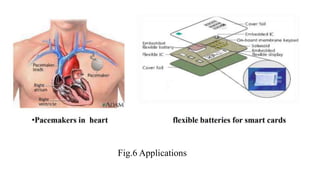
APPLICATIONS
• Cosmetics
• RFID Tag
• Medical care
• Micro processor
• Functional cards
• Thin display
Fig.6 Applications
ADVANTAGES
• The flexible battery can function even if it is rolled up, folded or cut.
• We can get 2.5 volts of electricity from a sample the size of a postage
stamp.
• If we stack 500 sheets together in a ream, that's 500 times the voltage.
If we rip the paper in half we cut power by 50%. So we can control the
power and voltage issue.
• Because the battery consists mainly of paper and carbon, it could be
used to power pacemakers within the body where conventional
batteries pose a toxic threat.
DISADVANTAGES
• Carbon ano tubes are very expansive.
• Batteries with large enough power are unlikely to be cost effective.
• For commercial viabilities, these batteries have to be scaled upto Sheets
of news paper size.
• Replacing old batteries results wastage of old electronic goods
Generation of E-Waste Should not be inhaled as they can damage lungs
CONCLUSION
• Lithium-ion batteries with CNT-microfiber paper-based current
collectors have been developed.
• The capacities are comparable with traditional batteries.
• It has a wide range of electronics applications as they provide
flexibility, lightweight, and high capacity features.
REFERENCE
• 1] L. Hu, J. W. Choi, Y. Yang, S. Jeong, F. La Mantia, F. Cui, and Y.
Cui, “Highly conductive paper for energy-storage devices,” Proc. Nat.
Academy Sci., vol. 106, pp. 21490–21494, 2009.
• [2] L.Hu,H.Wu,F. LaMantia,Y.Yang,andY.Cui,“Thin,flexiblesecondary
Li-ion paper batteries,” ACS Nano, vol. 4, pp. 5843–5848, 2010.
• [3]S.Stewart,P.Albertus,V.Srinivasan,I.Plitz,N.Pereira,G.Amatucci,and
J.Newman,“Optimizingthe performance of lithium titanate spinel
paired with activated carbon or iron phosphate,” J. Electrochem. Soc.,
vol. 155, pp. A253–A261, 2008.
• [4] L. Hu, D. S. Hecht, and G. Gruner, “Percolation in transparent and
conducting carbon nanotube networks,” Nano Lett., vol. 4, pp. 2513–
2517, 2004.
THANK YOU

Paper battery

  • 1.
    PAPER BATTERY Submitted by: Dikhil Lal N.P Roll no. 20 Reg no. 17080590
  • 2.
    WHAT IS PAPERBATTERY • A paper battery is a flexible, ultra-thin energy storage and production device formed by combining carbon nanotube with a conventional sheet of cellulose-based paper. • A paper battery acts as both a high-energy battery and super- capacitor, combining two components that are separate in traditional electronics.
  • 3.
    GENERAL Li-ION BATTERY •Generally Li-ion re-chargeable batteries are used in mobiles,laptops and most of the electronic devices. • 3 primary functional component of Li-ion battery are: • 1. -ve electrode(graphite) • 2. +ve electrode(cobalt oxide) • 3.electrolyte( lithium salt in organic solvent)
  • 4.
    • During dischargeand charging, lithium ions Li+ carry the current from the negative to the positive electrode and vice-versa respectively, through the non-aqueous electrolyte
  • 5.
    DISADVANTAGES OF Li-Ion •Expansive -- 40% more than NiCd. • Delicate -- battery temp must be monitored from within (which raises the price), and sealed particularly well. • Regulations -- when shipping Li-Ion batteries in bulk (which also raises the price).
  • 6.
    WORKING CONVENTIONAL BATTERY VsPAPER BATTERY • Conventional Battery produce electrons through a chemical reaction between electrolyte and metal. • Chemical reaction in Paper Battery is between electrolyte and carbon nano-tubes. Electrons must flow from negative to positive terminal for the chemical reaction.
  • 7.
    • The Paperelectrode stores charge while recharging in 10 seconds because ions flow through the thin electrode quicklyConventional Battery produce electrons through a chemical reaction between electrolyte and metal. • Chemical reaction in Paper Battery is between electrolyte and carbon nano-tubes. Electrons must flow from negative to positive terminal for the chemical reaction. • The Paper electrode stores charge while recharging in 10 seconds because ions flow through the thin electrode quickly.
  • 8.
    PROCESS OF PREPERINGPAPER BATTERY • First black carbon ink is applied on a cellulose based paper. • Black carbon ink is being spread on the paper. • It is heated so that the carbon nano tubes get attached to the paper. • Peal it off. • Connect LED on both the ends…and check it.
  • 9.
    WHY TO USEPAPER BATTERY? • Ultra-thin size & flexible structure. • Exhibits property of super-capacitor(22F-36F pergram) • Operating temper ature(-75 to 100 degree celsius) • provide both long-term, steady power production andbursts of energy. • Cost-effective.
  • 10.
    CONSTRUCTION OF PAPERBATTERY • CNT thin films were coated onto stainless steel (SS) substrates with a solution based process. • The concentration of CNT is 1.7 mg/mL. • A dried film with a thickness of 2 micrometer wasformed after drying the CNT ink on the SS substrate at 80 °C for 5 min.This film is then peeled off from substrate.
  • 11.
    • These filmsact as electrodes of paper battery.one film is pasted to electrolyte LTO (Li4Ti5O12) andthe other film is pasted to electrolyte LCO (LiCoO2). • Paper is sandwiched between two electrolytes LTO • and LCO with PVDF(poly vinylidene fluoride) .
  • 12.
    STRUCTURE OF PAPERBATTERY Fig.1 Structure of Paper Battery
  • 13.
    MICROSCOPIC VIEW OFLAYERS Fig.2 Microscopic View of Layers
  • 14.
    WORKING OF PAPERBATTERY • Batteries produce electrons through a chemical reaction between electrolyte and metal in the traditional battery. • Chemical reaction in the paper battery is between electrolyte and carbon nanotubes. • Electrons collect on the negative terminal of the battery and flow along a connected wire to the positive terminal.
  • 15.
    • Electrons mustflow from the negative to the positive terminal for the chemical reaction to continue.
  • 16.
    CARBON NANO TUBES •A carbon nanotube is a tube-shaped material, made of carbon, having a diameter measuring on the nanometer scale. • A nanometer is one billionth of the meter or about one ten-thousandth the thickness of the human hair. • The graphite layer appears somewhat like a rolled-up chicken wire with a continuous unbroken hexagonal mesh and carbon molecules at the apexes of the hexagons.
  • 17.
    • Carbon Nanotubeshave many structures, differing in length, thickness, and in the type of helicity and number of layers. • Although they are formed from essentially the same graphite sheet, their electrical characteristics differ depending on these variations, acting either as metals or as semiconductors. • Because of the symmetry and unique electronic structure of graphene, the structure of a nanotube strongly affects its electrical properties
  • 18.
  • 19.
  • 20.
    Fig.5 Multi –wallcarbon nano tube (MWCNT)
  • 21.
    APPLICATIONS • Cosmetics • RFIDTag • Medical care • Micro processor • Functional cards • Thin display
  • 22.
  • 23.
    ADVANTAGES • The flexiblebattery can function even if it is rolled up, folded or cut. • We can get 2.5 volts of electricity from a sample the size of a postage stamp. • If we stack 500 sheets together in a ream, that's 500 times the voltage. If we rip the paper in half we cut power by 50%. So we can control the power and voltage issue.
  • 24.
    • Because thebattery consists mainly of paper and carbon, it could be used to power pacemakers within the body where conventional batteries pose a toxic threat.
  • 25.
    DISADVANTAGES • Carbon anotubes are very expansive. • Batteries with large enough power are unlikely to be cost effective. • For commercial viabilities, these batteries have to be scaled upto Sheets of news paper size. • Replacing old batteries results wastage of old electronic goods Generation of E-Waste Should not be inhaled as they can damage lungs
  • 26.
    CONCLUSION • Lithium-ion batterieswith CNT-microfiber paper-based current collectors have been developed. • The capacities are comparable with traditional batteries. • It has a wide range of electronics applications as they provide flexibility, lightweight, and high capacity features.
  • 27.
    REFERENCE • 1] L.Hu, J. W. Choi, Y. Yang, S. Jeong, F. La Mantia, F. Cui, and Y. Cui, “Highly conductive paper for energy-storage devices,” Proc. Nat. Academy Sci., vol. 106, pp. 21490–21494, 2009. • [2] L.Hu,H.Wu,F. LaMantia,Y.Yang,andY.Cui,“Thin,flexiblesecondary Li-ion paper batteries,” ACS Nano, vol. 4, pp. 5843–5848, 2010.
  • 28.
    • [3]S.Stewart,P.Albertus,V.Srinivasan,I.Plitz,N.Pereira,G.Amatucci,and J.Newman,“Optimizingthe performanceof lithium titanate spinel paired with activated carbon or iron phosphate,” J. Electrochem. Soc., vol. 155, pp. A253–A261, 2008. • [4] L. Hu, D. S. Hecht, and G. Gruner, “Percolation in transparent and conducting carbon nanotube networks,” Nano Lett., vol. 4, pp. 2513– 2517, 2004.
  • 29.