By P.B.S.SIREESHA

Under the guidance of
Prof: VISHWANATH.P
Paper battery:?

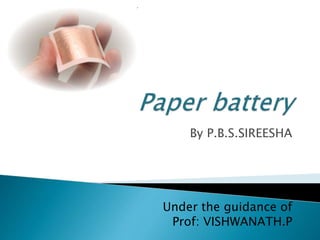
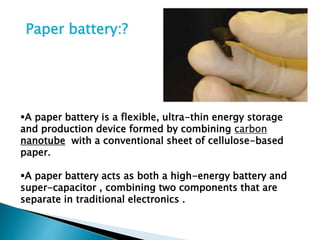
A paper battery is a flexible, ultra-thin energy storage
and production device formed by combining carbon
nanotube with a conventional sheet of cellulose-based
paper.
A paper battery acts as both a high-energy battery and
super-capacitor , combining two components that are
separate in traditional electronics .
GENERAL Li-ION BATTERY
Generally Li-ion re-chargeable batteries are used
in mobiles,laptops and most of the electronic devices.
3 primary functional component of Li-ion battery
are:
1. -ve electrode(graphite)
2. +ve electrode(cobalt oxide)
3.electrolyte( lithium salt in organic solvent)

During discharge and charging, lithium ions Li+
carry the current from the negative to the positive
electrode and vice-versa respectively, through the
non-aqueous electrolyte
Disadvantages of Li-Ion
expansive -- 40% more than NiCd.
delicate -- battery temp must be monitored
from within (which raises the price), and
sealed particularly well.
regulations -- when shipping Li-Ion
batteries in bulk (which also raises the
price).
Working Conventional Battery Vs Paper
Battery
Conventional Battery produce electrons through
a chemical reaction between electrolyte and
metal .Chemical reaction in Paper Battery is
between electrolyte and carbon nano-tubes.
Electrons must flow from negative to positive
terminal for the chemical reaction .The Paper
electrode stores charge while recharging in 10
seconds because ions flow through the thin
electrode quickly
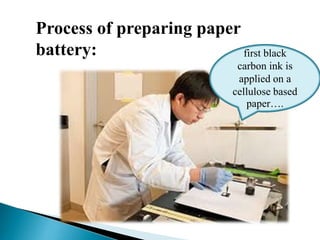
Process of preparing paper
battery:
first black
carbon ink is
applied on a
cellulose based
paper….
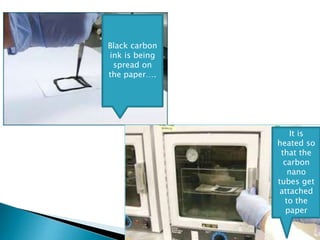
Black carbon
ink is being
spread on
the paper….

It is
heated so
that the
carbon
nano
tubes get
attached
to the
paper
Peal it off
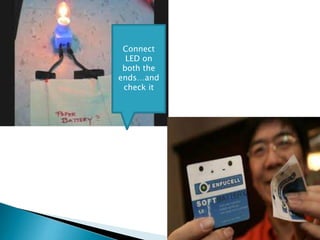
Connect
LED on
both the
ends…and
check it
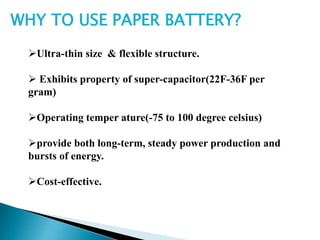
WHY TO USE PAPER BATTERY?
Ultra-thin size & flexible structure.
 Exhibits property of super-capacitor(22F-36F per
gram)
Operating temper ature(-75 to 100 degree celsius)

provide both long-term, steady power production and
bursts of energy.
Cost-effective.
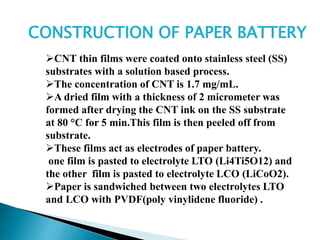
CONSTRUCTION OF PAPER BATTERY
CNT thin films were coated onto stainless steel (SS)
substrates with a solution based process.
The concentration of CNT is 1.7 mg/mL.
A dried film with a thickness of 2 micrometer was
formed after drying the CNT ink on the SS substrate
at 80 °C for 5 min.This film is then peeled off from
substrate.
These films act as electrodes of paper battery.
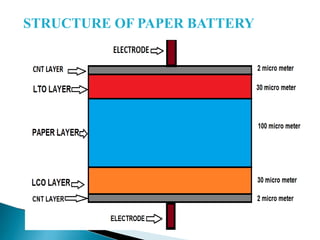
one film is pasted to electrolyte LTO (Li4Ti5O12) and
the other film is pasted to electrolyte LCO (LiCoO2).
Paper is sandwiched between two electrolytes LTO
and LCO with PVDF(poly vinylidene fluoride) .
STRUCTURE OF PAPER BATTERY
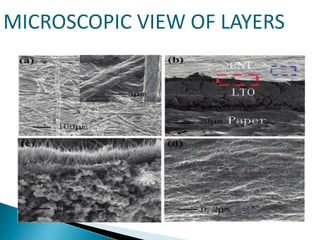
MICROSCOPIC VIEW OF LAYERS
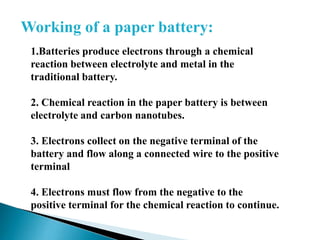
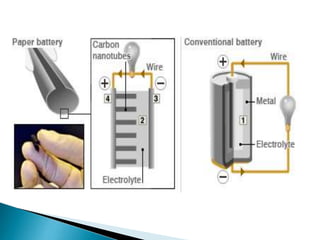
Working of a paper battery:
1.Batteries produce electrons through a chemical
reaction between electrolyte and metal in the
traditional battery.
2. Chemical reaction in the paper battery is between
electrolyte and carbon nanotubes.
3. Electrons collect on the negative terminal of the
battery and flow along a connected wire to the positive
terminal
4. Electrons must flow from the negative to the
positive terminal for the chemical reaction to continue.
Carbon nano tubes:
 A carbon nanotube is a tube-shaped material,
made of carbon, having a diameter measuring on
the nanometer scale.
 A nanometer is one billionth of the meter or
about one ten-thousandth the thickness of the
human hair.
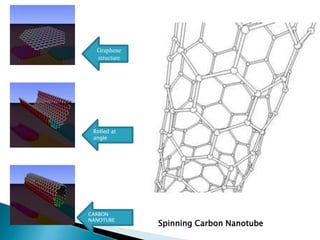
The graphite layer appears somewhat like a
rolled-up chicken wire with a continuous
unbroken hexagonal mesh and carbon molecules
at the apexes of the hexagons.
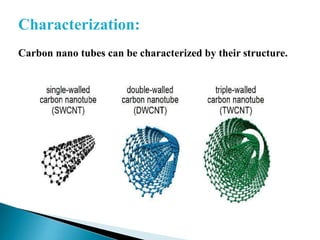
 Carbon Nanotubes have many structures,
differing in length, thickness, and in the type of
helicity and number of layers.
 Although they are formed from essentially the same
graphite sheet, their electrical characteristics differ
depending on these variations, acting either as metals
or as semiconductors.
 Because of the symmetry and unique electronic
structure of graphene, the structure of a nanotube
strongly affects its electrical properties. For a given
(n,m) nanotube, if n = m, the nanotube is metallic;
if n − m is a multiple of 3, then the nanotube is
semiconducting with a very small band gap, otherwise
the nanotube is a moderate semiconductor
Graphene
structure

Rolled at
angle

CARBON
NANOTUBE

Spinning Carbon Nanotube
Characterization:
Carbon nano tubes can be characterized by their structure.
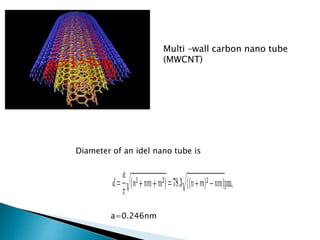
Multi –wall carbon nano tube
(MWCNT)

Diameter of an idel nano tube is

a=0.246nm
APPLICATIONS

APPLICATIONS
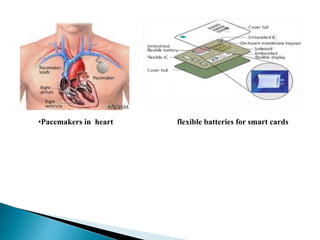
•Pacemakers in heart

flexible batteries for smart cards
ADVANTAGES
• The flexible battery can function even if it
is rolled up, folded or cut.
•We can get 2.5 volts of electricity from a
sample the size of a postage stamp.
•If we stack 500 sheets together in a ream,
that's 500 times the voltage. If we rip the
paper in half we cut power by 50%. So we
can control the power and voltage issue.
• Because the battery consists mainly of
paper and carbon, it could be used to power
pacemakers within the body where
conventional batteries pose a toxic threat.
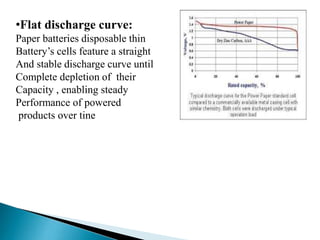
•Flat discharge curve:
Paper batteries disposable thin
Battery’s cells feature a straight
And stable discharge curve until
Complete depletion of their
Capacity , enabling steady
Performance of powered
products over tine
DISADVANTAGES
Carbon ano tubes are very expansive

Batteries with large enough power are unlikely to be cost effective
For commercial viabilities, these batteries have to be scaled upto
Sheets of news paper size.

Replacing old batteries results wastage of old electronic goods
Generation of E-Waste
Should not be inhaled as they can damage lungs
Paper battery
Paper battery

Paper battery

  • 1.
    By P.B.S.SIREESHA Under theguidance of Prof: VISHWANATH.P
  • 2.
    Paper battery:? A paperbattery is a flexible, ultra-thin energy storage and production device formed by combining carbon nanotube with a conventional sheet of cellulose-based paper. A paper battery acts as both a high-energy battery and super-capacitor , combining two components that are separate in traditional electronics .
  • 3.
    GENERAL Li-ION BATTERY GenerallyLi-ion re-chargeable batteries are used in mobiles,laptops and most of the electronic devices. 3 primary functional component of Li-ion battery are: 1. -ve electrode(graphite) 2. +ve electrode(cobalt oxide) 3.electrolyte( lithium salt in organic solvent) During discharge and charging, lithium ions Li+ carry the current from the negative to the positive electrode and vice-versa respectively, through the non-aqueous electrolyte
  • 4.
    Disadvantages of Li-Ion expansive-- 40% more than NiCd. delicate -- battery temp must be monitored from within (which raises the price), and sealed particularly well. regulations -- when shipping Li-Ion batteries in bulk (which also raises the price).
  • 5.
    Working Conventional BatteryVs Paper Battery Conventional Battery produce electrons through a chemical reaction between electrolyte and metal .Chemical reaction in Paper Battery is between electrolyte and carbon nano-tubes. Electrons must flow from negative to positive terminal for the chemical reaction .The Paper electrode stores charge while recharging in 10 seconds because ions flow through the thin electrode quickly
  • 6.
    Process of preparingpaper battery: first black carbon ink is applied on a cellulose based paper….
  • 7.
    Black carbon ink isbeing spread on the paper…. It is heated so that the carbon nano tubes get attached to the paper
  • 8.
  • 9.
  • 10.
    WHY TO USEPAPER BATTERY? Ultra-thin size & flexible structure.  Exhibits property of super-capacitor(22F-36F per gram) Operating temper ature(-75 to 100 degree celsius) provide both long-term, steady power production and bursts of energy. Cost-effective.
  • 11.
    CONSTRUCTION OF PAPERBATTERY CNT thin films were coated onto stainless steel (SS) substrates with a solution based process. The concentration of CNT is 1.7 mg/mL. A dried film with a thickness of 2 micrometer was formed after drying the CNT ink on the SS substrate at 80 °C for 5 min.This film is then peeled off from substrate. These films act as electrodes of paper battery. one film is pasted to electrolyte LTO (Li4Ti5O12) and the other film is pasted to electrolyte LCO (LiCoO2). Paper is sandwiched between two electrolytes LTO and LCO with PVDF(poly vinylidene fluoride) .
  • 12.
  • 13.
  • 14.
    Working of apaper battery: 1.Batteries produce electrons through a chemical reaction between electrolyte and metal in the traditional battery. 2. Chemical reaction in the paper battery is between electrolyte and carbon nanotubes. 3. Electrons collect on the negative terminal of the battery and flow along a connected wire to the positive terminal 4. Electrons must flow from the negative to the positive terminal for the chemical reaction to continue.
  • 16.
    Carbon nano tubes: A carbon nanotube is a tube-shaped material, made of carbon, having a diameter measuring on the nanometer scale.  A nanometer is one billionth of the meter or about one ten-thousandth the thickness of the human hair. The graphite layer appears somewhat like a rolled-up chicken wire with a continuous unbroken hexagonal mesh and carbon molecules at the apexes of the hexagons.  Carbon Nanotubes have many structures, differing in length, thickness, and in the type of helicity and number of layers.
  • 17.
     Although theyare formed from essentially the same graphite sheet, their electrical characteristics differ depending on these variations, acting either as metals or as semiconductors.  Because of the symmetry and unique electronic structure of graphene, the structure of a nanotube strongly affects its electrical properties. For a given (n,m) nanotube, if n = m, the nanotube is metallic; if n − m is a multiple of 3, then the nanotube is semiconducting with a very small band gap, otherwise the nanotube is a moderate semiconductor
  • 18.
  • 19.
    Characterization: Carbon nano tubescan be characterized by their structure.
  • 20.
    Multi –wall carbonnano tube (MWCNT) Diameter of an idel nano tube is a=0.246nm
  • 21.
  • 22.
    •Pacemakers in heart flexiblebatteries for smart cards
  • 23.
    ADVANTAGES • The flexiblebattery can function even if it is rolled up, folded or cut. •We can get 2.5 volts of electricity from a sample the size of a postage stamp. •If we stack 500 sheets together in a ream, that's 500 times the voltage. If we rip the paper in half we cut power by 50%. So we can control the power and voltage issue. • Because the battery consists mainly of paper and carbon, it could be used to power pacemakers within the body where conventional batteries pose a toxic threat.
  • 24.
    •Flat discharge curve: Paperbatteries disposable thin Battery’s cells feature a straight And stable discharge curve until Complete depletion of their Capacity , enabling steady Performance of powered products over tine
  • 25.
    DISADVANTAGES Carbon ano tubesare very expansive Batteries with large enough power are unlikely to be cost effective For commercial viabilities, these batteries have to be scaled upto Sheets of news paper size. Replacing old batteries results wastage of old electronic goods Generation of E-Waste Should not be inhaled as they can damage lungs