Submitted By :-
Name:-
ROLL no:-
Branch:-….., 5th Semester
 Battery
 Paper Battery
 Carbon Nanotubes ( CNT )
 Types of carbon nanotubes
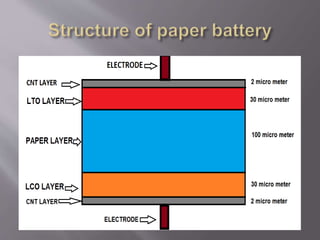
 Structure of paper battery
 Working
 Features
 Applications
 Advantages
 Disadvantages
• Battery is a device consisting of one or more
electrochemical cells that convert stored chemical
energy into electrical energy
BATTERY
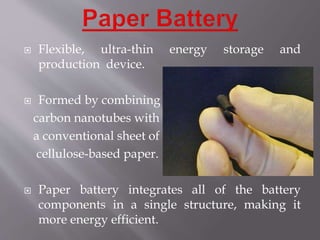
 Flexible, ultra-thin energy storage and
production device.
 Formed by combining
carbon nanotubes with
a conventional sheet of
cellulose-based paper.
 Paper battery integrates all of the battery
components in a single structure, making it
more energy efficient.
 Carbon nanotubes (CNTs; also known
as buckytubes) are allotropes of carbon with a
cylindrical nanostructure.
Clindrical
carbon
nanotube
Types Carbon nanotubes
SWCNT: single-wall carbon nanotube
DWCNT: double-wall carbon nanotube
TWCNT: triple-wall carbon nanotube
MWCNT: multi-wall carbon nanotube
Multi-wall carbon nanotube
(MWCNT)
2. Chemical reaction in the paper
battery is between electrolyte
and carbon nanotubes.
3. Electrons collect on the
negative terminal of the
battery and flow along a
connected wire to the
positive terminal.
4. Electrons must flow from
the negative to the positive
terminal for the chemical
reaction to continue.
 Ultra-thin size& flexible structure
 Exhibits property of super-capacitor
 1.5 volts of electricity from a sample the size of
a postage stamp.
 Efficiency doesn’t loss by cutting or folding.
 Operating temprature -75C to 150C.
 Thin - film can be stored for decades.
Smart card
Children’s
toys
Electronics
gadgets
Pace maker
 Light weight
 Flexible
 Biodegradable
 Carbon nanotubes are very expensive.
 Cutting of trees leading to destroying of the
nature.
 ENFUCELL
(China)
 INVEST
(Newyork)
PAPER BATTERY

PAPER BATTERY

  • 1.
    Submitted By :- Name:- ROLLno:- Branch:-….., 5th Semester
  • 2.
     Battery  PaperBattery  Carbon Nanotubes ( CNT )  Types of carbon nanotubes  Structure of paper battery  Working  Features  Applications  Advantages  Disadvantages
  • 3.
    • Battery isa device consisting of one or more electrochemical cells that convert stored chemical energy into electrical energy BATTERY
  • 4.
     Flexible, ultra-thinenergy storage and production device.  Formed by combining carbon nanotubes with a conventional sheet of cellulose-based paper.  Paper battery integrates all of the battery components in a single structure, making it more energy efficient.
  • 5.
     Carbon nanotubes(CNTs; also known as buckytubes) are allotropes of carbon with a cylindrical nanostructure. Clindrical carbon nanotube
  • 6.
    Types Carbon nanotubes SWCNT:single-wall carbon nanotube DWCNT: double-wall carbon nanotube TWCNT: triple-wall carbon nanotube MWCNT: multi-wall carbon nanotube Multi-wall carbon nanotube (MWCNT)
  • 8.
    2. Chemical reactionin the paper battery is between electrolyte and carbon nanotubes. 3. Electrons collect on the negative terminal of the battery and flow along a connected wire to the positive terminal. 4. Electrons must flow from the negative to the positive terminal for the chemical reaction to continue.
  • 9.
     Ultra-thin size&flexible structure  Exhibits property of super-capacitor  1.5 volts of electricity from a sample the size of a postage stamp.  Efficiency doesn’t loss by cutting or folding.  Operating temprature -75C to 150C.  Thin - film can be stored for decades.
  • 10.
  • 11.
     Light weight Flexible  Biodegradable
  • 12.
     Carbon nanotubesare very expensive.  Cutting of trees leading to destroying of the nature.
  • 13.