

Submitted to
I.Anitha Rani
Submitted by
Y.Keerthi Reddy(10JM1517),
V.Triveni(10JM1A0530),
K.T.V.N.Lakshmi(10JM1A0527).
PRIVACY- AND INTEGRITY-
PRESERVING RANGE QUERIES
IN SENSOR NETWORKS
ABSTRACT
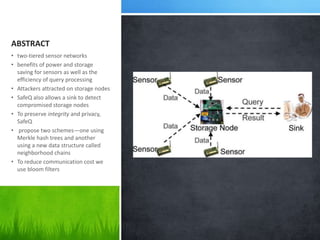
• two-tiered sensor networks
• benefits of power and storage
saving for sensors as well as the
efficiency of query processing
• Attackers attracted on storage nodes
• SafeQ also allows a sink to detect
compromised storage nodes
• To preserve integrity and privacy,
SafeQ
• propose two schemes—one using
Merkle hash trees and another
using a new data structure called
neighborhood chains
• To reduce communication cost we
use bloom filters
EXISTING SYSTEM
Existing Wireless sensor networks once sensor nodes have been
deployed, there will be minimal manual intervention and
monitoring. But, when nodes are deployed in a hostile
environment and there is no manual monitoring.
DRAWBACKS
• First, the attacker may obtain sensitive data that has been,
or will be, stored in the storage node.
• Second, the compromised storage node may return forged
data for a query.
• Third, this storage node may not include all data items that
satisfy the query.
PROPOSED SYSTEM
To preserve the privacy and integrity of range queries in
sensor networks
uses the bucket-partitioning for database privacy.
The basic idea is to divide the domain of data values into
multiple buckets.
SafeQ also allows a sink to detect compromised storage nodes
when they misbehave.
The sink is the point of contact for users of the sensor
network.
REQUIREMENTS
Software Requirements:
• O S : Windows XP or more
• Technology :JAVA, Swing
• Database : MS- Access
Hardware Requirements:
• Processor : Pentium IV
• Hard Disk : 40 GB.
• RAM :256 Mb.
MODULES
• SafeQ
• Integrity
• Privacy
• Range Queries
• Sink
• Storage Node
SAFEQ
• SafeQ is a protocol that prevents attackers from gaining
information from both sensor collected data and sink issued
queries.
• SafeQ also allows a sink to detect compromised storage nodes
when they misbehave.
• To preserve privacy, SafeQ uses a novel technique to encode
both data and queries such that a storage node can correctly
process encoded queries over encoded data without knowing
their values.
INTEGRITY
The sink needs to detect whether a query result from a
storage node includes forged data items or does not include all
the data that satisfy the query.
There are two key challenges in solving the privacyand
integrity-preserving range query problem.
 First, a storage node needs to correctly process encoded
queries over encoded data without knowing their actual
values.
 Second, a sink needs to verify that the result of a query
contains all the data items that satisfy the query and does not
contain any forged data.
PRIVACY
To preserve privacy, SafeQ uses a novel technique to encode
both data and queries such that a storage node can correctly
process encoded queries over encoded data without knowing
their actual values.
A compromised storage node cannot gain information from
sensor collected data and sink issued queries
A storage node can perform query processing
RANGE QURIES
The queries from the sink are range queries. A range query “is
a common database operation finding all the data items
collected at time-slot in the range”.
Note that the queries in most sensor network applications can
be easily modelled as range queries.
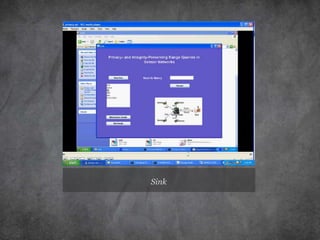
SINK
The sink is the point of contact for users of the sensor
network.
 Each time the sink receives a question from a user, it first
translates the question into multiple queries and then
disseminates the queries to the corresponding storage nodes
The sink unifies the query results from multiple storage nodes
into the final answer and sends it back to the user.
Sink can detect compromised storage nodes when they
misbehave.
STORAGE NODE
 Storage nodes are powerful wireless devices that are
equipped with much more storage capacity and computing
power than sensors.
The storage node collects all data from the sensor nodes.
The storage node can’t view the actual value of sensor node
data.
If the storage node trying to view the sensor node data, sink
detect misbehave of storage node.
DATAFLOW DIAGRAM
DATAFLOW DIAGRAM
SINK
USECASE DIAGRAM
CLASS DIAGRAM
SEQUENCE DIAGRAM
ACTIVITY DIAGRAM
SCREEN SHOTS
Sensor node sends file
Negative acknowledgement
False Positive
File stores in Storage Node
Sink
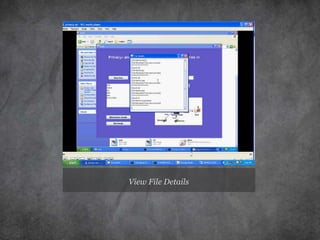
View File Details
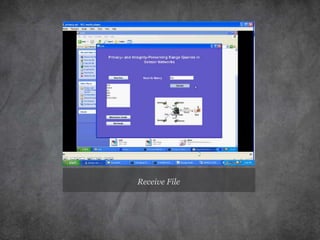
Receive File
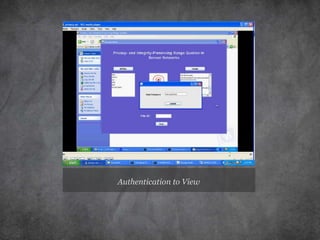
Authentication to View
Authentication Valid
Authentication Invalid
CONCLUSION
We make three key contributions in this paper.
SafeQ significantly strengthens the security of two-tiered
sensor networks.
We used Merkle Hash trees and neighbourhood chain to
preserve integrity
we propose an optimization technique using Bloom filters to
significantly reduce the communication cost between sensors
and storage nodes.
we propose a solution to adapt SafeQ for event-driven sensor
networks.
Any Queries????????

Privacy and integrity-preserving range queries

  • 1.
    Submitted to I.Anitha Rani Submittedby Y.Keerthi Reddy(10JM1517), V.Triveni(10JM1A0530), K.T.V.N.Lakshmi(10JM1A0527). PRIVACY- AND INTEGRITY- PRESERVING RANGE QUERIES IN SENSOR NETWORKS
  • 2.
    ABSTRACT • two-tiered sensornetworks • benefits of power and storage saving for sensors as well as the efficiency of query processing • Attackers attracted on storage nodes • SafeQ also allows a sink to detect compromised storage nodes • To preserve integrity and privacy, SafeQ • propose two schemes—one using Merkle hash trees and another using a new data structure called neighborhood chains • To reduce communication cost we use bloom filters
  • 3.
    EXISTING SYSTEM Existing Wirelesssensor networks once sensor nodes have been deployed, there will be minimal manual intervention and monitoring. But, when nodes are deployed in a hostile environment and there is no manual monitoring. DRAWBACKS • First, the attacker may obtain sensitive data that has been, or will be, stored in the storage node. • Second, the compromised storage node may return forged data for a query. • Third, this storage node may not include all data items that satisfy the query.
  • 4.
    PROPOSED SYSTEM To preservethe privacy and integrity of range queries in sensor networks uses the bucket-partitioning for database privacy. The basic idea is to divide the domain of data values into multiple buckets. SafeQ also allows a sink to detect compromised storage nodes when they misbehave. The sink is the point of contact for users of the sensor network.
  • 5.
    REQUIREMENTS Software Requirements: • OS : Windows XP or more • Technology :JAVA, Swing • Database : MS- Access Hardware Requirements: • Processor : Pentium IV • Hard Disk : 40 GB. • RAM :256 Mb.
  • 6.
    MODULES • SafeQ • Integrity •Privacy • Range Queries • Sink • Storage Node
  • 7.
    SAFEQ • SafeQ isa protocol that prevents attackers from gaining information from both sensor collected data and sink issued queries. • SafeQ also allows a sink to detect compromised storage nodes when they misbehave. • To preserve privacy, SafeQ uses a novel technique to encode both data and queries such that a storage node can correctly process encoded queries over encoded data without knowing their values.
  • 8.
    INTEGRITY The sink needsto detect whether a query result from a storage node includes forged data items or does not include all the data that satisfy the query. There are two key challenges in solving the privacyand integrity-preserving range query problem.  First, a storage node needs to correctly process encoded queries over encoded data without knowing their actual values.  Second, a sink needs to verify that the result of a query contains all the data items that satisfy the query and does not contain any forged data.
  • 9.
    PRIVACY To preserve privacy,SafeQ uses a novel technique to encode both data and queries such that a storage node can correctly process encoded queries over encoded data without knowing their actual values. A compromised storage node cannot gain information from sensor collected data and sink issued queries A storage node can perform query processing
  • 10.
    RANGE QURIES The queriesfrom the sink are range queries. A range query “is a common database operation finding all the data items collected at time-slot in the range”. Note that the queries in most sensor network applications can be easily modelled as range queries.
  • 11.
    SINK The sink isthe point of contact for users of the sensor network.  Each time the sink receives a question from a user, it first translates the question into multiple queries and then disseminates the queries to the corresponding storage nodes The sink unifies the query results from multiple storage nodes into the final answer and sends it back to the user. Sink can detect compromised storage nodes when they misbehave.
  • 12.
    STORAGE NODE  Storagenodes are powerful wireless devices that are equipped with much more storage capacity and computing power than sensors. The storage node collects all data from the sensor nodes. The storage node can’t view the actual value of sensor node data. If the storage node trying to view the sensor node data, sink detect misbehave of storage node.
  • 14.
  • 15.
  • 16.
  • 17.
  • 18.
  • 19.
  • 20.
  • 21.
  • 22.
  • 23.
  • 24.
    File stores inStorage Node
  • 25.
  • 26.
  • 27.
  • 28.
  • 29.
  • 30.
  • 31.
    CONCLUSION We make threekey contributions in this paper. SafeQ significantly strengthens the security of two-tiered sensor networks. We used Merkle Hash trees and neighbourhood chain to preserve integrity we propose an optimization technique using Bloom filters to significantly reduce the communication cost between sensors and storage nodes. we propose a solution to adapt SafeQ for event-driven sensor networks.
  • 32.