

PEDIATRIC HIV.
Jayatheeswaran.
Vijayakumar
Y5 | MD.
INTRODUCTION.
40 million people are estimated to be living with
HIV/AIDS.
3 millions are children.
Epidemiology in recent times are the highest between
individuals 15-24 years of age.
95% of the people that have HIV live in the developing
world.
MOTHER TO INFANT
TRANSMISSION.
35% of infants born to HIV+ will contract HIV without
interventions.
 15-20% occur during pregnancy.
 50% occur during labor/ delivery.
 33% occur during breastfeeding.
BREASTFEEDING.
•Infants can contract HIV through breastfeeding.
•In developing countries, formula is not often available or
is not financially possible, as a result it would be an
inevitable option.
•If the formula is available, then concerns are directed at
the cleanliness of the water supply or sterilization of
bottles.
DIAGNOSIS.
•An infant < 18 months of age is considered HIV-infected
if they are sero+ or were born to an HIV infected mother
and has +results on two separate HIV tests.
•An infant can be excluded by the disappearance of anti-
HIV antibody by 18 months of age – seroreversion.
CONDITIONS ASSOCIATED
WITH HIV.
Malnutrition.
 Impaired nutritional absorption.
 Increased nutritional
requirements.
 Reduced food intake.
 Lactose intolerance.
 Dehydration.
 HIV-induced diarrhea.
Failure to thrive.
 Alterations in function of GI
tract.
 Increased use of body fat
stores.
 Oral lesions and HIV-specific
gingivitis.
Developmental delays.
Micronutrient deficiencies.
 Depletion of vitamin and
mineral stores.
Neurological problems.
 Abnormal swallowing
mechanisms.
 Impaired brain growth.
 Seizures/ Strokes.
Opportunistic infections.
 Cryptosporidiosis.
 Tuberculosis.
Normal infections are
potentially fatal.
OTHER PROBLEMS.
•Categorized as an ‘AIDS’ family – stigma.
•Psychological burden.
•Socioeconomic status.
•Access to medication.
NUTRITIONAL ASSESSMENT.
•Detailed diet history.
•Medication history.
•Anthropometric data.
•Evaluation of weight changes.
•Laboratory data.
MANAGEMENT.
•Small frequent feedings.
•Nutrient supplementation.
•Soft-textured, moist foods at room temperature.
•Fluids tolerated via a straw.
MANAGEMENT.
•Estimate energy needs using a Metabolic Cart, RDA
tables or Bentler & Stannish formula.
 200kcal/kg & 4g/kg.
•Aggressive treatment of opportunistic infections.
•Tolerable anti-HIV regimen including a combination of 3
different medications.
 2 reverse transcriptase inhibitors (zidovudine + tenofovir) + 1
protease inhibitor (indinavir) – weight gain, improved mental
functioning.
MANAGEMENT.
•Consult with doctor before immunizations/ booster
shots.
•Evaluate feeding skills to see if tube feeding is necessary
or TPN is required.
•Diarrhoea.
 Lactaid milk & yogurt.
 Soy milk.
 Soluble forms of fibre – oatmeal, rice.
 Replace fluid loss with electrolyte solutions such as Pedialyte.
PROGNOSIS.
•Although HIV is usually deadly in children. The
development of anti-retroviral is promising.
•The nutritional status of the child and the diligence in
which viral replication is controlled is also important.
•Aggressive treatment of opportunistic infections are
important.
•Control of hematologic disturbances such as anaemia,
thrombocytopenia and neutropenia are also important.
•Natural progression of vertically acquired HIV infection
appears to have a trimodal distribution.
 15% have rapidly progressive disease. The remainder has either a
chronic progressive course or an infection pattern.
 Mean survival is 10 years.
PROGNOSTIC FACTORS.
•Advanced maternal
disease.
•High maternal viral load.
•Low maternal CD4+ count.
•Prematurity.
•In utero transmission.
•High viral load in the first
2 months of life.
•Lack of neutralizing
antibodies.
•Presence of p24 antigen.
•AIDS-defining illnesses.
(Pneumocystic carinii)
•Early cytomegalovirus
(CMV) infection.
•Early neurologic disease.
•Failure to thrive.
•Early-onset diarrhea.
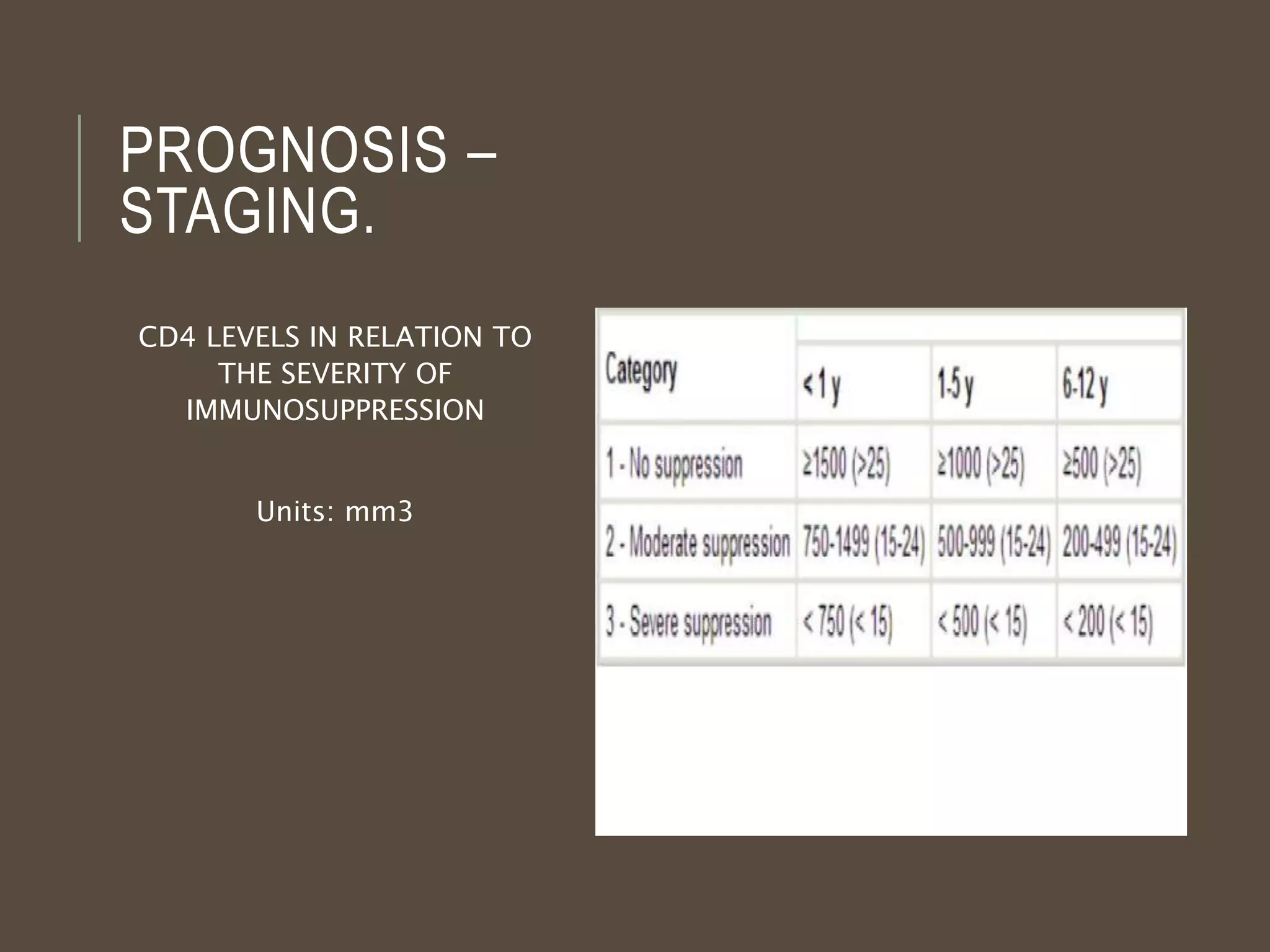
PROGNOSIS –
STAGING.
CD4 LEVELS IN RELATION TO
THE SEVERITY OF
IMMUNOSUPPRESSION
Units: mm3

Paediatric HIV

  • 1.
  • 2.
    INTRODUCTION. 40 million peopleare estimated to be living with HIV/AIDS. 3 millions are children. Epidemiology in recent times are the highest between individuals 15-24 years of age. 95% of the people that have HIV live in the developing world.
  • 3.
    MOTHER TO INFANT TRANSMISSION. 35%of infants born to HIV+ will contract HIV without interventions.  15-20% occur during pregnancy.  50% occur during labor/ delivery.  33% occur during breastfeeding.
  • 4.
    BREASTFEEDING. •Infants can contractHIV through breastfeeding. •In developing countries, formula is not often available or is not financially possible, as a result it would be an inevitable option. •If the formula is available, then concerns are directed at the cleanliness of the water supply or sterilization of bottles.
  • 5.
    DIAGNOSIS. •An infant <18 months of age is considered HIV-infected if they are sero+ or were born to an HIV infected mother and has +results on two separate HIV tests. •An infant can be excluded by the disappearance of anti- HIV antibody by 18 months of age – seroreversion.
  • 6.
    CONDITIONS ASSOCIATED WITH HIV. Malnutrition. Impaired nutritional absorption.  Increased nutritional requirements.  Reduced food intake.  Lactose intolerance.  Dehydration.  HIV-induced diarrhea. Failure to thrive.  Alterations in function of GI tract.  Increased use of body fat stores.  Oral lesions and HIV-specific gingivitis. Developmental delays. Micronutrient deficiencies.  Depletion of vitamin and mineral stores. Neurological problems.  Abnormal swallowing mechanisms.  Impaired brain growth.  Seizures/ Strokes. Opportunistic infections.  Cryptosporidiosis.  Tuberculosis. Normal infections are potentially fatal.
  • 7.
    OTHER PROBLEMS. •Categorized asan ‘AIDS’ family – stigma. •Psychological burden. •Socioeconomic status. •Access to medication.
  • 8.
    NUTRITIONAL ASSESSMENT. •Detailed diethistory. •Medication history. •Anthropometric data. •Evaluation of weight changes. •Laboratory data.
  • 9.
    MANAGEMENT. •Small frequent feedings. •Nutrientsupplementation. •Soft-textured, moist foods at room temperature. •Fluids tolerated via a straw.
  • 10.
    MANAGEMENT. •Estimate energy needsusing a Metabolic Cart, RDA tables or Bentler & Stannish formula.  200kcal/kg & 4g/kg. •Aggressive treatment of opportunistic infections. •Tolerable anti-HIV regimen including a combination of 3 different medications.  2 reverse transcriptase inhibitors (zidovudine + tenofovir) + 1 protease inhibitor (indinavir) – weight gain, improved mental functioning.
  • 11.
    MANAGEMENT. •Consult with doctorbefore immunizations/ booster shots. •Evaluate feeding skills to see if tube feeding is necessary or TPN is required. •Diarrhoea.  Lactaid milk & yogurt.  Soy milk.  Soluble forms of fibre – oatmeal, rice.  Replace fluid loss with electrolyte solutions such as Pedialyte.
  • 12.
    PROGNOSIS. •Although HIV isusually deadly in children. The development of anti-retroviral is promising. •The nutritional status of the child and the diligence in which viral replication is controlled is also important. •Aggressive treatment of opportunistic infections are important. •Control of hematologic disturbances such as anaemia, thrombocytopenia and neutropenia are also important. •Natural progression of vertically acquired HIV infection appears to have a trimodal distribution.  15% have rapidly progressive disease. The remainder has either a chronic progressive course or an infection pattern.  Mean survival is 10 years.
  • 13.
    PROGNOSTIC FACTORS. •Advanced maternal disease. •Highmaternal viral load. •Low maternal CD4+ count. •Prematurity. •In utero transmission. •High viral load in the first 2 months of life. •Lack of neutralizing antibodies. •Presence of p24 antigen. •AIDS-defining illnesses. (Pneumocystic carinii) •Early cytomegalovirus (CMV) infection. •Early neurologic disease. •Failure to thrive. •Early-onset diarrhea.
  • 14.
    PROGNOSIS – STAGING. CD4 LEVELSIN RELATION TO THE SEVERITY OF IMMUNOSUPPRESSION Units: mm3