

Tuberculosis in children
Epidemiology, Etiology, Clinical Features,
Complications, Management and Prevention
Prof. Imran Iqbal
Fellowship in Pediatric Neurology (Australia)
Prof of Paediatrics (2003-2018)
Prof of Pediatrics Emeritus, CHICH
Prof of Pediatrics, CIMS
Multan, Pakistan
(God speaking to Prophet Muhammad (PBUH)
Whatsoever is in the heavens and whatsoever is on the earth glorifies
Allah, and He is the All-Mighty, the All-Wise
Al Quran surah Al-Saff 61:1
Case Scenario
• A four year old child presents to OPD with cough and
fever for the last 30 days
• Child is not active as before
• Now he eats less than what he used to previously.
• Child lives in inner city with his extended family.
• His vaccinations are incomplete.
• His grandfather is suffering from chronic productive
cough.
Case Scenario (continued)
• Child has been to different doctors and received multiple
antibiotics.
• On physical examination, cervical lymph nodes are
palpable on left side.
• Chest crepitations are audible on the back in left infra-
scapular area
• What is your most likely diagnosis ?
• What is other diseases need to be excluded ?
• How will you manage this child ?
Diagnosis
• Tuberculosis
• Differential Diagnosis
• Unresolved Pneumonia
• Whooping Cough
• Hypersensitivity Pneumonitis
• Foreign body
Tuberculosis in children
Epidemiology
• Tuberculosis is endemic in Pakistan
• There are 230 new Tuberculosis cases per 100,000
population every year (500,000 in Pakistan)
• About 70000 persons die due to tuberculosis in Pakistan
every year
• Childhood Tuberculosis in children < 15 years of age
accounts for 20 % of total cases in Pakistan
Epidemiology
• Children can present with TB disease at any age
• Tuberculosis infection in children is common below 4 yrs
• Adolescents are at increased risk for development of TB
• Pulmonary TB is the commonest type of TB in children.
• Extra-pulmonary disease is seen in 30-40% of cases
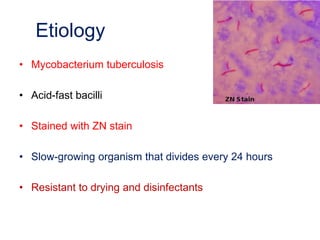
Etiology
• Mycobacterium tuberculosis
• Acid-fast bacilli
• Stained with ZN stain
• Slow-growing organism that divides every 24 hours
• Resistant to drying and disinfectants
Transmission – spread of infection
 Source – Adult Patients with tuberculosis
 Transmission – DROPLET infection
• Transmission more likely in the presence of :
-- close contact
-- darkness and lack of ventilation
 Host – susceptible children with low immunity
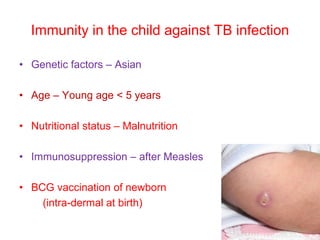
Immunity in the child against TB infection
• Genetic factors – Asian
• Age – Young age < 5 years
• Nutritional status – Malnutrition
• Immunosuppression – after Measles
• BCG vaccination of newborn
(intra-dermal at birth)
Infection with Tubercle Bacillus
• Mycobacterium tuberculosis infection can result in:
• Subclinical infection (latent tuberculosis)
OR
• Clinical disease (active tuberculosis)
• depending upon:
-- dose of infecting organism
-- immunity of child
Pathogenesis of
Tuberculosis in Children
Pathogenesis of Tuberculosis in Children
• Primary infection by Mycobacterium tuberculosis is
called Primary Complex
• Primary Complex consists of primary focus of infection
and enlarged regional lymph nodes
• Primary Complex can form in the:
-- tonsils (cervical lymph nodes)
-- lungs (hilar lymph nodes)
-- abdomen (mesenteric lymph nodes)
Primary Pulmonary Tuberculosis
• Initial pulmonary infection is a local sub-pleural focus
• Tubercle bacillus is carried by macrophages through
lymphatics to regional lymph nodes
• Hilar lymph nodes are enlarged
• Local spread of infection can occur in lungs
• Lymphatic and blood-borne spread can be to distant
organs
Spread of Mycobacterium tuberculosis in the body
Clinical Features
Clinical Features of Tuberculosis
• Non-specific general symptoms of Tuberculosis
• Failure to thrive
• Loss of weight
• Loss of appetite
• Low grade fever
• Apathy
• Local symptoms and signs
• Local symptoms and signs depend upon site of infection
Primary Pulmonary Tuberculosis
• Primary infection may be asymptomatic
• Non-specific general symptoms
• Pulmonary symptoms and signs
- mild cough
- persistent crepitations
- decreased breath sounds
- breathlessness
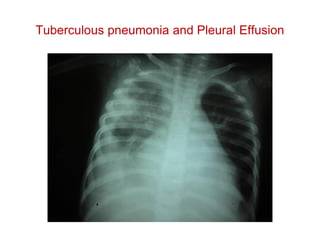
Tuberculous pneumonia and Pleural Effusion
Tuberculosis of Lymph nodes
• Persistent enlargement of Lymph nodes
• Non – tender enlargement
• Cold abscess (liquefaction necrosis)
• Discharging sinus
Tuberculosis of Lymph nodes
Tuberculosis of Cervical Lymph Nodes
Tuberculous Cold Abscess in the Neck
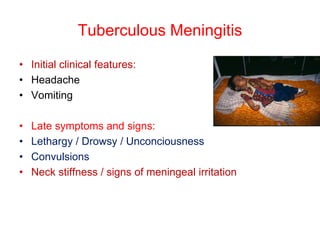
Tuberculous Meningitis
• Initial clinical features:
• Headache
• Vomiting
• Late symptoms and signs:
• Lethargy / Drowsy / Unconciousness
• Convulsions
• Neck stiffness / signs of meningeal irritation
Advanced Tuberculous Meningitis
Decerebrate Rigidity
Tuberculous Meningitis – CT Brain
Hydrocephalus and Infarctions
Tuberculous Meningitis and Tuberculoma
CT Brain (IV contrast)
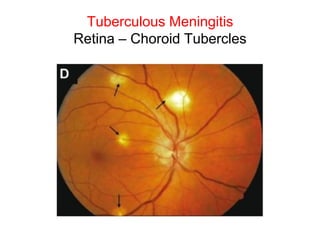
Tuberculous Meningitis
Retina – Choroid Tubercles
Abdominal Tuberculosis
• Pain abdomen
• Diarrhea / Constipation
• Abdominal distension – local, generalized
• Mesenteric lymphadenopathy
• Intestinal obstruction (hyperplastic tuberculosis)
• Ascites (exudative tuberculosis)
Abdominal Tuberculosis
Tuberculosis of Joints / Bones / Spine
• Pain
• Limp walk
• Joint swelling – Mono-articular Arthritis
• Discharging sinus on a bone
• Gibbus / acute kyphosis of spine (vertebral collapse due
to necrosis of intervertebral disc and vertebra)
• Paraparesis may result from pressure on nerve roots
Tuberculosis of Vertebral Column
X-ray Spine MRI Spine
Miliary Tuberculosis
• General symptoms of tuberculosis
• Hepatosplenomegaly
• Choroidal tubercles
Miliary Tuberculosis on Chest X-ray
Miliary TB – HRCT Chest
Diagnosis of Tuberculosis
Diagnosis of Tuberculosis in Children
is made by consideration of:
• General clinical features
• Local symptoms and signs
• History of contact with TB patient
• Tuberculin test
• Suggestive investigations
Investigations for Tuberculosis
• Tuberculin test (Monteux test)
• X – ray Chest
• Fluid Examination, Cytology, AFB smear, PCR, AFB culture and
sensitivity (CSF, Pleural Fluid, Ascitic fluid)
• Sputum / Gastric aspirate for AFB smear, PCR and AFB Culture
• Biopsy of local tissue / organ for histopathology and AFB culture
• PCR for MTB (GeneXpert) performed on CSF / Fluid aspirate
(also detects Rifampicin resistance)
• Blood IGRA (Interferon Gamma Release Assay) test
Score Chart for Diagnosis of Childhood Tuberculosis
Treatment of Tuberculosis
Treatment of Childhood Tuberculosis
• Make a confident diagnosis
• Prescribe standard anti-TB chemotherapy regime
• Ensure drug compliance
• Evaluate and treat adult sources / contacts of child
patient
Treatment Regimens
• Asymptomatic infection (Latent Tuberculosis)
• Primary pulmonary / lymph node / abdominal
tuberculosis in child
• T.B. Meningitis / Bone / Miliary tuberculosis
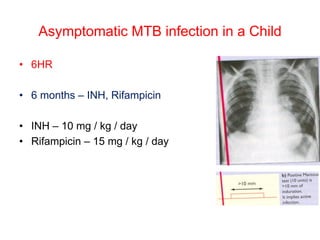
Asymptomatic MTB infection in a Child
• 6HR
• 6 months – INH, Rifampicin
• INH – 10 mg / kg / day
• Rifampicin – 15 mg / kg / day
Primary Tuberculosis in a Child
Pulmonary / Lymph node / Abdominal
• 2HRZ
• 4HR
• Initial 2 months – INH, Rifampicin, Pyrazinamide
• Next 4 months – INH, Rifampicin
• INH – 10 mg / kg / day
• Rifampicin – 15 mg / kg / day
• Pyrazinamide – 30 mg / kg / day
T.B. Meningitis / Miliary Tuberculosis / Bone T.B.
• 2HRZE
• 10HR
• Initial 2 months – INH, Rifampicin, Pyrazinamide, Ethambutal
• Next 10 months – INH, Rifampicin
• INH – 10 mg / kg / day
• Rifampicin – 15 mg / kg / day
• Pyrazinamide – 30 mg / kg / day
• Ethambutal – 20 mg / kg / day
Tuberculosis in Children – Steroid Therapy
 Steroids enhance symptom resolution and reduce fibrosis in
tuberculosis
 Steroids are given for initial 6 weeks with the start of Anti-
tuberculous chemotherapy in children with:
• T.B.M. (Tuberculous Meningitis)
• Miliary Tuberculosis
• Tuberculous Pericardial effusion
• Tuberculous Pleural effusion
PREVENTION of
Tuberculosis in Children
PREVENTION
 Health Promotion of Child –
- Vaccination against common infections
- Breastfeeding, Nutrition, Micronutrients
 Prevention of Transmission –
- Hand washing, Masks and Social Distancing
- Case finding and treatment of active adult TB cases
 Specific Protection –
• BCG vaccination at birth – Efficacy = 50 – 80 %
Prevention in the Newborn baby
whose mother has active Pulmonary Tuberculous
• DO NOT separate mother and baby
• START mother feeds
• Give anti-TB treatment to mother
• Prophylactic INH therapy given to baby for 3 months
• Re – evaluate baby at 3 months
• Give BCG to baby at 3 months
Thank You

Tuberculosis in children 2021

  • 1.
    Tuberculosis in children Epidemiology,Etiology, Clinical Features, Complications, Management and Prevention Prof. Imran Iqbal Fellowship in Pediatric Neurology (Australia) Prof of Paediatrics (2003-2018) Prof of Pediatrics Emeritus, CHICH Prof of Pediatrics, CIMS Multan, Pakistan
  • 2.
    (God speaking toProphet Muhammad (PBUH) Whatsoever is in the heavens and whatsoever is on the earth glorifies Allah, and He is the All-Mighty, the All-Wise Al Quran surah Al-Saff 61:1
  • 3.
    Case Scenario • Afour year old child presents to OPD with cough and fever for the last 30 days • Child is not active as before • Now he eats less than what he used to previously. • Child lives in inner city with his extended family. • His vaccinations are incomplete. • His grandfather is suffering from chronic productive cough.
  • 4.
    Case Scenario (continued) •Child has been to different doctors and received multiple antibiotics. • On physical examination, cervical lymph nodes are palpable on left side. • Chest crepitations are audible on the back in left infra- scapular area • What is your most likely diagnosis ? • What is other diseases need to be excluded ? • How will you manage this child ?
  • 5.
    Diagnosis • Tuberculosis • DifferentialDiagnosis • Unresolved Pneumonia • Whooping Cough • Hypersensitivity Pneumonitis • Foreign body
  • 6.
  • 7.
    Epidemiology • Tuberculosis isendemic in Pakistan • There are 230 new Tuberculosis cases per 100,000 population every year (500,000 in Pakistan) • About 70000 persons die due to tuberculosis in Pakistan every year • Childhood Tuberculosis in children < 15 years of age accounts for 20 % of total cases in Pakistan
  • 8.
    Epidemiology • Children canpresent with TB disease at any age • Tuberculosis infection in children is common below 4 yrs • Adolescents are at increased risk for development of TB • Pulmonary TB is the commonest type of TB in children. • Extra-pulmonary disease is seen in 30-40% of cases
  • 9.
    Etiology • Mycobacterium tuberculosis •Acid-fast bacilli • Stained with ZN stain • Slow-growing organism that divides every 24 hours • Resistant to drying and disinfectants
  • 10.
    Transmission – spreadof infection  Source – Adult Patients with tuberculosis  Transmission – DROPLET infection • Transmission more likely in the presence of : -- close contact -- darkness and lack of ventilation  Host – susceptible children with low immunity
  • 11.
    Immunity in thechild against TB infection • Genetic factors – Asian • Age – Young age < 5 years • Nutritional status – Malnutrition • Immunosuppression – after Measles • BCG vaccination of newborn (intra-dermal at birth)
  • 12.
    Infection with TubercleBacillus • Mycobacterium tuberculosis infection can result in: • Subclinical infection (latent tuberculosis) OR • Clinical disease (active tuberculosis) • depending upon: -- dose of infecting organism -- immunity of child
  • 13.
  • 14.
    Pathogenesis of Tuberculosisin Children • Primary infection by Mycobacterium tuberculosis is called Primary Complex • Primary Complex consists of primary focus of infection and enlarged regional lymph nodes • Primary Complex can form in the: -- tonsils (cervical lymph nodes) -- lungs (hilar lymph nodes) -- abdomen (mesenteric lymph nodes)
  • 16.
    Primary Pulmonary Tuberculosis •Initial pulmonary infection is a local sub-pleural focus • Tubercle bacillus is carried by macrophages through lymphatics to regional lymph nodes • Hilar lymph nodes are enlarged • Local spread of infection can occur in lungs • Lymphatic and blood-borne spread can be to distant organs
  • 17.
    Spread of Mycobacteriumtuberculosis in the body
  • 19.
  • 20.
    Clinical Features ofTuberculosis • Non-specific general symptoms of Tuberculosis • Failure to thrive • Loss of weight • Loss of appetite • Low grade fever • Apathy • Local symptoms and signs • Local symptoms and signs depend upon site of infection
  • 21.
    Primary Pulmonary Tuberculosis •Primary infection may be asymptomatic • Non-specific general symptoms • Pulmonary symptoms and signs - mild cough - persistent crepitations - decreased breath sounds - breathlessness
  • 24.
    Tuberculous pneumonia andPleural Effusion
  • 25.
    Tuberculosis of Lymphnodes • Persistent enlargement of Lymph nodes • Non – tender enlargement • Cold abscess (liquefaction necrosis) • Discharging sinus
  • 26.
  • 27.
  • 28.
  • 29.
    Tuberculous Meningitis • Initialclinical features: • Headache • Vomiting • Late symptoms and signs: • Lethargy / Drowsy / Unconciousness • Convulsions • Neck stiffness / signs of meningeal irritation
  • 30.
  • 31.
    Tuberculous Meningitis –CT Brain Hydrocephalus and Infarctions
  • 32.
    Tuberculous Meningitis andTuberculoma CT Brain (IV contrast)
  • 33.
  • 34.
    Abdominal Tuberculosis • Painabdomen • Diarrhea / Constipation • Abdominal distension – local, generalized • Mesenteric lymphadenopathy • Intestinal obstruction (hyperplastic tuberculosis) • Ascites (exudative tuberculosis)
  • 35.
  • 36.
    Tuberculosis of Joints/ Bones / Spine • Pain • Limp walk • Joint swelling – Mono-articular Arthritis • Discharging sinus on a bone • Gibbus / acute kyphosis of spine (vertebral collapse due to necrosis of intervertebral disc and vertebra) • Paraparesis may result from pressure on nerve roots
  • 37.
    Tuberculosis of VertebralColumn X-ray Spine MRI Spine
  • 38.
    Miliary Tuberculosis • Generalsymptoms of tuberculosis • Hepatosplenomegaly • Choroidal tubercles
  • 39.
  • 40.
    Miliary TB –HRCT Chest
  • 41.
  • 42.
    Diagnosis of Tuberculosisin Children is made by consideration of: • General clinical features • Local symptoms and signs • History of contact with TB patient • Tuberculin test • Suggestive investigations
  • 43.
    Investigations for Tuberculosis •Tuberculin test (Monteux test) • X – ray Chest • Fluid Examination, Cytology, AFB smear, PCR, AFB culture and sensitivity (CSF, Pleural Fluid, Ascitic fluid) • Sputum / Gastric aspirate for AFB smear, PCR and AFB Culture • Biopsy of local tissue / organ for histopathology and AFB culture • PCR for MTB (GeneXpert) performed on CSF / Fluid aspirate (also detects Rifampicin resistance) • Blood IGRA (Interferon Gamma Release Assay) test
  • 44.
    Score Chart forDiagnosis of Childhood Tuberculosis
  • 45.
  • 46.
    Treatment of ChildhoodTuberculosis • Make a confident diagnosis • Prescribe standard anti-TB chemotherapy regime • Ensure drug compliance • Evaluate and treat adult sources / contacts of child patient
  • 47.
    Treatment Regimens • Asymptomaticinfection (Latent Tuberculosis) • Primary pulmonary / lymph node / abdominal tuberculosis in child • T.B. Meningitis / Bone / Miliary tuberculosis
  • 48.
    Asymptomatic MTB infectionin a Child • 6HR • 6 months – INH, Rifampicin • INH – 10 mg / kg / day • Rifampicin – 15 mg / kg / day
  • 49.
    Primary Tuberculosis ina Child Pulmonary / Lymph node / Abdominal • 2HRZ • 4HR • Initial 2 months – INH, Rifampicin, Pyrazinamide • Next 4 months – INH, Rifampicin • INH – 10 mg / kg / day • Rifampicin – 15 mg / kg / day • Pyrazinamide – 30 mg / kg / day
  • 50.
    T.B. Meningitis /Miliary Tuberculosis / Bone T.B. • 2HRZE • 10HR • Initial 2 months – INH, Rifampicin, Pyrazinamide, Ethambutal • Next 10 months – INH, Rifampicin • INH – 10 mg / kg / day • Rifampicin – 15 mg / kg / day • Pyrazinamide – 30 mg / kg / day • Ethambutal – 20 mg / kg / day
  • 51.
    Tuberculosis in Children– Steroid Therapy  Steroids enhance symptom resolution and reduce fibrosis in tuberculosis  Steroids are given for initial 6 weeks with the start of Anti- tuberculous chemotherapy in children with: • T.B.M. (Tuberculous Meningitis) • Miliary Tuberculosis • Tuberculous Pericardial effusion • Tuberculous Pleural effusion
  • 52.
  • 53.
    PREVENTION  Health Promotionof Child – - Vaccination against common infections - Breastfeeding, Nutrition, Micronutrients  Prevention of Transmission – - Hand washing, Masks and Social Distancing - Case finding and treatment of active adult TB cases  Specific Protection – • BCG vaccination at birth – Efficacy = 50 – 80 %
  • 54.
    Prevention in theNewborn baby whose mother has active Pulmonary Tuberculous • DO NOT separate mother and baby • START mother feeds • Give anti-TB treatment to mother • Prophylactic INH therapy given to baby for 3 months • Re – evaluate baby at 3 months • Give BCG to baby at 3 months
  • 55.