Paediatric’s HIV
Koh Kian Chuan
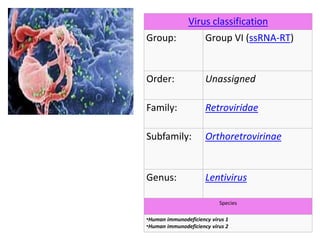
Virus classification
Group: Group VI (ssRNA-RT)
Order: Unassigned
Family: Retroviridae
Subfamily: Orthoretrovirinae
Genus: Lentivirus
Species
•Human immunodeficiency virus 1
•Human immunodeficiency virus 2
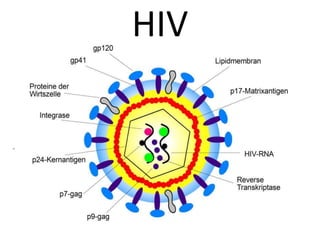
HIV
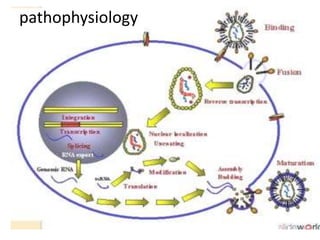
pathophysiology
Introduction
• By the end of 2006, estimated 2.3million children <15 years old
living with HIV with an estimated half a million new infections
occurring in children
• Children < age 12 years old constituted 1.5% of total reported
cases for 2006, those aged 13-19 years 1% and those aged 20-29
years 2.7%
• Vast majority of paediatric HIV infections are acquired vertically
• In developed countries, number of children of HIV positive
mothers newly infected with HIV has dramatically decreased
with a perinatal transmision rate of <1% a result of antiretroviral
(ARV) prophylaxis and the use of highly active antiretroviral
therapy (HAART) for pregnant HIV infected mother
Prevention of mother to child
transmission
• 3 components of treatment or prophylaxis
(antepartum, intrapartum and neonatal)
• Longer courses of ARV prophylaxis
• Therapy beginning earlier in pregnancy
• Combination regimens
Factors associated with higher
transmission rate
• Maternal
– Low CD4 counts
– High viral load
– Advanced disease
– Seroconversion during pregnancy
• Fetal
– Premature delivery
• Delivery and procedures
– Invasive procedures eg episiotomy
– Fetal blood sampling or amniocentesis
– Vaginal delivery
– Rupture of membrane >4 hrs
– chorioamnionitis
Investigation at birth
• FBC
• HbsAg, Hepatitis C, Toxoplasmosis, CMV, VDRL
serology
• LFT, RFT
• HIV DNA PCR
• Feeding
– not to breastfeed
– Against mixed feeding
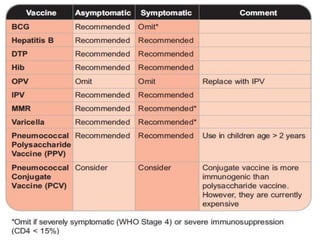
• Immunization
– All infants born to HIV infected mothers should
receive routine childhood immunisation at the
usual recommended age
• BCG
– Administered to HIV infected infants in the first month
of life is associated with low rates of complications
– Complications: lymphadenitis
disseminated infection
IRIS (immune reconstitution
inflammatory syndrome)
– Very little data on effectiveness of BCG in HIV infected
children
• Polio
– OPV (live attenuated vaccine)--Rare complication:
vaccine –associated paralytic poliomyelitis (VAPP)
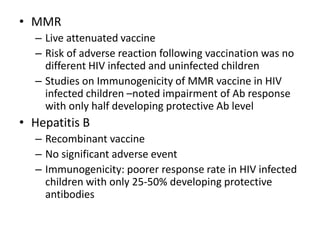
• MMR
– Live attenuated vaccine
– Risk of adverse reaction following vaccination was no
different HIV infected and uninfected children
– Studies on Immunogenicity of MMR vaccine in HIV
infected children –noted impairment of Ab response
with only half developing protective Ab level
• Hepatitis B
– Recombinant vaccine
– No significant adverse event
– Immunogenicity: poorer response rate in HIV infected
children with only 25-50% developing protective
antibodies
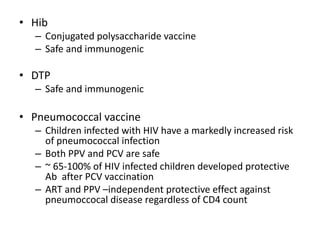
• Hib
– Conjugated polysaccharide vaccine
– Safe and immunogenic
• DTP
– Safe and immunogenic
• Pneumococcal vaccine
– Children infected with HIV have a markedly increased risk
of pneumococcal infection
– Both PPV and PCV are safe
– ~ 65-100% of HIV infected children developed protective
Ab after PCV vaccination
– ART and PPV –independent protective effect against
pneumoccocal disease regardless of CD4 count
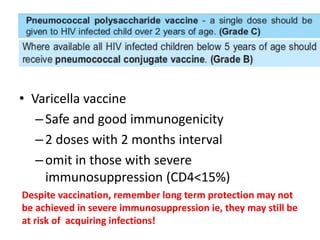
• Varicella vaccine
–Safe and good immunogenicity
–2 doses with 2 months interval
–omit in those with severe
immunosuppression (CD4<15%)
Despite vaccination, remember long term protection may not
be achieved in severe immunosuppression ie, they may still be
at risk of acquiring infections!
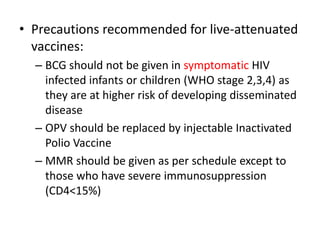
• Precautions recommended for live-attenuated
vaccines:
– BCG should not be given in symptomatic HIV
infected infants or children (WHO stage 2,3,4) as
they are at higher risk of developing disseminated
disease
– OPV should be replaced by injectable Inactivated
Polio Vaccine
– MMR should be given as per schedule except to
those who have severe immunosuppression
(CD4<15%)
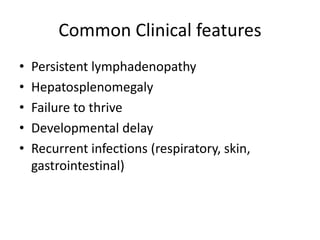
Common Clinical features
• Persistent lymphadenopathy
• Hepatosplenomegaly
• Failure to thrive
• Developmental delay
• Recurrent infections (respiratory, skin,
gastrointestinal)
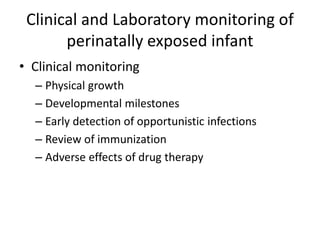
Clinical and Laboratory monitoring of
perinatally exposed infant
• Clinical monitoring
– Physical growth
– Developmental milestones
– Early detection of opportunistic infections
– Review of immunization
– Adverse effects of drug therapy
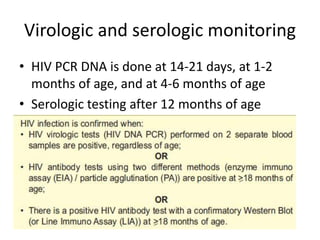
Virologic and serologic monitoring
• HIV PCR DNA is done at 14-21 days, at 1-2
months of age, and at 4-6 months of age
• Serologic testing after 12 months of age
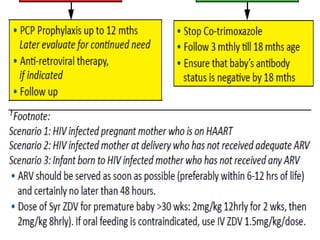
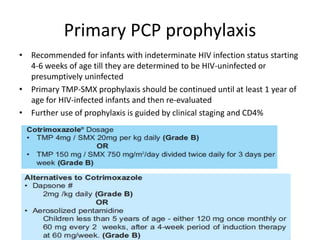
Primary PCP prophylaxis
• Recommended for infants with indeterminate HIV infection status starting
4-6 weeks of age till they are determined to be HIV-uninfected or
presumptively uninfected
• Primary TMP-SMX prophylaxis should be continued until at least 1 year of
age for HIV-infected infants and then re-evaluated
• Further use of prophylaxis is guided by clinical staging and CD4%
Management of HIV infected infants,
children and adolescents
• Monitoring of disease progression
– Clinical
– Immunologic- CD4 count and %
– Virologic – plasma viral load assay
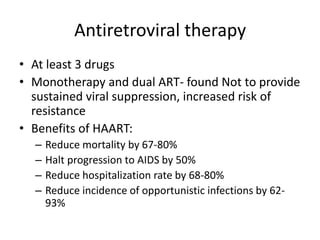
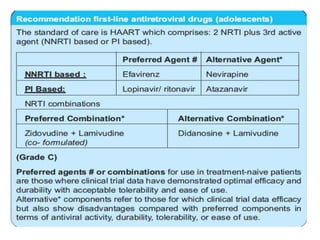
Antiretroviral therapy
• At least 3 drugs
• Monotherapy and dual ART- found Not to provide
sustained viral suppression, increased risk of
resistance
• Benefits of HAART:
– Reduce mortality by 67-80%
– Halt progression to AIDS by 50%
– Reduce hospitalization rate by 68-80%
– Reduce incidence of opportunistic infections by 62-
93%
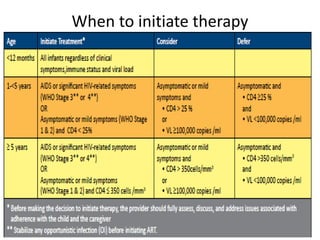
When to initiate therapy
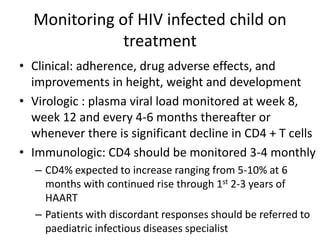
Monitoring of HIV infected child on
treatment
• Clinical: adherence, drug adverse effects, and
improvements in height, weight and development
• Virologic : plasma viral load monitored at week 8,
week 12 and every 4-6 months thereafter or
whenever there is significant decline in CD4 + T cells
• Immunologic: CD4 should be monitored 3-4 monthly
– CD4% expected to increase ranging from 5-10% at 6
months with continued rise through 1st 2-3 years of
HAART
– Patients with discordant responses should be referred to
paediatric infectious diseases specialist
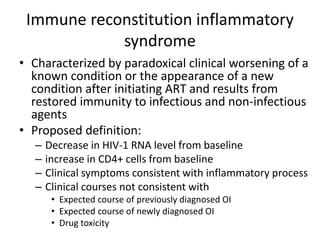
Immune reconstitution inflammatory
syndrome
• Characterized by paradoxical clinical worsening of a
known condition or the appearance of a new
condition after initiating ART and results from
restored immunity to infectious and non-infectious
agents
• Proposed definition:
– Decrease in HIV-1 RNA level from baseline
– increase in CD4+ cells from baseline
– Clinical symptoms consistent with inflammatory process
– Clinical courses not consistent with
• Expected course of previously diagnosed OI
• Expected course of newly diagnosed OI
• Drug toxicity
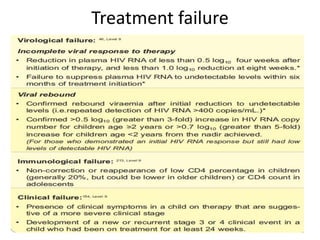
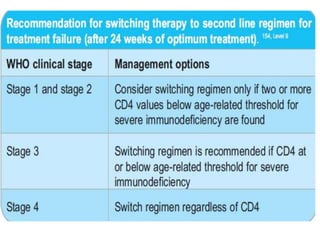
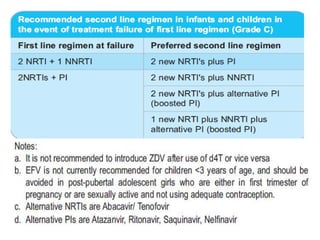
Treatment failure
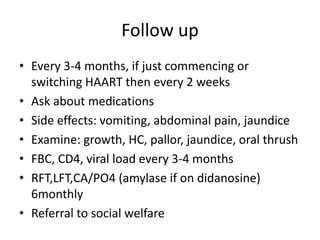
Follow up
• Every 3-4 months, if just commencing or
switching HAART then every 2 weeks
• Ask about medications
• Side effects: vomiting, abdominal pain, jaundice
• Examine: growth, HC, pallor, jaundice, oral thrush
• FBC, CD4, viral load every 3-4 months
• RFT,LFT,CA/PO4 (amylase if on didanosine)
6monthly
• Referral to social welfare
• Thank you

HIV in pediatric

  • 1.
  • 2.
    Virus classification Group: GroupVI (ssRNA-RT) Order: Unassigned Family: Retroviridae Subfamily: Orthoretrovirinae Genus: Lentivirus Species •Human immunodeficiency virus 1 •Human immunodeficiency virus 2
  • 3.
  • 4.
  • 5.
    Introduction • By theend of 2006, estimated 2.3million children <15 years old living with HIV with an estimated half a million new infections occurring in children • Children < age 12 years old constituted 1.5% of total reported cases for 2006, those aged 13-19 years 1% and those aged 20-29 years 2.7% • Vast majority of paediatric HIV infections are acquired vertically • In developed countries, number of children of HIV positive mothers newly infected with HIV has dramatically decreased with a perinatal transmision rate of <1% a result of antiretroviral (ARV) prophylaxis and the use of highly active antiretroviral therapy (HAART) for pregnant HIV infected mother
  • 6.
    Prevention of motherto child transmission • 3 components of treatment or prophylaxis (antepartum, intrapartum and neonatal) • Longer courses of ARV prophylaxis • Therapy beginning earlier in pregnancy • Combination regimens
  • 7.
    Factors associated withhigher transmission rate • Maternal – Low CD4 counts – High viral load – Advanced disease – Seroconversion during pregnancy • Fetal – Premature delivery • Delivery and procedures – Invasive procedures eg episiotomy – Fetal blood sampling or amniocentesis – Vaginal delivery – Rupture of membrane >4 hrs – chorioamnionitis
  • 10.
    Investigation at birth •FBC • HbsAg, Hepatitis C, Toxoplasmosis, CMV, VDRL serology • LFT, RFT • HIV DNA PCR
  • 11.
    • Feeding – notto breastfeed – Against mixed feeding • Immunization – All infants born to HIV infected mothers should receive routine childhood immunisation at the usual recommended age
  • 12.
    • BCG – Administeredto HIV infected infants in the first month of life is associated with low rates of complications – Complications: lymphadenitis disseminated infection IRIS (immune reconstitution inflammatory syndrome) – Very little data on effectiveness of BCG in HIV infected children • Polio – OPV (live attenuated vaccine)--Rare complication: vaccine –associated paralytic poliomyelitis (VAPP)
  • 13.
    • MMR – Liveattenuated vaccine – Risk of adverse reaction following vaccination was no different HIV infected and uninfected children – Studies on Immunogenicity of MMR vaccine in HIV infected children –noted impairment of Ab response with only half developing protective Ab level • Hepatitis B – Recombinant vaccine – No significant adverse event – Immunogenicity: poorer response rate in HIV infected children with only 25-50% developing protective antibodies
  • 14.
    • Hib – Conjugatedpolysaccharide vaccine – Safe and immunogenic • DTP – Safe and immunogenic • Pneumococcal vaccine – Children infected with HIV have a markedly increased risk of pneumococcal infection – Both PPV and PCV are safe – ~ 65-100% of HIV infected children developed protective Ab after PCV vaccination – ART and PPV –independent protective effect against pneumoccocal disease regardless of CD4 count
  • 15.
    • Varicella vaccine –Safeand good immunogenicity –2 doses with 2 months interval –omit in those with severe immunosuppression (CD4<15%) Despite vaccination, remember long term protection may not be achieved in severe immunosuppression ie, they may still be at risk of acquiring infections!
  • 16.
    • Precautions recommendedfor live-attenuated vaccines: – BCG should not be given in symptomatic HIV infected infants or children (WHO stage 2,3,4) as they are at higher risk of developing disseminated disease – OPV should be replaced by injectable Inactivated Polio Vaccine – MMR should be given as per schedule except to those who have severe immunosuppression (CD4<15%)
  • 18.
    Common Clinical features •Persistent lymphadenopathy • Hepatosplenomegaly • Failure to thrive • Developmental delay • Recurrent infections (respiratory, skin, gastrointestinal)
  • 19.
    Clinical and Laboratorymonitoring of perinatally exposed infant • Clinical monitoring – Physical growth – Developmental milestones – Early detection of opportunistic infections – Review of immunization – Adverse effects of drug therapy
  • 20.
    Virologic and serologicmonitoring • HIV PCR DNA is done at 14-21 days, at 1-2 months of age, and at 4-6 months of age • Serologic testing after 12 months of age
  • 22.
    Primary PCP prophylaxis •Recommended for infants with indeterminate HIV infection status starting 4-6 weeks of age till they are determined to be HIV-uninfected or presumptively uninfected • Primary TMP-SMX prophylaxis should be continued until at least 1 year of age for HIV-infected infants and then re-evaluated • Further use of prophylaxis is guided by clinical staging and CD4%
  • 23.
    Management of HIVinfected infants, children and adolescents • Monitoring of disease progression – Clinical – Immunologic- CD4 count and % – Virologic – plasma viral load assay
  • 26.
    Antiretroviral therapy • Atleast 3 drugs • Monotherapy and dual ART- found Not to provide sustained viral suppression, increased risk of resistance • Benefits of HAART: – Reduce mortality by 67-80% – Halt progression to AIDS by 50% – Reduce hospitalization rate by 68-80% – Reduce incidence of opportunistic infections by 62- 93%
  • 27.
  • 30.
    Monitoring of HIVinfected child on treatment • Clinical: adherence, drug adverse effects, and improvements in height, weight and development • Virologic : plasma viral load monitored at week 8, week 12 and every 4-6 months thereafter or whenever there is significant decline in CD4 + T cells • Immunologic: CD4 should be monitored 3-4 monthly – CD4% expected to increase ranging from 5-10% at 6 months with continued rise through 1st 2-3 years of HAART – Patients with discordant responses should be referred to paediatric infectious diseases specialist
  • 31.
    Immune reconstitution inflammatory syndrome •Characterized by paradoxical clinical worsening of a known condition or the appearance of a new condition after initiating ART and results from restored immunity to infectious and non-infectious agents • Proposed definition: – Decrease in HIV-1 RNA level from baseline – increase in CD4+ cells from baseline – Clinical symptoms consistent with inflammatory process – Clinical courses not consistent with • Expected course of previously diagnosed OI • Expected course of newly diagnosed OI • Drug toxicity
  • 32.
  • 35.
    Follow up • Every3-4 months, if just commencing or switching HAART then every 2 weeks • Ask about medications • Side effects: vomiting, abdominal pain, jaundice • Examine: growth, HC, pallor, jaundice, oral thrush • FBC, CD4, viral load every 3-4 months • RFT,LFT,CA/PO4 (amylase if on didanosine) 6monthly • Referral to social welfare
  • 36.

Editor's Notes

  • #4 HIV virion includes envelope (with gp41 and gp120 glycoproteins), matrix (with protei p17) and capsin (with protein p24) Enclosing 2 single stranded copies of RNA + enzymes in its core