By Priyanshi
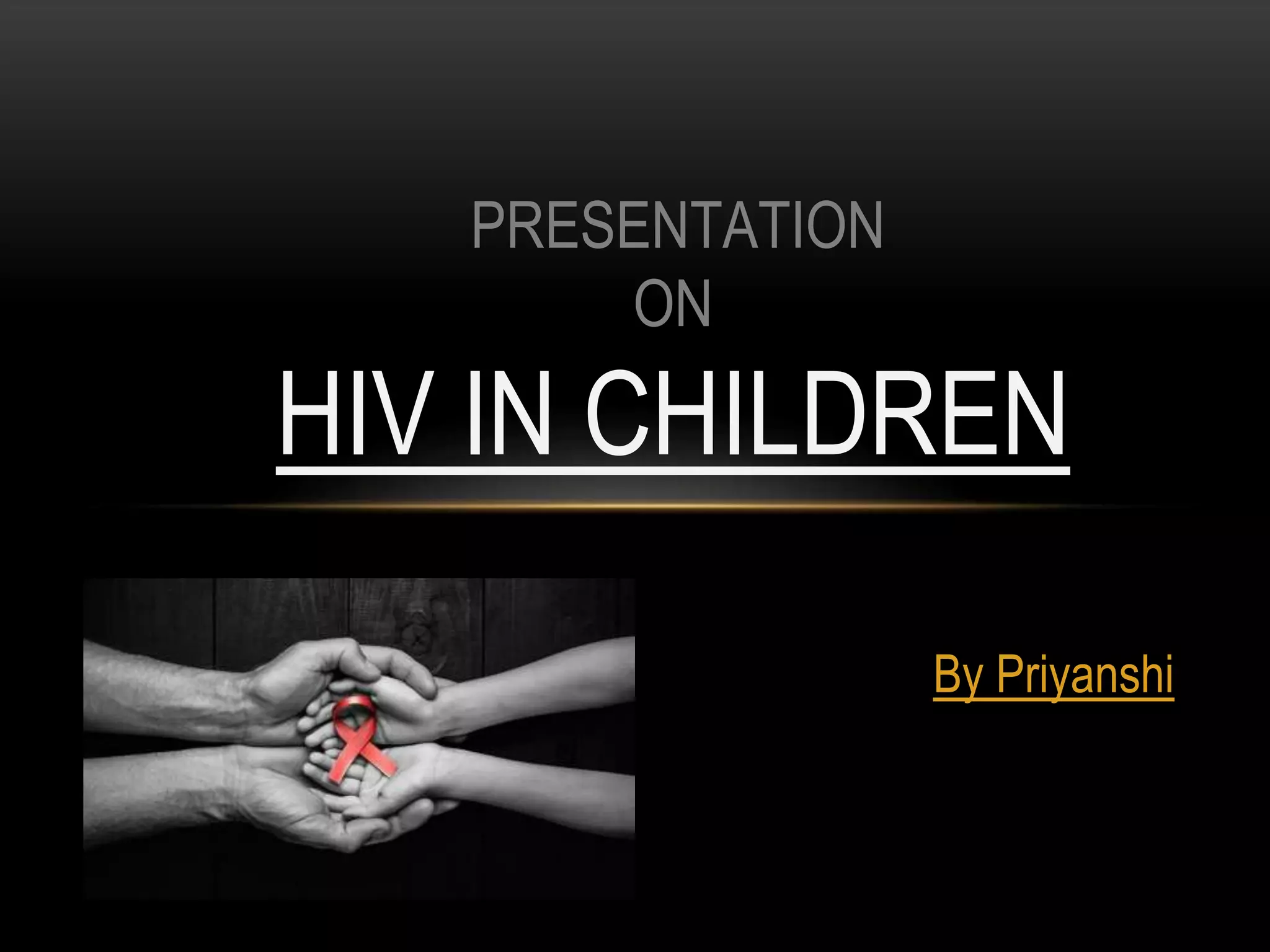
PRESENTATION
ON
HIV IN CHILDREN
• HIV stands for HUMAN
IMMUNODEFICIENCY VIRUS.
• It is a lentivirus belonging to the
family retroviridae — a virus built
of RNA instead of DNA.
• HIV infection is characterized by
profound loss of immune
function associated with
depletion of CD4 helper T –
cells.
INTRODUCTION
DEFINITION
• Human immunodeficiency virus is a virus that attacks the body’s
immune system and makes it hard for the body to fight against
infections.
• If HIV is not treated, it can lead to AIDS (acquired
immunodeficiency syndrome). AIDS is the late stage of HIV
infection that occurs when the body’s immune system is badly
damaged because of the virus.
• The interval from HIV infection to the diagnosis of AIDS ranges
from about 9 months to 20 years or longer.
• HIV contains RNA as its genetic material.
• The outer layer of the HIV cell is covered in coat proteins, which
can bind to certain WBCs. This allows the virus to enter the cell,
where it alters the DNA.
• The virus infects and destroys the CD4 lymphocytes which are
critical to the body’s immune response.
• Once a person gets infected, virus remains in his body lifelong and
the person is a symptomless carrier for years before the
symptoms actually appear.
INCIDENCE
• Globally in 2019, around 150,000 children aged between 0-9 were
newly infected with HIV, bringing the total number of children aged
0-9 living with HIV to 1.1 million. Nearly 90% of these children live
in sub-Saharan Africa.
• India has estimated 145,000 children <15 years of age who are
infected by HIV/AIDS, and about 22,000 new infections occur
every year. Children account for 7% of all the new HIV infections.
More than 90% of the HIV infections in children are the result of
maternal-to-child transmission.
IMPACT OF HIV/AIDS ON INFANT AND
CHILD SURVIVAL
• Between 62%-75% of children with HIV in developing countries
will not survive to their 5th birthday.
• Risk of death for a child with HIV is 45% and 62% by 2nd and 5th
year of life.
• 20% of children with HIV develop serious illnesses within the 1st
year of life.
• Approximately half of the children showing signs and symptoms in
the first year of life die before the age of three.
MODE OF
TRANSMISSION
VERTICAL
(90% cases)
HORIZONTAL
(10-15% cases)
VERTICAL
TRANSMISSION
IN UTERO (30‐35%)
DURING DELIVERY (60‐65%)
BREASTFEEDING (1‐3%)
HORIZONTAL
TRANSMISSION
SEXUAL INTERCOURSE
NEEDLE STICK INJURY
CONTAMINATED BLOOD AND BLOOD PRODUCTS
PATHO-
PHYSIOLOGY
CLINICAL
FEATURES
• Generalized
lymphadenopathy
• Oropharyngeal candidiasis
• Repeated common
infections
• Confirmed maternal HIV
infection
• Weight loss
• Slow growth
• Chronic diarrhea (>1 month)
• Prolonged fever (>1 month)
WHO CLINICAL CASE DEFINITION FOR
PEDIATRIC AIDS
Major signs Minor signs
CLASSIFICATION OF PEDIATRIC HIV
INFECTION ACCORDING TO CDC CLINICAL
CATEGORY
• N ‐ Asymptomatic
• A ‐ Mildly symptomatic
• B ‐ Moderately symptomatic
• C ‐ Severely symptomatic — AIDS defining condition
WHO CLINICAL STAGING OF HIV FOR INFANTS
AND CHILDREN WITH CONFIRMED HIV
INFECTION
Clinical stage 1
• Asymptomatic
• Persistent generalized lymphadenopathy
Clinical stage 2
• Unexplained persistent hepatosplenomegaly
• Papular pruritic eruptions
• Extensive wart virus infection
• Recurrent oral ulcerations
• Unexplained persistent parotid enlargement
• Herpes zoster
• Recurrent or chronic upper respiratory tract infections (otitis
media, sinusitis, tonsillitis)
• Fungal nail infections
Clinical stage 3
• Unexplained moderate malnutrition
• Unexplained persistent diarrhea (14 days or more)
• Unexplained persistent fever (above 37.5°C intermittent or
constant, for longer than 1 month)
• Persistent oral candidiasis (after first 6-8 weeks of life)
• Oral hairy leukoplakia
• Lymph node TB
• Pulmonary TB
• Severe recurrent bacterial pneumonia
• Unexplained anaemia (<8g/dL)
Clinical stage 4
• Unexplained severe wasting or severe malnutrition
• Recurrent severe bacterial infections
• Extra pulmonary TB
• Kaposi sarcoma
• Esophageal candidiasis
• HIV encephalopathy
• Symptomatic HIV associated nephropathy of HIV associated
cardiomyopathy
• Cerebral non-Hodgkin’s lymphoma
PRURITIC PAPULAR
ERUPTION ORAL ULCERATION
HERPES ZOSTER ORAL CANDIDIASIS
ORAL HAIRY LEUKOPLAKIA SEVERE WASTING
LABORATORY INVESTIGATIONS
• The ELISA test, is used to
detect the HIV antibody.
The blood sample will be
added to a cassette that
contains the viral protein,
called antigen.
If the blood contains
antibodies to HIV, it will bind
with the antigen and cause
the cassette’s contents to
change color.
• A Western blot test is used
to confirm a positive HIV
diagnosis.
• The Western blot test
separates the blood proteins
and detects the specific
proteins (called HIV
antibodies) that indicate an
HIV infection.
• PCR test is used to detect
HIV’s genetic material. It can
be used to screen the
donated blood supply and to
detect very early infections
before antibodies have been
developed.
• This test may be performed
just days or weeks after
exposure to HIV therefore
preferred for detecting HIV
infection in child younger
than 18 months.
• Assess the HIV associated
immunosuppression. Less the
CD4 count more the damage
to immune system.
• A normal CD4 count is from
500-1500 cells/mm3. CD4
counts of 750-1499 and <750
for infants, 500-999 and <500
for children 1-5 years of age
and 200-499 and <200 for
children 6-12 years of age are
expressed as moderate and
severe immunosuppression,
respectively for each age
category.
• It helps to assess the
severity of sepsis-related
anemia and other blood
related abnormalities.
• If non breastfeed in past 6-12 weeks
and the result is negative consider
HIV. But if the child is breastfeed
during past 6-12 weeks and result is
negative repeat the test after 6 weeks
of cessation of breastfeeding.
• In case of positive first antibody test
result, perform confirmatory HIV
antibody test.
• Two positive HIV antibody test results
in a clinically symptomatic child
indicate HIV infection in the child.
• Three positive HIV antibody test
results in a clinically asymptomatic
child indicate the child has HIV
infection.
• Quantitative serum
immunoglobulin tests are
used to detect abnormal
levels of the three major
classes (IgG, IgA and IgM).
Testing is used to help
diagnose various conditions
and diseases that affect the
levels of one or more of
these immunoglobulin
classes.
MANAGEMENT
OF
HIV INFECTED CHILD
A. CARE OF HIV EXPOSED CHILD
• Immediate care: Mouth and nostrils to wipe immediately ; early
baby bathing ; early cord clamping ; initiate feeding within 1st hour
of birth.
• Immunization and vitamin A supplements as per national
immunization schedule.
• Prophylaxis therapy: NVP single dose to mother during labour and
baby within 72 hours of birth ; Cotrimoxazole from age of 4-6
weeks.
• Follow – up.
• Counselling and psychological support.
B. ANTIRETROVIRAL THERAPY
According to NACO guidelines antiretroviral therapy, ART should be
initiated after eligibility screening with CD4 count or percentage and
clinical condition.
When To Start ART In Children, Guided By CD4
• <12 month infants: irrespective of CD4 count, ART to be given
• 12-35 months: if CD4 <750 cells/mm3 (<20%)
• 36-59 months: if CD4 <350 cells/mm3 (15%)
• 5 years old: start ART if <350 cells/mm3 especially if symptomatic.
Initiate ART before CD4 drops below 200 cells/mm3.
C. ART DRUGS
• Three main group of drugs used in HIV treatment are :-
1. Nucleoside Reverse Transcriptase Inhibitors (NRTI)
2. Non-Nucleoside Reverse Transcriptase Inhibitors (NNRTI)
3. Protease Inhibitors (PI)
• Highly active antiretroviral therapy is a combination of 2 NRTIs
with a PI or NNRTI.
• Recommended first line of treatment of HIV infected children is
combination of Zidovudine (AZT), Lamivudine (3TC) and
Nevirapine (NVP) with alternative choice of a combination of
Stavudine (d4T) Lamivudine (3TC) and Nevirapine (NVP).
D. TREATMENT OF OPPORTUNISTIC INFECTIONS
• Assess nutritional status and growth/development.
• Continue exclusive breastfeeding until 6 months old if replacement
feeding is not done.
• Nutritional counseling regarding nutritional deficiencies.
• Ensure vitamin A supplementation.
• Counselling of mothers who are breastfeeding and of
caregivers/children about food and water hygiene.
• Counsel on selection of specific high energy foods for children
with conditions that interfere with normal digestion or ingestion.
E. NUTRITION
F. PALLIATIVE CARE
• Prevention of opportunistic infections.
• Relief of symptoms and the management of pain.
• Establishing a mutual trusting relationship between the child and
family with the clinical team.
• Family needs to be given support and be taught appropriate skills
on home care of children.
VACCINE SELECTION IN HIV INFECTED CHILD
• Routine pediatric immunization must be given to HIV infected
infants and children with some modifications.
• MMR and varicella vaccines are recommended for HIV infected
children who are not severely immunocompromised.
• OPV should be avoided because there is an alternative injectable
inactivated polio vaccine available.
• Yellow fever vaccine should be avoided unless the risk of
exposure is extremely high.
• BCG vaccine should be omitted with symptomatic HIV.
• Hepatitis B vaccine can be administered.
PREVENTION
1. PREVENTION OF VERTICAL TRANSMISSION
Mother To Child Transmission
• It can be reduced to 50% by administering a regimen of
zidovudine to mother and also to newborn.
• In mother zidovudine is given 100mg, 5 times a day orally from
fourth week of gestation till delivery. And at the time of delivery
2 mg/kg IV zidovudine is given in the first hour of labour followed
by 1 mg/kg/hr till delivery.
• In newborn zidovudine is given 2 mg/kg every 6 hourly till 6 weeks
of life.
2. PREVENTION OF HORIZONTAL TRANSMISSION
• Universal precautions must be taken while caring for the newborn
or child.
• If blood or blood products needs to be administered to children,
they must be first screened for HIV and must not be taken from
stringent donors.
• Sterile and disposable needles and syringes must be used while
taking blood samples or for administration of medications.
• Post exposure prophylaxis must be given.
NURSING MANAGEMENT
• Review maternal records to identify infant who may be at risk of
HIV disease.
• Review records of at risk of known infected children to determine
nutritional status, growth and development, presence or risk of
opportunistic infection, laboratory values and immunization status.
• Asses physical symptoms like oral candidiasis and dental caries.
• Asses child’s coping response to frequent painful and invasive
procedures as part of ongoing management of disease.
• Use aseptic technique during invasive procedures.
• Monitor immunization status and advice families, the need of
complete immunization recommended in childhood.
• Educate family about importance of hygiene and food preparation.
• Educate family about risk factor of HIV and its management.
• Maintain hand hygiene before and after all care contacts and also
instruct the relatives to wash hands.
• Discuss extent and rationale for isolation and precautions as well
as maintenance of personal hygiene of baby/child.
NURSING DIAGNOSIS
• Risk for infections related to immunodeficiency rate.
• Altered nutrition related to anorexia, pain in abdomen.
• Diarrhoea and dehydration related to enteric pathogens and
infections.
• Altered pain related to advanced HIV diseases.
• Fear and anxiety related to diagnostic and treatment procedures.
• Knowledge deficit regarding transmission of HIV infection.
HIV in children

HIV in children

  • 1.
  • 2.
    • HIV standsfor HUMAN IMMUNODEFICIENCY VIRUS. • It is a lentivirus belonging to the family retroviridae — a virus built of RNA instead of DNA. • HIV infection is characterized by profound loss of immune function associated with depletion of CD4 helper T – cells. INTRODUCTION
  • 3.
    DEFINITION • Human immunodeficiencyvirus is a virus that attacks the body’s immune system and makes it hard for the body to fight against infections. • If HIV is not treated, it can lead to AIDS (acquired immunodeficiency syndrome). AIDS is the late stage of HIV infection that occurs when the body’s immune system is badly damaged because of the virus. • The interval from HIV infection to the diagnosis of AIDS ranges from about 9 months to 20 years or longer.
  • 5.
    • HIV containsRNA as its genetic material. • The outer layer of the HIV cell is covered in coat proteins, which can bind to certain WBCs. This allows the virus to enter the cell, where it alters the DNA. • The virus infects and destroys the CD4 lymphocytes which are critical to the body’s immune response. • Once a person gets infected, virus remains in his body lifelong and the person is a symptomless carrier for years before the symptoms actually appear.
  • 6.
    INCIDENCE • Globally in2019, around 150,000 children aged between 0-9 were newly infected with HIV, bringing the total number of children aged 0-9 living with HIV to 1.1 million. Nearly 90% of these children live in sub-Saharan Africa. • India has estimated 145,000 children <15 years of age who are infected by HIV/AIDS, and about 22,000 new infections occur every year. Children account for 7% of all the new HIV infections. More than 90% of the HIV infections in children are the result of maternal-to-child transmission.
  • 7.
    IMPACT OF HIV/AIDSON INFANT AND CHILD SURVIVAL • Between 62%-75% of children with HIV in developing countries will not survive to their 5th birthday. • Risk of death for a child with HIV is 45% and 62% by 2nd and 5th year of life. • 20% of children with HIV develop serious illnesses within the 1st year of life. • Approximately half of the children showing signs and symptoms in the first year of life die before the age of three.
  • 8.
  • 9.
  • 10.
  • 11.
  • 12.
  • 13.
  • 14.
  • 15.
  • 16.
    CONTAMINATED BLOOD ANDBLOOD PRODUCTS
  • 17.
  • 18.
  • 19.
    • Generalized lymphadenopathy • Oropharyngealcandidiasis • Repeated common infections • Confirmed maternal HIV infection • Weight loss • Slow growth • Chronic diarrhea (>1 month) • Prolonged fever (>1 month) WHO CLINICAL CASE DEFINITION FOR PEDIATRIC AIDS Major signs Minor signs
  • 20.
    CLASSIFICATION OF PEDIATRICHIV INFECTION ACCORDING TO CDC CLINICAL CATEGORY • N ‐ Asymptomatic • A ‐ Mildly symptomatic • B ‐ Moderately symptomatic • C ‐ Severely symptomatic — AIDS defining condition
  • 21.
    WHO CLINICAL STAGINGOF HIV FOR INFANTS AND CHILDREN WITH CONFIRMED HIV INFECTION Clinical stage 1 • Asymptomatic • Persistent generalized lymphadenopathy Clinical stage 2 • Unexplained persistent hepatosplenomegaly • Papular pruritic eruptions • Extensive wart virus infection
  • 22.
    • Recurrent oralulcerations • Unexplained persistent parotid enlargement • Herpes zoster • Recurrent or chronic upper respiratory tract infections (otitis media, sinusitis, tonsillitis) • Fungal nail infections Clinical stage 3 • Unexplained moderate malnutrition • Unexplained persistent diarrhea (14 days or more) • Unexplained persistent fever (above 37.5°C intermittent or constant, for longer than 1 month)
  • 23.
    • Persistent oralcandidiasis (after first 6-8 weeks of life) • Oral hairy leukoplakia • Lymph node TB • Pulmonary TB • Severe recurrent bacterial pneumonia • Unexplained anaemia (<8g/dL) Clinical stage 4 • Unexplained severe wasting or severe malnutrition • Recurrent severe bacterial infections • Extra pulmonary TB
  • 24.
    • Kaposi sarcoma •Esophageal candidiasis • HIV encephalopathy • Symptomatic HIV associated nephropathy of HIV associated cardiomyopathy • Cerebral non-Hodgkin’s lymphoma
  • 25.
  • 26.
    HERPES ZOSTER ORALCANDIDIASIS
  • 27.
    ORAL HAIRY LEUKOPLAKIASEVERE WASTING
  • 28.
  • 30.
    • The ELISAtest, is used to detect the HIV antibody. The blood sample will be added to a cassette that contains the viral protein, called antigen. If the blood contains antibodies to HIV, it will bind with the antigen and cause the cassette’s contents to change color.
  • 32.
    • A Westernblot test is used to confirm a positive HIV diagnosis. • The Western blot test separates the blood proteins and detects the specific proteins (called HIV antibodies) that indicate an HIV infection.
  • 34.
    • PCR testis used to detect HIV’s genetic material. It can be used to screen the donated blood supply and to detect very early infections before antibodies have been developed. • This test may be performed just days or weeks after exposure to HIV therefore preferred for detecting HIV infection in child younger than 18 months.
  • 36.
    • Assess theHIV associated immunosuppression. Less the CD4 count more the damage to immune system. • A normal CD4 count is from 500-1500 cells/mm3. CD4 counts of 750-1499 and <750 for infants, 500-999 and <500 for children 1-5 years of age and 200-499 and <200 for children 6-12 years of age are expressed as moderate and severe immunosuppression, respectively for each age category.
  • 38.
    • It helpsto assess the severity of sepsis-related anemia and other blood related abnormalities.
  • 40.
    • If nonbreastfeed in past 6-12 weeks and the result is negative consider HIV. But if the child is breastfeed during past 6-12 weeks and result is negative repeat the test after 6 weeks of cessation of breastfeeding. • In case of positive first antibody test result, perform confirmatory HIV antibody test. • Two positive HIV antibody test results in a clinically symptomatic child indicate HIV infection in the child. • Three positive HIV antibody test results in a clinically asymptomatic child indicate the child has HIV infection.
  • 42.
    • Quantitative serum immunoglobulintests are used to detect abnormal levels of the three major classes (IgG, IgA and IgM). Testing is used to help diagnose various conditions and diseases that affect the levels of one or more of these immunoglobulin classes.
  • 43.
  • 44.
    A. CARE OFHIV EXPOSED CHILD • Immediate care: Mouth and nostrils to wipe immediately ; early baby bathing ; early cord clamping ; initiate feeding within 1st hour of birth. • Immunization and vitamin A supplements as per national immunization schedule. • Prophylaxis therapy: NVP single dose to mother during labour and baby within 72 hours of birth ; Cotrimoxazole from age of 4-6 weeks. • Follow – up. • Counselling and psychological support.
  • 45.
    B. ANTIRETROVIRAL THERAPY Accordingto NACO guidelines antiretroviral therapy, ART should be initiated after eligibility screening with CD4 count or percentage and clinical condition. When To Start ART In Children, Guided By CD4 • <12 month infants: irrespective of CD4 count, ART to be given • 12-35 months: if CD4 <750 cells/mm3 (<20%) • 36-59 months: if CD4 <350 cells/mm3 (15%) • 5 years old: start ART if <350 cells/mm3 especially if symptomatic. Initiate ART before CD4 drops below 200 cells/mm3.
  • 46.
    C. ART DRUGS •Three main group of drugs used in HIV treatment are :- 1. Nucleoside Reverse Transcriptase Inhibitors (NRTI) 2. Non-Nucleoside Reverse Transcriptase Inhibitors (NNRTI) 3. Protease Inhibitors (PI) • Highly active antiretroviral therapy is a combination of 2 NRTIs with a PI or NNRTI. • Recommended first line of treatment of HIV infected children is combination of Zidovudine (AZT), Lamivudine (3TC) and Nevirapine (NVP) with alternative choice of a combination of Stavudine (d4T) Lamivudine (3TC) and Nevirapine (NVP).
  • 47.
    D. TREATMENT OFOPPORTUNISTIC INFECTIONS • Assess nutritional status and growth/development. • Continue exclusive breastfeeding until 6 months old if replacement feeding is not done. • Nutritional counseling regarding nutritional deficiencies. • Ensure vitamin A supplementation. • Counselling of mothers who are breastfeeding and of caregivers/children about food and water hygiene. • Counsel on selection of specific high energy foods for children with conditions that interfere with normal digestion or ingestion. E. NUTRITION
  • 48.
    F. PALLIATIVE CARE •Prevention of opportunistic infections. • Relief of symptoms and the management of pain. • Establishing a mutual trusting relationship between the child and family with the clinical team. • Family needs to be given support and be taught appropriate skills on home care of children.
  • 49.
    VACCINE SELECTION INHIV INFECTED CHILD • Routine pediatric immunization must be given to HIV infected infants and children with some modifications. • MMR and varicella vaccines are recommended for HIV infected children who are not severely immunocompromised. • OPV should be avoided because there is an alternative injectable inactivated polio vaccine available. • Yellow fever vaccine should be avoided unless the risk of exposure is extremely high. • BCG vaccine should be omitted with symptomatic HIV. • Hepatitis B vaccine can be administered.
  • 50.
  • 51.
    1. PREVENTION OFVERTICAL TRANSMISSION Mother To Child Transmission • It can be reduced to 50% by administering a regimen of zidovudine to mother and also to newborn. • In mother zidovudine is given 100mg, 5 times a day orally from fourth week of gestation till delivery. And at the time of delivery 2 mg/kg IV zidovudine is given in the first hour of labour followed by 1 mg/kg/hr till delivery. • In newborn zidovudine is given 2 mg/kg every 6 hourly till 6 weeks of life.
  • 52.
    2. PREVENTION OFHORIZONTAL TRANSMISSION • Universal precautions must be taken while caring for the newborn or child. • If blood or blood products needs to be administered to children, they must be first screened for HIV and must not be taken from stringent donors. • Sterile and disposable needles and syringes must be used while taking blood samples or for administration of medications. • Post exposure prophylaxis must be given.
  • 53.
    NURSING MANAGEMENT • Reviewmaternal records to identify infant who may be at risk of HIV disease. • Review records of at risk of known infected children to determine nutritional status, growth and development, presence or risk of opportunistic infection, laboratory values and immunization status. • Asses physical symptoms like oral candidiasis and dental caries. • Asses child’s coping response to frequent painful and invasive procedures as part of ongoing management of disease.
  • 54.
    • Use aseptictechnique during invasive procedures. • Monitor immunization status and advice families, the need of complete immunization recommended in childhood. • Educate family about importance of hygiene and food preparation. • Educate family about risk factor of HIV and its management. • Maintain hand hygiene before and after all care contacts and also instruct the relatives to wash hands. • Discuss extent and rationale for isolation and precautions as well as maintenance of personal hygiene of baby/child.
  • 55.
    NURSING DIAGNOSIS • Riskfor infections related to immunodeficiency rate. • Altered nutrition related to anorexia, pain in abdomen. • Diarrhoea and dehydration related to enteric pathogens and infections. • Altered pain related to advanced HIV diseases. • Fear and anxiety related to diagnostic and treatment procedures. • Knowledge deficit regarding transmission of HIV infection.