Sub topic       : Packet Forwarding in WAN
Teaching aids   : Diagrams


                                             1
Recap

In the previous topic, you have learnt about


      • Wide Area Network (WAN) Architecture

      • WAN features

      • Applications


                                               2
Objectives

 On the completion of this topic, you would be
 able to understand about

 • Definition of packet forwarding (or packet switching)

 • WAN addressing

 • WAN routing


                                                           3
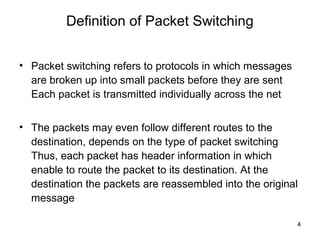
Definition of Packet Switching


• Packet switching refers to protocols in which messages
  are broken up into small packets before they are sent
  Each packet is transmitted individually across the net


• The packets may even follow different routes to the
  destination, depends on the type of packet switching
  Thus, each packet has header information in which
  enable to route the packet to its destination. At the
  destination the packets are reassembled into the original
  message

                                                           4
There are two basic types of Packet Switching
networks.


1. Virtual Circuit Packet Switching Networks


2. Datagram Packet Switching Networks


                                                5
Virtual Circuit Packet Switching Networks
                      (VCP)

• An initial setup phase is used to set up a route between the
 intermediate nodes for all the packets passed during the
 session between the two end nodes


• In each intermediate node, an entry is registered in a table
 to indicate the route for the connection that has been set up


                                                                 6
VCPS networks           cont….

• The packets passed through this route, have short
  headers, containing only a virtual circuit identifier (VCI)

• Each intermediate node passes the packets according to
  the information that was stored in its table, in the setup
  phase and according to the packets header content

• In this way, packets arrive at the destination in the correct
  sequence

• The most common forms of Virtual Circuit networks are
  ATM and Frame Relay, which are commonly used for
  public data networks (PDN)

                                                                  7
Datagram Packet Switching Networks
            (DPS Network)

• This approach uses a different, more dynamic scheme, to
  determine the route through the network links

• Each packet is treated as an independent entity, and its
  header contains full information about the destination of the
  packet

• The intermediate nodes examine the header of the packet,
  and decide the next hop of this packet


                                                             8
DPS Networks cont…..
• The shortest way to pass the packet to its destination -

  protocols such as RIP/OSPF is used to determine the
  shortest path to the destination

• Finding a free node to pass the packet to - in this way,
  bottle necks are eliminated, since packets can reach
  the destination in alternate routes. Thus, in this
  method, the packets don't follow a pre-established
  route, and the intermediate nodes (the routers) don't
  have pre-defined knowledge of the routes that the
 packets should be passed through                            9
DPS Networks          contd..

• Packets can follow different routes to the destination

• Due to the nature of this method, the packets can reach the
  destination in a different order than they were sent, thus
  they must be sorted at the destination to form the original
  message

• This approach is time consuming since every router has to
  decide where to send each packet

• The main implementation of Datagram Switching network is
  the Internet which uses the IP network protocol

                                                              10
Packet Switching Transfers Packets Across a Carrier Network


                         Fig .1

                                                      11
Packet Switch

• The basic component of a WAN is a packet switch
  because it moves packets from one connection to another


• It consists of special-purpose hardware with a processor,
   memory, and I/O connectors


• A packet switch is illustrated in Figure 1


                                                          12
Packet Switch


  Fig .2


                13
Packet Switch

• High-speed I/O devices connect one switch to another

• Lower speed devices connect the switch to an
  individual computer

• The actual hardware depends on the WAN technology
  and the speed required, and most forms of point-to-point
  communication are used

• An interconnected set of packet switches forms the
  WAN

• A small WAN is illustrated in Figure 3
                                                         14
Small WAN


  Fig .3
            15
WAN Addressing

• A WAN operates in the same way as a LAN


• Each WAN technology defines the frame format to be
 used and each computer connected to a switch is
 allocated a physical address


                                                       16
WAN addressing         contd….

• Many WANs use hierarchical addressing which
  simplifies forwarding


• The simplest scheme divides an address into two parts,
  one identifying the packet switch and the other the
  computer connected to that switch


• This is illustrated in Figure 4


                                                           17
Hierarchical Addresses


      Fig .4

                         18
Hierarchical Addresses                contd….

• In practice, a physical address is represented as a single
  binary number, with some bits representing the switch and
  the other bits the computer

• A packet switch uses the destination address to decide how
  to forward the packet, i.e. which connection to use

• It does not keep complete information about all destinations,
  but has information about the next hop to send the packet
  nearer its destination

• This is called next-hop forwarding, and is illustrated in
  Figure 5
                                                               19
A Small WAN Network


       Fig .5


                      20
A Small WAN Network                 contd…

• In fig (a), we have a small network of three packet switches


• In fig (b), we have the next-hop forwarding table for switch 2


• Note that next-hop forwarding does not depend on the
  packet's original source or on the path the packet has taken
  before arriving at the switch


• This is known as source independence and is fundamental to
  packet forwarding


                                                               21
Routing
• The table containing the next-hop information is called a
  routing table and the process of forwarding a packet is
  known as routing

• When forwarding a packet, the packet switch only needs to
  examine the first part of the hierarchical address

• This means the routing table can be shortened to contain
  one entry per destination switch rather than one entry per
  destination computer

• This is illustrated in Figure 6

                                                              22
Routing Table


   Fig .6


                23
Routing Table          contd….


• This is an abbreviated version of the routing table, made
  possible by hierarchical addressing


• When forwarding to a local computer, the switch uses the
  second part of the address to select the specific
  computer

                                                              24
Summary

In this class, you have learnt about


   • Definition of packet forwarding or packet switching


   • WAN addressing


   • WAN routing


                                                           25
Quiz

    1.   The difference between Packet Switching and
     Circuit Switching is

     a) There is no difference

.    b) In Circuit Switching the lines are dedicated to the
        connection while in Packet Switching they are not

     c) Packet Switching is ideal for audio or video


                                                              26
Quiz
 2. How do switches route arriving packets?


A) The switches route the packets to the default router

B) According to the IP address in the packet header

C) The switch will send the packet on the interface with the
   least load

D) On the basis of information contained in each packet header


                                                               27
Frequently Asked Questions


1.   Define packet switching

2.   Explain the types of packet switching

3.   Explain WAN addressing

4.   Explain routing


                                             28

Packet forwarding in wan.46

  • 1.
    Sub topic : Packet Forwarding in WAN Teaching aids : Diagrams 1
  • 2.
    Recap In the previoustopic, you have learnt about • Wide Area Network (WAN) Architecture • WAN features • Applications 2
  • 3.
    Objectives On thecompletion of this topic, you would be able to understand about • Definition of packet forwarding (or packet switching) • WAN addressing • WAN routing 3
  • 4.
    Definition of PacketSwitching • Packet switching refers to protocols in which messages are broken up into small packets before they are sent Each packet is transmitted individually across the net • The packets may even follow different routes to the destination, depends on the type of packet switching Thus, each packet has header information in which enable to route the packet to its destination. At the destination the packets are reassembled into the original message 4
  • 5.
    There are twobasic types of Packet Switching networks. 1. Virtual Circuit Packet Switching Networks 2. Datagram Packet Switching Networks 5
  • 6.
    Virtual Circuit PacketSwitching Networks (VCP) • An initial setup phase is used to set up a route between the intermediate nodes for all the packets passed during the session between the two end nodes • In each intermediate node, an entry is registered in a table to indicate the route for the connection that has been set up 6
  • 7.
    VCPS networks cont…. • The packets passed through this route, have short headers, containing only a virtual circuit identifier (VCI) • Each intermediate node passes the packets according to the information that was stored in its table, in the setup phase and according to the packets header content • In this way, packets arrive at the destination in the correct sequence • The most common forms of Virtual Circuit networks are ATM and Frame Relay, which are commonly used for public data networks (PDN) 7
  • 8.
    Datagram Packet SwitchingNetworks (DPS Network) • This approach uses a different, more dynamic scheme, to determine the route through the network links • Each packet is treated as an independent entity, and its header contains full information about the destination of the packet • The intermediate nodes examine the header of the packet, and decide the next hop of this packet 8
  • 9.
    DPS Networks cont….. •The shortest way to pass the packet to its destination - protocols such as RIP/OSPF is used to determine the shortest path to the destination • Finding a free node to pass the packet to - in this way, bottle necks are eliminated, since packets can reach the destination in alternate routes. Thus, in this method, the packets don't follow a pre-established route, and the intermediate nodes (the routers) don't have pre-defined knowledge of the routes that the packets should be passed through 9
  • 10.
    DPS Networks contd.. • Packets can follow different routes to the destination • Due to the nature of this method, the packets can reach the destination in a different order than they were sent, thus they must be sorted at the destination to form the original message • This approach is time consuming since every router has to decide where to send each packet • The main implementation of Datagram Switching network is the Internet which uses the IP network protocol 10
  • 11.
    Packet Switching TransfersPackets Across a Carrier Network Fig .1 11
  • 12.
    Packet Switch • Thebasic component of a WAN is a packet switch because it moves packets from one connection to another • It consists of special-purpose hardware with a processor, memory, and I/O connectors • A packet switch is illustrated in Figure 1 12
  • 13.
    Packet Switch Fig .2 13
  • 14.
    Packet Switch • High-speedI/O devices connect one switch to another • Lower speed devices connect the switch to an individual computer • The actual hardware depends on the WAN technology and the speed required, and most forms of point-to-point communication are used • An interconnected set of packet switches forms the WAN • A small WAN is illustrated in Figure 3 14
  • 15.
    Small WAN Fig .3 15
  • 16.
    WAN Addressing • AWAN operates in the same way as a LAN • Each WAN technology defines the frame format to be used and each computer connected to a switch is allocated a physical address 16
  • 17.
    WAN addressing contd…. • Many WANs use hierarchical addressing which simplifies forwarding • The simplest scheme divides an address into two parts, one identifying the packet switch and the other the computer connected to that switch • This is illustrated in Figure 4 17
  • 18.
  • 19.
    Hierarchical Addresses contd…. • In practice, a physical address is represented as a single binary number, with some bits representing the switch and the other bits the computer • A packet switch uses the destination address to decide how to forward the packet, i.e. which connection to use • It does not keep complete information about all destinations, but has information about the next hop to send the packet nearer its destination • This is called next-hop forwarding, and is illustrated in Figure 5 19
  • 20.
    A Small WANNetwork Fig .5 20
  • 21.
    A Small WANNetwork contd… • In fig (a), we have a small network of three packet switches • In fig (b), we have the next-hop forwarding table for switch 2 • Note that next-hop forwarding does not depend on the packet's original source or on the path the packet has taken before arriving at the switch • This is known as source independence and is fundamental to packet forwarding 21
  • 22.
    Routing • The tablecontaining the next-hop information is called a routing table and the process of forwarding a packet is known as routing • When forwarding a packet, the packet switch only needs to examine the first part of the hierarchical address • This means the routing table can be shortened to contain one entry per destination switch rather than one entry per destination computer • This is illustrated in Figure 6 22
  • 23.
    Routing Table Fig .6 23
  • 24.
    Routing Table contd…. • This is an abbreviated version of the routing table, made possible by hierarchical addressing • When forwarding to a local computer, the switch uses the second part of the address to select the specific computer 24
  • 25.
    Summary In this class,you have learnt about • Definition of packet forwarding or packet switching • WAN addressing • WAN routing 25
  • 26.
    Quiz 1. The difference between Packet Switching and Circuit Switching is a) There is no difference . b) In Circuit Switching the lines are dedicated to the connection while in Packet Switching they are not c) Packet Switching is ideal for audio or video 26
  • 27.
    Quiz 2. Howdo switches route arriving packets? A) The switches route the packets to the default router B) According to the IP address in the packet header C) The switch will send the packet on the interface with the least load D) On the basis of information contained in each packet header 27
  • 28.
    Frequently Asked Questions 1. Define packet switching 2. Explain the types of packet switching 3. Explain WAN addressing 4. Explain routing 28