© Oxford University Press 2007. All rights reserved. 1
Mobile Ad-hoc and Sensor Networks
Lesson 05
Mobile Ad-hoc Network (MANET)
Routing Algorithms─ Part 2
© Oxford University Press 2007. All rights reserved. 2
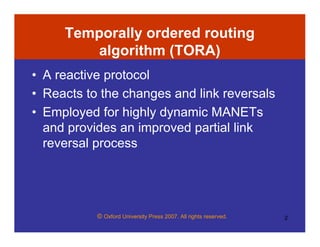
Temporally ordered routing
algorithm (TORA)
• A reactive protocol
• Reacts to the changes and link reversals
• Employed for highly dynamic MANETs
and provides an improved partial link
reversal process
© Oxford University Press 2007. All rights reserved. 3
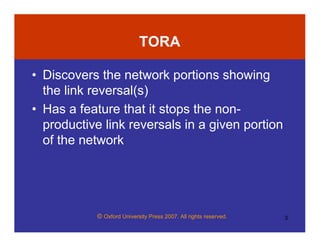
TORA
• Discovers the network portions showing
the link reversal(s)
• Has a feature that it stops the non-
productive link reversals in a given portion
of the network
© Oxford University Press 2007. All rights reserved. 4
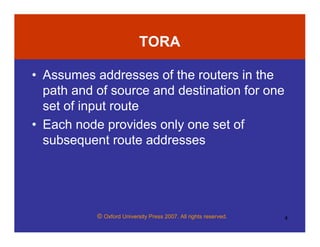
TORA
• Assumes addresses of the routers in the
path and of source and destination for one
set of input route
• Each node provides only one set of
subsequent route addresses
© Oxford University Press 2007. All rights reserved. 5
TORA
• Possesses network capacity such that
many nodes can send packets to a given
destination
• Guarantees loop-free routes and supports
multicasting (from one source to multiple
destinations)
© Oxford University Press 2007. All rights reserved. 6
TORA
• Unlike AODV, but similar to DSR, TORA
supports unidirectional links and also
provides multiple routing paths
• It does not exchange hello messages
periodically to listen to disconnected links
as done by AODV
© Oxford University Press 2007. All rights reserved. 7
TORA
• Phases 1, 2, and 3 in TORA are route
creation, route maintenance, and
productive (useful) link reversal(s) (vector
discarding)
© Oxford University Press 2007. All rights reserved. 8
Cluster-head gateway switch routing
(CGSR)
• A hierarchical routing protocol
• proactive protocol
• When a source routes the packets to
destination, the routing tables are already
available at the nodes
• A cluster higher in hierarchy sends the
packets to the cluster lower in hierarchy
• Each cluster can have several daughters
and forms a tree-like structure in CGSR
© Oxford University Press 2007. All rights reserved. 9
CGSR
• Forms a cluster structure
• The nodes aggregate into clusters using
an appropriate algorithm
• The different clusters can be assigned to
different band of frequencies in FDMA or
different spreading CDMA codes
© Oxford University Press 2007. All rights reserved. 10
CGSR algorithm
• Defines a cluster-head, the node used for
connection to other clusters
• Also defines a gateway node which
provides switching (communication)
between two or more cluster-heads
© Oxford University Press 2007. All rights reserved. 11
Three types of nodes in CGSR
1. Internal nodes in a cluster which transmit
and receive the messages and packets
through a cluster-head
© Oxford University Press 2007. All rights reserved. 12
Three types of nodes in CGSR
2. Cluster-head in each cluster such that
there is a cluster-head which dynamically
schedules the route paths. It controls a
group of ad-hoc hosts, monitors
broadcasting within the cluster, and
forwards the messages to another
cluster-head
© Oxford University Press 2007. All rights reserved. 13
Three types of nodes in CGSR
3. Gateway node to carry out transmission
and reception of messages and packets
between cluster-heads of two clusters
© Oxford University Press 2007. All rights reserved. 14
Cluster structure
• A higher performance of the routing
protocol as compared to other protocols
because it provides gateway switch-type
traffic redirections and clusters provide an
effective membership of nodes for
connectivity
© Oxford University Press 2007. All rights reserved. 15
Phases 1, 2, and 3 of CGSR
• Routing path discovery and caching,
maintaining update, and distribution,
respectively
• The basic processes of CGSR are cluster
definitions and selection of clusters for
routing
• Algorithms are used for both the
processes
© Oxford University Press 2007. All rights reserved. 16
Flat Routing Table Driven Protocol
• Routing cache table used earlier was a
routing table which builds by caching the
RERP and RERR packets
• Flat routing table driven protocol is a
proactive protocol
• This means that routing table will be
available in advance at a node
© Oxford University Press 2007. All rights reserved. 17
Flat Routing Table Driven Protocol
• In the proactive protocol, the routing table
is available at each node shows available
routes from itself to target destination
node, is dynamically modified to show
available routes, and has rows for all
destined targets irrespective of whether
they will eventually be needed or not
© Oxford University Press 2007. All rights reserved. 18
Flat Routing Table Driven Protocol
• The packet does not specify route in the
header and the routes need not be
discovered after the demand is raised
© Oxford University Press 2007. All rights reserved. 19
Optimized Link State Routing
Protocol (OLSR)
• Characteristics similar to those of link state
flat routing table driven protocol, but in this
case, only required updates are sent to the
routing database
• Reduces the overhead control packet size
and numbers
• Further, there are multi-point nodes for
relay of data
© Oxford University Press 2007. All rights reserved. 20
Optimized Link State Routing
Protocol (OLSR)
• A node selects independently a multi-point
node which also relays the route tables
• The node provides bi-directional links such
that the routes provided by the multi-point
relay routing neighbouring node is also
taken into account
© Oxford University Press 2007. All rights reserved. 21
Summary
• TORA─ A reactive protocol, Reacts to
the changes and link reversals,
Employed for highly dynamic MANETs
and provides an improved partial link
reversal process
…
© Oxford University Press 2007. All rights reserved. 22
…Summary
• CGSR ─A hierarchical routing protocol,
proactive protocol, When a source routes
the packets to destination, the routing
tables are already available at the nodes
…
© Oxford University Press 2007. All rights reserved. 23
…Summary
• Flat Routing table based protocol
• Optimized Link State Reversal
© Oxford University Press 2007. All rights reserved. 24
End of Lesson 05
Mobile Ad-hoc Network (MANET) Routing
Algorithms─ Part 2

Mobile Ad-hoc Network (MANET) Routing Algorithms─ Part 2

  • 1.
    © Oxford UniversityPress 2007. All rights reserved. 1 Mobile Ad-hoc and Sensor Networks Lesson 05 Mobile Ad-hoc Network (MANET) Routing Algorithms─ Part 2
  • 2.
    © Oxford UniversityPress 2007. All rights reserved. 2 Temporally ordered routing algorithm (TORA) • A reactive protocol • Reacts to the changes and link reversals • Employed for highly dynamic MANETs and provides an improved partial link reversal process
  • 3.
    © Oxford UniversityPress 2007. All rights reserved. 3 TORA • Discovers the network portions showing the link reversal(s) • Has a feature that it stops the non- productive link reversals in a given portion of the network
  • 4.
    © Oxford UniversityPress 2007. All rights reserved. 4 TORA • Assumes addresses of the routers in the path and of source and destination for one set of input route • Each node provides only one set of subsequent route addresses
  • 5.
    © Oxford UniversityPress 2007. All rights reserved. 5 TORA • Possesses network capacity such that many nodes can send packets to a given destination • Guarantees loop-free routes and supports multicasting (from one source to multiple destinations)
  • 6.
    © Oxford UniversityPress 2007. All rights reserved. 6 TORA • Unlike AODV, but similar to DSR, TORA supports unidirectional links and also provides multiple routing paths • It does not exchange hello messages periodically to listen to disconnected links as done by AODV
  • 7.
    © Oxford UniversityPress 2007. All rights reserved. 7 TORA • Phases 1, 2, and 3 in TORA are route creation, route maintenance, and productive (useful) link reversal(s) (vector discarding)
  • 8.
    © Oxford UniversityPress 2007. All rights reserved. 8 Cluster-head gateway switch routing (CGSR) • A hierarchical routing protocol • proactive protocol • When a source routes the packets to destination, the routing tables are already available at the nodes • A cluster higher in hierarchy sends the packets to the cluster lower in hierarchy • Each cluster can have several daughters and forms a tree-like structure in CGSR
  • 9.
    © Oxford UniversityPress 2007. All rights reserved. 9 CGSR • Forms a cluster structure • The nodes aggregate into clusters using an appropriate algorithm • The different clusters can be assigned to different band of frequencies in FDMA or different spreading CDMA codes
  • 10.
    © Oxford UniversityPress 2007. All rights reserved. 10 CGSR algorithm • Defines a cluster-head, the node used for connection to other clusters • Also defines a gateway node which provides switching (communication) between two or more cluster-heads
  • 11.
    © Oxford UniversityPress 2007. All rights reserved. 11 Three types of nodes in CGSR 1. Internal nodes in a cluster which transmit and receive the messages and packets through a cluster-head
  • 12.
    © Oxford UniversityPress 2007. All rights reserved. 12 Three types of nodes in CGSR 2. Cluster-head in each cluster such that there is a cluster-head which dynamically schedules the route paths. It controls a group of ad-hoc hosts, monitors broadcasting within the cluster, and forwards the messages to another cluster-head
  • 13.
    © Oxford UniversityPress 2007. All rights reserved. 13 Three types of nodes in CGSR 3. Gateway node to carry out transmission and reception of messages and packets between cluster-heads of two clusters
  • 14.
    © Oxford UniversityPress 2007. All rights reserved. 14 Cluster structure • A higher performance of the routing protocol as compared to other protocols because it provides gateway switch-type traffic redirections and clusters provide an effective membership of nodes for connectivity
  • 15.
    © Oxford UniversityPress 2007. All rights reserved. 15 Phases 1, 2, and 3 of CGSR • Routing path discovery and caching, maintaining update, and distribution, respectively • The basic processes of CGSR are cluster definitions and selection of clusters for routing • Algorithms are used for both the processes
  • 16.
    © Oxford UniversityPress 2007. All rights reserved. 16 Flat Routing Table Driven Protocol • Routing cache table used earlier was a routing table which builds by caching the RERP and RERR packets • Flat routing table driven protocol is a proactive protocol • This means that routing table will be available in advance at a node
  • 17.
    © Oxford UniversityPress 2007. All rights reserved. 17 Flat Routing Table Driven Protocol • In the proactive protocol, the routing table is available at each node shows available routes from itself to target destination node, is dynamically modified to show available routes, and has rows for all destined targets irrespective of whether they will eventually be needed or not
  • 18.
    © Oxford UniversityPress 2007. All rights reserved. 18 Flat Routing Table Driven Protocol • The packet does not specify route in the header and the routes need not be discovered after the demand is raised
  • 19.
    © Oxford UniversityPress 2007. All rights reserved. 19 Optimized Link State Routing Protocol (OLSR) • Characteristics similar to those of link state flat routing table driven protocol, but in this case, only required updates are sent to the routing database • Reduces the overhead control packet size and numbers • Further, there are multi-point nodes for relay of data
  • 20.
    © Oxford UniversityPress 2007. All rights reserved. 20 Optimized Link State Routing Protocol (OLSR) • A node selects independently a multi-point node which also relays the route tables • The node provides bi-directional links such that the routes provided by the multi-point relay routing neighbouring node is also taken into account
  • 21.
    © Oxford UniversityPress 2007. All rights reserved. 21 Summary • TORA─ A reactive protocol, Reacts to the changes and link reversals, Employed for highly dynamic MANETs and provides an improved partial link reversal process …
  • 22.
    © Oxford UniversityPress 2007. All rights reserved. 22 …Summary • CGSR ─A hierarchical routing protocol, proactive protocol, When a source routes the packets to destination, the routing tables are already available at the nodes …
  • 23.
    © Oxford UniversityPress 2007. All rights reserved. 23 …Summary • Flat Routing table based protocol • Optimized Link State Reversal
  • 24.
    © Oxford UniversityPress 2007. All rights reserved. 24 End of Lesson 05 Mobile Ad-hoc Network (MANET) Routing Algorithms─ Part 2