Downloaded 340 times



![NODE STRUCTURE
Class Node
{
public:
char value;
bool end;
Node *children[26];
}
The Character Value (A – Z) / (a – z).
Indicates Whether This Node Completes A Word
Represents The 26 Letters In The Alphabet](https://image.slidesharecdn.com/trietree2014-140816121627-phpapp01/85/Trie-Data-Structure-10-320.jpg)


![INSERTION ALGORITHM
Insert: Apple
Second Convert All Of The String’s Character To Uppercase Or To Lowercase.
char currentChar = tolower(word.at(i));
Here, Suppose string s = “Apple” And Length Of String Is 5 So……….
s[0] = A, s[1] = p, s[2] = p, s[3] = l, s[4] = e](https://image.slidesharecdn.com/trietree2014-140816121627-phpapp01/85/Trie-Data-Structure-17-320.jpg)
![INSERTION ALGORITHM
Insert: Apple
Second Convert All Of The String’s Character To Uppercase Or To Lowercase.
char currentChar = tolower(word.at(i));
A p p l e
0 1 2 3 4
Here, Suppose string s = “Apple” And Length Of String Is 5 So……….
s[0] = A, s[1] = p, s[2] = p, s[3] = l, s[4] = e](https://image.slidesharecdn.com/trietree2014-140816121627-phpapp01/85/Trie-Data-Structure-18-320.jpg)


![INSERTION ALGORITHM
Insert: Apple
if (currentNode->children[0] != NULL)
{
currentNode = currentNode->children[0];
}
false
0 …
1
0
…
2
0
…
2
6
NULL
If 0 Pointing To The NULL?
Check If The Current Node Has The Current Character As One Of Its
Descendants](https://image.slidesharecdn.com/trietree2014-140816121627-phpapp01/85/Trie-Data-Structure-24-320.jpg)
![INSERTION ALGORITHM
Insert: Apple
if (currentNode->children[0] != NULL)
{
currentNode = currentNode->children[0];
}
Is 0 Pointing To The NULL?
YES!
So IF Statement Won’t Execute…………
And The Current Node Doesn't have the current
character as one of its descendants
Here 0 Is The Index Value ( a – ‘a’ )
Check If The Current Node Has The Current Character As One Of Its
Descendants
false
0 …
1
0
…
2
0
…
2
6
NULL](https://image.slidesharecdn.com/trietree2014-140816121627-phpapp01/85/Trie-Data-Structure-25-320.jpg)
![INSERTION ALGORITHM
Insert: Apple
else
{
Node *newNode = new Node(currentChar);
currentNode->children[0] = newNode;
currentNode = newNode;
}
So………. Node Constructor](https://image.slidesharecdn.com/trietree2014-140816121627-phpapp01/85/Trie-Data-Structure-26-320.jpg)
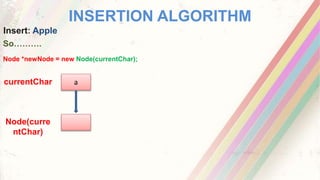


![INSERTION ALGORITHM
Insert: Apple
currentNode->children[0] = newNode;
So……….
anewNode RootcurrentNode
0](https://image.slidesharecdn.com/trietree2014-140816121627-phpapp01/85/Trie-Data-Structure-30-320.jpg)
![INSERTION ALGORITHM
Insert: Apple
currentNode->children[0] = newNode;
So……….
a
newNode Root
0
currentNode](https://image.slidesharecdn.com/trietree2014-140816121627-phpapp01/85/Trie-Data-Structure-31-320.jpg)


![INSERTION ALGORITHM
Insert: Apple
if (currentNode->children[15] != NULL)
{
currentNode = currentNode->children[15];
}
a
false
1
5
…
1
0
…
2
0
…
2
6
NULL
If 15 Pointing To The NULL?
Check If The Current Node Has The Current Character As One Of Its
Descendants](https://image.slidesharecdn.com/trietree2014-140816121627-phpapp01/85/Trie-Data-Structure-38-320.jpg)
![INSERTION ALGORITHM
Insert: Apple
if (currentNode->children[15] != NULL)
{
currentNode = currentNode->children[15];
}
Check If The Current Node Has The Current Character As One Of Its
Descendants
a
false
1
5
…
1
0
…
2
0
…
2
6
Is 15 Pointing To The NULL?
YES!
So IF Statement Won’t Execute…………
And The Current Node Doesn't have the current
character as one of its descendants
Here 15 Is The Index Value ( p – ‘a’ )
NULL](https://image.slidesharecdn.com/trietree2014-140816121627-phpapp01/85/Trie-Data-Structure-39-320.jpg)
![INSERTION ALGORITHM
Insert: Apple
else
{
Node *newNode = new Node(currentChar);
currentNode->children[15] = newNode;
currentNode = newNode;
}
So………. Node Constructor](https://image.slidesharecdn.com/trietree2014-140816121627-phpapp01/85/Trie-Data-Structure-40-320.jpg)


![INSERTION ALGORITHM
Insert: Apple
currentNode->children[15] = newNode;
So……….
pnewNode acurrentNode
1
5](https://image.slidesharecdn.com/trietree2014-140816121627-phpapp01/85/Trie-Data-Structure-44-320.jpg)
![INSERTION ALGORITHM
Insert: Apple
currentNode->children[15] = newNode;
So……….
p
newNode a
1
5
currentNode](https://image.slidesharecdn.com/trietree2014-140816121627-phpapp01/85/Trie-Data-Structure-45-320.jpg)


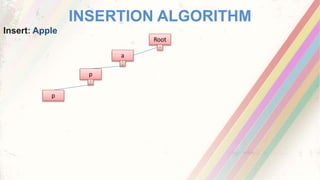


![INSERTION ALGORITHM
Insert: Army
if (currentNode->children[0] != NULL)
{
currentNode = currentNode->children[0];
}
false
0 …
1
0
…
2
0
…
2
6
NULL
If 0 Pointing To The NULL?
Check If The Current Node Has The Current Character As One Of Its
Descendants](https://image.slidesharecdn.com/trietree2014-140816121627-phpapp01/85/Trie-Data-Structure-62-320.jpg)
![INSERTION ALGORITHM
Insert: Army
if (currentNode->children[0] != NULL)
{
currentNode = currentNode->children[0];
}
Is 0 Pointing To The NULL?
NO!
So IF Statement Will Execute…………
Here 0 Is The Index Value ( a – ‘a’ )
Check If The Current Node Has The Current Character As One Of Its
Descendants
false
0 …
1
0
…
2
0
…
2
6
NULL](https://image.slidesharecdn.com/trietree2014-140816121627-phpapp01/85/Trie-Data-Structure-63-320.jpg)
![INSERTION ALGORITHM
Insert: Army
currentNode = currentNode->children[0];
So……….](https://image.slidesharecdn.com/trietree2014-140816121627-phpapp01/85/Trie-Data-Structure-64-320.jpg)


![INSERTION ALGORITHM
Insert: Army
if (currentNode->children[17] != NULL)
{
currentNode = currentNode->children[17];
}
a
false
1
7
…
1
0
…
2
0
…
2
6
NULL
If 15 Pointing To The NULL?
Check If The Current Node Has The Current Character As One Of Its
Descendants](https://image.slidesharecdn.com/trietree2014-140816121627-phpapp01/85/Trie-Data-Structure-69-320.jpg)
![INSERTION ALGORITHM
Insert: Army
if (currentNode->children[17] != NULL)
{
currentNode = currentNode->children[17];
}
Check If The Current Node Has The Current Character As One Of Its
Descendants
a
false
1
7
…
1
0
…
2
0
…
2
6
Is 17 Pointing To The NULL?
YES!
So IF Statement Won’t Execute…………
And The Current Node Doesn't have the current
character as one of its descendants
Here 17 Is The Index Value ( r – ‘a’ )
NULL](https://image.slidesharecdn.com/trietree2014-140816121627-phpapp01/85/Trie-Data-Structure-70-320.jpg)
![INSERTION ALGORITHM
Insert: Army
else
{
Node *newNode = new Node(currentChar);
currentNode->children[17] = newNode;
currentNode = newNode;
}
So………. Node Constructor](https://image.slidesharecdn.com/trietree2014-140816121627-phpapp01/85/Trie-Data-Structure-71-320.jpg)


![INSERTION ALGORITHM
Insert: Army
currentNode->children[17] = newNode;
So……….](https://image.slidesharecdn.com/trietree2014-140816121627-phpapp01/85/Trie-Data-Structure-75-320.jpg)


![DELETION ALGORITHM
Delete: Army
if (currentNode->children[0] != NULL)
{
currentNode = currentNode->children[0];
}
false
0 …
1
0
…
2
0
…
2
6
NULL
If 0 Pointing To The NULL?
Check If The Current Node Has The Current Character As One Of Its
Descendants](https://image.slidesharecdn.com/trietree2014-140816121627-phpapp01/85/Trie-Data-Structure-90-320.jpg)
![DELETION ALGORITHM
Delete: Army
if (currentNode->children[0] != NULL)
{
currentNode = currentNode->children[0];
}
Is 0 Pointing To The NULL?
NO!
So IF Statement Will Execute…………
Here 0 Is The Index Value ( a – ‘a’ )
Check If The Current Node Has The Current Character As One Of Its
Descendants
false
0 …
1
0
…
2
0
…
2
6
NULL](https://image.slidesharecdn.com/trietree2014-140816121627-phpapp01/85/Trie-Data-Structure-91-320.jpg)
![DELETION ALGORITHM
Delete: Army
currentNode = currentNode->children[0];
So……….](https://image.slidesharecdn.com/trietree2014-140816121627-phpapp01/85/Trie-Data-Structure-92-320.jpg)


![DELETION ALGORITHM
Delete: Army
if (currentNode->children[17] != NULL)
{
currentNode = currentNode->children[17];
}
a
false
1
7
…
1
0
…
2
0
…
2
6
NULL
If 15 Pointing To The NULL?
Check If The Current Node Has The Current Character As One Of Its
Descendants](https://image.slidesharecdn.com/trietree2014-140816121627-phpapp01/85/Trie-Data-Structure-96-320.jpg)
![DELETION ALGORITHM
Delete: Army
if (currentNode->children[17] != NULL)
{
currentNode = currentNode->children[17];
}
Check If The Current Node Has The Current Character As One Of Its
Descendants
a
false
1
7
…
1
0
…
2
0
…
2
6
Is 17 Pointing To The NULL?
NO!
So IF Statement Will Execute…………
Here 17 Is The Index Value ( r – ‘a’ )
NULL](https://image.slidesharecdn.com/trietree2014-140816121627-phpapp01/85/Trie-Data-Structure-97-320.jpg)


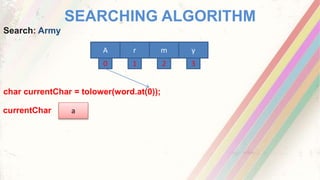


![SEARCHING ALGORITHM
Search: Army
if (currentNode->children[0] != NULL)
{
currentNode = currentNode->children[0];
}
false
0 …
1
0
…
2
0
…
2
6
NULL
If 0 Pointing To The NULL?
Check If The Current Node Has The Current Character As One Of Its
Descendants](https://image.slidesharecdn.com/trietree2014-140816121627-phpapp01/85/Trie-Data-Structure-109-320.jpg)
![SEARCHING ALGORITHM
Search: Army
if (currentNode->children[0] != NULL)
{
currentNode = currentNode->children[0];
}
Is 0 Pointing To The NULL?
NO!
So IF Statement Will Execute…………
Here 0 Is The Index Value ( a – ‘a’ )
Check If The Current Node Has The Current Character As One Of Its
Descendants
false
0 …
1
0
…
2
0
…
2
6
NULL](https://image.slidesharecdn.com/trietree2014-140816121627-phpapp01/85/Trie-Data-Structure-110-320.jpg)
![SEARCHING ALGORITHM
Search: Army
currentNode = currentNode->children[0];
So……….](https://image.slidesharecdn.com/trietree2014-140816121627-phpapp01/85/Trie-Data-Structure-111-320.jpg)


![SEARCHING ALGORITHM
Search: Army
if (currentNode->children[17] != NULL)
{
currentNode = currentNode->children[17];
}
a
false
1
7
…
1
0
…
2
0
…
2
6
NULL
If 15 Pointing To The NULL?
Check If The Current Node Has The Current Character As One Of Its
Descendants](https://image.slidesharecdn.com/trietree2014-140816121627-phpapp01/85/Trie-Data-Structure-115-320.jpg)
![SEARCHING ALGORITHM
Search: Army
if (currentNode->children[17] != NULL)
{
currentNode = currentNode->children[17];
}
Check If The Current Node Has The Current Character As One Of Its
Descendants
a
false
1
7
…
1
0
…
2
0
…
2
6
Is 17 Pointing To The NULL?
NO!
So IF Statement Will Execute…………
Here 17 Is The Index Value ( r – ‘a’ )
NULL](https://image.slidesharecdn.com/trietree2014-140816121627-phpapp01/85/Trie-Data-Structure-116-320.jpg)



![PRINTING ALGORITHM
Trie::alphabetize(Node * node, string prefix = "")
{
if (node->end)
cout << prefix << endl;
for (int i = 0; i < 26; ++i)
{
if (node->children[i] != NULL)
{
string currentString = prefix + node->children[i]->value;
alphabetize(node->children[i], currentString);
}
}
}](https://image.slidesharecdn.com/trietree2014-140816121627-phpapp01/85/Trie-Data-Structure-125-320.jpg)


![PRINTING ALGORITHM
Trie::alphabetize(Node * node, string prefix = "")
{
if (node->end)
cout << prefix << endl;
for (int i = 0; i < 26; ++i)
{
if (node->children[i] != NULL)
{
string currentString = prefix + node->children[i]->value;
alphabetize(node->children[i], currentString);
}
}
}](https://image.slidesharecdn.com/trietree2014-140816121627-phpapp01/85/Trie-Data-Structure-128-320.jpg)
![PRINTING ALGORITHM
Root
0
a
1
5
p
1
5
p
1
1
l
4
e
bool end will be True
1
7
r
1
2
m
1
5
y
if (node->children[0] != NULL) (2)](https://image.slidesharecdn.com/trietree2014-140816121627-phpapp01/85/Trie-Data-Structure-129-320.jpg)
![PRINTING ALGORITHM
Printing Result
CASE RESULT
CASE 1 FALSE
CASE 2 TRUE
string currentString = prefix + node->children[0]->value;
string currentString = “” +a;
string currentString = a;
alphabetize(node->children[0], currentString);](https://image.slidesharecdn.com/trietree2014-140816121627-phpapp01/85/Trie-Data-Structure-130-320.jpg)
![PRINTING ALGORITHM
Trie::alphabetize(Node * node, string prefix = "")
{
if (node->end)
cout << prefix << endl;
for (int i = 0; i < 26; ++i)
{
if (node->children[i] != NULL)
{
string currentString = prefix + node->children[i]->value;
alphabetize(node->children[i], currentString);
}
}
}](https://image.slidesharecdn.com/trietree2014-140816121627-phpapp01/85/Trie-Data-Structure-131-320.jpg)
![PRINTING ALGORITHM
Root
0
a
1
5
p
1
5
p
1
1
l
4
e
bool end will be True
1
7
r
1
2
m
1
5
y
if (node->children[1] != NULL) (3)](https://image.slidesharecdn.com/trietree2014-140816121627-phpapp01/85/Trie-Data-Structure-132-320.jpg)

![PRINTING ALGORITHM
Trie::alphabetize(Node * node, string prefix = "")
{
if (node->end)
cout << prefix << endl;
for (int i = 0; i < 26; ++i)
{
if (node->children[i] != NULL)
{
string currentString = prefix + node->children[i]->value;
alphabetize(node->children[i], currentString);
}
}
}](https://image.slidesharecdn.com/trietree2014-140816121627-phpapp01/85/Trie-Data-Structure-134-320.jpg)
![PRINTING ALGORITHM
Root
0
a
1
5
p
1
5
p
1
1
l
4
e
bool end will be True
1
7
r
1
2
m
1
5
y
if (node->children[2] != NULL) (4)](https://image.slidesharecdn.com/trietree2014-140816121627-phpapp01/85/Trie-Data-Structure-135-320.jpg)

![PRINTING ALGORITHM
Trie::alphabetize(Node * node, string prefix = "")
{
if (node->end)
cout << prefix << endl;
for (int i = 0; i < 26; ++i)
{
if (node->children[i] != NULL)
{
string currentString = prefix + node->children[i]->value;
alphabetize(node->children[i], currentString);
}
}
}](https://image.slidesharecdn.com/trietree2014-140816121627-phpapp01/85/Trie-Data-Structure-137-320.jpg)
![PRINTING ALGORITHM
Root
0
a
1
5
p
1
5
p
1
1
l
4
e
bool end will be True
1
7
r
1
2
m
1
5
y
if (node->children[15] != NULL)
(17)](https://image.slidesharecdn.com/trietree2014-140816121627-phpapp01/85/Trie-Data-Structure-138-320.jpg)
![PRINTING ALGORITHM
Printing Result
CASE RESULT
CASE 17 TRUE
string currentString = prefix + node->children[15]->value;
string currentString = a + p;
string currentString = ap;
alphabetize(node->children[15], currentString);](https://image.slidesharecdn.com/trietree2014-140816121627-phpapp01/85/Trie-Data-Structure-139-320.jpg)
![PRINTING ALGORITHM
Trie::alphabetize(Node * node, string prefix = "")
{
if (node->end)
cout << prefix << endl;
for (int i = 0; i < 26; ++i)
{
if (node->children[i] != NULL)
{
string currentString = prefix + node->children[i]->value;
alphabetize(node->children[i], currentString);
}
}
}](https://image.slidesharecdn.com/trietree2014-140816121627-phpapp01/85/Trie-Data-Structure-140-320.jpg)
![PRINTING ALGORITHM
Root
0
a
1
5
p
1
5
p
1
1
l
4
e
bool end will be True
1
7
r
1
2
m
1
5
y
if (node->children[15] != NULL)
(18)](https://image.slidesharecdn.com/trietree2014-140816121627-phpapp01/85/Trie-Data-Structure-141-320.jpg)
![PRINTING ALGORITHM
Printing Result
CASE RESULT
CASE 18 TRUE
string currentString = prefix + node->children[15]->value;
string currentString = ap + p;
string currentString = app;
alphabetize(node->children[15], currentString);](https://image.slidesharecdn.com/trietree2014-140816121627-phpapp01/85/Trie-Data-Structure-142-320.jpg)

![PRINTING ALGORITHM
Trie::alphabetize(Node * node, string prefix = "")
{
if (node->end)
cout << prefix << endl;
for (int i = 0; i < 26; ++i)
{
if (node->children[i] != NULL)
{
string currentString = prefix + node->children[i]->value;
alphabetize(node->children[i], currentString);
}
}
}](https://image.slidesharecdn.com/trietree2014-140816121627-phpapp01/85/Trie-Data-Structure-144-320.jpg)
![PRINTING ALGORITHM
Root
0
a
1
5
p
1
5
p
1
1
l
4
e
bool end will be True
1
7
r
1
2
m
1
5
y
if (node->children[4] != NULL)
(19)](https://image.slidesharecdn.com/trietree2014-140816121627-phpapp01/85/Trie-Data-Structure-145-320.jpg)
![PRINTING ALGORITHM
Trie::alphabetize(Node * node, string prefix = "")
{
if (node->end)
cout << prefix << endl;
for (int i = 0; i < 26; ++i)
{
if (node->children[i] != NULL)
{
string currentString = prefix + node->children[i]->value;
alphabetize(node->children[i], currentString);
}
}
}](https://image.slidesharecdn.com/trietree2014-140816121627-phpapp01/85/Trie-Data-Structure-146-320.jpg)
![PRINTING ALGORITHM
Printing Result
CASE RESULT
CASE 19 TRUE
string currentString = prefix + node->children[15]->value;
string currentString = appl + e;
string currentString = apple;
alphabetize(node->children[4], currentString);](https://image.slidesharecdn.com/trietree2014-140816121627-phpapp01/85/Trie-Data-Structure-147-320.jpg)


![SOURCE CODETrie.h
#ifndef TRIE_H
#define TRIE_H
#include <iostream>
#include <vector>
#include <string>
#include <assert.h>
#include <new>
using namespace std;
class Node
{
public:
char value;
bool end;
Node *children[26];
Node(char value);
};
class Trie
{
public:
Trie();
void addWord(string word);
bool searchForWord(string word);
void deleteWord(string word);
Node *getRoot();
void alphabetize(Node *, string);
private:
Node *root;
};
#endif // TRIE_H](https://image.slidesharecdn.com/trietree2014-140816121627-phpapp01/85/Trie-Data-Structure-151-320.jpg)
![SOURCE CODETrie.c
#ifndef TRIE_CPP
#define TRIE_CPP
#include <iostream>
#include "trie.h"
using namespace std;
Node::Node(char value)
{
this->value = value;
end = false;
for(int i = 0; i < 26; ++i)
{
children[i] = NULL;
}
}
Trie::Trie()
{
root = new Node(' ');
root->end = true;
}
Node *Trie::getRoot()
{
return root;
}](https://image.slidesharecdn.com/trietree2014-140816121627-phpapp01/85/Trie-Data-Structure-152-320.jpg)
![SOURCE CODETrie.c
void Trie::addWord(string word)
{
Node * currentNode = root;
for (int i = 0; i < (int)word.size(); ++i)
{
char currentChar = tolower(word.at(i));
int index = currentChar - 'a';
assert(index >= 0); // Makes sure the character is between a-z
if (currentNode->children[index] != NULL)
{
// check if the current node has the current character as one of its
decendants
currentNode = currentNode->children[index];
}
else
{
// the current node doesn't have the current character as one of its
decendants
Node * newNode = new Node(currentChar);
currentNode->children[index] = newNode;
currentNode = newNode;
}
if (i == (int)word.size() - 1)
{
// the last character of the word has been reached
currentNode->end = true;
}
}
}](https://image.slidesharecdn.com/trietree2014-140816121627-phpapp01/85/Trie-Data-Structure-153-320.jpg)
![SOURCE CODETrie.c
bool Trie::searchForWord(string word)
{
Node *currentNode = root;
for(int i = 0; i < (int)word.size(); ++i)
{
char currentChar = tolower(word.at(i));
int index = currentChar - 'a';
assert(index >= 0);
if(currentNode->children[index] != NULL)
{
currentNode = currentNode->children[index];
}
else
{
return false;
}
if(i == (int)word.size() - 1 && !currentNode->end)
{
return false;
}
}
return true;
}](https://image.slidesharecdn.com/trietree2014-140816121627-phpapp01/85/Trie-Data-Structure-154-320.jpg)
![SOURCE CODETrie.c
void Trie::deleteWord(string word)
{
Node *currentNode = root;
for(int i = 0; i < (int)word.size(); ++i)
{
char currentChar = tolower(word.at(i));
int index = currentChar - 'a';
assert(index >= 0);
if(currentNode->children[index] != NULL)
{
currentNode = currentNode->children[index];
}
else
{
return;
}
if(i == (int)word.size() - 1 && currentNode->end)
{
currentNode->end = false;
}
}
}](https://image.slidesharecdn.com/trietree2014-140816121627-phpapp01/85/Trie-Data-Structure-155-320.jpg)
![SOURCE CODETrie.c
void Trie::alphabetize(Node *node, string prefix = "")
{
if (node->end)
cout << prefix << endl;
for (int i = 0; i < 26; ++i)
{
if (node->children[i] != NULL)
{
string currentString = prefix + node->children[i]->value;
alphabetize(node->children[i], currentString);
}
}
}
#endif // TRIE_CPP](https://image.slidesharecdn.com/trietree2014-140816121627-phpapp01/85/Trie-Data-Structure-156-320.jpg)
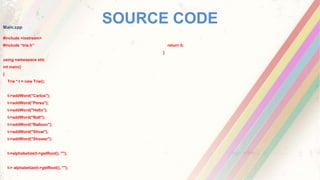


Trie is an efficient data structure for storing and retrieving strings. It stores strings in a tree structure, with each node representing a character. Common operations on a trie like insertion, deletion and searching of strings can be performed in O(M) time where M is the length of the string. The document then provides details on the node structure used to implement a trie, along with pseudocode for inserting strings like "Apple" and "Army" into an empty trie.


