TRIES DATA STRUCTURE
Presented By – Aman Tandon
5 June 2014
Outline
• Understand Requirements
• What is Trie?
• Different types of Tries.
• Memory and Time Analysis using Tries
• Various application of the Tries
Understand Requirements
● Insertion is faster as compared to the Hash
Table
● Lookup is much more faster than hash table
implementations
● You can store as many keys as much you want
without any reconstruction as like in Hash Table
if size becomes full
● There are no collision of different keys in tries
What is TRIE?
• The term trie comes from retrieval. This term
was coined by Edward Fredkin, who pronounce
it tri as in the word retrieval
• In computer science, a trie, also called digital
tree and sometimes radix tree or prefix tree
• All the descendants of a node have a common
prefix of the string associated with that node,
and the root is associated with the empty string.
Different Types of Tries
● Standard Tries
● Compressed/Compact Tries
● Suffix Tries
Standard Tries
• The standard trie for a set of strings S is an
ordered tree such that:
o each node but the root is labeled with a
character
o the children of a node are alphabetically
ordered
o the paths from the external nodes to the root
yield the strings of S
•The number of children a node can have is the
size/total number of characters in the language
and all children are ordered alphabetically.
•leaf node is represented as square
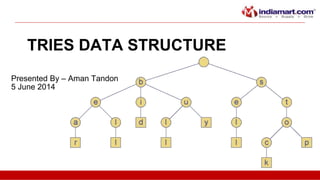
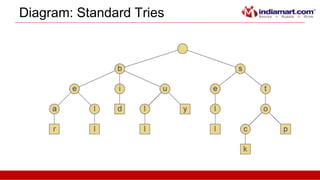
•Example: standard trie for the set of strings S = {
bear, bell, bid, bull, buy, sell, stock, stop }
Diagram: Standard Tries
● A standard trie uses O(n) space. Operations (find,insert,
remove) take time O(dm) each, where:
○ n = total size of the strings in S
○ m =size of the string parameter of the operation
○ d =alphabet size
● The bad thing about this data structure is space
requirements
Time/Space complexity of Standard Tries
Applications of Standard Tries
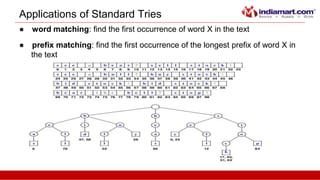
● word matching: find the first occurrence of word X in the text
● prefix matching: find the first occurrence of the longest prefix of word X in
the text
Compressed Tries
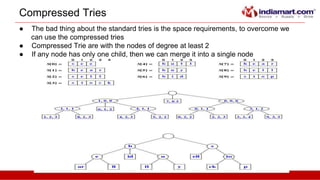
● The bad thing about the standard tries is the space requirements, to overcome we
can use the compressed tries
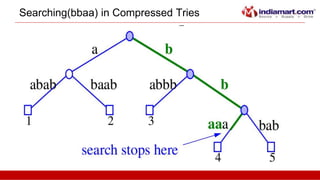
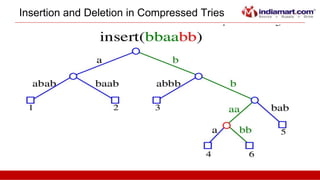
● Compressed Trie are with the nodes of degree at least 2
● If any node has only one child, then we can merge it into a single node
Searching(bbaa) in Compressed Tries
Insertion and Deletion in Compressed Tries
Suffix Tries
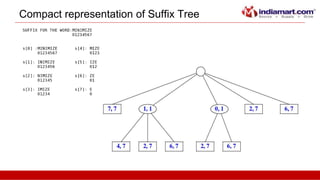
A suffix trie is a compressed trie for all the suffixes
of a text
Compact representation of Suffix Tree
Tries and Web Search Engines
● The index of a search engine (collection of all
searchable words) is stored into a compressed
trie
● Each leaf of the trie is associated with a word
and has a list of pages (URLs) containing that
word, called occurrence list
● The trie is kept in internal memory
●The occurrence lists are kept in external
memory and are ranked by relevance
●Boolean queries for sets of words (e.g., Java
and coffee) correspond to set operations
(e.g.,intersection) on the occurrence lists
TRIES_data_structure

TRIES_data_structure

  • 1.
    TRIES DATA STRUCTURE PresentedBy – Aman Tandon 5 June 2014
  • 2.
    Outline • Understand Requirements •What is Trie? • Different types of Tries. • Memory and Time Analysis using Tries • Various application of the Tries
  • 3.
    Understand Requirements ● Insertionis faster as compared to the Hash Table ● Lookup is much more faster than hash table implementations ● You can store as many keys as much you want without any reconstruction as like in Hash Table if size becomes full ● There are no collision of different keys in tries
  • 4.
    What is TRIE? •The term trie comes from retrieval. This term was coined by Edward Fredkin, who pronounce it tri as in the word retrieval • In computer science, a trie, also called digital tree and sometimes radix tree or prefix tree • All the descendants of a node have a common prefix of the string associated with that node, and the root is associated with the empty string.
  • 5.
    Different Types ofTries ● Standard Tries ● Compressed/Compact Tries ● Suffix Tries
  • 6.
    Standard Tries • Thestandard trie for a set of strings S is an ordered tree such that: o each node but the root is labeled with a character o the children of a node are alphabetically ordered o the paths from the external nodes to the root yield the strings of S
  • 7.
    •The number ofchildren a node can have is the size/total number of characters in the language and all children are ordered alphabetically. •leaf node is represented as square •Example: standard trie for the set of strings S = { bear, bell, bid, bull, buy, sell, stock, stop }
  • 8.
  • 9.
    ● A standardtrie uses O(n) space. Operations (find,insert, remove) take time O(dm) each, where: ○ n = total size of the strings in S ○ m =size of the string parameter of the operation ○ d =alphabet size ● The bad thing about this data structure is space requirements Time/Space complexity of Standard Tries
  • 10.
    Applications of StandardTries ● word matching: find the first occurrence of word X in the text ● prefix matching: find the first occurrence of the longest prefix of word X in the text
  • 11.
    Compressed Tries ● Thebad thing about the standard tries is the space requirements, to overcome we can use the compressed tries ● Compressed Trie are with the nodes of degree at least 2 ● If any node has only one child, then we can merge it into a single node
  • 12.
  • 13.
    Insertion and Deletionin Compressed Tries
  • 14.
    Suffix Tries A suffixtrie is a compressed trie for all the suffixes of a text
  • 15.
  • 16.
    Tries and WebSearch Engines ● The index of a search engine (collection of all searchable words) is stored into a compressed trie ● Each leaf of the trie is associated with a word and has a list of pages (URLs) containing that word, called occurrence list ● The trie is kept in internal memory
  • 17.
    ●The occurrence listsare kept in external memory and are ranked by relevance ●Boolean queries for sets of words (e.g., Java and coffee) correspond to set operations (e.g.,intersection) on the occurrence lists