Routing
Contents
 Different type of routing
 Fields of routing table
 Forwarding technique
 Populate a routing table
Different types of routing
 Direct routing
 Indirect routing
 Static routing
 Dynamic routing
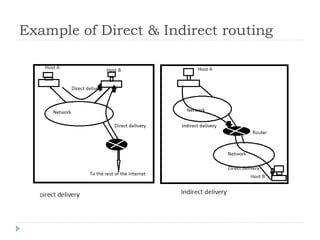
Direct and Indirect Routing
 When routing is performed in the same network than
direct routing happens. Performed by Host.
 Destination network = local network
 Indirect routing performed from one network to
another network.
 Destination network ≠ local network
 Packet is forwarded to default gateway
Example of Direct & Indirect routing
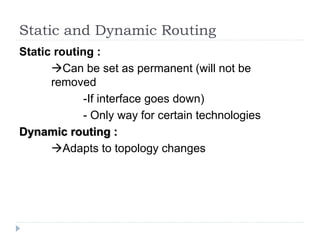
Static and Dynamic Routing
Static routing :
Can be set as permanent (will not be
removed
-If interface goes down)
- Only way for certain technologies
Dynamic routing :
Adapts to topology changes
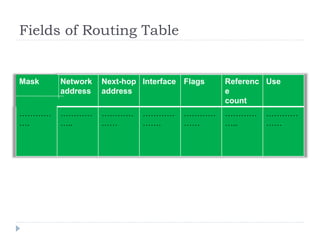
Fields of Routing Table
Mask Network
address
Next-hop
address
Interface Flags Referenc
e
count
Use
…………
….
…………
…..
…………
……
…………
…….
…………
……
…………
…..
…………
……
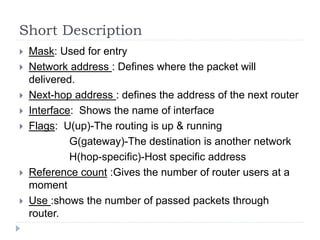
Short Description
 Mask: Used for entry
 Network address : Defines where the packet will
delivered.
 Next-hop address : defines the address of the next router
 Interface: Shows the name of interface
 Flags: U(up)-The routing is up & running
G(gateway)-The destination is another network
H(hop-specific)-Host specific address
 Reference count :Gives the number of router users at a
moment
 Use :shows the number of passed packets through
router.
Packet Forwarding Techniques
 Next Hop Method
 Network Specific Method
 Host Specific Method
 Default Method
TCP/IP Protocol Suite
6.2 FORWARDING
Forwarding means to place the packet in its route to its destination.
Forwarding requires a host or a router to have a routing table.
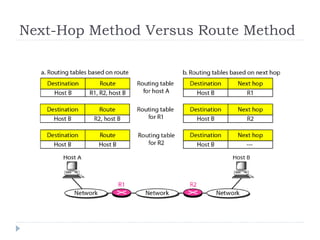
Next-Hop Method Versus Route Method
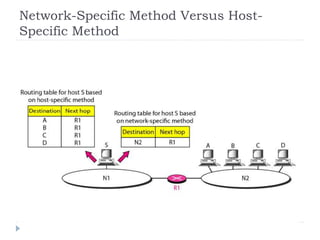
Network-Specific Method Versus Host-
Specific Method
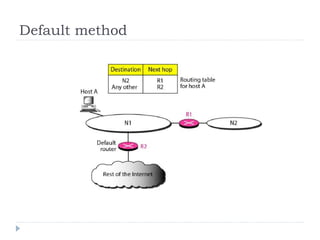
Default method
Populate a Routing Table
A network router sends packets to remote network
sites based on information in its routing table. This
table is like an index that has an IP address, a MAC
address and an interface number
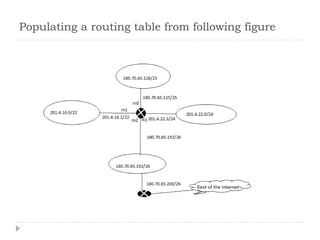
Populating a routing table from following figure
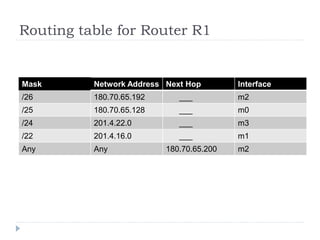
Routing table for Router R1
Mask Network Address Next Hop Interface
/26 180.70.65.192 ___ m2
/25 180.70.65.128 ___ m0
/24 201.4.22.0 ___ m3
/22 201.4.16.0 ___ m1
Any Any 180.70.65.200 m2

Routing, Different types of forwarding technique

  • 1.
  • 2.
    Contents  Different typeof routing  Fields of routing table  Forwarding technique  Populate a routing table
  • 3.
    Different types ofrouting  Direct routing  Indirect routing  Static routing  Dynamic routing
  • 4.
    Direct and IndirectRouting  When routing is performed in the same network than direct routing happens. Performed by Host.  Destination network = local network  Indirect routing performed from one network to another network.  Destination network ≠ local network  Packet is forwarded to default gateway
  • 5.
    Example of Direct& Indirect routing
  • 6.
    Static and DynamicRouting Static routing : Can be set as permanent (will not be removed -If interface goes down) - Only way for certain technologies Dynamic routing : Adapts to topology changes
  • 7.
    Fields of RoutingTable Mask Network address Next-hop address Interface Flags Referenc e count Use ………… …. ………… ….. ………… …… ………… ……. ………… …… ………… ….. ………… ……
  • 8.
    Short Description  Mask:Used for entry  Network address : Defines where the packet will delivered.  Next-hop address : defines the address of the next router  Interface: Shows the name of interface  Flags: U(up)-The routing is up & running G(gateway)-The destination is another network H(hop-specific)-Host specific address  Reference count :Gives the number of router users at a moment  Use :shows the number of passed packets through router.
  • 9.
    Packet Forwarding Techniques Next Hop Method  Network Specific Method  Host Specific Method  Default Method
  • 10.
    TCP/IP Protocol Suite 6.2FORWARDING Forwarding means to place the packet in its route to its destination. Forwarding requires a host or a router to have a routing table.
  • 11.
  • 12.
    Network-Specific Method VersusHost- Specific Method
  • 13.
  • 14.
    Populate a RoutingTable A network router sends packets to remote network sites based on information in its routing table. This table is like an index that has an IP address, a MAC address and an interface number
  • 15.
    Populating a routingtable from following figure
  • 16.
    Routing table forRouter R1 Mask Network Address Next Hop Interface /26 180.70.65.192 ___ m2 /25 180.70.65.128 ___ m0 /24 201.4.22.0 ___ m3 /22 201.4.16.0 ___ m1 Any Any 180.70.65.200 m2