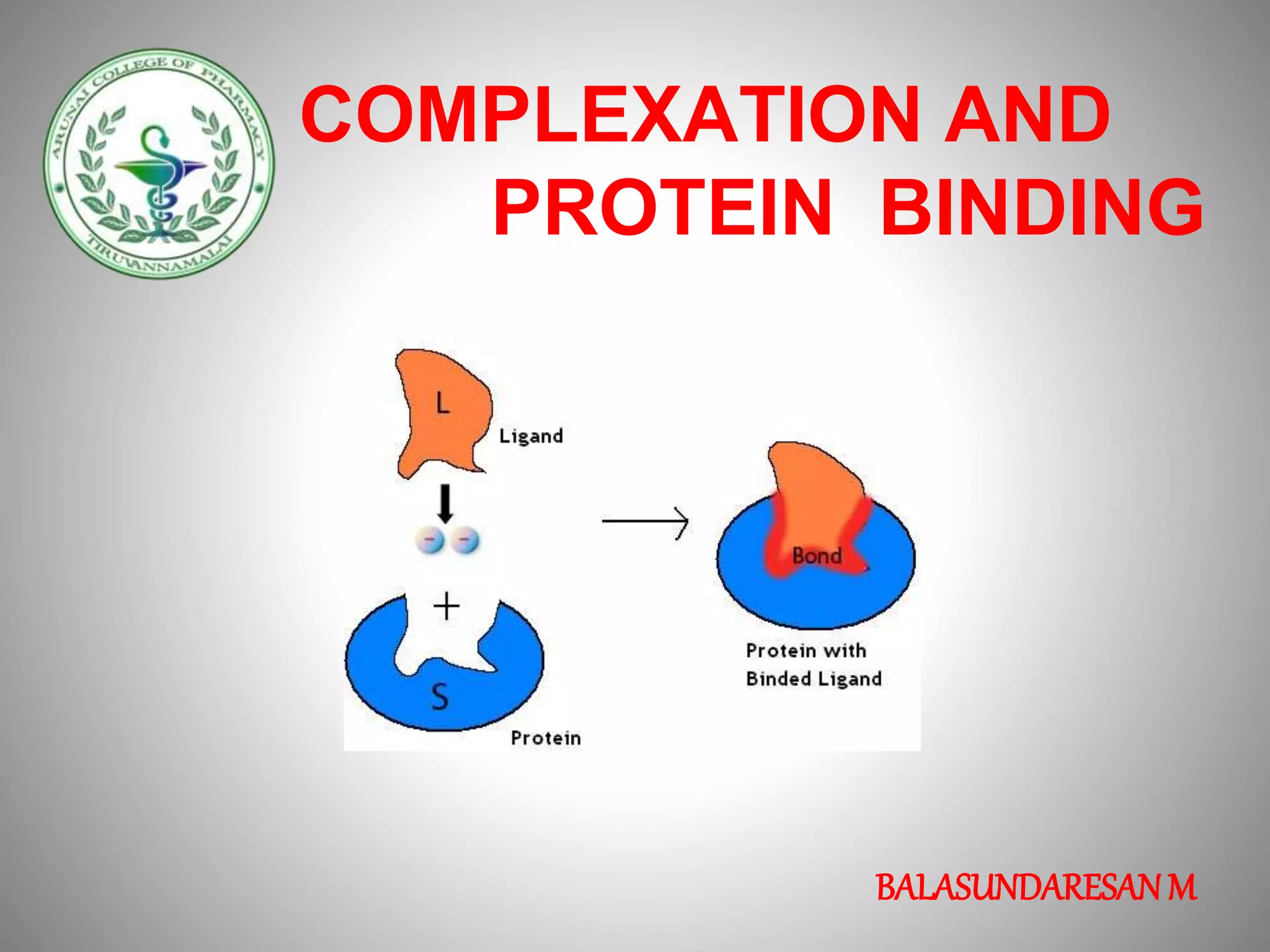


COMPLEXATION AND
PROTEIN BINDING
BALASUNDARESANM
Contents
1. Introduction
2. Classification of Complexation
3. Applications
4. Methods of analysis
5. Protein binding
6. Complexation and drug action
7. Crystalline structures of complexes and
thermodynamic treatment of stability constants.
Introduction
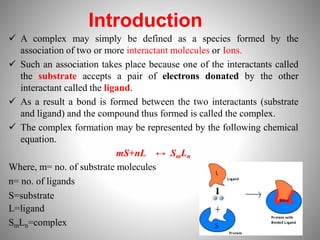
 A complex may simply be defined as a species formed by the
association of two or more interactant molecules or Ions.
 Such an association takes place because one of the interactants called
the substrate accepts a pair of electrons donated by the other
interactant called the ligand.
 As a result a bond is formed between the two interactants (substrate
and ligand) and the compound thus formed is called the complex.
 The complex formation may be represented by the following chemical
equation.
mS+nL ↔ SmLn
Where, m= no. of substrate molecules
n= no. of ligands
S=substrate
L=ligand
SmLn=complex
Types of Complexes
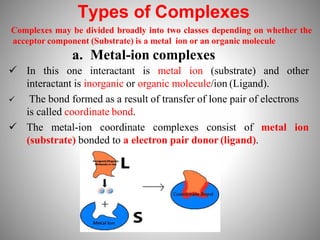
Complexes may be divided broadly into two classes depending on whether the
acceptor component (Substrate) is a metal ion or an organic molecule
a. Metal-ion complexes
 In this one interactant is metal ion (substrate) and other
interactant is inorganic or organic molecule/ion (Ligand).
 The bond formed as a result of transfer of lone pair of electrons
is called coordinate bond.
 The metal-ion coordinate complexes consist of metal ion
(substrate) bonded to a electron pair donor (ligand).
Types of Complexes..
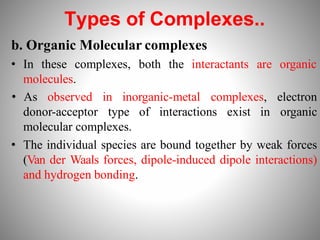
b. Organic Molecular complexes
• In these complexes, both the interactants are organic
molecules.
donor-acceptor type of interactions exist in
• As observed in inorganic-metal complexes, electron
organic
molecular complexes.
• The individual species are bound together by weak forces
(Van der Waals forces, dipole-induced dipole interactions)
and hydrogen bonding.
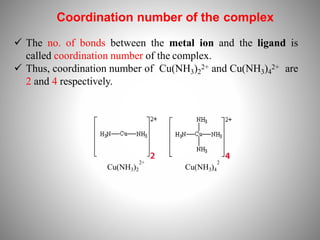
Coordination number of the complex
 The no. of bonds between the metal ion and the ligand is
called coordination number of the complex.
 Thus, coordination number of Cu(NH3)2
2+ and Cu(NH3)4
2+ are
2 and 4 respectively.
2+
Cu(NH3)2
2
Cu(NH3)4
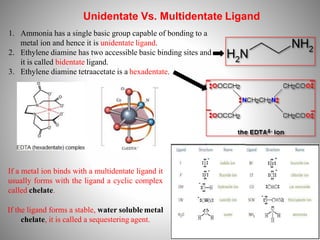
Unidentate Vs. Multidentate Ligand
1. Ammonia has a single basic group capable of bonding to a
metal ion and hence it is unidentate ligand.
2. Ethylene diamine has two accessible basic binding sites and
it is called bidentate ligand.
3. Ethylene diamine tetraacetate is a hexadentate.
If a metal ion binds with a multidentate ligand it
usually forms with the ligand a cyclic complex
called chelate.
If the ligand forms a stable, water soluble metal
chelate, it is called a sequestering agent.
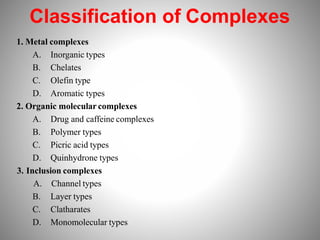
Classification of Complexes
1. Metal complexes
A. Inorganic types
B. Chelates
C. Olefin type
D. Aromatic types
2. Organic molecular complexes
A. Drug and caffeine complexes
B. Polymer types
C. Picric acid types
D. Quinhydrone types
3. Inclusion complexes
A. Channel types
B. Layer types
C. Clatharates
D. Monomolecular types
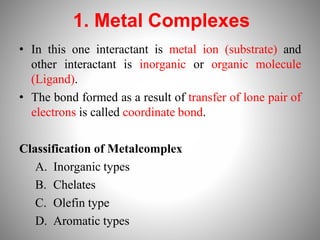
1. Metal Complexes
• In this one interactant is metal ion (substrate) and
other interactant is inorganic or organic molecule
(Ligand).
• The bond formed as a result of transfer of lone pair of
electrons is called coordinate bond.
Classification of Metalcomplex
A. Inorganic types
B. Chelates
C. Olefin type
D. Aromatic types
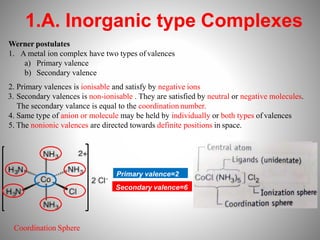
1.A. Inorganic type Complexes
Werner postulates
1. A metal ion complex have two types of valences
a) Primary valence
b) Secondary valence
2. Primary valences is ionisable and satisfy by negative ions
3. Secondary valences is non-ionisable . They are satisfied by neutral or negative molecules.
The secondary valance is equal to the coordination number.
4. Same type of anion or molecule may be held by individually or both types of valences
5. The nonionic valences are directed towards definite positions in space.
Primary valence=2
Secondary valence=6
Coordination Sphere
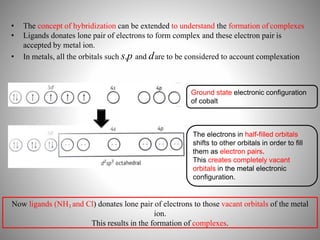
• The concept of hybridization can be extended to understand the formation of complexes
• Ligands donates lone pair of electrons to form complex and these electron pair is
accepted by metal ion.
• In metals, all the orbitals such s,p and dare to be considered to account complexation
Ground state electronic configuration
of cobalt
The electrons in half-filled orbitals
shifts to other orbitals in order to fill
them as electron pairs.
This creates completely vacant
orbitals in the metal electronic
configuration.
Now ligands (NH3 and Cl) donates lone pair of electrons to those vacant orbitals of the metal
ion.
This results in the formation of complexes.
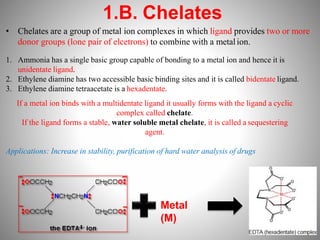
1.B. Chelates
• Chelates are a group of metal ion complexes in which ligand provides two or more
donor groups (lone pair of elcetrons) to combine with a metalion.
1. Ammonia has a single basic group capable of bonding to a metal ion and hence it is
unidentate ligand.
2. Ethylene diamine has two accessible basic binding sites and it is called bidentate ligand.
3. Ethylene diamine tetraacetate is a hexadentate.
If a metal ion binds with a multidentate ligand it usually forms with the ligand a cyclic
complex called chelate.
If the ligand forms a stable, water soluble metal chelate, it is called a sequestering
agent.
Applications: Increase in stability, purification of hard water analysis of drugs
Metal
(M)
2. Organic Molecular Complex
• In these complexes, both the interactants are organic
molecules.
• The individual species are bound together by weaker
forces (Van der Waals forces, dipole-induced dipole
interactions) or hydrogen bonding.
Classification of organic molecular complex
A. Drug and caffeine complexes
B. Polymer types
C. Picric acid types
D. Quinhydrone types
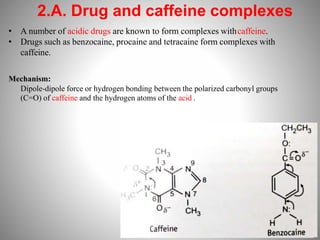
• A number of acidic drugs are known to form complexes withcaffeine.
• Drugs such as benzocaine, procaine and tetracaine form complexes with
caffeine.
Mechanism:
Dipole-dipole force or hydrogen bonding between the polarized carbonyl groups
(C=O) of caffeine and the hydrogen atoms of the acid .
2.A. Drug and caffeine complexes
2.B. Polymer Complexes
 Many pharmaceutical additives such as polyethylene glycols
(PEGs), carboxymethyl cellulose (CMC) contain nucleophilic
oxygen. These can form complexes with various drugs.
 These types of complexes produce incompatibilities with the
dosage forms which may delay absorption of drugs and produce
physical, chemical and pharmacological effects.
E.g. Polymers: carbowaxes, pluronics etc.
Drugs: tannic acid, salicylic acid, phenols etc.
Carboxyl methylcellulose (CMC) + Amphetamine
absorbed complex
= poorly
Nucleophilic: tendency to donate electrons
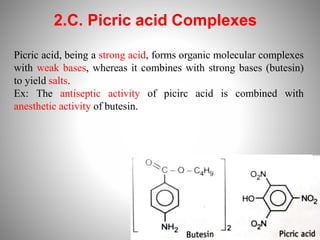
2.C. Picric acid Complexes
Picric acid, being a strong acid, forms organic molecular complexes
with weak bases, whereas it combines with strong bases (butesin)
to yield salts.
Ex: The antiseptic activity of picirc acid is combined with
anesthetic activity of butesin.
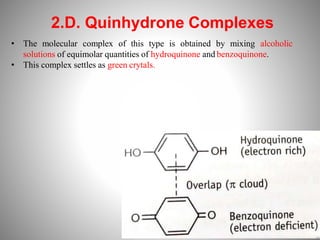
2.D. Quinhydrone Complexes
• The molecular complex of this type is obtained by mixing alcoholic
solutions of equimolar quantities of hydroquinone and benzoquinone.
• This complex settles as green crytals.
3. Inclusion Complexes
• Inclusion complexes are also called occlusion
(closure) compounds in which one of the
components is trapped in the open lattice or cage like
crystal structure of other.
• Here, the interaction is not due chemical reactivity,
but because of the favorable molecular architecture.
Classifications of Inclusion complex
A. Channel types
B. Layer types
C. Clathrates
D. Monomolecular types
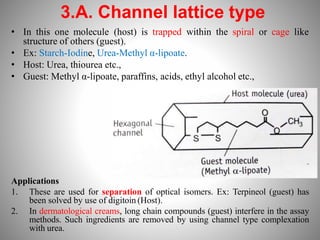
3.A. Channel lattice type
• In this one molecule (host) is trapped within the spiral or cage like
structure of others (guest).
• Ex: Starch-Iodine, Urea-Methyl α-lipoate.
• Host: Urea, thiourea etc.,
• Guest: Methyl α-lipoate, paraffins, acids, ethyl alcohol etc.,
Applications
1. These are used for separation of optical isomers. Ex: Terpineol (guest) has
been solved by use of digitoin (Host).
2. In dermatological creams, long chain compounds (guest) interfere in the assay
methods. Such ingredients are removed by using channel type complexation
with urea.
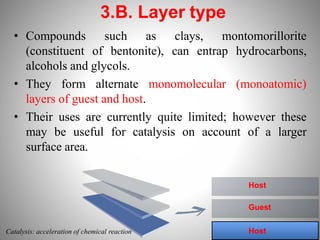
• Compounds such as clays, montomorillorite
(constituent of bentonite), can entrap hydrocarbons,
alcohols and glycols.
• They form alternate monomolecular (monoatomic)
layers of guest and host.
• Their uses are currently quite limited; however these
may be useful for catalysis on account of a larger
surface area.
3.B. Layer type
Host
Host
Guest
Catalysis: acceleration of chemical reaction
3.C. Clathrates
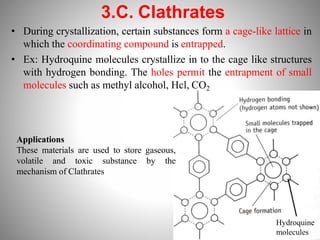
• During crystallization, certain substances form a cage-like lattice in
which the coordinating compound is entrapped.
• Ex: Hydroquine molecules crystallize in to the cage like structures
with hydrogen bonding. The holes permit the entrapment of small
molecules such as methyl alcohol, Hcl, CO2
Hydroquine
molecules
Applications
These materials are used to store gaseous,
volatile and toxic substance by the
mechanism of Clathrates
3.D. Monomolecular type
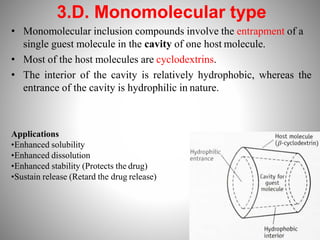
• Monomolecular inclusion compounds involve the entrapment of a
single guest molecule in the cavity of one host molecule.
• Most of the host molecules are cyclodextrins.
• The interior of the cavity is relatively hydrophobic, whereas the
entrance of the cavity is hydrophilic in nature.
Applications
•Enhanced solubility
•Enhanced dissolution
•Enhanced stability (Protects the drug)
•Sustain release (Retard the drug release)
Method of Analysis of
complexes
Methods
1. Continuous variation method
2. Distribution method
3. Solubility method
4. pH variation method
1. Continuous variation method
• Physical
constant,
properties such as dielectric
refractive index etc., are
characteristics of particular species.
• When no complexation b/w species (A and
B) the value is linear (_ _ _ _).
• In case of complexation no linear
the
phenomenon observed. This is
indication of complexation (1:1).
2. Distribution method
• The distribution behavior of a solute b/w two immiscible liquids
is expressed as distribution coefficient or partition coefficient.
• When the solute forms complex with added substance the
distribution pattern changes depending on the nature of complex
(water soluble or insoluble)
Ex: I + K+I-
2
Iodine+Pottasium iodide
K+ I-
3


3
The equilibrium constant
K+ I-
[I2] [K+I-]
K=
Distribution coefficient of I2 b/w carbon disulfide and water= 625
Distribution coefficient of K+ I- Complex b/w carbon disulfide and water= 954
3
Iodine-Pottasium iodide complex
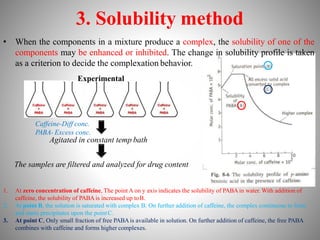
3. Solubility method
Caffeine-Diff conc.
PABA- Excess conc.
Agitated in constant temp bath
The samples are filtered and analyzed for drug content
1. At zero concentration of caffeine, The point A on y axis indicates the solubility of PABA in water. With addition of
caffeine, the solubility of PABA is increased up toB.
2. At point B, the solution is saturated with complex B. On further addition of caffeine, the complex continuous to form
and starts precipitates upon the pointC.
3. At point C, Only small fraction of free PABA is available in solution. On further addition of caffeine, the free PABA
combines with caffeine and forms higher complexes.
• When the components in a mixture produce a complex, the solubility of one of the
components may be enhanced or inhibited. The change in solubility profile is taken
as a criterion to decide the complexation behavior.
Experimental
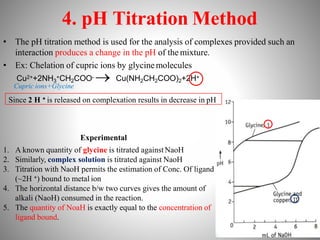
4. pH Titration Method
• The pH titration method is used for the analysis of complexes provided such an
interaction produces a change in the pH of the mixture.
• Ex: Chelation of cupric ions by glycine molecules
Cu2++2NH3
+CH2COO-
 Cu(NH2CH2COO)2+2H+
Cupric ions+Glycine
Since 2 H + is released on complexation results in decrease in pH
Experimental
1. A known quantity of glycine is titrated againstNaoH
2. Similarly, complex solution is titrated against NaoH
3. Titration with NaoH permits the estimation of Conc. Of ligand
(~2H +) bound to metal ion
4. The horizontal distance b/w two curves gives the amount of
alkali (NaoH) consumed in the reaction.
5. The quantity of NoaH is exactly equal to the concentration of
ligand bound.
Applications
1. Physical state: It is possible to convert a liquid to a solid complex and thus improve its
processing characteristics. For example, nitroglycerin is transformed to its crystalline
inclusion complex with β- cyclodextrin; the complex contains 15.6% nitroglycerine and is
explosion-proof.
2. Volatility: When it is desirable to reduce substrate volatility in order can to stabilize a
system or to overcome an unpleasant odour, complex can offer the advantage. For
example., in the formulation, iodine is complexed with polyvinylpyrrolidone (PVP)
3. Solid state stability: The solid state stability of drugs can he enhanced by complexation.
For example, beta cyclodextrin complexes of vitamin A and D are stabilisedchemically.
4. Chemical stability: Complex formation will alter chemical reactivity. Either inhibitory
or catalytic effects may be observed. For example, the rate of hydrolysis of benzocaine is
reduced by complexing it with caffeine.
5. Solubility: Many examples of solubility enhancement by complexation halves been
reported. For example, at low concentrations, caffeine enhances the solubility of p-
aminobenzoic acid (PABA).
6. Dissolution: If solubility is enhanced, the dissolution rate should also increase and
complexation is one possible method. The dissolution rate of phenobarbital is enhanced by
using β-cyclodextrin inclusion complexes.
7. Partition coefficients: This will be enhanced by complexation Ex: I2 and KIcomplex
Applications.
.
8. Absorption and bioavailability: The absorption and bioavailability of tetracyclines was
reduced when coadministered with divalent cations such as calcium, magnesium and
aluminum, on account of formation of insoluble metal complexes. On the other hand, beta-
cyclodextrin complexes of indomethacin and barbiturates have enhanced the drug
bioavailability.
9. Reduced toxicity: Cyclodextrins are effective in reducing the ulcerogenic effect of
indomethacin and local tissue toxicity of chlorpromazine.
10. Antidote for metal poisoning: Toxic metal ions such arsenic, mercury, antimony etc., bind
to -SH groups of various enzymes and interfere with their normal function. Compounds
such as dimercaprol (BAL. British Anti-Lewisite) form water soluble complexes with
these metal ions and eliminate them rapidly from the body. Other examples are: Beryllium
poisoning: Salicylic acid. Lead poisoning: EDTA
11. Antibacterial activity: Antitubercular drug, PAS (p-aminosalicylic acid) is known to form
a cupric complex and also a chelate. Cupric chelate has shown greater in vivo
antitubercular activity in mice than cupric complex.
Complexation and Drug
action/activity
1. Write two applications of complexation each in formulation and drug
action
A:Formulation: Physical state, volatility, solid state stability,
Drug action: Absorption and bioavailability, reduced toxicity,
antibacterial activity.
2. How does complexation influences the drug action? Explain with the
help of two examples
A:Once complexation occurs, the physical and chemical properties of the
complexing species are altered. These properties include solubility,
stability, partitioning, energy absorption and emission, and
conductance of the drug. Complexes can alter the pharmacologic
activity of the agent by inhibiting interactions with receptors.
Examples: Absorption and bioavailability, reduced toxicity,
antibacterial activity.
PROTEIN BINDING
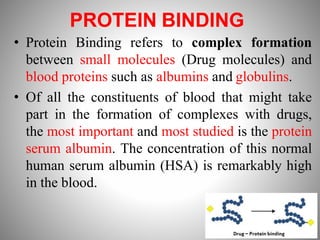
• Protein Binding refers to complex formation
between small molecules (Drug molecules) and
blood proteins such as albumins and globulins.
• Of all the constituents of blood that might take
part in the formation of complexes with drugs,
the most important and most studied is the protein
serum albumin. The concentration of this normal
human serum albumin (HSA) is remarkably high
in the blood.
• Binding is a function of the affinity of the protein
molecule for the drug molecules and also the
concentration of drugs and proteins. The
interaction between protein (P) and drug (D) for a
simple case of 1:1 protein drug complex can be
represented as follows:
P + D PD
Applying the law of mass action, the expression is
K=[PD]/[P] [D]
or, [PD] = K[P] [D]
Where, K= Association Constant
[P]= Concentration of unbound drug
[D]= Concentration of bound drug
[PD]= Concentration of protein drug complex
Methods of determining Protein Binding
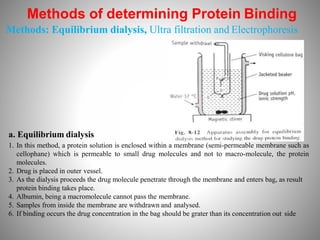
Methods: Equilibrium dialysis, Ultra filtration and Electrophoresis
a. Equilibrium dialysis
1. In this method, a protein solution is enclosed within a membrane (semi-permeable membrane such as
cellophane) which is permeable to small drug molecules and not to macro-molecule, the protein
molecules.
2. Drug is placed in outer vessel.
3. As the dialysis proceeds the drug molecule penetrate through the membrane and enters bag, as result
protein binding takes place.
4. Albumin, being a macromolecule cannot pass the membrane.
5. Samples from inside the membrane are withdrawn and analysed.
6. If binding occurs the drug concentration in the bag should be grater than its concentration out side
Methods of determining
Protein Binding
b. Dynamic dialysis method
1. The dynamic dialysis method is based on the rate of
disappearance of the drug from a dialysis bag which is
proportional to the concentration of unbound drug.
2. The dialysis process follows the rate law
d[Dt]
 k[Df ]
dt
Where, [Dt]= conc. of total drug. Mol/L
[Df]= conc. of free (unbound) drug in the bag, Mol/L
k= First order rate constant or permeability constant
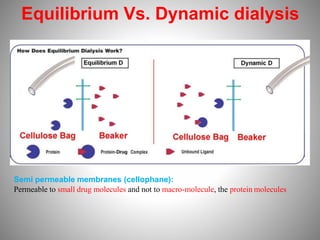
Equilibrium Vs. Dynamic dialysis
Semi permeable membranes (cellophane):
Permeable to small drug molecules and not to macro-molecule, the protein molecules
Significance of Protein Binding
1. Plasma protein bound drugs are unable to penetrate biological membranes. Hence they
cannot be excreted or biotransformed. Only free form of the drug is pharmacologically active.
2. Binding between plasma protein and drug is a reversible interaction. The bound drug acts as a
reservoir which releases the drug in the free form to replace the drug which is removed from the
body by excretion or biotransformation. This effect prolongs the duration of action of the
drug.
3. Drugs may exhibit competitive binding due to differences in the affinities of the drugs for the
binding sites in the protein molecule. Such competitive binding may be advantageous or
disadvantageous. For example, displacement of antibiotics by other drugs provides better effect
due to the release of free antibiotic for action. But displacement of protein bound anticoagulants
may cause excessive bleeding.
4. Drugs may interact with other tissues also similar to drug protein binding. For example, very
lipid soluble drugs like thiopentone accumulate in the body fat, and tetracyclines in teeth.
5. The concentration of a drug in the plasma is often a measure of drug distribution in the
body since the drug distributed in various organs of the body show a dynamic equilibrium.
6. If a drug protein binding is very high, the concentration of free form of the drug may not be
sufficient to elicit pharmacological activity. This can be remedied by giving sufficiently more
amount of drug to provide the required concentration for activity.
7. Protein binding may lead to increase in solubility of certain drugs eg. discoumarol.
Complex as drugs
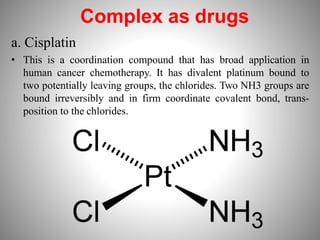
a. Cisplatin
• This is a coordination compound that has broad application in
human cancer chemotherapy. It has divalent platinum bound to
two potentially leaving groups, the chlorides. Two NH3 groups are
bound irreversibly and in firm coordinate covalent bond, trans-
position to the chlorides.
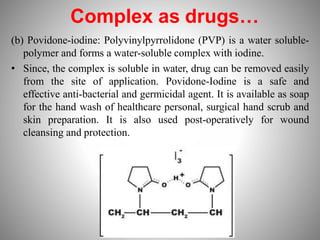
Complex as drugs…
(b) Povidone-iodine: Polyvinylpyrrolidone (PVP) is a water soluble-
polymer and forms a water-soluble complex with iodine.
• Since, the complex is soluble in water, drug can be removed easily
from the site of application. Povidone-Iodine is a safe and
effective anti-bacterial and germicidal agent. It is available as soap
for the hand wash of healthcare personal, surgical hand scrub and
skin preparation. It is also used post-operatively for wound
cleansing and protection.
Questions
Essay (10 M)
1. What is protein binding and explain the significance of proteinbinding.
2. Write about the method of analysis of complexation
Short notes (5 M)
1. Write two applications of complexation each in formulation and drug
action.
2. How does complexation influences the drug action? Explain with the help
of two examples
3. Define complex compounds. Write about the various types of metal
complexes.
4. Explain about the werner theory of complexation.
5. Write about various the types of organic molecular and inclusion
complexes.
COMPLEXATION & PROTEIN BINDING.pptx

COMPLEXATION & PROTEIN BINDING.pptx

  • 1.
  • 2.
    Contents 1. Introduction 2. Classificationof Complexation 3. Applications 4. Methods of analysis 5. Protein binding 6. Complexation and drug action 7. Crystalline structures of complexes and thermodynamic treatment of stability constants.
  • 3.
    Introduction  A complexmay simply be defined as a species formed by the association of two or more interactant molecules or Ions.  Such an association takes place because one of the interactants called the substrate accepts a pair of electrons donated by the other interactant called the ligand.  As a result a bond is formed between the two interactants (substrate and ligand) and the compound thus formed is called the complex.  The complex formation may be represented by the following chemical equation. mS+nL ↔ SmLn Where, m= no. of substrate molecules n= no. of ligands S=substrate L=ligand SmLn=complex
  • 4.
    Types of Complexes Complexesmay be divided broadly into two classes depending on whether the acceptor component (Substrate) is a metal ion or an organic molecule a. Metal-ion complexes  In this one interactant is metal ion (substrate) and other interactant is inorganic or organic molecule/ion (Ligand).  The bond formed as a result of transfer of lone pair of electrons is called coordinate bond.  The metal-ion coordinate complexes consist of metal ion (substrate) bonded to a electron pair donor (ligand).
  • 5.
    Types of Complexes.. b.Organic Molecular complexes • In these complexes, both the interactants are organic molecules. donor-acceptor type of interactions exist in • As observed in inorganic-metal complexes, electron organic molecular complexes. • The individual species are bound together by weak forces (Van der Waals forces, dipole-induced dipole interactions) and hydrogen bonding.
  • 6.
    Coordination number ofthe complex  The no. of bonds between the metal ion and the ligand is called coordination number of the complex.  Thus, coordination number of Cu(NH3)2 2+ and Cu(NH3)4 2+ are 2 and 4 respectively. 2+ Cu(NH3)2 2 Cu(NH3)4
  • 7.
    Unidentate Vs. MultidentateLigand 1. Ammonia has a single basic group capable of bonding to a metal ion and hence it is unidentate ligand. 2. Ethylene diamine has two accessible basic binding sites and it is called bidentate ligand. 3. Ethylene diamine tetraacetate is a hexadentate. If a metal ion binds with a multidentate ligand it usually forms with the ligand a cyclic complex called chelate. If the ligand forms a stable, water soluble metal chelate, it is called a sequestering agent.
  • 8.
    Classification of Complexes 1.Metal complexes A. Inorganic types B. Chelates C. Olefin type D. Aromatic types 2. Organic molecular complexes A. Drug and caffeine complexes B. Polymer types C. Picric acid types D. Quinhydrone types 3. Inclusion complexes A. Channel types B. Layer types C. Clatharates D. Monomolecular types
  • 9.
    1. Metal Complexes •In this one interactant is metal ion (substrate) and other interactant is inorganic or organic molecule (Ligand). • The bond formed as a result of transfer of lone pair of electrons is called coordinate bond. Classification of Metalcomplex A. Inorganic types B. Chelates C. Olefin type D. Aromatic types
  • 10.
    1.A. Inorganic typeComplexes Werner postulates 1. A metal ion complex have two types of valences a) Primary valence b) Secondary valence 2. Primary valences is ionisable and satisfy by negative ions 3. Secondary valences is non-ionisable . They are satisfied by neutral or negative molecules. The secondary valance is equal to the coordination number. 4. Same type of anion or molecule may be held by individually or both types of valences 5. The nonionic valences are directed towards definite positions in space. Primary valence=2 Secondary valence=6 Coordination Sphere
  • 11.
    • The conceptof hybridization can be extended to understand the formation of complexes • Ligands donates lone pair of electrons to form complex and these electron pair is accepted by metal ion. • In metals, all the orbitals such s,p and dare to be considered to account complexation Ground state electronic configuration of cobalt The electrons in half-filled orbitals shifts to other orbitals in order to fill them as electron pairs. This creates completely vacant orbitals in the metal electronic configuration. Now ligands (NH3 and Cl) donates lone pair of electrons to those vacant orbitals of the metal ion. This results in the formation of complexes.
  • 12.
    1.B. Chelates • Chelatesare a group of metal ion complexes in which ligand provides two or more donor groups (lone pair of elcetrons) to combine with a metalion. 1. Ammonia has a single basic group capable of bonding to a metal ion and hence it is unidentate ligand. 2. Ethylene diamine has two accessible basic binding sites and it is called bidentate ligand. 3. Ethylene diamine tetraacetate is a hexadentate. If a metal ion binds with a multidentate ligand it usually forms with the ligand a cyclic complex called chelate. If the ligand forms a stable, water soluble metal chelate, it is called a sequestering agent. Applications: Increase in stability, purification of hard water analysis of drugs Metal (M)
  • 13.
    2. Organic MolecularComplex • In these complexes, both the interactants are organic molecules. • The individual species are bound together by weaker forces (Van der Waals forces, dipole-induced dipole interactions) or hydrogen bonding. Classification of organic molecular complex A. Drug and caffeine complexes B. Polymer types C. Picric acid types D. Quinhydrone types
  • 14.
    • A numberof acidic drugs are known to form complexes withcaffeine. • Drugs such as benzocaine, procaine and tetracaine form complexes with caffeine. Mechanism: Dipole-dipole force or hydrogen bonding between the polarized carbonyl groups (C=O) of caffeine and the hydrogen atoms of the acid . 2.A. Drug and caffeine complexes
  • 15.
    2.B. Polymer Complexes Many pharmaceutical additives such as polyethylene glycols (PEGs), carboxymethyl cellulose (CMC) contain nucleophilic oxygen. These can form complexes with various drugs.  These types of complexes produce incompatibilities with the dosage forms which may delay absorption of drugs and produce physical, chemical and pharmacological effects. E.g. Polymers: carbowaxes, pluronics etc. Drugs: tannic acid, salicylic acid, phenols etc. Carboxyl methylcellulose (CMC) + Amphetamine absorbed complex = poorly Nucleophilic: tendency to donate electrons
  • 16.
    2.C. Picric acidComplexes Picric acid, being a strong acid, forms organic molecular complexes with weak bases, whereas it combines with strong bases (butesin) to yield salts. Ex: The antiseptic activity of picirc acid is combined with anesthetic activity of butesin.
  • 17.
    2.D. Quinhydrone Complexes •The molecular complex of this type is obtained by mixing alcoholic solutions of equimolar quantities of hydroquinone and benzoquinone. • This complex settles as green crytals.
  • 18.
    3. Inclusion Complexes •Inclusion complexes are also called occlusion (closure) compounds in which one of the components is trapped in the open lattice or cage like crystal structure of other. • Here, the interaction is not due chemical reactivity, but because of the favorable molecular architecture. Classifications of Inclusion complex A. Channel types B. Layer types C. Clathrates D. Monomolecular types
  • 19.
    3.A. Channel latticetype • In this one molecule (host) is trapped within the spiral or cage like structure of others (guest). • Ex: Starch-Iodine, Urea-Methyl α-lipoate. • Host: Urea, thiourea etc., • Guest: Methyl α-lipoate, paraffins, acids, ethyl alcohol etc., Applications 1. These are used for separation of optical isomers. Ex: Terpineol (guest) has been solved by use of digitoin (Host). 2. In dermatological creams, long chain compounds (guest) interfere in the assay methods. Such ingredients are removed by using channel type complexation with urea.
  • 20.
    • Compounds suchas clays, montomorillorite (constituent of bentonite), can entrap hydrocarbons, alcohols and glycols. • They form alternate monomolecular (monoatomic) layers of guest and host. • Their uses are currently quite limited; however these may be useful for catalysis on account of a larger surface area. 3.B. Layer type Host Host Guest Catalysis: acceleration of chemical reaction
  • 21.
    3.C. Clathrates • Duringcrystallization, certain substances form a cage-like lattice in which the coordinating compound is entrapped. • Ex: Hydroquine molecules crystallize in to the cage like structures with hydrogen bonding. The holes permit the entrapment of small molecules such as methyl alcohol, Hcl, CO2 Hydroquine molecules Applications These materials are used to store gaseous, volatile and toxic substance by the mechanism of Clathrates
  • 22.
    3.D. Monomolecular type •Monomolecular inclusion compounds involve the entrapment of a single guest molecule in the cavity of one host molecule. • Most of the host molecules are cyclodextrins. • The interior of the cavity is relatively hydrophobic, whereas the entrance of the cavity is hydrophilic in nature. Applications •Enhanced solubility •Enhanced dissolution •Enhanced stability (Protects the drug) •Sustain release (Retard the drug release)
  • 23.
    Method of Analysisof complexes Methods 1. Continuous variation method 2. Distribution method 3. Solubility method 4. pH variation method
  • 24.
    1. Continuous variationmethod • Physical constant, properties such as dielectric refractive index etc., are characteristics of particular species. • When no complexation b/w species (A and B) the value is linear (_ _ _ _). • In case of complexation no linear the phenomenon observed. This is indication of complexation (1:1).
  • 25.
    2. Distribution method •The distribution behavior of a solute b/w two immiscible liquids is expressed as distribution coefficient or partition coefficient. • When the solute forms complex with added substance the distribution pattern changes depending on the nature of complex (water soluble or insoluble) Ex: I + K+I- 2 Iodine+Pottasium iodide K+ I- 3   3 The equilibrium constant K+ I- [I2] [K+I-] K= Distribution coefficient of I2 b/w carbon disulfide and water= 625 Distribution coefficient of K+ I- Complex b/w carbon disulfide and water= 954 3 Iodine-Pottasium iodide complex
  • 26.
    3. Solubility method Caffeine-Diffconc. PABA- Excess conc. Agitated in constant temp bath The samples are filtered and analyzed for drug content 1. At zero concentration of caffeine, The point A on y axis indicates the solubility of PABA in water. With addition of caffeine, the solubility of PABA is increased up toB. 2. At point B, the solution is saturated with complex B. On further addition of caffeine, the complex continuous to form and starts precipitates upon the pointC. 3. At point C, Only small fraction of free PABA is available in solution. On further addition of caffeine, the free PABA combines with caffeine and forms higher complexes. • When the components in a mixture produce a complex, the solubility of one of the components may be enhanced or inhibited. The change in solubility profile is taken as a criterion to decide the complexation behavior. Experimental
  • 27.
    4. pH TitrationMethod • The pH titration method is used for the analysis of complexes provided such an interaction produces a change in the pH of the mixture. • Ex: Chelation of cupric ions by glycine molecules Cu2++2NH3 +CH2COO-  Cu(NH2CH2COO)2+2H+ Cupric ions+Glycine Since 2 H + is released on complexation results in decrease in pH Experimental 1. A known quantity of glycine is titrated againstNaoH 2. Similarly, complex solution is titrated against NaoH 3. Titration with NaoH permits the estimation of Conc. Of ligand (~2H +) bound to metal ion 4. The horizontal distance b/w two curves gives the amount of alkali (NaoH) consumed in the reaction. 5. The quantity of NoaH is exactly equal to the concentration of ligand bound.
  • 28.
    Applications 1. Physical state:It is possible to convert a liquid to a solid complex and thus improve its processing characteristics. For example, nitroglycerin is transformed to its crystalline inclusion complex with β- cyclodextrin; the complex contains 15.6% nitroglycerine and is explosion-proof. 2. Volatility: When it is desirable to reduce substrate volatility in order can to stabilize a system or to overcome an unpleasant odour, complex can offer the advantage. For example., in the formulation, iodine is complexed with polyvinylpyrrolidone (PVP) 3. Solid state stability: The solid state stability of drugs can he enhanced by complexation. For example, beta cyclodextrin complexes of vitamin A and D are stabilisedchemically. 4. Chemical stability: Complex formation will alter chemical reactivity. Either inhibitory or catalytic effects may be observed. For example, the rate of hydrolysis of benzocaine is reduced by complexing it with caffeine. 5. Solubility: Many examples of solubility enhancement by complexation halves been reported. For example, at low concentrations, caffeine enhances the solubility of p- aminobenzoic acid (PABA). 6. Dissolution: If solubility is enhanced, the dissolution rate should also increase and complexation is one possible method. The dissolution rate of phenobarbital is enhanced by using β-cyclodextrin inclusion complexes. 7. Partition coefficients: This will be enhanced by complexation Ex: I2 and KIcomplex
  • 29.
    Applications. . 8. Absorption andbioavailability: The absorption and bioavailability of tetracyclines was reduced when coadministered with divalent cations such as calcium, magnesium and aluminum, on account of formation of insoluble metal complexes. On the other hand, beta- cyclodextrin complexes of indomethacin and barbiturates have enhanced the drug bioavailability. 9. Reduced toxicity: Cyclodextrins are effective in reducing the ulcerogenic effect of indomethacin and local tissue toxicity of chlorpromazine. 10. Antidote for metal poisoning: Toxic metal ions such arsenic, mercury, antimony etc., bind to -SH groups of various enzymes and interfere with their normal function. Compounds such as dimercaprol (BAL. British Anti-Lewisite) form water soluble complexes with these metal ions and eliminate them rapidly from the body. Other examples are: Beryllium poisoning: Salicylic acid. Lead poisoning: EDTA 11. Antibacterial activity: Antitubercular drug, PAS (p-aminosalicylic acid) is known to form a cupric complex and also a chelate. Cupric chelate has shown greater in vivo antitubercular activity in mice than cupric complex.
  • 30.
    Complexation and Drug action/activity 1.Write two applications of complexation each in formulation and drug action A:Formulation: Physical state, volatility, solid state stability, Drug action: Absorption and bioavailability, reduced toxicity, antibacterial activity. 2. How does complexation influences the drug action? Explain with the help of two examples A:Once complexation occurs, the physical and chemical properties of the complexing species are altered. These properties include solubility, stability, partitioning, energy absorption and emission, and conductance of the drug. Complexes can alter the pharmacologic activity of the agent by inhibiting interactions with receptors. Examples: Absorption and bioavailability, reduced toxicity, antibacterial activity.
  • 31.
    PROTEIN BINDING • ProteinBinding refers to complex formation between small molecules (Drug molecules) and blood proteins such as albumins and globulins. • Of all the constituents of blood that might take part in the formation of complexes with drugs, the most important and most studied is the protein serum albumin. The concentration of this normal human serum albumin (HSA) is remarkably high in the blood.
  • 32.
    • Binding isa function of the affinity of the protein molecule for the drug molecules and also the concentration of drugs and proteins. The interaction between protein (P) and drug (D) for a simple case of 1:1 protein drug complex can be represented as follows: P + D PD Applying the law of mass action, the expression is K=[PD]/[P] [D] or, [PD] = K[P] [D] Where, K= Association Constant [P]= Concentration of unbound drug [D]= Concentration of bound drug [PD]= Concentration of protein drug complex
  • 33.
    Methods of determiningProtein Binding Methods: Equilibrium dialysis, Ultra filtration and Electrophoresis a. Equilibrium dialysis 1. In this method, a protein solution is enclosed within a membrane (semi-permeable membrane such as cellophane) which is permeable to small drug molecules and not to macro-molecule, the protein molecules. 2. Drug is placed in outer vessel. 3. As the dialysis proceeds the drug molecule penetrate through the membrane and enters bag, as result protein binding takes place. 4. Albumin, being a macromolecule cannot pass the membrane. 5. Samples from inside the membrane are withdrawn and analysed. 6. If binding occurs the drug concentration in the bag should be grater than its concentration out side
  • 34.
    Methods of determining ProteinBinding b. Dynamic dialysis method 1. The dynamic dialysis method is based on the rate of disappearance of the drug from a dialysis bag which is proportional to the concentration of unbound drug. 2. The dialysis process follows the rate law d[Dt]  k[Df ] dt Where, [Dt]= conc. of total drug. Mol/L [Df]= conc. of free (unbound) drug in the bag, Mol/L k= First order rate constant or permeability constant
  • 35.
    Equilibrium Vs. Dynamicdialysis Semi permeable membranes (cellophane): Permeable to small drug molecules and not to macro-molecule, the protein molecules
  • 36.
    Significance of ProteinBinding 1. Plasma protein bound drugs are unable to penetrate biological membranes. Hence they cannot be excreted or biotransformed. Only free form of the drug is pharmacologically active. 2. Binding between plasma protein and drug is a reversible interaction. The bound drug acts as a reservoir which releases the drug in the free form to replace the drug which is removed from the body by excretion or biotransformation. This effect prolongs the duration of action of the drug. 3. Drugs may exhibit competitive binding due to differences in the affinities of the drugs for the binding sites in the protein molecule. Such competitive binding may be advantageous or disadvantageous. For example, displacement of antibiotics by other drugs provides better effect due to the release of free antibiotic for action. But displacement of protein bound anticoagulants may cause excessive bleeding. 4. Drugs may interact with other tissues also similar to drug protein binding. For example, very lipid soluble drugs like thiopentone accumulate in the body fat, and tetracyclines in teeth. 5. The concentration of a drug in the plasma is often a measure of drug distribution in the body since the drug distributed in various organs of the body show a dynamic equilibrium. 6. If a drug protein binding is very high, the concentration of free form of the drug may not be sufficient to elicit pharmacological activity. This can be remedied by giving sufficiently more amount of drug to provide the required concentration for activity. 7. Protein binding may lead to increase in solubility of certain drugs eg. discoumarol.
  • 37.
    Complex as drugs a.Cisplatin • This is a coordination compound that has broad application in human cancer chemotherapy. It has divalent platinum bound to two potentially leaving groups, the chlorides. Two NH3 groups are bound irreversibly and in firm coordinate covalent bond, trans- position to the chlorides.
  • 38.
    Complex as drugs… (b)Povidone-iodine: Polyvinylpyrrolidone (PVP) is a water soluble- polymer and forms a water-soluble complex with iodine. • Since, the complex is soluble in water, drug can be removed easily from the site of application. Povidone-Iodine is a safe and effective anti-bacterial and germicidal agent. It is available as soap for the hand wash of healthcare personal, surgical hand scrub and skin preparation. It is also used post-operatively for wound cleansing and protection.
  • 39.
    Questions Essay (10 M) 1.What is protein binding and explain the significance of proteinbinding. 2. Write about the method of analysis of complexation Short notes (5 M) 1. Write two applications of complexation each in formulation and drug action. 2. How does complexation influences the drug action? Explain with the help of two examples 3. Define complex compounds. Write about the various types of metal complexes. 4. Explain about the werner theory of complexation. 5. Write about various the types of organic molecular and inclusion complexes.