PH AND BUFFERS
Introduction
• PH- The term introduced by SORENSONS
• P- Potenz - german word, means power /potential
• H-Hydrogen ion
• PH-Power or potential of hydrogen
• ACID- Is a proton donor, which means a chemical that
increases the concentration of hydrogen ions in a solution
• BASE- Is a proton acceptor, which means a chemical that
decreases the concentration of hydrogen ion in solution.
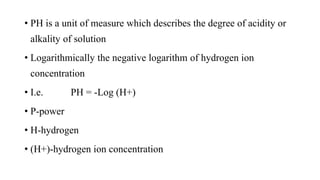
• PH is a unit of measure which describes the degree of acidity or
alkality of solution
• Logarithmically the negative logarithm of hydrogen ion
concentration
• I.e. PH = -Log (H+)
• P-power
• H-hydrogen
• (H+)-hydrogen ion concentration
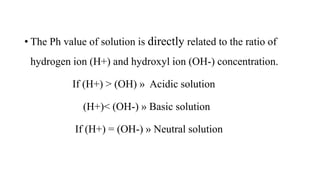
• The Ph value of solution is directly related to the ratio of
hydrogen ion (H+) and hydroxyl ion (OH-) concentration.
If (H+) > (OH) » Acidic solution
(H+)< (OH-) » Basic solution
If (H+) = (OH-) » Neutral solution
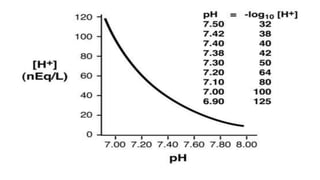
PH VS H+ ION CONCENTRATION
• As concentration of H+ ion increases, PH value decreases.
INDICATOR
A substance which shows the acidic/alkaline character of other
substances by change in colour.
TYPES OF INDICATORS
Neutral : litmus, turmeric, red cabbage
Olfactory : onion, vanilla
Synthetic : phenolphthalein, methyl orange
LITMUS PAPER : litmus dye is obtained from lichen
• Litmus paper turns red when dipped in an acidic solution
• Litmus paper turns blue when dipped in basic solution
UNIVERSAL INDICATOR:
A universal indicator is a pH indicator made of a solution of several
compounds that exhibits several smooth colour changes over a wide
range pH values to indicate the acidity or alkalinity of solutions.
A universal indicator is usually composed of water, 1-
propanol, phenolphthalein, sodium hydroxide, methyl
red, bromothymol blue, sodium bisulfite, and thymol blue.
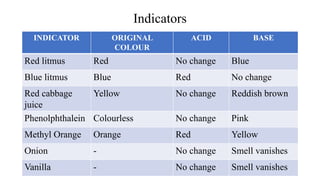
Indicators
INDICATOR ORIGINAL
COLOUR
ACID BASE
Red litmus Red No change Blue
Blue litmus Blue Red No change
Red cabbage
juice
Yellow No change Reddish brown
Phenolphthalein Colourless No change Pink
Methyl Orange Orange Red Yellow
Onion - No change Smell vanishes
Vanilla - No change Smell vanishes
PH METER
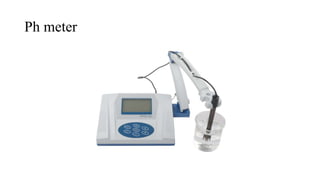
• It is the instrument that measures [H+] with concentration of
solution, using an ion selective electrode that ideally responds
to H+ ions
The 1st commercial pH meter was built in 1936.
pH meter – parts
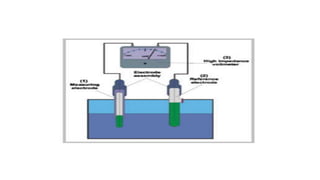
A basic pH measuring system consists of
(1) the measuring electrode - a pH sensitive electrode,
(2) the reference electrode
(3) a high impedance voltmeter
Ph meter
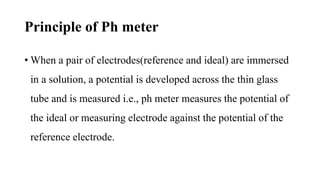
Principle of Ph meter
• When a pair of electrodes(reference and ideal) are immersed
in a solution, a potential is developed across the thin glass
tube and is measured i.e., ph meter measures the potential of
the ideal or measuring electrode against the potential of the
reference electrode.
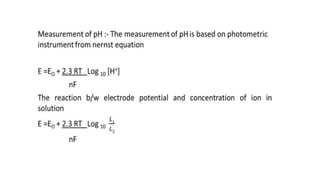
Where
E → Measured potential
Eo → Functional potential
R → Molar gas constant [8.314 J mol-1k-1]
T → Absolute temperature [in K]
F → Faraday constant [96500 KJ/mole]
n → Ionic charge
L1 & L2 → concentration of solution 1 & 2
Types of pH meter
• Bench Top pH meter
• Portable pH meter
• Manual pH meter
• Digital pH meter
Applications:
• For diagnosis of various metabolic disorders
• Pharmaceuticals
• Agriculture
• Dying and painting industry
• Fermentation reaction
• Sewage treatment
• Fertilizers
Maintenance of pH meter
• pH meter should be kept on a level & stable non vibrating surface with
continuous power supply with UPC backup system.
• Cover the pH meter with clean protective cover when not in use.
• The outside case of the pH meter should be cleaned using mild
detergent or disinfectant.
• All wires & contacts should be cleaned to avoid corrosion.
Maintenance of electrodes
• To dry the electrode, use clean soft tissues and blot the liquid
from the electrode.
• Ensure that the electrode is used and stored within its
specified temperature range.
• Ensure that air bubbles are not trapped at the bottom of the
electrode.
Electrode storage
• Short term storage → immerse electrode in pH 4 buffer solution
• Long term storage → in reference electrolyte solution
( 3mol/L KCl solution).
• Combination electrodes → in conc. KCl only.
• Never store electrodes in Distilled water or De-ionized water.
Cleaning of electrodes
• Electrode cleaning in case of Proteins, blood etc should be
done by Enzyme solutions (Pepsin in 0.1mol/L HCl)
• Stubborn deposits should be done by Hydrogen peroxide,
sodium hypochlorite.
Buffers
• Buffers are solutions which resist change in Ph when small amounts of
acid or base is added.
• Any substance that can reversibly bind hydrogen ions can labelled as a
buffer.
• Buffers are usually mixtures of salts of weak acids with their strong
bases or salts of weak bases with their strong acids.
TYPES OF BUFFERS
• ACID BUFFER: solution of a mixture of weak acid ans a salt
of this weak acid with strong base
CH3COOH + CH3COONA
• BASIC BUFFER: solution of a mixture of weak base and salt
of this weak base with strong acid.
NH4OH + NH4CL
HOW BUFFERS WORK
Equilibrium between acid and base
eg: acetate buffer
CH3COOH → CH3COO- + H+
• If more H+ is added to the solution its simply shifts the
equilibrium to the left absorbing H+ so the H+ remains
unchanged
• If H+ is removed then the equilibrium shifts to the right
releasing H+ to keep the Ph constant.
BUFFERS USED IN BIOCHEMISTRY
LABORATORY PROCEDURES
Different buffers are used for electrophoresis, the most
common being
• Tri acetate EDTA
• Tri borate EDTA
Buffers in gel electrophoresis are used to provide ions that
carry on a current and to maintain ph at a relatively constant
value.
VERNOL OR BICARBONATE BUFFER
FOR ELECTROPHORESIS (PH 8.6)
• 1.84 g of Ethyl barbituric acid and 10.3 g sodium diacetyl
barbituric acid are added to 800ml distilled water
• Slightly heating dissolves diethyl barbituric acid.
• After cooling ph is checked and adjusted to 8.6 and made
upto 1000ml.
Hydrogen ion homeostasis
• Buffer systems
• Respiratory
• Renal mechanisms
Thank you

PH, BUFFERS, PH METER.pptx

  • 1.
  • 2.
    Introduction • PH- Theterm introduced by SORENSONS • P- Potenz - german word, means power /potential • H-Hydrogen ion • PH-Power or potential of hydrogen • ACID- Is a proton donor, which means a chemical that increases the concentration of hydrogen ions in a solution • BASE- Is a proton acceptor, which means a chemical that decreases the concentration of hydrogen ion in solution.
  • 3.
    • PH isa unit of measure which describes the degree of acidity or alkality of solution • Logarithmically the negative logarithm of hydrogen ion concentration • I.e. PH = -Log (H+) • P-power • H-hydrogen • (H+)-hydrogen ion concentration
  • 4.
    • The Phvalue of solution is directly related to the ratio of hydrogen ion (H+) and hydroxyl ion (OH-) concentration. If (H+) > (OH) » Acidic solution (H+)< (OH-) » Basic solution If (H+) = (OH-) » Neutral solution
  • 6.
    PH VS H+ION CONCENTRATION • As concentration of H+ ion increases, PH value decreases. INDICATOR A substance which shows the acidic/alkaline character of other substances by change in colour.
  • 7.
    TYPES OF INDICATORS Neutral: litmus, turmeric, red cabbage Olfactory : onion, vanilla Synthetic : phenolphthalein, methyl orange LITMUS PAPER : litmus dye is obtained from lichen • Litmus paper turns red when dipped in an acidic solution • Litmus paper turns blue when dipped in basic solution
  • 8.
    UNIVERSAL INDICATOR: A universalindicator is a pH indicator made of a solution of several compounds that exhibits several smooth colour changes over a wide range pH values to indicate the acidity or alkalinity of solutions. A universal indicator is usually composed of water, 1- propanol, phenolphthalein, sodium hydroxide, methyl red, bromothymol blue, sodium bisulfite, and thymol blue.
  • 9.
    Indicators INDICATOR ORIGINAL COLOUR ACID BASE Redlitmus Red No change Blue Blue litmus Blue Red No change Red cabbage juice Yellow No change Reddish brown Phenolphthalein Colourless No change Pink Methyl Orange Orange Red Yellow Onion - No change Smell vanishes Vanilla - No change Smell vanishes
  • 10.
    PH METER • Itis the instrument that measures [H+] with concentration of solution, using an ion selective electrode that ideally responds to H+ ions The 1st commercial pH meter was built in 1936. pH meter – parts A basic pH measuring system consists of (1) the measuring electrode - a pH sensitive electrode, (2) the reference electrode (3) a high impedance voltmeter
  • 12.
  • 13.
    Principle of Phmeter • When a pair of electrodes(reference and ideal) are immersed in a solution, a potential is developed across the thin glass tube and is measured i.e., ph meter measures the potential of the ideal or measuring electrode against the potential of the reference electrode.
  • 15.
    Where E → Measuredpotential Eo → Functional potential R → Molar gas constant [8.314 J mol-1k-1] T → Absolute temperature [in K] F → Faraday constant [96500 KJ/mole] n → Ionic charge L1 & L2 → concentration of solution 1 & 2
  • 16.
    Types of pHmeter • Bench Top pH meter • Portable pH meter • Manual pH meter • Digital pH meter
  • 17.
    Applications: • For diagnosisof various metabolic disorders • Pharmaceuticals • Agriculture • Dying and painting industry • Fermentation reaction • Sewage treatment • Fertilizers
  • 18.
    Maintenance of pHmeter • pH meter should be kept on a level & stable non vibrating surface with continuous power supply with UPC backup system. • Cover the pH meter with clean protective cover when not in use. • The outside case of the pH meter should be cleaned using mild detergent or disinfectant. • All wires & contacts should be cleaned to avoid corrosion.
  • 19.
    Maintenance of electrodes •To dry the electrode, use clean soft tissues and blot the liquid from the electrode. • Ensure that the electrode is used and stored within its specified temperature range. • Ensure that air bubbles are not trapped at the bottom of the electrode.
  • 20.
    Electrode storage • Shortterm storage → immerse electrode in pH 4 buffer solution • Long term storage → in reference electrolyte solution ( 3mol/L KCl solution). • Combination electrodes → in conc. KCl only. • Never store electrodes in Distilled water or De-ionized water.
  • 21.
    Cleaning of electrodes •Electrode cleaning in case of Proteins, blood etc should be done by Enzyme solutions (Pepsin in 0.1mol/L HCl) • Stubborn deposits should be done by Hydrogen peroxide, sodium hypochlorite.
  • 22.
    Buffers • Buffers aresolutions which resist change in Ph when small amounts of acid or base is added. • Any substance that can reversibly bind hydrogen ions can labelled as a buffer. • Buffers are usually mixtures of salts of weak acids with their strong bases or salts of weak bases with their strong acids.
  • 23.
    TYPES OF BUFFERS •ACID BUFFER: solution of a mixture of weak acid ans a salt of this weak acid with strong base CH3COOH + CH3COONA • BASIC BUFFER: solution of a mixture of weak base and salt of this weak base with strong acid. NH4OH + NH4CL
  • 24.
    HOW BUFFERS WORK Equilibriumbetween acid and base eg: acetate buffer CH3COOH → CH3COO- + H+ • If more H+ is added to the solution its simply shifts the equilibrium to the left absorbing H+ so the H+ remains unchanged • If H+ is removed then the equilibrium shifts to the right releasing H+ to keep the Ph constant.
  • 25.
    BUFFERS USED INBIOCHEMISTRY LABORATORY PROCEDURES Different buffers are used for electrophoresis, the most common being • Tri acetate EDTA • Tri borate EDTA Buffers in gel electrophoresis are used to provide ions that carry on a current and to maintain ph at a relatively constant value.
  • 26.
    VERNOL OR BICARBONATEBUFFER FOR ELECTROPHORESIS (PH 8.6) • 1.84 g of Ethyl barbituric acid and 10.3 g sodium diacetyl barbituric acid are added to 800ml distilled water • Slightly heating dissolves diethyl barbituric acid. • After cooling ph is checked and adjusted to 8.6 and made upto 1000ml.
  • 27.
    Hydrogen ion homeostasis •Buffer systems • Respiratory • Renal mechanisms
  • 28.