
CHEST PHYSIOTHERAPY
TECHNIQUES
DR PRASADNAIK MOODE PT (MPT)
CLINICAL PHYSIOTHERAPIST
BREATHING EXERCISES
• Diaphragmatic Breathing Technique
• Segmental Breathing Technique
• Glossopharyngeal Breathing Technique
• Pursed lip Breathing Technique
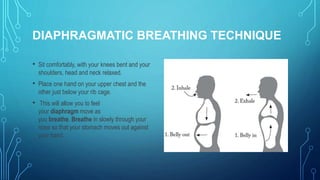
DIAPHRAGMATIC BREATHING TECHNIQUE
• Sit comfortably, with your knees bent and your
shoulders, head and neck relaxed.
• Place one hand on your upper chest and the
other just below your rib cage.
• This will allow you to feel
your diaphragm move as
you breathe. Breathe in slowly through your
nose so that your stomach moves out against
your hand.
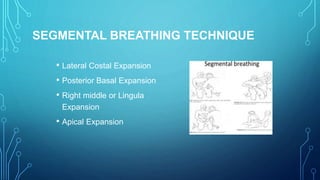
SEGMENTAL BREATHING TECHNIQUE
• Lateral Costal Expansion
• Posterior Basal Expansion
• Right middle or Lingula
Expansion
• Apical Expansion
GLOSSOPHARYNGEAL BREATHING
TECHNIQUE
• Take srveral “Gulps” of air.
• Then the mouth is closed and the
tongue pushes the air back and
traps it in the pharynx.
• The air is then forced into the lungs
when the glottis is opened. This
increases the depth of the
inspiration and the patient’s vital
capacity.
PURSED LIP BREATHING TECHNIQUE
• Bteath in slowly through your nose for
two counts, keeping your mouth closed.
• Take a normal breath.
• Pucker or "purse" your lips as if you
were going to whistle and breathe out.
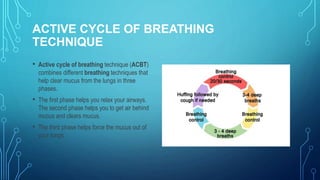
ACTIVE CYCLE OF BREATHING
TECHNIQUE
• Active cycle of breathing technique (ACBT)
combines different breathing techniques that
help clear mucus from the lungs in three
phases.
• The first phase helps you relax your airways.
The second phase helps you to get air behind
mucus and clears mucus.
• The third phase helps force the mucus out of
your lungs.
FORCED EXPIRATION TECHNIQUE (FET)
• In forced expiration, when it is
necessary to empty the lungs of more
air than normal, the abdominal muscles
contract and force the diaphragm
upwards and contraction of the internal
intercostal muscles actively pulls the
ribs downwards.Ju
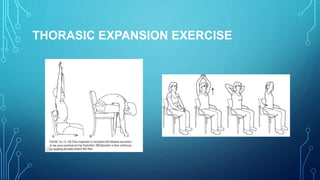
THORASIC EXPANSION EXERCISE
AIRWAY CLEARANCE TECHNIQUES
• Postural Drainage
• Cough and Huff
• Manual Percussion and Vibrations
• Active Cycle of Breathing Techniques
• Flutter
POSTURAL DRAINAGE
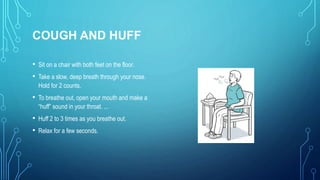
COUGH AND HUFF
• Sit on a chair with both feet on the floor.
• Take a slow, deep breath through your nose.
Hold for 2 counts.
• To breathe out, open your mouth and make a
“huff” sound in your throat. ...
• Huff 2 to 3 times as you breathe out.
• Relax for a few seconds.
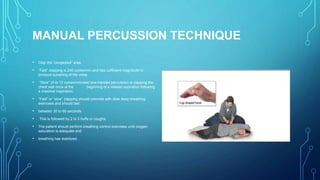
MANUAL PERCUSSION TECHNIQUE
• Clap the “congested” area.
• “Fast” clapping is 240 cycles/min and has sufficient magnitude to
produce quivering of the voice.
• “Slow” (6 to 12 cycles/minutes) one-handed percussion is clapping the
chest wall once at the beginning of a relaxed expiration following
a maximal inspiration.
• “Fast” or “slow” clapping should coincide with slow deep breathing
exercises and should last
• between 30 to 60 seconds.
• This is followed by 2 to 3 huffs or coughs.
• The patient should perform breathing control exercises until oxygen
saturation is adequate and
• breathing has stabilized.
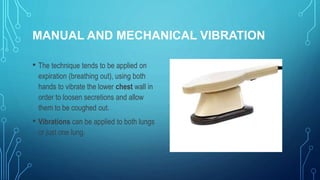
MANUAL AND MECHANICAL VIBRATION
• The technique tends to be applied on
expiration (breathing out), using both
hands to vibrate the lower chest wall in
order to loosen secretions and allow
them to be coughed out.
• Vibrations can be applied to both lungs
or just one lung.
INDICATION AND CONTRAINDICATION
• Excessive secretion retention
• Aspiration of fluid into lungs
• Clinical signs of mucus retention
• Suspicion of secretion retention
• Oxygen desaturation
• Bronchospasm
• Fractured ribs
• Bruising
• Patient intolerance
• Cardiovascular consequences
• Recent bright red hemoptysis.
• Recent pacemaker insertion.
• Pulmonary embolism.
FLUTTER
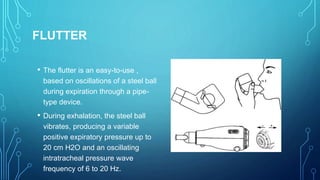
• The flutter is an easy-to-use ,
based on oscillations of a steel ball
during expiration through a pipe-
type device.
• During exhalation, the steel ball
vibrates, producing a variable
positive expiratory pressure up to
20 cm H2O and an oscillating
intratracheal pressure wave
frequency of 6 to 20 Hz.
INCENTIVE SPIROMETRY
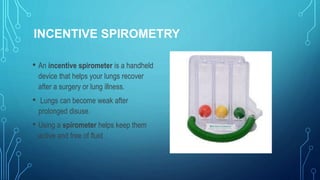
• An incentive spirometer is a handheld
device that helps your lungs recover
after a surgery or lung illness.
• Lungs can become weak after
prolonged disuse.
• Using a spirometer helps keep them
active and free of fluid
THANK YOU

CHEST PHYSIOTHERAPY TECHNIQUES

  • 1.
    CHEST PHYSIOTHERAPY TECHNIQUES DR PRASADNAIKMOODE PT (MPT) CLINICAL PHYSIOTHERAPIST
  • 2.
    BREATHING EXERCISES • DiaphragmaticBreathing Technique • Segmental Breathing Technique • Glossopharyngeal Breathing Technique • Pursed lip Breathing Technique
  • 3.
    DIAPHRAGMATIC BREATHING TECHNIQUE •Sit comfortably, with your knees bent and your shoulders, head and neck relaxed. • Place one hand on your upper chest and the other just below your rib cage. • This will allow you to feel your diaphragm move as you breathe. Breathe in slowly through your nose so that your stomach moves out against your hand.
  • 4.
    SEGMENTAL BREATHING TECHNIQUE •Lateral Costal Expansion • Posterior Basal Expansion • Right middle or Lingula Expansion • Apical Expansion
  • 5.
    GLOSSOPHARYNGEAL BREATHING TECHNIQUE • Takesrveral “Gulps” of air. • Then the mouth is closed and the tongue pushes the air back and traps it in the pharynx. • The air is then forced into the lungs when the glottis is opened. This increases the depth of the inspiration and the patient’s vital capacity.
  • 6.
    PURSED LIP BREATHINGTECHNIQUE • Bteath in slowly through your nose for two counts, keeping your mouth closed. • Take a normal breath. • Pucker or "purse" your lips as if you were going to whistle and breathe out.
  • 7.
    ACTIVE CYCLE OFBREATHING TECHNIQUE • Active cycle of breathing technique (ACBT) combines different breathing techniques that help clear mucus from the lungs in three phases. • The first phase helps you relax your airways. The second phase helps you to get air behind mucus and clears mucus. • The third phase helps force the mucus out of your lungs.
  • 8.
    FORCED EXPIRATION TECHNIQUE(FET) • In forced expiration, when it is necessary to empty the lungs of more air than normal, the abdominal muscles contract and force the diaphragm upwards and contraction of the internal intercostal muscles actively pulls the ribs downwards.Ju
  • 9.
  • 10.
    AIRWAY CLEARANCE TECHNIQUES •Postural Drainage • Cough and Huff • Manual Percussion and Vibrations • Active Cycle of Breathing Techniques • Flutter
  • 11.
  • 13.
    COUGH AND HUFF •Sit on a chair with both feet on the floor. • Take a slow, deep breath through your nose. Hold for 2 counts. • To breathe out, open your mouth and make a “huff” sound in your throat. ... • Huff 2 to 3 times as you breathe out. • Relax for a few seconds.
  • 14.
    MANUAL PERCUSSION TECHNIQUE •Clap the “congested” area. • “Fast” clapping is 240 cycles/min and has sufficient magnitude to produce quivering of the voice. • “Slow” (6 to 12 cycles/minutes) one-handed percussion is clapping the chest wall once at the beginning of a relaxed expiration following a maximal inspiration. • “Fast” or “slow” clapping should coincide with slow deep breathing exercises and should last • between 30 to 60 seconds. • This is followed by 2 to 3 huffs or coughs. • The patient should perform breathing control exercises until oxygen saturation is adequate and • breathing has stabilized.
  • 15.
    MANUAL AND MECHANICALVIBRATION • The technique tends to be applied on expiration (breathing out), using both hands to vibrate the lower chest wall in order to loosen secretions and allow them to be coughed out. • Vibrations can be applied to both lungs or just one lung.
  • 16.
    INDICATION AND CONTRAINDICATION •Excessive secretion retention • Aspiration of fluid into lungs • Clinical signs of mucus retention • Suspicion of secretion retention • Oxygen desaturation • Bronchospasm • Fractured ribs • Bruising • Patient intolerance • Cardiovascular consequences • Recent bright red hemoptysis. • Recent pacemaker insertion. • Pulmonary embolism.
  • 17.
    FLUTTER • The flutteris an easy-to-use , based on oscillations of a steel ball during expiration through a pipe- type device. • During exhalation, the steel ball vibrates, producing a variable positive expiratory pressure up to 20 cm H2O and an oscillating intratracheal pressure wave frequency of 6 to 20 Hz.
  • 18.
    INCENTIVE SPIROMETRY • Anincentive spirometer is a handheld device that helps your lungs recover after a surgery or lung illness. • Lungs can become weak after prolonged disuse. • Using a spirometer helps keep them active and free of fluid
  • 19.