Dr Arvind Kr Verma
What is oxygen therapy
 Oxygen therapy is the administration of oxygen at a concentration or
pressure greater than that found in the environment.
 Goal of supplemental oxygen therapy is to ensure appropriate oxygen
delivery to vital end-organ tissues.
 Oxygen therapy is a key treatment in respiratory care.
OXYGEN – A PRESCRIBED DRUG
 Must be written legibly by the doctor.
 Prescriptions should be dated by the doctor.
 Doctor must indicate duration of O2 therapy.
 The O2 concentration must be prescribed.
 The flow rate must be prescribed .
Tissue hypoxia
 Tissue hypoxia is governed by the balance between oxygen delivery and
oxygen utilization.
 Generally, failures in oxygen delivery lead to most instances of tissue
hypoxia.
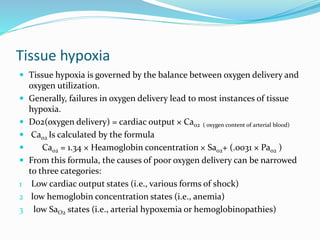
 Do2(oxygen delivery) = cardiac output × Cao2 ( oxygen content of arterial blood)
 Cao2 Is calculated by the formula
 Cao2 = 1.34 × Heamoglobin concentration × Sao2+ (.0031 × Pao2 )
 From this formula, the causes of poor oxygen delivery can be narrowed
to three categories:
1 Low cardiac output states (i.e., various forms of shock)
2 low hemoglobin concentration states (i.e., anemia)
3 low SaO2 states (i.e., arterial hypoxemia or hemoglobinopathies)
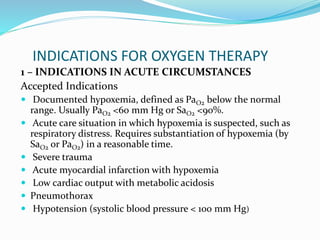
INDICATIONS FOR OXYGEN THERAPY
1 – INDICATIONS IN ACUTE CIRCUMSTANCES
Accepted Indications
 Documented hypoxemia, defined as PaO2 below the normal
range. Usually PaO2 <60 mm Hg or SaO2 <90%.
 Acute care situation in which hypoxemia is suspected, such as
respiratory distress. Requires substantiation of hypoxemia (by
SaO2 or PaO2) in a reasonable time.
 Severe trauma
 Acute myocardial infarction with hypoxemia
 Low cardiac output with metabolic acidosis
 Pneumothorax
 Hypotension (systolic blood pressure < 100 mm Hg)
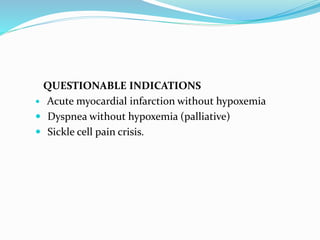
QUESTIONABLE INDICATIONS
 Acute myocardial infarction without hypoxemia
 Dyspnea without hypoxemia (palliative)
 Sickle cell pain crisis.
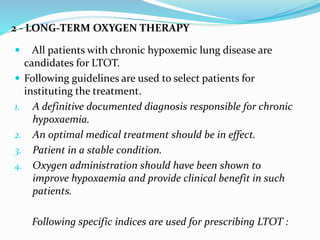
2 - LONG-TERM OXYGEN THERAPY
 All patients with chronic hypoxemic lung disease are
candidates for LTOT.
 Following guidelines are used to select patients for
instituting the treatment.
1. A definitive documented diagnosis responsible for chronic
hypoxaemia.
2. An optimal medical treatment should be in effect.
3. Patient in a stable condition.
4. Oxygen administration should have been shown to
improve hypoxaemia and provide clinical benefit in such
patients.
Following specific indices are used for prescribing LTOT :
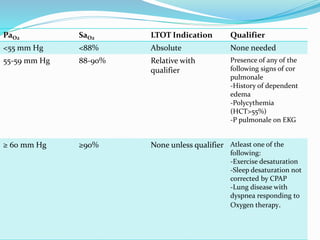
PaO2 SaO2 LTOT Indication Qualifier
<55 mm Hg <88% Absolute None needed
55-59 mm Hg 88-90% Relative with
qualifier
Presence of any of the
following signs of cor
pulmonale
-History of dependent
edema
-Polycythemia
(HCT>55%)
-P pulmonale on EKG
≥ 60 mm Hg ≥90% None unless qualifier Atleast one of the
following:
-Exercise desaturation
-Sleep desaturation not
corrected by CPAP
-Lung disease with
dyspnea responding to
Oxygen therapy.
 According to NOTT trial 1980 and BMRCD trial 1981 in patient
with COPD and hypoxemia, we can infer that supplemental
oxygen for >15 h/d is better than no oxygen at all, and that
continuous supplemental oxygen is better than nocturnal-only
therapy.
 Based on the BMRCD trial, most prescriptions for oxygen are
written for at least 15 hour/day
 SOURCE :
 NOTT Trial : Nocturnal Oxygen Therapy Trial Group. Ann Intern
Med. 1980;93(3):391–398.
 BMRCD (British Medical Research Council Domiciliary )Trial :
Report of the Medical Research Council Working Party. Lancet.
1981;1(8222):681–686.
BENEFITS OF LTOT
 Improvement in duration of survival.
 Improved intellectual function.
 Improves the severity of right heart failure.
 Decrease in red cell mass and hematocrit level
POTENTIAL BENEFITS
1- Increased exercise ability.
2-Improved quality of life.
3-Decrease in dyspnea.
4-Delayed development of cor pulmonale.
5-Decrease in hospitalization and exacerbations of respiratory failure .
Physiologic Indications for Nocturnal Oxygen Therapy
Patients with significant desaturation while sleeping may warrant nocturnal
supplemental oxygen.
 PaO2 <55 mm Hg with sleep or SaO2 <88% with sleep
Or
 PaO2 decreases more than 10 mm Hg with sleep
Or
 SaO2 decreases more than 5% with sleep and signs of nocturnal
hypoxemia including
• Pulmonary hypertension
• Daytime somnolence
• Cardiac arrythmias
 Patient should be evaluated for a sleep disorder and need for positive
pressure device
Oxygen Therapy In Air Travel
 Modern aircrafts are pressurised to cabin altitudes upto 8000 feet.
 At this altitude oxygen will be equivalent to that of breathing 15% at sea
level.
 Patients whose PaO2 ≥70 mm Hg (SpO2 > 95%) at ground level, their in-
flight PaO2 will likely exceed 50 mm Hg, which is generally considered
adequate .
 Methods for preflight hypoxia testing are:
 6 Minute Walk Test - if a patient has an abnormally low 6-minute
walk distance, has significant dyspnea during the test, or experiences a
decline in SpO2 to <85%, the patient will likely need supplemental oxygen
during air travel.
 Hypoxia altitude simulation test - In this test, an arterial blood
gas is drawn just prior to administration of a gas mixture with an FIO2 of
15.1%. Another arterial blood gas is drawn 20 minutes later, while the
patient breathes the hypoxic gas mixture. If the PaO2 is <50 mm Hg,
administration of supplemental oxygen during flight is recommended.
If the PaO2 is between 50 and 55 mm Hg, further testing should be
considered, including a 6-minute walk test.
OXYGEN DELIVERY DEVICES
LOW FLOW (VARIABLE
PERFORMANCE)
HIGH FLOW (FIXED
PERFORMANCE)
1 Nasal cannulae
2 Oxygen Mask
3 Mask with reservoir bag
1 Venturi mask
2 High flow nasal cannulae
3 High flow oxygen generators
WHAT IS: LOW FLOW
 Low-flow systems deliver only a fraction of the patient’s minute
ventilation as pure oxygen
 The maximum flow in these systems is 15 L/min.
 Since a patient’s tidal volume usually varies from breath to breath, and
the delivered flow of oxygen from the device is constant, the fraction of
inspired oxygen for any given breath is impossible to predict.
 Because of the uncertainty of the FIO2 delivered by low-flow devices,
they are sometimes referred to as “variable performance devices.”
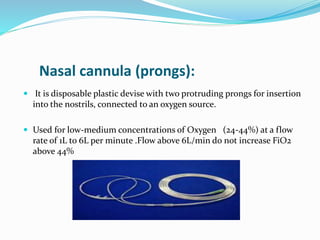
Nasal cannula (prongs):
 It is disposable plastic devise with two protruding prongs for insertion
into the nostrils, connected to an oxygen source.
 Used for low-medium concentrations of Oxygen (24-44%) at a flow
rate of 1L to 6L per minute .Flow above 6L/min do not increase FiO2
above 44%
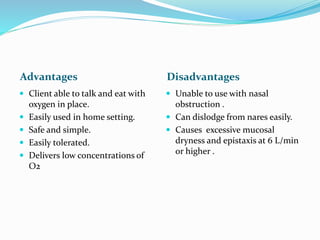
Advantages Disadvantages
 Client able to talk and eat with
oxygen in place.
 Easily used in home setting.
 Safe and simple.
 Easily tolerated.
 Delivers low concentrations of
O2
 Unable to use with nasal
obstruction .
 Can dislodge from nares easily.
 Causes excessive mucosal
dryness and epistaxis at 6 L/min
or higher .
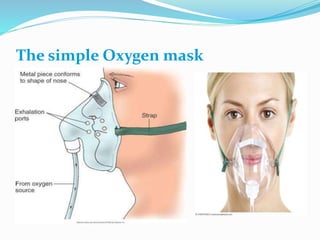
The simple Oxygen mask
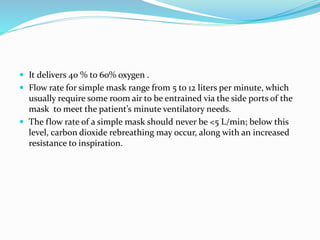
 It delivers 40 % to 60% oxygen .
 Flow rate for simple mask range from 5 to 12 liters per minute, which
usually require some room air to be entrained via the side ports of the
mask to meet the patient’s minute ventilatory needs.
 The flow rate of a simple mask should never be <5 L/min; below this
level, carbon dioxide rebreathing may occur, along with an increased
resistance to inspiration.
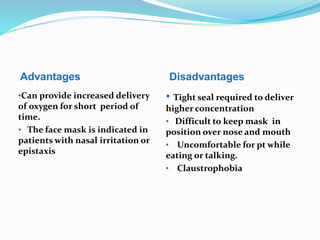
Advantages Disadvantages
•Can provide increased delivery
of oxygen for short period of
time.
• The face mask is indicated in
patients with nasal irritation or
epistaxis
• Tight seal required to deliver
higher concentration
• Difficult to keep mask in
position over nose and mouth
• Uncomfortable for pt while
eating or talking.
• Claustrophobia
Mask with reservoir bag
 Two type
1 partial rebreathing reservoir mask
2 Non rebreathing reservoir mask
3 PROVIDE FLOW BETWEEN 8-15 L/ M
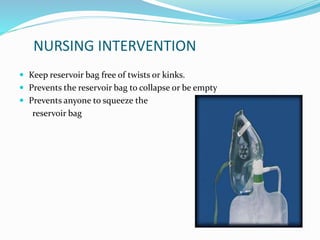
The partial re-breathing reservoir mask:
 The mask has a reservoir bag that must remain inflated during both
inspiration & expiration.
 It collects the first parts of the patients' exhaled air.
 The oxygen flow rate must be maintained at a minimum of 6 L/min to
ensure that the patient does not rebreath large amounts of exhaled air.
 The remaining exhaled air exits through vents.
 It is used to deliver oxygen concentrations up to 80%
 .
NURSING INTERVENTION
 Keep reservoir bag free of twists or kinks.
 Prevents the reservoir bag to collapse or be empty
 Prevents anyone to squeeze the
reservoir bag
ADVANTAGES DISADVANTAGES
 Can inhale room air through
opening in mask if oxygen
supply briefly interrupted.
 Require tight seal
 Eating and talking
difficult,uncmfortable
 claustrophobia
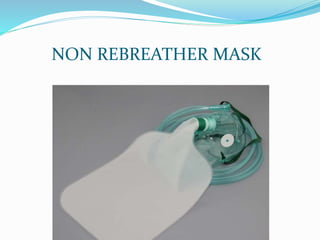
The non rebreathing reservoir mask
 Provides highest concentration of oxygen(60 -100%) at flow rate of 4 -
10 L/min.
 Similar to the partial rebreather mask except that two one way valves
are present to conserve the exhaled air. The bag is an oxygen reservoir.
 When the patient exhales, the one way valve closes and all the exhaled
air is vent out and the patient does not re breath any of the exhaled air.
NON REBREATHER MASK
Nursing Intervention
 Maintain flow rate so reservoir bag collapse only slightly during
inspiration.
 Check that valves and rubber flap are functioning properly (open
during expiration)
 Never allow anybody to squeeze the bag empty.
ADVANTAGES DISADVANTAGE
 Delivers the highest possible O2
concentration.
 Suitable for patient breathing
spontaneously with severe
hypoxemia.
 Impractical for LTOT.
 Malfunction can cause CO2
build up.
 Suffocation
 Expensive
 claustrophobia
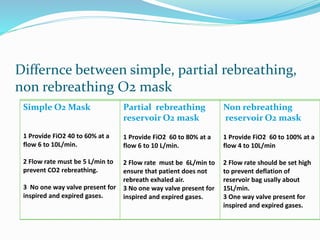
Differnce between simple, partial rebreathing,
non rebreathing O2 mask
Simple O2 Mask
1 Provide FiO2 40 to 60% at a
flow 6 to 10L/min.
2 Flow rate must be 5 L/min to
prevent CO2 rebreathing.
3 No one way valve present for
inspired and expired gases.
Partial rebreathing
reservoir O2 mask
1 Provide FiO2 60 to 80% at a
flow 6 to 10 L/min.
2 Flow rate must be 6L/min to
ensure that patient does not
rebreath exhaled air.
3 No one way valve present for
inspired and expired gases.
Non rebreathing
reservoir O2 mask
1 Provide FiO2 60 to 100% at a
flow 4 to 10L/min
2 Flow rate should be set high
to prevent deflation of
reservoir bag usally about
15L/min.
3 One way valve present for
inspired and expired gases.
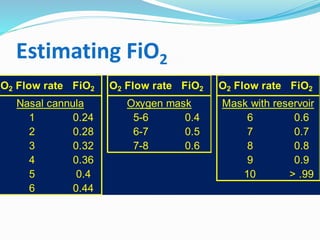
Estimating FiO2
O2 Flow rate FiO2 O2 Flow rate FiO2 O2 Flow rate FiO2
Nasal cannula Oxygen mask Mask with reservoir
1 0.24 5-6 0.4 6 0.6
2 0.28 6-7 0.5 7 0.7
3 0.32 7-8 0.6 8 0.8
4 0.36 9 0.9
5 0.4 10 > .99
6 0.44
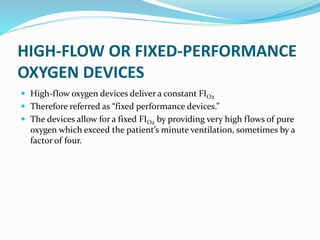
HIGH-FLOW OR FIXED-PERFORMANCE
OXYGEN DEVICES
 High-flow oxygen devices deliver a constant FIO2
 Therefore referred as “fixed performance devices.”
 The devices allow for a fixed FIO2 by providing very high flows of pure
oxygen which exceed the patient’s minute ventilation, sometimes by a
factor of four.
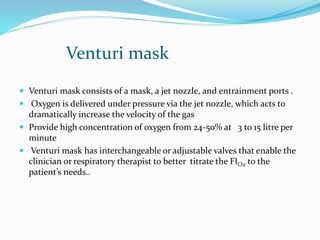
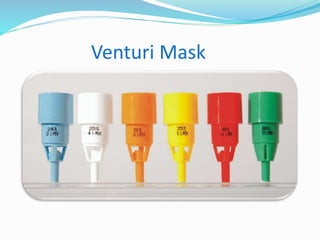
Venturi mask
 Venturi mask consists of a mask, a jet nozzle, and entrainment ports .
 Oxygen is delivered under pressure via the jet nozzle, which acts to
dramatically increase the velocity of the gas
 Provide high concentration of oxygen from 24-50% at 3 to 15 litre per
minute
 Venturi mask has interchangeable or adjustable valves that enable the
clinician or respiratory therapist to better titrate the FIO2 to the
patient’s needs..
Venturi Mask
Venturi Mask
 Advantages
Delivers most precise oxygen Concentration
Doesn’t dry mucous membranes
 Disadvantages
uncomfortable
Risk for skin irritation
Produce respiratory depression in COPD patient with high oxygen concentration
50%
High-Flow Generators for O2 therapy
 High-flow generators are used to ensure noninvasive delivery of a
constant, high concentration of inspired oxygen.
 High-flow generators are capable of delivering gas in excess of 40 to 60
L/min.
 Given the high flows delivered, a constant FIO2 is achieved, regardless
of the patient’s minute ventilation and fit of the mask.
 The devices are noisy and require specialized personnel to set up and
monitor, limiting their usage to intensive care settings.
High-Flow Nasal Cannulae
 Recently, nasal cannulae that can deliver much higher rates of flow
than simple nasal cannulae have been developed (e.g., Vapotherm®)
that allow delivery of much higher flows (and therefore, higher FIO2) of
humidified oxygen.
 The devices can deliver between 1 and 60 L/min and may be more
comfortable than a facemask.
High flow nasal canulae
HAZARDS OF O2 THERAPY
1.Drying of mucous membrane.
2.Depression of ventilation in COPD.
3. Atlectasis due to absorption collapse.
4.O2 toxicity.
5.ACUTE RESPIRATORY DISTRESS SYNDROME AND BRONCHOPULMONARY
DYSPLASIA
OXYGEN TOXICITY
 Clinical toxicity is generally absent when the FIO2 is <50%.
 The exposure level at which oxygen toxicity occurs has not been clearly
identified, although a higher FIO2 experienced for a longer period of
time is associated with an increased risk.
 1.Pulmonary oxygen toxicity (Lorrain-Smith effect)
- Symptoms:
- substernal pain, irresistable cough, dyspnoea,
- Vital Capicity decreases , compliance decreases .
- pulmonary interstitial edema leading to fibrosis.
.
 2.Retrolental fibroplasia :
- Occurs when PaO2 more than 80mmhg for more than 3 hrs in new
born.
- Very premature babies are more susceptible.
- O2 saturation must be around 90-92 %, to prevent it.
Thank you

Oxygen therapy

  • 1.
  • 2.
    What is oxygentherapy  Oxygen therapy is the administration of oxygen at a concentration or pressure greater than that found in the environment.  Goal of supplemental oxygen therapy is to ensure appropriate oxygen delivery to vital end-organ tissues.  Oxygen therapy is a key treatment in respiratory care.
  • 3.
    OXYGEN – APRESCRIBED DRUG  Must be written legibly by the doctor.  Prescriptions should be dated by the doctor.  Doctor must indicate duration of O2 therapy.  The O2 concentration must be prescribed.  The flow rate must be prescribed .
  • 4.
    Tissue hypoxia  Tissuehypoxia is governed by the balance between oxygen delivery and oxygen utilization.  Generally, failures in oxygen delivery lead to most instances of tissue hypoxia.  Do2(oxygen delivery) = cardiac output × Cao2 ( oxygen content of arterial blood)  Cao2 Is calculated by the formula  Cao2 = 1.34 × Heamoglobin concentration × Sao2+ (.0031 × Pao2 )  From this formula, the causes of poor oxygen delivery can be narrowed to three categories: 1 Low cardiac output states (i.e., various forms of shock) 2 low hemoglobin concentration states (i.e., anemia) 3 low SaO2 states (i.e., arterial hypoxemia or hemoglobinopathies)
  • 5.
    INDICATIONS FOR OXYGENTHERAPY 1 – INDICATIONS IN ACUTE CIRCUMSTANCES Accepted Indications  Documented hypoxemia, defined as PaO2 below the normal range. Usually PaO2 <60 mm Hg or SaO2 <90%.  Acute care situation in which hypoxemia is suspected, such as respiratory distress. Requires substantiation of hypoxemia (by SaO2 or PaO2) in a reasonable time.  Severe trauma  Acute myocardial infarction with hypoxemia  Low cardiac output with metabolic acidosis  Pneumothorax  Hypotension (systolic blood pressure < 100 mm Hg)
  • 6.
    QUESTIONABLE INDICATIONS  Acutemyocardial infarction without hypoxemia  Dyspnea without hypoxemia (palliative)  Sickle cell pain crisis.
  • 7.
    2 - LONG-TERMOXYGEN THERAPY  All patients with chronic hypoxemic lung disease are candidates for LTOT.  Following guidelines are used to select patients for instituting the treatment. 1. A definitive documented diagnosis responsible for chronic hypoxaemia. 2. An optimal medical treatment should be in effect. 3. Patient in a stable condition. 4. Oxygen administration should have been shown to improve hypoxaemia and provide clinical benefit in such patients. Following specific indices are used for prescribing LTOT :
  • 8.
    PaO2 SaO2 LTOTIndication Qualifier <55 mm Hg <88% Absolute None needed 55-59 mm Hg 88-90% Relative with qualifier Presence of any of the following signs of cor pulmonale -History of dependent edema -Polycythemia (HCT>55%) -P pulmonale on EKG ≥ 60 mm Hg ≥90% None unless qualifier Atleast one of the following: -Exercise desaturation -Sleep desaturation not corrected by CPAP -Lung disease with dyspnea responding to Oxygen therapy.
  • 9.
     According toNOTT trial 1980 and BMRCD trial 1981 in patient with COPD and hypoxemia, we can infer that supplemental oxygen for >15 h/d is better than no oxygen at all, and that continuous supplemental oxygen is better than nocturnal-only therapy.  Based on the BMRCD trial, most prescriptions for oxygen are written for at least 15 hour/day  SOURCE :  NOTT Trial : Nocturnal Oxygen Therapy Trial Group. Ann Intern Med. 1980;93(3):391–398.  BMRCD (British Medical Research Council Domiciliary )Trial : Report of the Medical Research Council Working Party. Lancet. 1981;1(8222):681–686.
  • 10.
    BENEFITS OF LTOT Improvement in duration of survival.  Improved intellectual function.  Improves the severity of right heart failure.  Decrease in red cell mass and hematocrit level POTENTIAL BENEFITS 1- Increased exercise ability. 2-Improved quality of life. 3-Decrease in dyspnea. 4-Delayed development of cor pulmonale. 5-Decrease in hospitalization and exacerbations of respiratory failure .
  • 11.
    Physiologic Indications forNocturnal Oxygen Therapy Patients with significant desaturation while sleeping may warrant nocturnal supplemental oxygen.  PaO2 <55 mm Hg with sleep or SaO2 <88% with sleep Or  PaO2 decreases more than 10 mm Hg with sleep Or  SaO2 decreases more than 5% with sleep and signs of nocturnal hypoxemia including • Pulmonary hypertension • Daytime somnolence • Cardiac arrythmias  Patient should be evaluated for a sleep disorder and need for positive pressure device
  • 12.
    Oxygen Therapy InAir Travel  Modern aircrafts are pressurised to cabin altitudes upto 8000 feet.  At this altitude oxygen will be equivalent to that of breathing 15% at sea level.  Patients whose PaO2 ≥70 mm Hg (SpO2 > 95%) at ground level, their in- flight PaO2 will likely exceed 50 mm Hg, which is generally considered adequate .
  • 13.
     Methods forpreflight hypoxia testing are:  6 Minute Walk Test - if a patient has an abnormally low 6-minute walk distance, has significant dyspnea during the test, or experiences a decline in SpO2 to <85%, the patient will likely need supplemental oxygen during air travel.  Hypoxia altitude simulation test - In this test, an arterial blood gas is drawn just prior to administration of a gas mixture with an FIO2 of 15.1%. Another arterial blood gas is drawn 20 minutes later, while the patient breathes the hypoxic gas mixture. If the PaO2 is <50 mm Hg, administration of supplemental oxygen during flight is recommended. If the PaO2 is between 50 and 55 mm Hg, further testing should be considered, including a 6-minute walk test.
  • 14.
    OXYGEN DELIVERY DEVICES LOWFLOW (VARIABLE PERFORMANCE) HIGH FLOW (FIXED PERFORMANCE) 1 Nasal cannulae 2 Oxygen Mask 3 Mask with reservoir bag 1 Venturi mask 2 High flow nasal cannulae 3 High flow oxygen generators
  • 15.
    WHAT IS: LOWFLOW  Low-flow systems deliver only a fraction of the patient’s minute ventilation as pure oxygen  The maximum flow in these systems is 15 L/min.  Since a patient’s tidal volume usually varies from breath to breath, and the delivered flow of oxygen from the device is constant, the fraction of inspired oxygen for any given breath is impossible to predict.  Because of the uncertainty of the FIO2 delivered by low-flow devices, they are sometimes referred to as “variable performance devices.”
  • 16.
    Nasal cannula (prongs): It is disposable plastic devise with two protruding prongs for insertion into the nostrils, connected to an oxygen source.  Used for low-medium concentrations of Oxygen (24-44%) at a flow rate of 1L to 6L per minute .Flow above 6L/min do not increase FiO2 above 44%
  • 17.
    Advantages Disadvantages  Clientable to talk and eat with oxygen in place.  Easily used in home setting.  Safe and simple.  Easily tolerated.  Delivers low concentrations of O2  Unable to use with nasal obstruction .  Can dislodge from nares easily.  Causes excessive mucosal dryness and epistaxis at 6 L/min or higher .
  • 18.
  • 19.
     It delivers40 % to 60% oxygen .  Flow rate for simple mask range from 5 to 12 liters per minute, which usually require some room air to be entrained via the side ports of the mask to meet the patient’s minute ventilatory needs.  The flow rate of a simple mask should never be <5 L/min; below this level, carbon dioxide rebreathing may occur, along with an increased resistance to inspiration.
  • 20.
    Advantages Disadvantages •Can provideincreased delivery of oxygen for short period of time. • The face mask is indicated in patients with nasal irritation or epistaxis • Tight seal required to deliver higher concentration • Difficult to keep mask in position over nose and mouth • Uncomfortable for pt while eating or talking. • Claustrophobia
  • 21.
    Mask with reservoirbag  Two type 1 partial rebreathing reservoir mask 2 Non rebreathing reservoir mask 3 PROVIDE FLOW BETWEEN 8-15 L/ M
  • 22.
    The partial re-breathingreservoir mask:  The mask has a reservoir bag that must remain inflated during both inspiration & expiration.  It collects the first parts of the patients' exhaled air.  The oxygen flow rate must be maintained at a minimum of 6 L/min to ensure that the patient does not rebreath large amounts of exhaled air.  The remaining exhaled air exits through vents.  It is used to deliver oxygen concentrations up to 80%  .
  • 23.
    NURSING INTERVENTION  Keepreservoir bag free of twists or kinks.  Prevents the reservoir bag to collapse or be empty  Prevents anyone to squeeze the reservoir bag
  • 24.
    ADVANTAGES DISADVANTAGES  Caninhale room air through opening in mask if oxygen supply briefly interrupted.  Require tight seal  Eating and talking difficult,uncmfortable  claustrophobia
  • 25.
    The non rebreathingreservoir mask  Provides highest concentration of oxygen(60 -100%) at flow rate of 4 - 10 L/min.  Similar to the partial rebreather mask except that two one way valves are present to conserve the exhaled air. The bag is an oxygen reservoir.  When the patient exhales, the one way valve closes and all the exhaled air is vent out and the patient does not re breath any of the exhaled air.
  • 26.
  • 27.
    Nursing Intervention  Maintainflow rate so reservoir bag collapse only slightly during inspiration.  Check that valves and rubber flap are functioning properly (open during expiration)  Never allow anybody to squeeze the bag empty.
  • 28.
    ADVANTAGES DISADVANTAGE  Deliversthe highest possible O2 concentration.  Suitable for patient breathing spontaneously with severe hypoxemia.  Impractical for LTOT.  Malfunction can cause CO2 build up.  Suffocation  Expensive  claustrophobia
  • 29.
    Differnce between simple,partial rebreathing, non rebreathing O2 mask Simple O2 Mask 1 Provide FiO2 40 to 60% at a flow 6 to 10L/min. 2 Flow rate must be 5 L/min to prevent CO2 rebreathing. 3 No one way valve present for inspired and expired gases. Partial rebreathing reservoir O2 mask 1 Provide FiO2 60 to 80% at a flow 6 to 10 L/min. 2 Flow rate must be 6L/min to ensure that patient does not rebreath exhaled air. 3 No one way valve present for inspired and expired gases. Non rebreathing reservoir O2 mask 1 Provide FiO2 60 to 100% at a flow 4 to 10L/min 2 Flow rate should be set high to prevent deflation of reservoir bag usally about 15L/min. 3 One way valve present for inspired and expired gases.
  • 30.
    Estimating FiO2 O2 Flowrate FiO2 O2 Flow rate FiO2 O2 Flow rate FiO2 Nasal cannula Oxygen mask Mask with reservoir 1 0.24 5-6 0.4 6 0.6 2 0.28 6-7 0.5 7 0.7 3 0.32 7-8 0.6 8 0.8 4 0.36 9 0.9 5 0.4 10 > .99 6 0.44
  • 31.
    HIGH-FLOW OR FIXED-PERFORMANCE OXYGENDEVICES  High-flow oxygen devices deliver a constant FIO2  Therefore referred as “fixed performance devices.”  The devices allow for a fixed FIO2 by providing very high flows of pure oxygen which exceed the patient’s minute ventilation, sometimes by a factor of four.
  • 32.
    Venturi mask  Venturimask consists of a mask, a jet nozzle, and entrainment ports .  Oxygen is delivered under pressure via the jet nozzle, which acts to dramatically increase the velocity of the gas  Provide high concentration of oxygen from 24-50% at 3 to 15 litre per minute  Venturi mask has interchangeable or adjustable valves that enable the clinician or respiratory therapist to better titrate the FIO2 to the patient’s needs..
  • 33.
  • 34.
    Venturi Mask  Advantages Deliversmost precise oxygen Concentration Doesn’t dry mucous membranes  Disadvantages uncomfortable Risk for skin irritation Produce respiratory depression in COPD patient with high oxygen concentration 50%
  • 35.
    High-Flow Generators forO2 therapy  High-flow generators are used to ensure noninvasive delivery of a constant, high concentration of inspired oxygen.  High-flow generators are capable of delivering gas in excess of 40 to 60 L/min.  Given the high flows delivered, a constant FIO2 is achieved, regardless of the patient’s minute ventilation and fit of the mask.  The devices are noisy and require specialized personnel to set up and monitor, limiting their usage to intensive care settings.
  • 36.
    High-Flow Nasal Cannulae Recently, nasal cannulae that can deliver much higher rates of flow than simple nasal cannulae have been developed (e.g., Vapotherm®) that allow delivery of much higher flows (and therefore, higher FIO2) of humidified oxygen.  The devices can deliver between 1 and 60 L/min and may be more comfortable than a facemask.
  • 37.
  • 38.
    HAZARDS OF O2THERAPY 1.Drying of mucous membrane. 2.Depression of ventilation in COPD. 3. Atlectasis due to absorption collapse. 4.O2 toxicity. 5.ACUTE RESPIRATORY DISTRESS SYNDROME AND BRONCHOPULMONARY DYSPLASIA
  • 39.
    OXYGEN TOXICITY  Clinicaltoxicity is generally absent when the FIO2 is <50%.  The exposure level at which oxygen toxicity occurs has not been clearly identified, although a higher FIO2 experienced for a longer period of time is associated with an increased risk.  1.Pulmonary oxygen toxicity (Lorrain-Smith effect) - Symptoms: - substernal pain, irresistable cough, dyspnoea, - Vital Capicity decreases , compliance decreases . - pulmonary interstitial edema leading to fibrosis.
  • 40.
    .  2.Retrolental fibroplasia: - Occurs when PaO2 more than 80mmhg for more than 3 hrs in new born. - Very premature babies are more susceptible. - O2 saturation must be around 90-92 %, to prevent it.
  • 41.

Editor's Notes

  • #31 Source :Fishman’s Pulmonary Diseases and Disorders 5th edition year 2015