Procedural Sedation
Kate Donaghy
26th March 2015
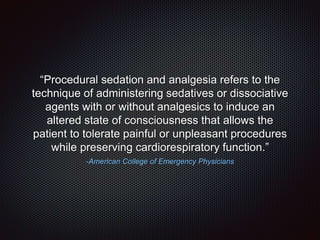
-American College of Emergency Physicians
“Procedural sedation and analgesia refers to the
technique of administering sedatives or dissociative
agents with or without analgesics to induce an
altered state of consciousness that allows the
patient to tolerate painful or unpleasant procedures
while preserving cardiorespiratory function.”
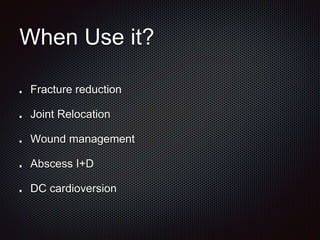
When Use it?
Fracture reduction
Joint Relocation
Wound management
Abscess I+D
DC cardioversion
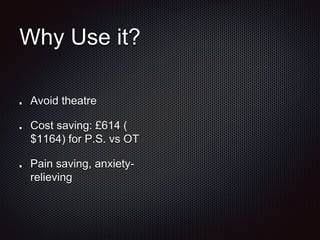
Why Use it?
Avoid theatre
Cost saving: £614 (
$1164) for P.S. vs OT
Pain saving, anxiety-
relieving
Alternatives
Local anaesthetic direct
infiltration
Nerve blocks
Bier’s Block
GA
Text
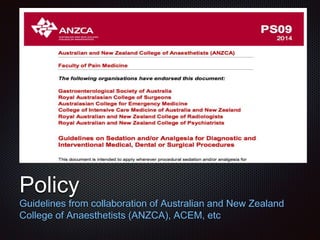
Policy
Guidelines from collaboration of Australian and New Zealand
College of Anaesthetists (ANZCA), ACEM, etc
Levels of Sedation (ASA)
Minimal Sedation
Moderate Sedation (‘Conscious sedation’)
Deep Sedation
General Anaesthesia
Dissociative Sedation
The Ideal agent
Predictable induction and maintenance of sedation
prompt recovery
minimal recall
no complications
Often an opioid analgesic with a sedative and
amnesic agent
Options
Nitrous Oxide
Propofol
Ketamine
Midazolam
Etomidate
Opioids in combination
Combination eg Ketamine-
Propofol
Propofol
Benefits: rapid onset and recovery
Onset: 30-60sec; Peak 60-120sec, Duration 3-10min
Contraindication: allergy to egg and soy
Caution:haemodynamically unstable, elderly
SEs: hypotension, bradycardia, resp depression, pain on
infusion
No analgesic properties: give with an opioid
Dose: 0.5-2mg/kg
Midazolam
Anxiolytic, sedative, amnesic. No analgesia
Reversible
onset 1-5min, peak 10-15min, duration 1-2.5hrs
SEs: hypotension, resp depression, paradoxical reaction
Dose: 0.025-0.05mg/kg titrated to 0.4mg/kg max
caution: avoid alcohol and mental-alert activities for
24hrs
Nitrous Oxide
Inhalational: amnesia, sedation, analgesia
Fast induction
Contraindication: pneumothorax, bowel obstruction
Caution: diffusion hypoxia: O2 for 20min after
SEs: vomiting
Dose: mask inhalation: 30-70%, safety valve, if pt overly
sedated, mouth piece falls
Ketamine
Dissociative Anaesthetic
IV: Onset 1-2min, peak 2-3min, duration 5-15min
Benefits: Increase HR and BP, maintain airway reflexes, bronchodilator
SEs: laryngospasm, emergence reactions, oral secretions, reduce seizure
threshold, vomiting, resp depression, ???raised ICP
Good for children more than adults
Contraindications: schizophrenia, raised IOP, (URTIs)
Warn parents re stare; pleasant dreams!, room quiet
Dose: 0.5-1.5mg/kg IV, 2-4mg/kg IM
Etomidate
Acts on GABA receptor
onset 20-60sec, peak 1min, duration 3-8min
limited effects on cardiovascular function
good for altered myocardial contractility and raised ICP
SEs: n+v, pain at injection site, myoclonus, adrenocortical
suppression?
Dose: 0.1-0.15mg/kg
Opioids
Morphine 0.05-0.1mg/kg every 5-15min
onset 1-2.5min, peak 10-20min, duration 1-4hrs
SEs: n+v, dizziness, injection site pain, agitation, flushing,
paraesthesia
Fentanyl 1-2mcg/kg
onset immediate, peak 1-3min, duration 30-60min
SEs: resp depression, rigidity (rapid IV), brady and
hypotension, dizzy, n+v, diaphoresis
Ketofol
Ketamine - emergence reactions in adults, emesis
Propofol - hypotension and respiratory depression
combination to give sedation that is closer to ideal,
avoid opioid use with propofol
RCTs suggest ketofol no better than propofol
Australia
EMA - Procedural Sedation Practices - 2011
Propofol used in 2/3 cases (adults 94%)
65% ketamine use was in children
Half of pts did not have pre-procedural analgesia:
oligoanalgesia is an issue
Morphine:Fentanyl 4:1
Methods
Assessment
Preparation
Procedure
Aftercare
Assessment
Patient: HPC, PMHx, DHx, Allergies, prev anaesthetics, loose teeth,
exercise tolerance, LMP
Fasting status
Airway grade: Mallampati score
CVS/Resp exam
Review results
Department Status
Consent
Cautions
elderly, children <2yr
heart, lung, Cerebrovascular, renal, liver disease
morbid obesity, OSA, difficult AW
cardiovascular compromise, severe anaemia
potential for aspiration e.g. Pregnant
anaesthetic adverse events previously
ASA grades P4-5
Preparation
At least 3 appropriately trained staff (1 for drugs and AW, 1 proceduralist,
assistant) (AW, ALS competent)
Procedure Room appropriate, lighting
oxygen (FM, NC)
BMV apparatus, airways, intubation equip, suction
crash cart, defibrillator
medications, emergency drugs
monitoring (cardiac, pulse oximeter, capnography, BP)
Emergency Plan
Procedure
IVC, positioning
Pre-oxygenation
Baseline observations
Medications
Monitoring, depth of
sedation
Aftercare
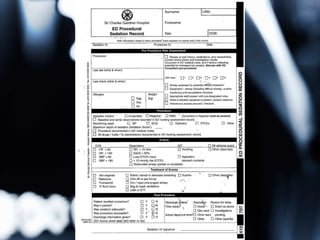
Documentation: drugs, IVF, monitoring, rescue
interventions, complications
Recovery: Doc present until spont respiration, stable vitals,
protective reflexes, sedation level 2
Further recovery: fully awake, obs, pain, dressing,
mobilising, E+D, voided
discharge to responsible adult
advice: E+D, analgesia, driving/machinery/decisions
Complications
Sedation related events common: 1 in 5
Vomiting, aspiration, hypo/hypertension,
brady/tachycardia, hypoventilation, desaturation,
obstructed airway
Adverse outcomes rare
Higher risk (resp): age, level of sedation, premed,
sedation drug (person in charge)
Managing Complications
Resp Depression: stimulation, airway manoeuvres, BMV, Airways
Hypotension: IVF, elevate legs, metaraminol
Laryngospasm: 100% O2 with mask, tight seal, closed expiratory valve ->
positive pressure
manually ventilate
Break laryngospasm - Larson’s point
Deepening sedation - propofol
suxamethonium IV or IM
Intubate
Controversies
Fasting status? 2+6 or no evidence of decreased aspiration?
Capnography? prevent hypoxia but no difference in outcome
How many doctors? 1 or 2?
Supplemental Opioids? Respiratory depression vs catecholamine
surge
Nasal NIV?? - AJEM 2015
Conclusion
Essential skill for ED
trainees
Know of policies and
departmental
credentialing
Choose your patient
Anticipate complications
ReferencesAustralian and New Zealand College of Anaesthetists (ANZCA) (2014) Guidelines on Sedation and/or Analgesia for Diagnostic and
Interventional Medical, Dental or Surgical Procedures. [Online]. Available at: http://www.anzca.edu.au/resources/professional-
documents/pdfs/ps09-2014-guidelines-on-sedation-and-or-analgesia-for-diagnostic-and-interventional-medical-dental-or-surgical-
procedures.pdf (Accessed: 24/3/15).
Bell A, Taylor DM et al. (2011) 'Procedural sedation practices in Australian Emergency Departments', Emergency Medicine
Australasia, 23, pp. 458-465.
Godwin SA, Burton JH et al. (2014) 'Clinical Policy: Procedural Sedation and Analgesia in the Emergency Department', Annals of
Emergency Medicine, 63, pp. 247-258.
Boyle A, Dixon V et al. (2010) 'Sedation of children in the emergency department for short painful procedures compared with
theatre, how much does it save? Economic evaluation', Emergency Medicine Journal, 28, pp. 383-386.
Andolfatto G, Abu-Laban RB et al (2012) 'Ketamine-Propofol Combination (Ketofol) Versus Propofol Alone for Emergency
Department Procedural Sedation and Analgesia: A Randomized Double-Blind Trial', Annals of Emergency Medicine, 59(6), pp. 504-
512.
Miner JR, Moore JC et al (2013) 'Randomized Clinical Trial of the Effect of Supplemental Opioids in Procedural Sedation with
Propofol on Serum Catecholamines', Academic Emergency Medicine, 20(4), pp. 330-337.
Strayer RJ, Caputo ND (2015) 'Noninvasive ventilation during procedural sedation in the ED: a case series', American Journal of
Emergency Medicine, 33, pp. 116-120.
Taylor DM, Bell A et al. (2011) 'Risk factors for sedation-related events during procedural sedation in the emergency department',
Emergency Medicine Australasia , 23(), pp. 466-473.

Procedural Sedation

  • 1.
  • 2.
    -American College ofEmergency Physicians “Procedural sedation and analgesia refers to the technique of administering sedatives or dissociative agents with or without analgesics to induce an altered state of consciousness that allows the patient to tolerate painful or unpleasant procedures while preserving cardiorespiratory function.”
  • 3.
    When Use it? Fracturereduction Joint Relocation Wound management Abscess I+D DC cardioversion
  • 4.
    Why Use it? Avoidtheatre Cost saving: £614 ( $1164) for P.S. vs OT Pain saving, anxiety- relieving
  • 5.
  • 6.
    Text Policy Guidelines from collaborationof Australian and New Zealand College of Anaesthetists (ANZCA), ACEM, etc
  • 7.
    Levels of Sedation(ASA) Minimal Sedation Moderate Sedation (‘Conscious sedation’) Deep Sedation General Anaesthesia Dissociative Sedation
  • 8.
    The Ideal agent Predictableinduction and maintenance of sedation prompt recovery minimal recall no complications Often an opioid analgesic with a sedative and amnesic agent
  • 9.
  • 10.
    Propofol Benefits: rapid onsetand recovery Onset: 30-60sec; Peak 60-120sec, Duration 3-10min Contraindication: allergy to egg and soy Caution:haemodynamically unstable, elderly SEs: hypotension, bradycardia, resp depression, pain on infusion No analgesic properties: give with an opioid Dose: 0.5-2mg/kg
  • 11.
    Midazolam Anxiolytic, sedative, amnesic.No analgesia Reversible onset 1-5min, peak 10-15min, duration 1-2.5hrs SEs: hypotension, resp depression, paradoxical reaction Dose: 0.025-0.05mg/kg titrated to 0.4mg/kg max caution: avoid alcohol and mental-alert activities for 24hrs
  • 12.
    Nitrous Oxide Inhalational: amnesia,sedation, analgesia Fast induction Contraindication: pneumothorax, bowel obstruction Caution: diffusion hypoxia: O2 for 20min after SEs: vomiting Dose: mask inhalation: 30-70%, safety valve, if pt overly sedated, mouth piece falls
  • 13.
    Ketamine Dissociative Anaesthetic IV: Onset1-2min, peak 2-3min, duration 5-15min Benefits: Increase HR and BP, maintain airway reflexes, bronchodilator SEs: laryngospasm, emergence reactions, oral secretions, reduce seizure threshold, vomiting, resp depression, ???raised ICP Good for children more than adults Contraindications: schizophrenia, raised IOP, (URTIs) Warn parents re stare; pleasant dreams!, room quiet Dose: 0.5-1.5mg/kg IV, 2-4mg/kg IM
  • 14.
    Etomidate Acts on GABAreceptor onset 20-60sec, peak 1min, duration 3-8min limited effects on cardiovascular function good for altered myocardial contractility and raised ICP SEs: n+v, pain at injection site, myoclonus, adrenocortical suppression? Dose: 0.1-0.15mg/kg
  • 15.
    Opioids Morphine 0.05-0.1mg/kg every5-15min onset 1-2.5min, peak 10-20min, duration 1-4hrs SEs: n+v, dizziness, injection site pain, agitation, flushing, paraesthesia Fentanyl 1-2mcg/kg onset immediate, peak 1-3min, duration 30-60min SEs: resp depression, rigidity (rapid IV), brady and hypotension, dizzy, n+v, diaphoresis
  • 16.
    Ketofol Ketamine - emergencereactions in adults, emesis Propofol - hypotension and respiratory depression combination to give sedation that is closer to ideal, avoid opioid use with propofol RCTs suggest ketofol no better than propofol
  • 17.
    Australia EMA - ProceduralSedation Practices - 2011 Propofol used in 2/3 cases (adults 94%) 65% ketamine use was in children Half of pts did not have pre-procedural analgesia: oligoanalgesia is an issue Morphine:Fentanyl 4:1
  • 18.
  • 19.
    Assessment Patient: HPC, PMHx,DHx, Allergies, prev anaesthetics, loose teeth, exercise tolerance, LMP Fasting status Airway grade: Mallampati score CVS/Resp exam Review results Department Status Consent
  • 20.
    Cautions elderly, children <2yr heart,lung, Cerebrovascular, renal, liver disease morbid obesity, OSA, difficult AW cardiovascular compromise, severe anaemia potential for aspiration e.g. Pregnant anaesthetic adverse events previously ASA grades P4-5
  • 21.
    Preparation At least 3appropriately trained staff (1 for drugs and AW, 1 proceduralist, assistant) (AW, ALS competent) Procedure Room appropriate, lighting oxygen (FM, NC) BMV apparatus, airways, intubation equip, suction crash cart, defibrillator medications, emergency drugs monitoring (cardiac, pulse oximeter, capnography, BP) Emergency Plan
  • 22.
  • 23.
    Aftercare Documentation: drugs, IVF,monitoring, rescue interventions, complications Recovery: Doc present until spont respiration, stable vitals, protective reflexes, sedation level 2 Further recovery: fully awake, obs, pain, dressing, mobilising, E+D, voided discharge to responsible adult advice: E+D, analgesia, driving/machinery/decisions
  • 25.
    Complications Sedation related eventscommon: 1 in 5 Vomiting, aspiration, hypo/hypertension, brady/tachycardia, hypoventilation, desaturation, obstructed airway Adverse outcomes rare Higher risk (resp): age, level of sedation, premed, sedation drug (person in charge)
  • 26.
    Managing Complications Resp Depression:stimulation, airway manoeuvres, BMV, Airways Hypotension: IVF, elevate legs, metaraminol Laryngospasm: 100% O2 with mask, tight seal, closed expiratory valve -> positive pressure manually ventilate Break laryngospasm - Larson’s point Deepening sedation - propofol suxamethonium IV or IM Intubate
  • 27.
    Controversies Fasting status? 2+6or no evidence of decreased aspiration? Capnography? prevent hypoxia but no difference in outcome How many doctors? 1 or 2? Supplemental Opioids? Respiratory depression vs catecholamine surge Nasal NIV?? - AJEM 2015
  • 28.
    Conclusion Essential skill forED trainees Know of policies and departmental credentialing Choose your patient Anticipate complications
  • 29.
    ReferencesAustralian and NewZealand College of Anaesthetists (ANZCA) (2014) Guidelines on Sedation and/or Analgesia for Diagnostic and Interventional Medical, Dental or Surgical Procedures. [Online]. Available at: http://www.anzca.edu.au/resources/professional- documents/pdfs/ps09-2014-guidelines-on-sedation-and-or-analgesia-for-diagnostic-and-interventional-medical-dental-or-surgical- procedures.pdf (Accessed: 24/3/15). Bell A, Taylor DM et al. (2011) 'Procedural sedation practices in Australian Emergency Departments', Emergency Medicine Australasia, 23, pp. 458-465. Godwin SA, Burton JH et al. (2014) 'Clinical Policy: Procedural Sedation and Analgesia in the Emergency Department', Annals of Emergency Medicine, 63, pp. 247-258. Boyle A, Dixon V et al. (2010) 'Sedation of children in the emergency department for short painful procedures compared with theatre, how much does it save? Economic evaluation', Emergency Medicine Journal, 28, pp. 383-386. Andolfatto G, Abu-Laban RB et al (2012) 'Ketamine-Propofol Combination (Ketofol) Versus Propofol Alone for Emergency Department Procedural Sedation and Analgesia: A Randomized Double-Blind Trial', Annals of Emergency Medicine, 59(6), pp. 504- 512. Miner JR, Moore JC et al (2013) 'Randomized Clinical Trial of the Effect of Supplemental Opioids in Procedural Sedation with Propofol on Serum Catecholamines', Academic Emergency Medicine, 20(4), pp. 330-337. Strayer RJ, Caputo ND (2015) 'Noninvasive ventilation during procedural sedation in the ED: a case series', American Journal of Emergency Medicine, 33, pp. 116-120. Taylor DM, Bell A et al. (2011) 'Risk factors for sedation-related events during procedural sedation in the emergency department', Emergency Medicine Australasia , 23(), pp. 466-473.

Editor's Notes

  • #5 UK study 2010 in BMJ - for children undergoing procedural sedation for procedures rather than OT - saving of £614 - $1164
  • #8 Minimal sedation - near normal alertness, respond normally to verbal commands - eg burns dressings Moderate sedation - depression of consciousness, patients respond purposefully to commands, maintain their airway, ventilation and cardiovascular function. Delayed response to commands, event amnesia. fentanyl or BDZ Deep sedation - cannot be easily aroused but respond purposefully after repeated/painful stimulation. may need assistance maintaining patent airway and spontaneous ventilation may be inadequate. cardiovascular fn usually maintained - propofol or BDZ- maybe with opioid. General Anaesthesia - unresponsive to all stimuli, absence of airway reflexes, need assistance in airway, ventilation, and cardiovascular support Dissociative - trance like cataleptic state - profound analgesia and amnesia, retention of airway reflexes, ventilation and cardiovascular Fn. ketamine.
  • #9 No complications – bradycardia, resp depression, hypotension.
  • #11 Potentiation of the chloride current mediated through the GABAa receptor complex
  • #13 N2O readily dissolves in the blood so after procedure, N2O dissovles back into alveolus, leading to dilution of O2 and CO2, and hypoxia, low CO2 would depress ventilation.
  • #14 inhibition of NMDA receptor may give atropine due to oral secretions - really only if oral procedures Children have lower incidence of and less severity of emergence reactions More evidence that raised ICP is not an issue IM - if IV access difficult. longer recovery, more vomiting, less titration BDZs as Tx
  • #15 no endocrine effect as bolus?
  • #17 no better at reducing resp depression
  • #21 plan as if you may need to do RSI
  • #22 Staff competent in airway management, resuscitation
  • #26 EMA- risk factors
  • #28 Fasting - waste resources, in difference in apnoeas or aspirations, except perhaps those with grade 4 aw Pulse oximetry has a response delay - time required to detect hypoxaemia. Capnography to detect hypoventilation before O2 desaturation by monitoring ETCO2: predicts hypoxaemia 60sec before hand:Capnography does decrease no. of hypoxic events, but not the number requiring intervention other than stimulation, O2, or aiway repositioning, no difference in outcome. Most hypoxia is mild, brief, self limited or responsive to minimal intervention OPIOIDS: Respiratory depression, vs catecholamine surge, chronic pain. Nasal NIV – additional safety espec in obese pts or poor aw.