Core skills Study Day
Mr. Shibu Chacko,
Critical Care Outreach Team
Sessions
Physiological Observations
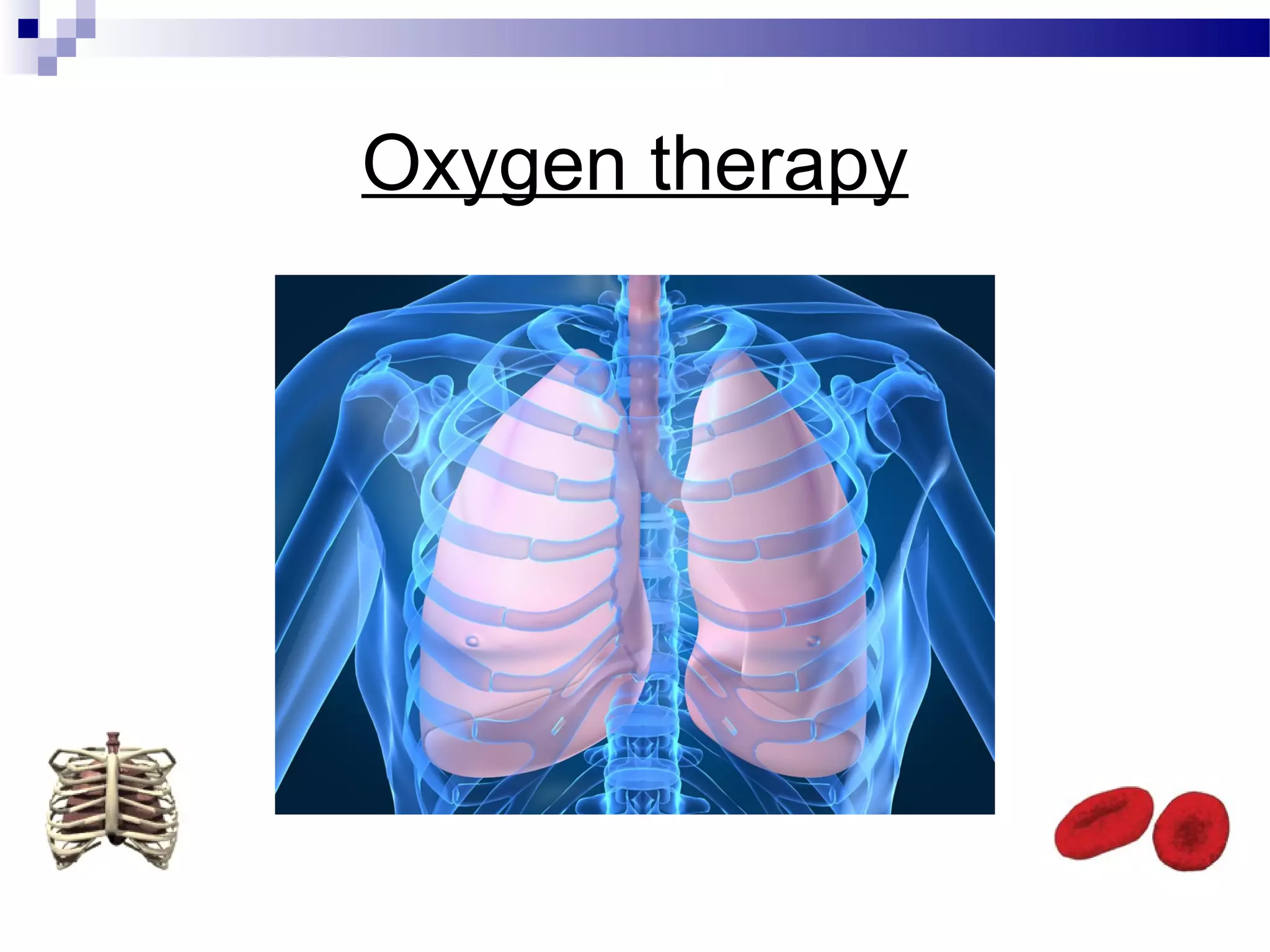
Oxygen therapy
Critical Care Outreach Team
 4 Members
 8 am to 8 pm (7 days a week including
Bank Holidays)
 Bleep 725
 Site team at out of hours
 Extending to 24/7 soon!!!
Identification Data
 Full name ( Forename and Surname)
 Hospital No / NHS Number
 Date, time and Year
Temperature
 Normal Body temperature
 Equipment – Tympanic Thermometer
 Other thermometers
 Abnormalities
Hyperthermia
Hypothermia
Pulse / Heart rate
 What is pulse? Locations
 Tachycardia – Hypovolaemia, Sepsis,
Electrolyte abnormalities, pathological
Conditions
 Bradycardia – Reduced cardiac output
 Drugs, Thyroid problems, IHD
 Young fit athletes
Blood Pressure
 Pressure of blood with in arteries
 Systolic and Diastolic BP
 Pulse pressure
Resting pulse pressure = 40 mm Hg
High PP – Indicator of heart disease
Low PP – Indicates poor cardiac
function
MAP
 Average (mean) arterial blood pressure
during a single cardiac cycle
 Reflects the haemodynamic perfusion
pressure of vital organs
 Normal MAP
 How to calculate??
Hypertension
 Systemic arterial BP is elevated
 Two types
 Primary (90%) – No medical cause
 Secondary (10%) – Problems with
Kidneys, Heart, arteries,
endocrine system etc
Hypotension
 Abnormally low Blood pressure
 SBP <90 or DBP <60 mm of Hg
 Causes – Hypovolaemia, Sepsis, Heart
failure, Anaemia,
Bradycardia, Endocrine
 Treatment- How?
Respirations
 Process involves inspiration and expiration
 Normal rate?
 How to count respirations?
 Muscles of Inspiration – Diaphragm and
inter-costal muscles
 Expiration - a passive process
 Accessory muscles of breathing ??
Oxygen % (FiO2) / Flow rate
 Depend on the type of system using
 Main types
Uncontrolled systems
Controlled systems
Oxygen saturation
 O2 is carried in blood attached to Hb
 Monitors the % of Hb saturated with O2
 1 Hb molecule can carry 4 O2 molecule
 Normal value 95% and above
 If low, what to do???
AVPU
 Quick and easy method to assess LOC
 A – ALERT
 V- Responds to Voice
 P- Responds to Pain
 U- Unresponsive
Nausea and Pain score
 Nausea score
 0-3 (0 = No vomiting to 3 = frequent
vomiting)
 Pain score
 0-10 (0= No pain to 10 being the worst
possible pain)
MMEWS Score
 Early warning score
 To help to identify those patients who are
at risk of deteriorating
 Get help early
MMEWS Exercise: 1
 Temp: 37.5
 BP: 110 / 50
 Heart rate: 105 /mt
 Respirations 18
 Sats: 90 % on room air
 AVPU: A
 Urine output : 50 mls / hour
 What is the MMEWS?
MMEWS Exercise:2
 Temperature: 39.0 degrees
 BP: 77/40
 Heart rate: 135 /mt
 Respiration: 32/mt
 Saturation: 99 % on 15litres oxygen
 AVPU: V
 Urine output : 50 mls / hour
 What is the MMEWS?
Oxygen therapy
Objectives
 Understand the indications for oxygen
therapy
 Identify and understand the use of
different oxygen delivery systems
 Implications for humidification
 Be able to set up oxygen equipment.
Introduction
 Oxygen is a colorless, odorless, tasteless
gas that is essential for the body to
function properly and to survive
 Living cells must be fuelled with oxygen in
order to survive
 The respiratory system functions to supply
oxygen to the cells and remove carbon
dioxide from the tissues
Important Points
 Room air contains approx. 21% oxygen
 Illness and injury increase tissue oxygen
demand
 It should be prescribed.
 Failure to use correctly can be fatal
 Patients must receive this therapy in an
appropriate, safe and comfortable way
 Monitoring is essential
Aim of Oxygen Therapy
 Maintain patients Oxygen saturation levels
as close to a ‘normal’ value as is possible
given the patient’s current disease state
 Healthy patient has a saturation of > 95%
breathing room air
Indications for oxygen therapy
 Hypoxaemia.
 Acute hypotension.
 Breathing inadequacy.
 Trauma.
 Acute illness - Sepsis
 CO poisoning.
 Severe anaemia.
 During the peri-operative period.
Oxygen delivery methods
 All systems require
1. Oxygen supply.
2. Flow meter.
3. Oxygen tubing.
4. Oxygen Delivery device / system.
5. (Humidifier).
Oxygen Delivery Systems
 Two Types
• Uncontrolled / Variable
• Controlled / Fixed
Uncontrolled / Variable Systems
 Exact percentage of oxygen given
unknown
Types of Uncontrolled / Variable
systems
 Nasal cannula
 Simple face mask
 Non re-breathing masks
1. Nasal Cannula
ADVANTAGES
1. Comfortable, well tolerated
2. Cheap and simple to use
3. Patient can E & D
4. Communication
5. Less claustrophobic
6. Administer Nebulisers
7. Preferred method for COPD
patients
0.5 – 4 litres per min
Disadvantages Nasal Cannula
 Drying effect with increased flows i.e.
headaches
 Easily dislodged if not fitted correctly
 May cause irritation
 Unable to artificially humidify
 Potential for pressure area breakdown
2. Medium Concentration Mask
 Advantages
1. Simple to use
2. Sizes to fit average adults
3. Low cost
 Minimum 5 litres per min
Disadvantages
 Claustrophobic
 Interferes with eating and drinking
 Potential pressure area breakdown
 Oxygen percentage delivered will be
uncontrolled
3.Non-rebreathing Mask / Bag
 For the acutely unwell patient.
 Effective short term treatment
Minimum 15 litres per min
Non-rebreathing mask
 Allows the delivery of high concentrations of
oxygen (85% at 15 litres/min).
 Has a reservoir bag to entrain oxygen.
 One way valves prevent room and expired air
from diluting the oxygen concentration.
 A tight seal is essential.
 Reservoir bag must be seen to expand freely
Disadvantages
 Unable to humidify
 Oxygen percentage delivered will be
uncontrolled
 Patient discomfort as tight seal needed
 High flows of oxygen can cause retention of
secretions
 Need to be set up properly – Do you know
how to?
Controlled / Fixed Systems
 Exact percentage of oxygen given is
known
 O2 concentration is determined by the O2
flow rate
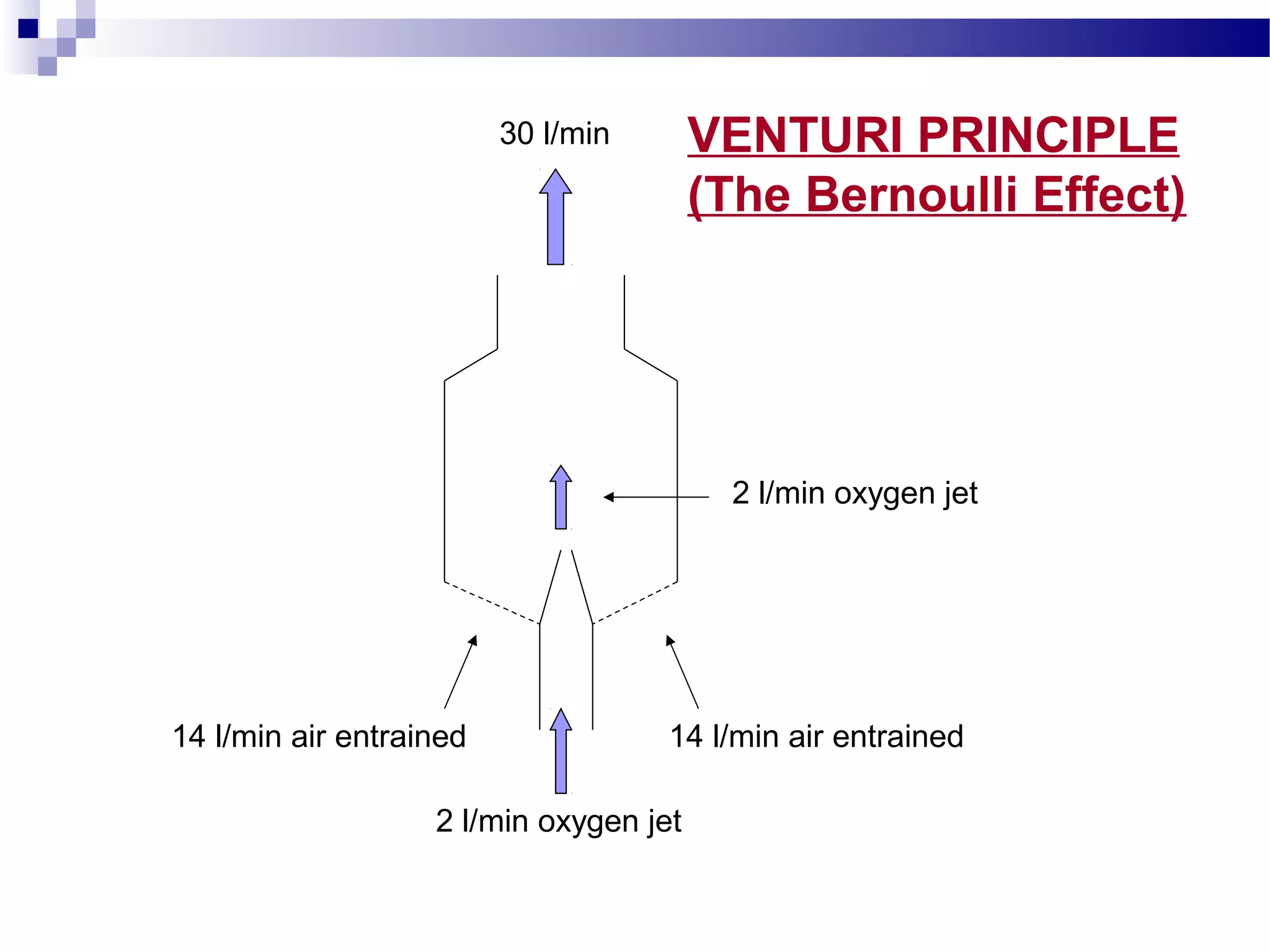
 Systems entrain air using the Venturi
principle
 Can have fixed systems or changeable
systems to give different O2 %
14 l/min air entrained14 l/min air entrained
2 l/min oxygen jet
2 l/min oxygen jet
30 l/min VENTURI PRINCIPLE
(The Bernoulli Effect)
Venturi Mask
 Mixes a specific volume of air and oxygen.
 Useful for accurately delivering low
concentrations of oxygen.
 Valves are colour coded and flow rate
required to deliver a fixed concentration is
shown on each valve.
 Can deliver oxygen concentrations
between 24-60%.
Venturi System
 Preferred method of
administration in COPD
patients if using
facemask
 Oxygen flow rate written
on the venturi
 Colour coded, adapters
can be changed
Disadvantages
 Nothing major
 Unable to humidify
 Noisy
 Change every 7 days
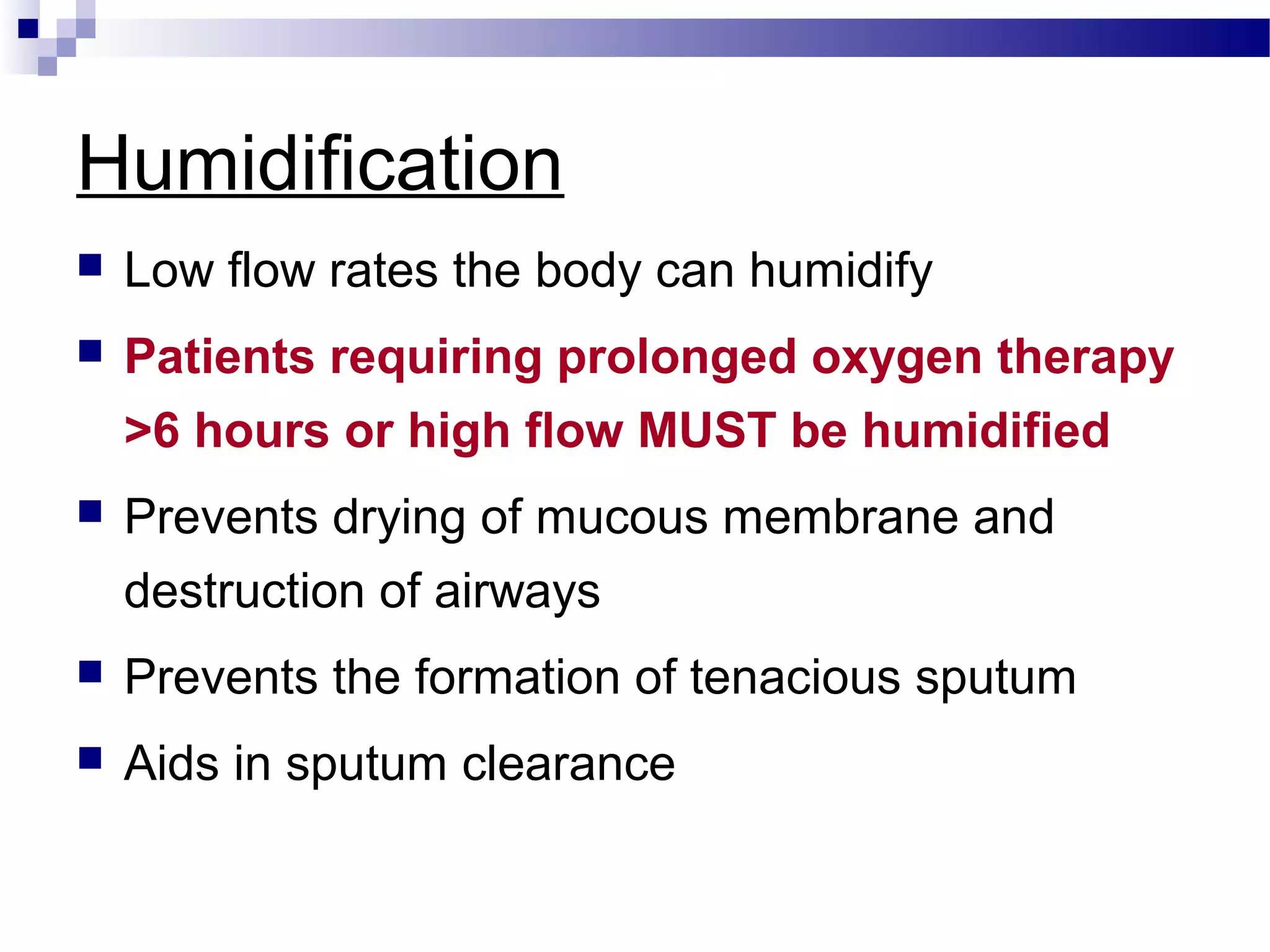
Humidification
 Low flow rates the body can humidify
 Patients requiring prolonged oxygen therapy
>6 hours or high flow MUST be humidified
 Prevents drying of mucous membrane and
destruction of airways
 Prevents the formation of tenacious sputum
 Aids in sputum clearance
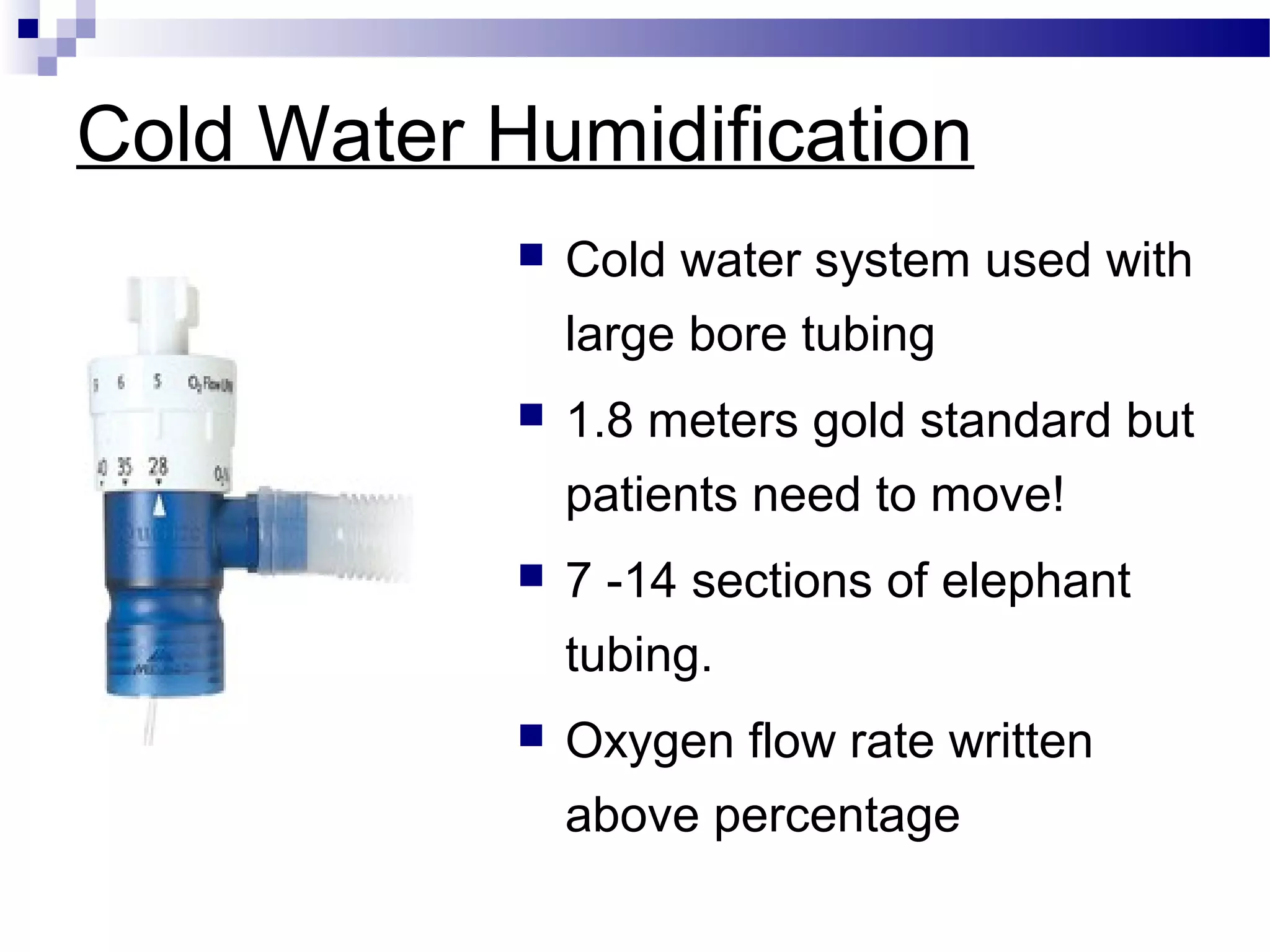
Cold Water Humidification
 Cold water system used with
large bore tubing
 1.8 meters gold standard but
patients need to move!
 7 -14 sections of elephant
tubing.
 Oxygen flow rate written
above percentage
Complications with humidified
oxygen
 Bronchoconstriction
 Decreased lung function if over-humidified
 Increased risk of infection
Nasal Cannula
Simple Face Mask
Fixed Concentration Mask (Venturi System)
Quattro Humidification System
Non-Rebreather Mask & Bag
(High Concentration Mask)
•Uncontrolled Oxygen Delivery System
•Flow Rate: 0.5 – 4 lpm (litres per minute)
•Suitability: All patients who require
low flow oxygen therapy
Benefits: Cheap. Easy to use. Relatively
comfortable. Not claustrophobic. Patient
can eat, drink & talk. Can give nebulisers.
Disadvantages: Oxygen % is uncontrolled.
Needs clear nasal airway. Can’t humidify.
Dries mucous membranes. Headaches.
•Uncontrolled Oxygen Delivery System
•Flow Rate: Minimum 5 lpm
•Suitability: General purpose
Benefits: Cheap. Simple to use. Fits most
‘average’ sized adults
Disadvantages: Re-breathing of CO2 at
flows less than 5.0 lpm. Oxygen % is
uncontrolled. Claustrophobic. Interferes
with eating, drinking and talking.
•Controlled Oxygen Delivery System
•Flow Rate: Indicated on each venturi
(different colours for different O2 %)
•Should be the system of choice
Benefits: Oxygen % is controlled. Venturis
can be changed as patient improves. Oxygen
% delivered not dependent on respiratory
pattern. Cheap. Simple to use.
Disadvantages: Noisy. Claustrophobic.
Can’t be humidified.
•Controlled Oxygen Delivery System
•Flow Rate: Indicated for each oxygen percentage
•System of choice for patients requiring
oxygen for 6 hours or more (excluding cannula)
Benefits: Oxygen % is controlled. Oxygen
is humidified for greater patient comfort.
Disadvantages: More complex to set up
correctly. Noisy. Claustrophobic
•Uncontrolled Oxygen Delivery System
•Flow Rate: 15 lpm
•System of choice for acutely unwell patients
Benefits: Delivers high O2 concentrations.
Short term use in acute situations.
Disadvantages: Oxygen % is uncontrolled.
Short term use only. Must be set up
correctly. Can’t humidify. Claustrophobic
C Plowright (Nurse Consultant Critical Care) & J Kindred (Respiratory Nurse Specialist)
Feb 2011
Oxygen Delivery Systems
Please check at least daily for signs of development of pressure points on nose / ears
Monitoring of patients
 RESPIRATION RATES
 Oxygen saturations
 Probe position
 Arterial blood gases (gold standard)
 Document % oxygen, liters per min
Pulse Oximetry
 Measures arterial blood oxygen
saturations which equates to the % of
haemoglobin filled with O2
 Well perfused area
 No information about Co2 levels
Oxygen therapy in
Special Situations
Oxygen and Arterial Blood Gases
collection
Do not
remove O2
to take a
Blood Gas !
OXYGEN THERAPY & COPD
 Can have oxygen therapy
 In acute situations can have high flow, i.e.
Cardiac / Respiratory arrest
 Blood gases to be monitored
 Normal saturations 88 – 92 %
 CO2 kills slowly, but no O2 kills quickly
Oxygen Driven Nebulisers
 Asthmatic and
Acutely unwell
patients
 Not for COPD
patients'
 Flow rate 6-8 lpm
Care of patients
 Mouth care
 Hydration
 Pressure area care
 Observations
 NO SMOKING
Points to Remember
 Room air contains 21% oxygen
 Patients breathing pattern
 System used
 Oxygen flow meter, the ball sits in the
middle of the line
 Low flow meters may be used for
specific patients
Summary
 Oxygen is required for cell metabolism
 Oxygen requirements are higher in critically
ill patients
 Be aware of different delivery systems
 Always consider humidification
 Safety aspects
 Treat like any other drug.
Any Questions ?

Core skills for nurses and oxygen therapy

  • 1.
    Core skills StudyDay Mr. Shibu Chacko, Critical Care Outreach Team
  • 2.
  • 3.
    Critical Care OutreachTeam  4 Members  8 am to 8 pm (7 days a week including Bank Holidays)  Bleep 725  Site team at out of hours  Extending to 24/7 soon!!!
  • 4.
    Identification Data  Fullname ( Forename and Surname)  Hospital No / NHS Number  Date, time and Year
  • 5.
    Temperature  Normal Bodytemperature  Equipment – Tympanic Thermometer  Other thermometers  Abnormalities Hyperthermia Hypothermia
  • 6.
    Pulse / Heartrate  What is pulse? Locations  Tachycardia – Hypovolaemia, Sepsis, Electrolyte abnormalities, pathological Conditions  Bradycardia – Reduced cardiac output  Drugs, Thyroid problems, IHD  Young fit athletes
  • 7.
    Blood Pressure  Pressureof blood with in arteries  Systolic and Diastolic BP  Pulse pressure Resting pulse pressure = 40 mm Hg High PP – Indicator of heart disease Low PP – Indicates poor cardiac function
  • 8.
    MAP  Average (mean)arterial blood pressure during a single cardiac cycle  Reflects the haemodynamic perfusion pressure of vital organs  Normal MAP  How to calculate??
  • 9.
    Hypertension  Systemic arterialBP is elevated  Two types  Primary (90%) – No medical cause  Secondary (10%) – Problems with Kidneys, Heart, arteries, endocrine system etc
  • 10.
    Hypotension  Abnormally lowBlood pressure  SBP <90 or DBP <60 mm of Hg  Causes – Hypovolaemia, Sepsis, Heart failure, Anaemia, Bradycardia, Endocrine  Treatment- How?
  • 11.
    Respirations  Process involvesinspiration and expiration  Normal rate?  How to count respirations?  Muscles of Inspiration – Diaphragm and inter-costal muscles  Expiration - a passive process  Accessory muscles of breathing ??
  • 12.
    Oxygen % (FiO2)/ Flow rate  Depend on the type of system using  Main types Uncontrolled systems Controlled systems
  • 13.
    Oxygen saturation  O2is carried in blood attached to Hb  Monitors the % of Hb saturated with O2  1 Hb molecule can carry 4 O2 molecule  Normal value 95% and above  If low, what to do???
  • 14.
    AVPU  Quick andeasy method to assess LOC  A – ALERT  V- Responds to Voice  P- Responds to Pain  U- Unresponsive
  • 15.
    Nausea and Painscore  Nausea score  0-3 (0 = No vomiting to 3 = frequent vomiting)  Pain score  0-10 (0= No pain to 10 being the worst possible pain)
  • 16.
    MMEWS Score  Earlywarning score  To help to identify those patients who are at risk of deteriorating  Get help early
  • 17.
    MMEWS Exercise: 1 Temp: 37.5  BP: 110 / 50  Heart rate: 105 /mt  Respirations 18  Sats: 90 % on room air  AVPU: A  Urine output : 50 mls / hour  What is the MMEWS?
  • 18.
    MMEWS Exercise:2  Temperature:39.0 degrees  BP: 77/40  Heart rate: 135 /mt  Respiration: 32/mt  Saturation: 99 % on 15litres oxygen  AVPU: V  Urine output : 50 mls / hour  What is the MMEWS?
  • 19.
  • 20.
    Objectives  Understand theindications for oxygen therapy  Identify and understand the use of different oxygen delivery systems  Implications for humidification  Be able to set up oxygen equipment.
  • 21.
    Introduction  Oxygen isa colorless, odorless, tasteless gas that is essential for the body to function properly and to survive  Living cells must be fuelled with oxygen in order to survive  The respiratory system functions to supply oxygen to the cells and remove carbon dioxide from the tissues
  • 22.
    Important Points  Roomair contains approx. 21% oxygen  Illness and injury increase tissue oxygen demand  It should be prescribed.  Failure to use correctly can be fatal  Patients must receive this therapy in an appropriate, safe and comfortable way  Monitoring is essential
  • 23.
    Aim of OxygenTherapy  Maintain patients Oxygen saturation levels as close to a ‘normal’ value as is possible given the patient’s current disease state  Healthy patient has a saturation of > 95% breathing room air
  • 24.
    Indications for oxygentherapy  Hypoxaemia.  Acute hypotension.  Breathing inadequacy.  Trauma.  Acute illness - Sepsis  CO poisoning.  Severe anaemia.  During the peri-operative period.
  • 25.
    Oxygen delivery methods All systems require 1. Oxygen supply. 2. Flow meter. 3. Oxygen tubing. 4. Oxygen Delivery device / system. 5. (Humidifier).
  • 26.
    Oxygen Delivery Systems Two Types • Uncontrolled / Variable • Controlled / Fixed
  • 27.
    Uncontrolled / VariableSystems  Exact percentage of oxygen given unknown
  • 28.
    Types of Uncontrolled/ Variable systems  Nasal cannula  Simple face mask  Non re-breathing masks
  • 29.
    1. Nasal Cannula ADVANTAGES 1.Comfortable, well tolerated 2. Cheap and simple to use 3. Patient can E & D 4. Communication 5. Less claustrophobic 6. Administer Nebulisers 7. Preferred method for COPD patients 0.5 – 4 litres per min
  • 30.
    Disadvantages Nasal Cannula Drying effect with increased flows i.e. headaches  Easily dislodged if not fitted correctly  May cause irritation  Unable to artificially humidify  Potential for pressure area breakdown
  • 31.
    2. Medium ConcentrationMask  Advantages 1. Simple to use 2. Sizes to fit average adults 3. Low cost  Minimum 5 litres per min
  • 32.
    Disadvantages  Claustrophobic  Interfereswith eating and drinking  Potential pressure area breakdown  Oxygen percentage delivered will be uncontrolled
  • 33.
    3.Non-rebreathing Mask /Bag  For the acutely unwell patient.  Effective short term treatment Minimum 15 litres per min
  • 34.
    Non-rebreathing mask  Allowsthe delivery of high concentrations of oxygen (85% at 15 litres/min).  Has a reservoir bag to entrain oxygen.  One way valves prevent room and expired air from diluting the oxygen concentration.  A tight seal is essential.  Reservoir bag must be seen to expand freely
  • 35.
    Disadvantages  Unable tohumidify  Oxygen percentage delivered will be uncontrolled  Patient discomfort as tight seal needed  High flows of oxygen can cause retention of secretions  Need to be set up properly – Do you know how to?
  • 36.
    Controlled / FixedSystems  Exact percentage of oxygen given is known  O2 concentration is determined by the O2 flow rate  Systems entrain air using the Venturi principle  Can have fixed systems or changeable systems to give different O2 %
  • 37.
    14 l/min airentrained14 l/min air entrained 2 l/min oxygen jet 2 l/min oxygen jet 30 l/min VENTURI PRINCIPLE (The Bernoulli Effect)
  • 38.
    Venturi Mask  Mixesa specific volume of air and oxygen.  Useful for accurately delivering low concentrations of oxygen.  Valves are colour coded and flow rate required to deliver a fixed concentration is shown on each valve.  Can deliver oxygen concentrations between 24-60%.
  • 39.
    Venturi System  Preferredmethod of administration in COPD patients if using facemask  Oxygen flow rate written on the venturi  Colour coded, adapters can be changed
  • 40.
    Disadvantages  Nothing major Unable to humidify  Noisy  Change every 7 days
  • 41.
    Humidification  Low flowrates the body can humidify  Patients requiring prolonged oxygen therapy >6 hours or high flow MUST be humidified  Prevents drying of mucous membrane and destruction of airways  Prevents the formation of tenacious sputum  Aids in sputum clearance
  • 42.
    Cold Water Humidification Cold water system used with large bore tubing  1.8 meters gold standard but patients need to move!  7 -14 sections of elephant tubing.  Oxygen flow rate written above percentage
  • 43.
    Complications with humidified oxygen Bronchoconstriction  Decreased lung function if over-humidified  Increased risk of infection
  • 44.
    Nasal Cannula Simple FaceMask Fixed Concentration Mask (Venturi System) Quattro Humidification System Non-Rebreather Mask & Bag (High Concentration Mask) •Uncontrolled Oxygen Delivery System •Flow Rate: 0.5 – 4 lpm (litres per minute) •Suitability: All patients who require low flow oxygen therapy Benefits: Cheap. Easy to use. Relatively comfortable. Not claustrophobic. Patient can eat, drink & talk. Can give nebulisers. Disadvantages: Oxygen % is uncontrolled. Needs clear nasal airway. Can’t humidify. Dries mucous membranes. Headaches. •Uncontrolled Oxygen Delivery System •Flow Rate: Minimum 5 lpm •Suitability: General purpose Benefits: Cheap. Simple to use. Fits most ‘average’ sized adults Disadvantages: Re-breathing of CO2 at flows less than 5.0 lpm. Oxygen % is uncontrolled. Claustrophobic. Interferes with eating, drinking and talking. •Controlled Oxygen Delivery System •Flow Rate: Indicated on each venturi (different colours for different O2 %) •Should be the system of choice Benefits: Oxygen % is controlled. Venturis can be changed as patient improves. Oxygen % delivered not dependent on respiratory pattern. Cheap. Simple to use. Disadvantages: Noisy. Claustrophobic. Can’t be humidified. •Controlled Oxygen Delivery System •Flow Rate: Indicated for each oxygen percentage •System of choice for patients requiring oxygen for 6 hours or more (excluding cannula) Benefits: Oxygen % is controlled. Oxygen is humidified for greater patient comfort. Disadvantages: More complex to set up correctly. Noisy. Claustrophobic •Uncontrolled Oxygen Delivery System •Flow Rate: 15 lpm •System of choice for acutely unwell patients Benefits: Delivers high O2 concentrations. Short term use in acute situations. Disadvantages: Oxygen % is uncontrolled. Short term use only. Must be set up correctly. Can’t humidify. Claustrophobic C Plowright (Nurse Consultant Critical Care) & J Kindred (Respiratory Nurse Specialist) Feb 2011 Oxygen Delivery Systems Please check at least daily for signs of development of pressure points on nose / ears
  • 45.
    Monitoring of patients RESPIRATION RATES  Oxygen saturations  Probe position  Arterial blood gases (gold standard)  Document % oxygen, liters per min
  • 46.
    Pulse Oximetry  Measuresarterial blood oxygen saturations which equates to the % of haemoglobin filled with O2  Well perfused area  No information about Co2 levels
  • 47.
  • 48.
    Oxygen and ArterialBlood Gases collection Do not remove O2 to take a Blood Gas !
  • 49.
    OXYGEN THERAPY &COPD  Can have oxygen therapy  In acute situations can have high flow, i.e. Cardiac / Respiratory arrest  Blood gases to be monitored  Normal saturations 88 – 92 %  CO2 kills slowly, but no O2 kills quickly
  • 50.
    Oxygen Driven Nebulisers Asthmatic and Acutely unwell patients  Not for COPD patients'  Flow rate 6-8 lpm
  • 51.
    Care of patients Mouth care  Hydration  Pressure area care  Observations  NO SMOKING
  • 52.
    Points to Remember Room air contains 21% oxygen  Patients breathing pattern  System used  Oxygen flow meter, the ball sits in the middle of the line  Low flow meters may be used for specific patients
  • 53.
    Summary  Oxygen isrequired for cell metabolism  Oxygen requirements are higher in critically ill patients  Be aware of different delivery systems  Always consider humidification  Safety aspects  Treat like any other drug.
  • 54.

Editor's Notes

  • #9 MAP: MAP is defines as the average arterial blood pressure during a single cardiac cycle. The reason why it is important is that it reflects the hemodynamic perfusion pressure of the vital organs. A MAP of above 65 is necessary to perfuse coronary arteries, brain and kidneys. How to calculate MAP? MAP= Systolic BP + Diastolic BP + Diastolic BP divided by 3 Example: Systolic 160 and diastolic BP 70 MAP= 160+70+70/ 3= 100 mmHg (Source : Adam and Osborne 2005)