Powerful ideas for a healthier world
Andrea Baccarelli, MD, PhD, MPH
Laboratory of Environmental Epigenetics
Epigenetics and
Environmental Health
A Step-by-Step Tutorial
Objective of my presentation
• To review:
– General epigenetic concepts
– Why we may be interested in epigenetics
– Environmental influences and epigenetics
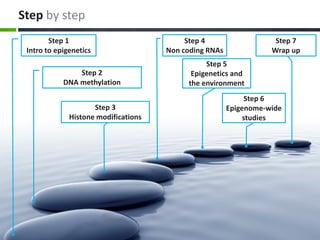
Step by step
Step 1
Intro to epigenetics
Step 2
DNA methylation
Step 3
Histone modifications
Step 4
Non coding RNAs
Step 5
Epigenetics and
the environment
Step 6
Epigenome-wide
studies
Step 7
Wrap up
Epigenetics glossary
• Glossary enclosed with the seminar invitation
• Compiled from online sources
• General and technical definitions:
– Epigenetics and the epigenome
– General concepts
– Epigenetic mechanisms
• DNA methylation
• Histone Modifications
• Non coding RNAs
Step by step
Step 1
Intro to epigenetics
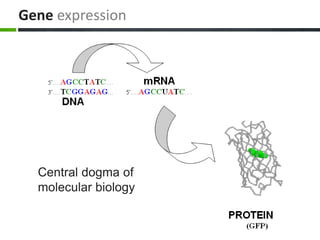
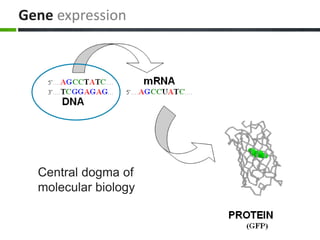
Gene expression
Central dogma of
molecular biology
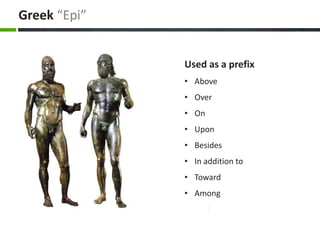
Greek ā€œEpiā€
Used as a prefix
• Above
• Over
• On
• Upon
• Besides
• In addition to
• Toward
• Among
Greek ā€œEpiā€
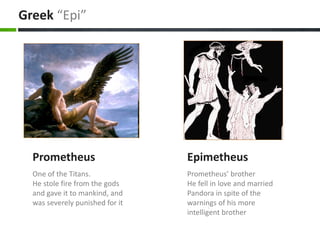
Prometheus
One of the Titans.
He stole fire from the gods
and gave it to mankind, and
was severely punished for it
Epimetheus
Prometheus’ brother
He fell in love and married
Pandora in spite of the
warnings of his more
intelligent brother
Greek ā€œEpiā€
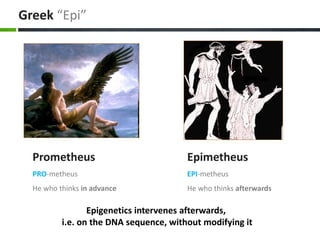
Prometheus
PRO-metheus
He who thinks in advance
Epimetheus
EPI-metheus
He who thinks afterwards
Epigenetics intervenes afterwards,
i.e. on the DNA sequence, without modifying it
Epigenetics
• Changes in gene expression that:
-do not depend on the DNA sequence
-can be stable
• Through cell division (mitotically stable)
• Transgenerational inheritance
(limited evidence in humans)
–may persist even in the absence of the
conditions that established them (biological
memory)
(adapted from Richards, Nat Gen 2006)
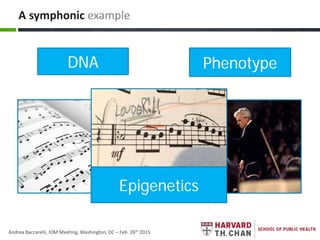
A symphonic example
DNA Phenotype
Epigenetics
Andrea Baccarelli, IOM Meeting, Washington, DC – Feb 26th 2015
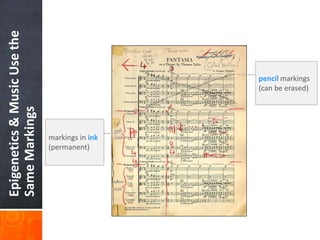
Epigenetics
&
Music
Use
the
Same
Markings
Epigenetics
&
Music
Use
the
Same
Markings
pencil markings
(can be erased)
markings in ink
(permanent)
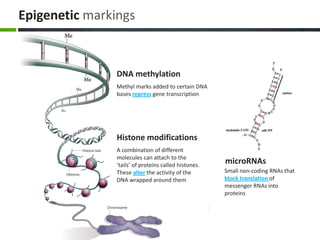
Epigenetic markings
DNA methylation
Methyl marks added to certain DNA
bases repress gene transcription
Histone modifications
A combination of different
molecules can attach to the
ā€˜tails’ of proteins called histones.
These alter the activity of the
DNA wrapped around them
microRNAs
Small non-coding RNAs that
block translation of
messenger RNAs into
proteins
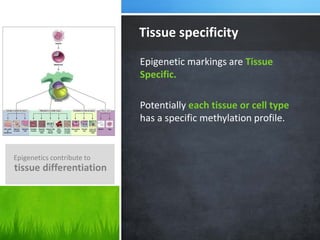
Epigenetics contribute to
tissue differentiation
Tissue specificity
Epigenetic markings are Tissue
Specific.
Potentially each tissue or cell type
has a specific methylation profile.
Step by step
Step 1
Intro to epigenetics
Step 2
DNA methylation
Gene expression
Central dogma of
molecular biology
DNA
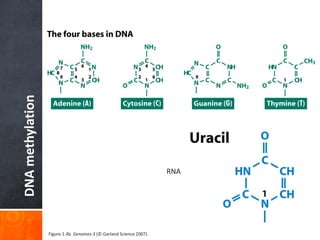
methylation (more accurately: it is usually associated with suppressed RNA)
RNA
Figure 1.4b Genomes 3 (Ā© Garland Science 2007)
DNA
methylation
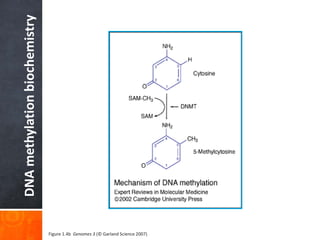
biochemistry
Figure 1.4b Genomes 3 (Ā© Garland Science 2007)
DNA
methylation
DNA methylation suppresses RNA expression
(more accurately: it is usually associated with suppressed RNA)
DNA
methylation
inactive
DNA
demethylation
active or poised
to be activated
Cytosine-phosphate-Guanine
CpG sites
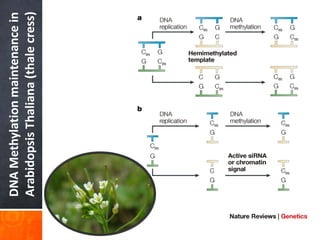
DNA
Methylation
maintenance
in
Arabidopsis
Thaliana
(thale
cress)
Step by step
Step 1
Intro to epigenetics
Step 2
DNA methylation
Step 3
Histone modifications
A severe problem of packaging!
• Human cell has 2m of DNA
• Nucleus is 0.006 mm in diameter
• Two opposing requirements:
– 1. Compaction
– 2. Access – Transcription
Replication
Repair
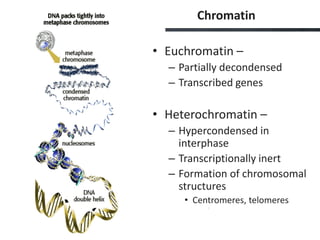
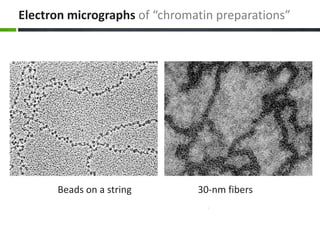
Chromatin
• Euchromatin –
– Partially decondensed
– Transcribed genes
• Heterochromatin –
– Hypercondensed in
interphase
– Transcriptionally inert
– Formation of chromosomal
structures
• Centromeres, telomeres
Electron micrographs of ā€œchromatin preparationsā€
Beads on a string 30-nm fibers
Histone
modifications
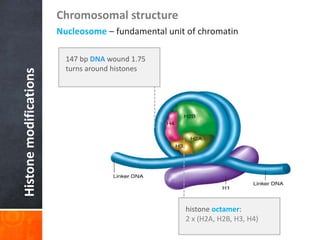
Chromosomal structure
Nucleosome – fundamental unit of chromatin
147 bp DNA wound 1.75
turns around histones
histone octamer:
2 x (H2A, H2B, H3, H4)
Histone
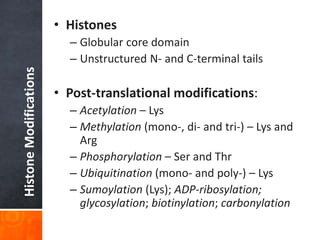
Modifications • Histones
– Globular core domain
– Unstructured N- and C-terminal tails
• Post-translational modifications:
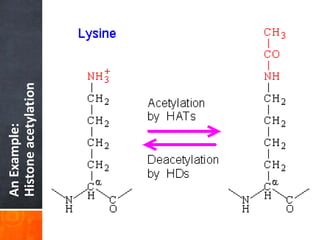
– Acetylation – Lys
– Methylation (mono-, di- and tri-) – Lys and
Arg
– Phosphorylation – Ser and Thr
– Ubiquitination (mono- and poly-) – Lys
– Sumoylation (Lys); ADP-ribosylation;
glycosylation; biotinylation; carbonylation
An
Example:
Histone
acetylation
Histone
modifications
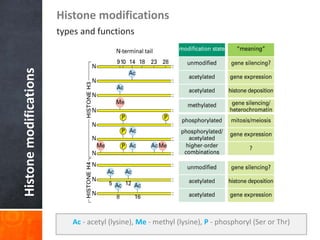
Histone modifications
types and functions
Ac - acetyl (lysine), Me - methyl (lysine), P - phosphoryl (Ser or Thr)
Step by step
Step 1
Intro to epigenetics
Step 2
DNA methylation
Step 3
Histone modifications
Step 4
Non coding RNAs
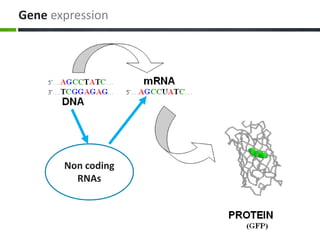
Gene expression
Non coding
RNAs
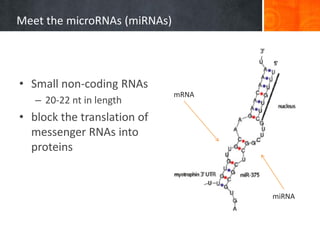
Meet the microRNAs (miRNAs)
• Small non-coding RNAs
– 20-22 nt in length
• block the translation of
messenger RNAs into
proteins
miRNA
mRNA
miRNAs
• May regulate >30% of human genes
• miRBASE Release 21.0 (Sep 2014) has 28,645 entries
– from 223 species
– in humans: 1,881 precursors, 2,588 mature miRNAs
• Discovery of new miRNAsis ongoing …
• Source: miRBASE database
http://www.mirbase.org/cgi-bin/browse.pl?org=hsa
Other non-coding RNA types
• Non-coding RNA = miRNAs?
• Other types of non-coding RNAs
– PIWI-interacting RNAs (piRNAs)
– small nucleolar RNAs (snoRNAs)
– promoter-associated small RNAs (PASRs)
– transcriptional start sites associated (TSSa-RNA)
– transcribed ultraconserved regions (T-UCRs)
– promoter upstream transcripts (PROMPTS)
– large intergenic non-coding RNAs (lincRNAs)
Step by step
Step 1
Intro to epigenetics
Step 2
DNA methylation
Step 3
Histone modifications
Step 4
Non coding RNAs
Step 5
Epigenetics and
the environment
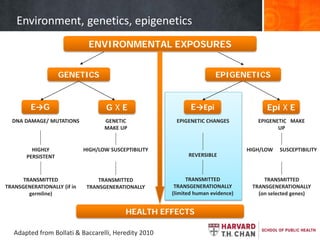
E→G
DNA DAMAGE/ MUTATIONS
HIGHLY
PERSISTENT
TRANSMITTED
TRANSGENERATIONALLY (if in
germline)
G X E
GENETIC
MAKE UP
HIGH/LOW SUSCEPTIBILITY
TRANSMITTED
TRANSGENERATIONALLY
E→Epi
EPIGENETIC CHANGES
REVERSIBLE
TRANSMITTED
TRANSGENERATIONALLY
(limited human evidence)
Epi X E
EPIGENETIC MAKE
UP
HIGH/LOW SUSCEPTIBILITY
TRANSMITTED
TRANSGENERATIONALLY
(on selected genes)
Environment, genetics, epigenetics
ENVIRONMENTAL EXPOSURES
GENETICS EPIGENETICS
HEALTH EFFECTS
Adapted from Bollati & Baccarelli, Heredity 2010
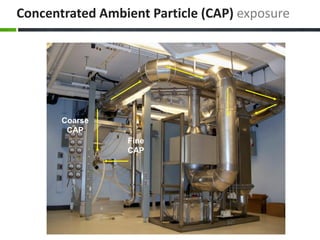
Concentrated Ambient Particle (CAP) exposure
Coarse
CAP
Fine
CAP
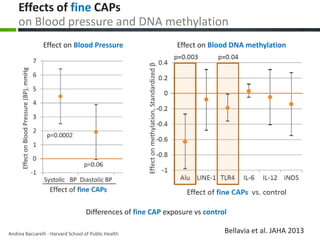
Effects of fine CAPs
on Blood pressure and DNA methylation
Effect on Blood Pressure Effect on Blood DNA methylation
Differences of fine CAP exposure vs control
Bellavia et al. JAHA 2013
Andrea Baccarelli - Harvard School of Public Health
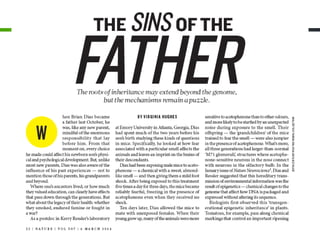
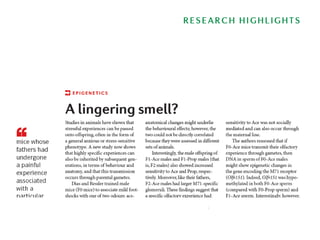
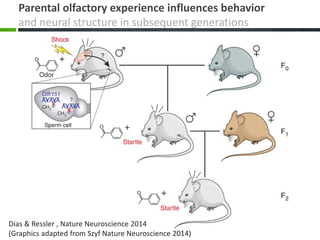
Parental olfactory experience influences behavior
and neural structure in subsequent generations
Dias & Ressler , Nature Neuroscience 2014
(Graphics adapted from Szyf Nature Neuroscience 2014)
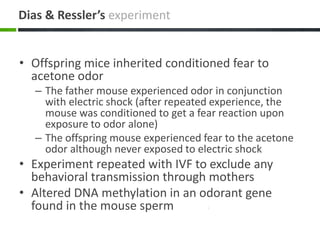
Dias & Ressler’s experiment
• Offspring mice inherited conditioned fear to
acetone odor
– The father mouse experienced odor in conjunction
with electric shock (after repeated experience, the
mouse was conditioned to get a fear reaction upon
exposure to odor alone)
– The offspring mouse experienced fear to the acetone
odor although never exposed to electric shock
• Experiment repeated with IVF to exclude any
behavioral transmission through mothers
• Altered DNA methylation in an odorant gene
found in the mouse sperm
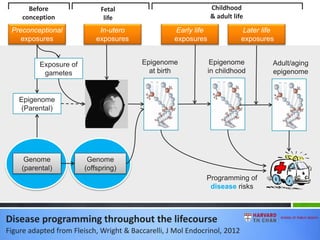
Disease programming throughout the lifecourse
Figure adapted from Fleisch, Wright & Baccarelli, J Mol Endocrinol, 2012
Before
conception
Preconceptional
exposures
Fetal
life
In-utero
exposures
Exposure of
gametes
Genome
(parental)
Epigenome
(Parental)
Childhood
& adult life
Early life
exposures
Later life
exposures
Epigenome
at birth
Epigenome
in childhood
Programming of
disease risks
Adult/aging
epigenome
Genome
(offspring)
Step by step
Step 1
Intro to epigenetics
Step 2
DNA methylation
Step 3
Histone modifications
Step 4
Non coding RNAs
Step 5
Epigenetics and
the environment
Step 6
Epigenome-wide
studies
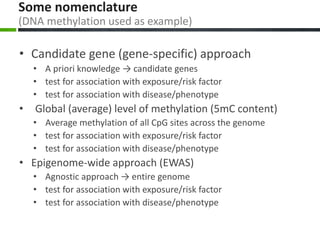
Some nomenclature
(DNA methylation used as example)
• Candidate gene (gene-specific) approach
• A priori knowledge → candidate genes
• test for association with exposure/risk factor
• test for association with disease/phenotype
• Global (average) level of methylation (5mC content)
• Average methylation of all CpG sites across the genome
• test for association with exposure/risk factor
• test for association with disease/phenotype
• Epigenome-wide approach (EWAS)
• Agnostic approach → entire genome
• test for association with exposure/risk factor
• test for association with disease/phenotype
Examples (DNA methylation)
• Candidate gene approach
– Participant #1’s blood has 26% methylation in the IL6
promoter (N.B.: any other region of interest can be
targeted, e.g., CpGi shore, shelf, etc.)
• Global methylation approach
– Participant #1’s blood has 4.5% methylation (i.e., 4.5% of
all cytosines found in blood are methylated; no
information on where the methylated cytosines are
located)
• Genome-wide approach
– Methylation in Participant #1’s blood is measured at a high
number of CpG sites (e.g, if we use Illumina Infinium 450K
beadchip → we will get ā‰ˆ486,000 numbers [one for each
CpG site] for Participant #1’s blood)
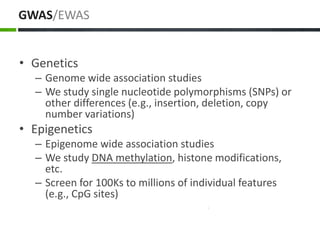
GWAS/EWAS
• Genetics
– Genome wide association studies
– We study single nucleotide polymorphisms (SNPs) or
other differences (e.g., insertion, deletion, copy
number variations)
• Epigenetics
– Epigenome wide association studies
– We study DNA methylation, histone modifications,
etc.
– Screen for 100Ks to millions of individual features
(e.g., CpG sites)
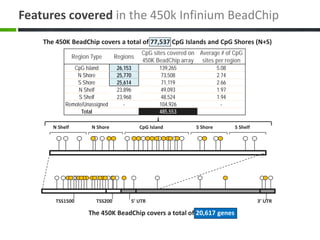
Features covered in the 450k Infinium BeadChip
The 450K BeadChip covers a total of 77,537 CpG Islands and CpG Shores (N+S)
Region Type Regions
CpG sites covered on
450K BeadChip array
Average # of CpG
sites per region
CpG Island 26,153 139,265 5.08
N Shore 25,770 73,508 2.74
S Shore 25,614 71,119 2.66
N Shelf 23,896 49,093 1.97
S Shelf 23,968 48,524 1.94
Remote/Unassigned - 104,926 -
Total 485,553
5’ UTR 3’ UTR
TSS1500 TSS200
N Shelf N Shore S Shore S Shelf
CpG Island
The 450K BeadChip covers a total of 20,617 genes
Step by step
Step 1
Intro to epigenetics
Step 2
DNA methylation
Step 3
Histone modifications
Step 4
Non coding RNAs
Step 5
Epigenetics and
the environment
Step 6
Epigenome-wide
studies
Step 7
Wrap up
Conclusions
• Epigenetics is all about control of gene expression
– Relatively stable
– Biological programming
– Influenced by the environment
• Epigenetics investigates different mechanisms
– Not limited to those presented here
• Expanding research on how environmental
toxicants may reprogram the epigenome and
affect human health
Some readings
• Michels K. Epigenetic Epidemiology. Springer,
2012
• Relton CL & Davey Smith G. Is epidemiology
ready for epigenetics? Int J Epidemiol. 2012
Feb;41(1):5-9.
• Hou L, Zhang X, Wang D, Baccarelli A.
Environmental chemical exposures and human
epigenetics. Int J Epidemiol. 2012
Feb;41(1):79-105.
Thanks!

EPIGENETICS101-BACCARELLI.EPIGENETICS101-BACCARELLI.PDF

  • 1.
    Powerful ideas fora healthier world Andrea Baccarelli, MD, PhD, MPH Laboratory of Environmental Epigenetics Epigenetics and Environmental Health A Step-by-Step Tutorial
  • 2.
    Objective of mypresentation • To review: – General epigenetic concepts – Why we may be interested in epigenetics – Environmental influences and epigenetics
  • 3.
    Step by step Step1 Intro to epigenetics Step 2 DNA methylation Step 3 Histone modifications Step 4 Non coding RNAs Step 5 Epigenetics and the environment Step 6 Epigenome-wide studies Step 7 Wrap up
  • 4.
    Epigenetics glossary • Glossaryenclosed with the seminar invitation • Compiled from online sources • General and technical definitions: – Epigenetics and the epigenome – General concepts – Epigenetic mechanisms • DNA methylation • Histone Modifications • Non coding RNAs
  • 5.
    Step by step Step1 Intro to epigenetics
  • 6.
    Gene expression Central dogmaof molecular biology
  • 7.
    Greek ā€œEpiā€ Used asa prefix • Above • Over • On • Upon • Besides • In addition to • Toward • Among
  • 8.
    Greek ā€œEpiā€ Prometheus One ofthe Titans. He stole fire from the gods and gave it to mankind, and was severely punished for it Epimetheus Prometheus’ brother He fell in love and married Pandora in spite of the warnings of his more intelligent brother
  • 9.
    Greek ā€œEpiā€ Prometheus PRO-metheus He whothinks in advance Epimetheus EPI-metheus He who thinks afterwards Epigenetics intervenes afterwards, i.e. on the DNA sequence, without modifying it
  • 10.
    Epigenetics • Changes ingene expression that: -do not depend on the DNA sequence -can be stable • Through cell division (mitotically stable) • Transgenerational inheritance (limited evidence in humans) –may persist even in the absence of the conditions that established them (biological memory) (adapted from Richards, Nat Gen 2006)
  • 11.
    A symphonic example DNAPhenotype Epigenetics Andrea Baccarelli, IOM Meeting, Washington, DC – Feb 26th 2015
  • 12.
  • 13.
  • 14.
    Epigenetic markings DNA methylation Methylmarks added to certain DNA bases repress gene transcription Histone modifications A combination of different molecules can attach to the ā€˜tails’ of proteins called histones. These alter the activity of the DNA wrapped around them microRNAs Small non-coding RNAs that block translation of messenger RNAs into proteins
  • 15.
    Epigenetics contribute to tissuedifferentiation Tissue specificity Epigenetic markings are Tissue Specific. Potentially each tissue or cell type has a specific methylation profile.
  • 16.
    Step by step Step1 Intro to epigenetics Step 2 DNA methylation
  • 17.
    Gene expression Central dogmaof molecular biology
  • 18.
    DNA methylation (more accurately:it is usually associated with suppressed RNA) RNA Figure 1.4b Genomes 3 (Ā© Garland Science 2007)
  • 19.
  • 20.
    DNA methylation DNA methylation suppressesRNA expression (more accurately: it is usually associated with suppressed RNA) DNA methylation inactive DNA demethylation active or poised to be activated Cytosine-phosphate-Guanine CpG sites
  • 21.
  • 22.
    Step by step Step1 Intro to epigenetics Step 2 DNA methylation Step 3 Histone modifications
  • 23.
    A severe problemof packaging! • Human cell has 2m of DNA • Nucleus is 0.006 mm in diameter • Two opposing requirements: – 1. Compaction – 2. Access – Transcription Replication Repair
  • 24.
    Chromatin • Euchromatin – –Partially decondensed – Transcribed genes • Heterochromatin – – Hypercondensed in interphase – Transcriptionally inert – Formation of chromosomal structures • Centromeres, telomeres
  • 25.
    Electron micrographs ofā€œchromatin preparationsā€ Beads on a string 30-nm fibers
  • 26.
    Histone modifications Chromosomal structure Nucleosome –fundamental unit of chromatin 147 bp DNA wound 1.75 turns around histones histone octamer: 2 x (H2A, H2B, H3, H4)
  • 27.
    Histone Modifications • Histones –Globular core domain – Unstructured N- and C-terminal tails • Post-translational modifications: – Acetylation – Lys – Methylation (mono-, di- and tri-) – Lys and Arg – Phosphorylation – Ser and Thr – Ubiquitination (mono- and poly-) – Lys – Sumoylation (Lys); ADP-ribosylation; glycosylation; biotinylation; carbonylation
  • 28.
  • 29.
    Histone modifications Histone modifications types andfunctions Ac - acetyl (lysine), Me - methyl (lysine), P - phosphoryl (Ser or Thr)
  • 30.
    Step by step Step1 Intro to epigenetics Step 2 DNA methylation Step 3 Histone modifications Step 4 Non coding RNAs
  • 31.
  • 32.
    Meet the microRNAs(miRNAs) • Small non-coding RNAs – 20-22 nt in length • block the translation of messenger RNAs into proteins miRNA mRNA
  • 33.
    miRNAs • May regulate>30% of human genes • miRBASE Release 21.0 (Sep 2014) has 28,645 entries – from 223 species – in humans: 1,881 precursors, 2,588 mature miRNAs • Discovery of new miRNAsis ongoing … • Source: miRBASE database http://www.mirbase.org/cgi-bin/browse.pl?org=hsa
  • 34.
    Other non-coding RNAtypes • Non-coding RNA = miRNAs? • Other types of non-coding RNAs – PIWI-interacting RNAs (piRNAs) – small nucleolar RNAs (snoRNAs) – promoter-associated small RNAs (PASRs) – transcriptional start sites associated (TSSa-RNA) – transcribed ultraconserved regions (T-UCRs) – promoter upstream transcripts (PROMPTS) – large intergenic non-coding RNAs (lincRNAs)
  • 35.
    Step by step Step1 Intro to epigenetics Step 2 DNA methylation Step 3 Histone modifications Step 4 Non coding RNAs Step 5 Epigenetics and the environment
  • 36.
    E→G DNA DAMAGE/ MUTATIONS HIGHLY PERSISTENT TRANSMITTED TRANSGENERATIONALLY(if in germline) G X E GENETIC MAKE UP HIGH/LOW SUSCEPTIBILITY TRANSMITTED TRANSGENERATIONALLY E→Epi EPIGENETIC CHANGES REVERSIBLE TRANSMITTED TRANSGENERATIONALLY (limited human evidence) Epi X E EPIGENETIC MAKE UP HIGH/LOW SUSCEPTIBILITY TRANSMITTED TRANSGENERATIONALLY (on selected genes) Environment, genetics, epigenetics ENVIRONMENTAL EXPOSURES GENETICS EPIGENETICS HEALTH EFFECTS Adapted from Bollati & Baccarelli, Heredity 2010
  • 37.
    Concentrated Ambient Particle(CAP) exposure Coarse CAP Fine CAP
  • 38.
    Effects of fineCAPs on Blood pressure and DNA methylation Effect on Blood Pressure Effect on Blood DNA methylation Differences of fine CAP exposure vs control Bellavia et al. JAHA 2013 Andrea Baccarelli - Harvard School of Public Health
  • 39.
    Parental olfactory experienceinfluences behavior and neural structure in subsequent generations Dias & Ressler , Nature Neuroscience 2014 (Graphics adapted from Szyf Nature Neuroscience 2014)
  • 40.
    Dias & Ressler’sexperiment • Offspring mice inherited conditioned fear to acetone odor – The father mouse experienced odor in conjunction with electric shock (after repeated experience, the mouse was conditioned to get a fear reaction upon exposure to odor alone) – The offspring mouse experienced fear to the acetone odor although never exposed to electric shock • Experiment repeated with IVF to exclude any behavioral transmission through mothers • Altered DNA methylation in an odorant gene found in the mouse sperm
  • 43.
    Disease programming throughoutthe lifecourse Figure adapted from Fleisch, Wright & Baccarelli, J Mol Endocrinol, 2012 Before conception Preconceptional exposures Fetal life In-utero exposures Exposure of gametes Genome (parental) Epigenome (Parental) Childhood & adult life Early life exposures Later life exposures Epigenome at birth Epigenome in childhood Programming of disease risks Adult/aging epigenome Genome (offspring)
  • 44.
    Step by step Step1 Intro to epigenetics Step 2 DNA methylation Step 3 Histone modifications Step 4 Non coding RNAs Step 5 Epigenetics and the environment Step 6 Epigenome-wide studies
  • 45.
    Some nomenclature (DNA methylationused as example) • Candidate gene (gene-specific) approach • A priori knowledge → candidate genes • test for association with exposure/risk factor • test for association with disease/phenotype • Global (average) level of methylation (5mC content) • Average methylation of all CpG sites across the genome • test for association with exposure/risk factor • test for association with disease/phenotype • Epigenome-wide approach (EWAS) • Agnostic approach → entire genome • test for association with exposure/risk factor • test for association with disease/phenotype
  • 46.
    Examples (DNA methylation) •Candidate gene approach – Participant #1’s blood has 26% methylation in the IL6 promoter (N.B.: any other region of interest can be targeted, e.g., CpGi shore, shelf, etc.) • Global methylation approach – Participant #1’s blood has 4.5% methylation (i.e., 4.5% of all cytosines found in blood are methylated; no information on where the methylated cytosines are located) • Genome-wide approach – Methylation in Participant #1’s blood is measured at a high number of CpG sites (e.g, if we use Illumina Infinium 450K beadchip → we will get ā‰ˆ486,000 numbers [one for each CpG site] for Participant #1’s blood)
  • 48.
    GWAS/EWAS • Genetics – Genomewide association studies – We study single nucleotide polymorphisms (SNPs) or other differences (e.g., insertion, deletion, copy number variations) • Epigenetics – Epigenome wide association studies – We study DNA methylation, histone modifications, etc. – Screen for 100Ks to millions of individual features (e.g., CpG sites)
  • 49.
    Features covered inthe 450k Infinium BeadChip The 450K BeadChip covers a total of 77,537 CpG Islands and CpG Shores (N+S) Region Type Regions CpG sites covered on 450K BeadChip array Average # of CpG sites per region CpG Island 26,153 139,265 5.08 N Shore 25,770 73,508 2.74 S Shore 25,614 71,119 2.66 N Shelf 23,896 49,093 1.97 S Shelf 23,968 48,524 1.94 Remote/Unassigned - 104,926 - Total 485,553 5’ UTR 3’ UTR TSS1500 TSS200 N Shelf N Shore S Shore S Shelf CpG Island The 450K BeadChip covers a total of 20,617 genes
  • 50.
    Step by step Step1 Intro to epigenetics Step 2 DNA methylation Step 3 Histone modifications Step 4 Non coding RNAs Step 5 Epigenetics and the environment Step 6 Epigenome-wide studies Step 7 Wrap up
  • 51.
    Conclusions • Epigenetics isall about control of gene expression – Relatively stable – Biological programming – Influenced by the environment • Epigenetics investigates different mechanisms – Not limited to those presented here • Expanding research on how environmental toxicants may reprogram the epigenome and affect human health
  • 52.
    Some readings • MichelsK. Epigenetic Epidemiology. Springer, 2012 • Relton CL & Davey Smith G. Is epidemiology ready for epigenetics? Int J Epidemiol. 2012 Feb;41(1):5-9. • Hou L, Zhang X, Wang D, Baccarelli A. Environmental chemical exposures and human epigenetics. Int J Epidemiol. 2012 Feb;41(1):79-105.
  • 53.