G H PATEL COLLEGE OF
ENGINEERING AND
TECHNOLOGY
SUB : SIGNAL &SYSTEM
BATCH : 1A09
BRANCH : ELECTRICAL
PREPERED BY:-
YASH KOTHADIA - 150110109019
ABHISHEK LALKIYA -150110109020
MAULIK VASOYA - 150110109060
CONVOLUTION
 Consider the DT system:
 If the input signal is and the system has no
energy at , the output
is called the impulse response of the system
[ ]y n[ ]x n
[ ]h n[ ]n
[ ] [ ]x n n
[ ] [ ]y n h n
System
System
0n 
DT Unit-Impulse Response
 Consider the DT system described by
 Its impulse response can be found to be
[ ] [ 1] [ ]y n ay n bx n  
( ) , 0,1,2,
[ ]
0, 1, 2, 3,
n
a b n
h n
n
 
 
   
EXAMPLE
 Let x[n] be an arbitrary input signal to a DT LTI system
 Suppose that for
 This signal can be represented as
0
[ ] [0] [ ] [1] [ 1] [2] [ 2]
[ ] [ ], 0,1,2,
i
x n x n x n x n
x i n i n
  



     
  
1, 2,n   [ ] 0x n 
PRESENTING SYSTEM IN TERM OF
SHIFTED AND SCALED IMPULS
0
[ ] [ ] [ ], 0
i
y n x i h n i n


  
EXPLOTING TIME -
INVERIANCE AND LINEARITY
 This particular summation is called the convolution sum
 Equation is called the convolution
representation of the system.
 A DT LTI system is completely described by its impulse
response h[n].
0
[ ] [ ] [ ]
i
y n x i h n i


 
[ ] [ ]x n h n
[ ] [ ] [ ]y n x n h n 
CONVOLUTION SUM
(LINEAR CONVOLUTION)
 Since the impulse response h[n] provides the
complete description of a DT LTI system, we write
[ ]y n[ ]x n [ ]h n
BLOCK DIAGRAM
REPRESENTATION OF DT LTI
SYSTEM
 Suppose that we have two signals x[n] and v[n] that
are not zero for negative times .
 Then, their convolution is expressed by the two-
sided series
[ ] [ ] [ ]
i
y n x i v n i


 
THE CONVOLUTION SUM FOR
NONCAUSAL SIGNALS
 Suppose that both x[n] and v[n] are equal to the
rectangular pulse p[n] (causal signal) represent
below
EXAMPLE: CONVOLUTION OF TWO
RECTANGULAR PULSES
 The signal is equal to the pulse p[i] folded about
the vertical axis
[ ]v i
THE FOLDED PULS
SHIFTING V[N- I] OVER X[I]
PLOT OF X[N]*V[N]
 Associatively
 Commutatively
 Distributive w.r.t. addition
[ ] ( [ ] [ ]) ( [ ] [ ]) [ ]x n v n w n x n v n w n    
[ ] [ ] [ ] [ ]x n v n v n x n  
[ ] ( [ ] [ ]) [ ] [ ] [ ] [ ]x n v n w n x n v n x n w n     
PROPERTIES OF CONVOLUTION SUM
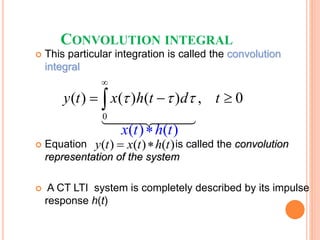
CONVOLUTION INTEGRAL
 This particular integration is called the convolution
integral
 Equation is called the convolution
representation of the system
 A CT LTI system is completely described by its impulse
response h(t)
( ) ( )x t h t
( ) ( ) ( )y t x t h t 
0
( ) ( ) ( ) , 0y t x h t d t  

  
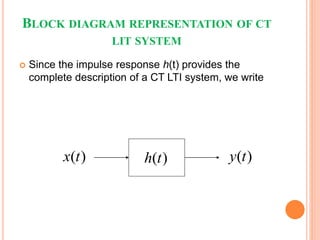
 Since the impulse response h(t) provides the
complete description of a CT LTI system, we write
( )y t( )x t ( )h t
BLOCK DIAGRAM REPRESENTATION OF CT
LIT SYSTEM
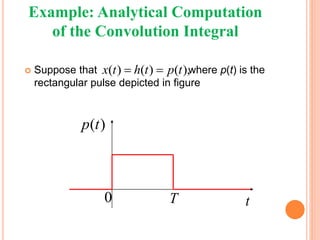
 Suppose that where p(t) is the
rectangular pulse depicted in figure
( ) ( ) ( ),x t h t p t 
( )p t
tT0
Example: Analytical Computation
of the Convolution Integral
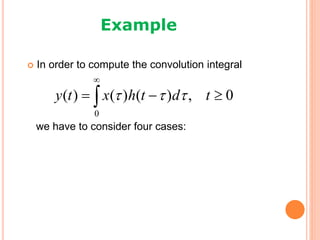
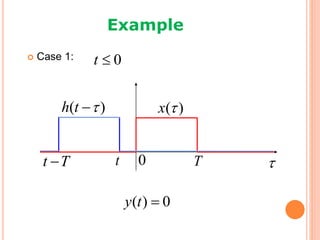
 In order to compute the convolution integral
we have to consider four cases:
0
( ) ( ) ( ) , 0y t x h t d t  

  
Example
 Case 1: 0t 
( )x 
T0
( )h t 
t T t
( ) 0y t 
Example
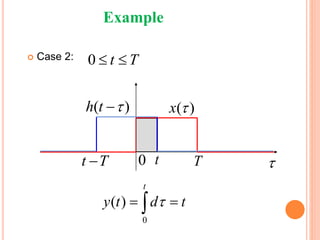
 Case 2: 0 t T 
( )x 
T0
( )h t 
t T t
0
( )
t
y t d t 
Example
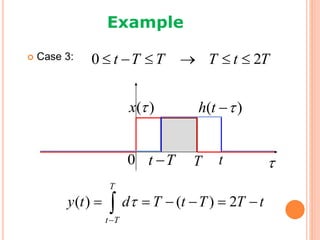
 Case 3:
( )x 
T0
( )h t 
t T t
( ) ( ) 2
T
t T
y t d T t T T t

     
0 2t T T T t T     
Example
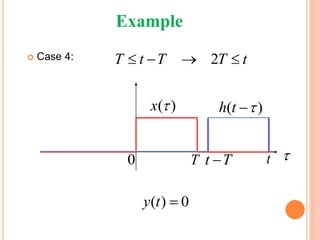
 Case 4:
( ) 0y t 
( )x 
T0
( )h t 
t T t
2T t T T t   
Example
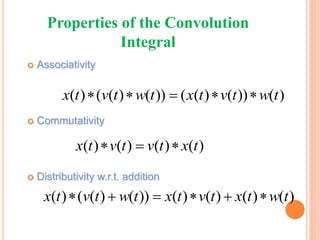
 Associativity
 Commutativity
 Distributivity w.r.t. addition
( ) ( ( ) ( )) ( ( ) ( )) ( )x t v t w t x t v t w t    
( ) ( ) ( ) ( )x t v t v t x t  
( ) ( ( ) ( )) ( ) ( ) ( ) ( )x t v t w t x t v t x t w t     
Properties of the Convolution
Integral
convolution

convolution

  • 1.
    G H PATELCOLLEGE OF ENGINEERING AND TECHNOLOGY SUB : SIGNAL &SYSTEM BATCH : 1A09 BRANCH : ELECTRICAL PREPERED BY:- YASH KOTHADIA - 150110109019 ABHISHEK LALKIYA -150110109020 MAULIK VASOYA - 150110109060
  • 2.
  • 3.
     Consider theDT system:  If the input signal is and the system has no energy at , the output is called the impulse response of the system [ ]y n[ ]x n [ ]h n[ ]n [ ] [ ]x n n [ ] [ ]y n h n System System 0n  DT Unit-Impulse Response
  • 4.
     Consider theDT system described by  Its impulse response can be found to be [ ] [ 1] [ ]y n ay n bx n   ( ) , 0,1,2, [ ] 0, 1, 2, 3, n a b n h n n         EXAMPLE
  • 5.
     Let x[n]be an arbitrary input signal to a DT LTI system  Suppose that for  This signal can be represented as 0 [ ] [0] [ ] [1] [ 1] [2] [ 2] [ ] [ ], 0,1,2, i x n x n x n x n x i n i n                1, 2,n   [ ] 0x n  PRESENTING SYSTEM IN TERM OF SHIFTED AND SCALED IMPULS
  • 6.
    0 [ ] [] [ ], 0 i y n x i h n i n      EXPLOTING TIME - INVERIANCE AND LINEARITY
  • 7.
     This particularsummation is called the convolution sum  Equation is called the convolution representation of the system.  A DT LTI system is completely described by its impulse response h[n]. 0 [ ] [ ] [ ] i y n x i h n i     [ ] [ ]x n h n [ ] [ ] [ ]y n x n h n  CONVOLUTION SUM (LINEAR CONVOLUTION)
  • 8.
     Since theimpulse response h[n] provides the complete description of a DT LTI system, we write [ ]y n[ ]x n [ ]h n BLOCK DIAGRAM REPRESENTATION OF DT LTI SYSTEM
  • 9.
     Suppose thatwe have two signals x[n] and v[n] that are not zero for negative times .  Then, their convolution is expressed by the two- sided series [ ] [ ] [ ] i y n x i v n i     THE CONVOLUTION SUM FOR NONCAUSAL SIGNALS
  • 10.
     Suppose thatboth x[n] and v[n] are equal to the rectangular pulse p[n] (causal signal) represent below EXAMPLE: CONVOLUTION OF TWO RECTANGULAR PULSES
  • 11.
     The signalis equal to the pulse p[i] folded about the vertical axis [ ]v i THE FOLDED PULS
  • 12.
  • 13.
  • 14.
     Associatively  Commutatively Distributive w.r.t. addition [ ] ( [ ] [ ]) ( [ ] [ ]) [ ]x n v n w n x n v n w n     [ ] [ ] [ ] [ ]x n v n v n x n   [ ] ( [ ] [ ]) [ ] [ ] [ ] [ ]x n v n w n x n v n x n w n      PROPERTIES OF CONVOLUTION SUM
  • 15.
    CONVOLUTION INTEGRAL  Thisparticular integration is called the convolution integral  Equation is called the convolution representation of the system  A CT LTI system is completely described by its impulse response h(t) ( ) ( )x t h t ( ) ( ) ( )y t x t h t  0 ( ) ( ) ( ) , 0y t x h t d t      
  • 16.
     Since theimpulse response h(t) provides the complete description of a CT LTI system, we write ( )y t( )x t ( )h t BLOCK DIAGRAM REPRESENTATION OF CT LIT SYSTEM
  • 17.
     Suppose thatwhere p(t) is the rectangular pulse depicted in figure ( ) ( ) ( ),x t h t p t  ( )p t tT0 Example: Analytical Computation of the Convolution Integral
  • 18.
     In orderto compute the convolution integral we have to consider four cases: 0 ( ) ( ) ( ) , 0y t x h t d t       Example
  • 19.
     Case 1:0t  ( )x  T0 ( )h t  t T t ( ) 0y t  Example
  • 20.
     Case 2:0 t T  ( )x  T0 ( )h t  t T t 0 ( ) t y t d t  Example
  • 21.
     Case 3: ()x  T0 ( )h t  t T t ( ) ( ) 2 T t T y t d T t T T t        0 2t T T T t T      Example
  • 22.
     Case 4: () 0y t  ( )x  T0 ( )h t  t T t 2T t T T t    Example
  • 23.
     Associativity  Commutativity Distributivity w.r.t. addition ( ) ( ( ) ( )) ( ( ) ( )) ( )x t v t w t x t v t w t     ( ) ( ) ( ) ( )x t v t v t x t   ( ) ( ( ) ( )) ( ) ( ) ( ) ( )x t v t w t x t v t x t w t      Properties of the Convolution Integral